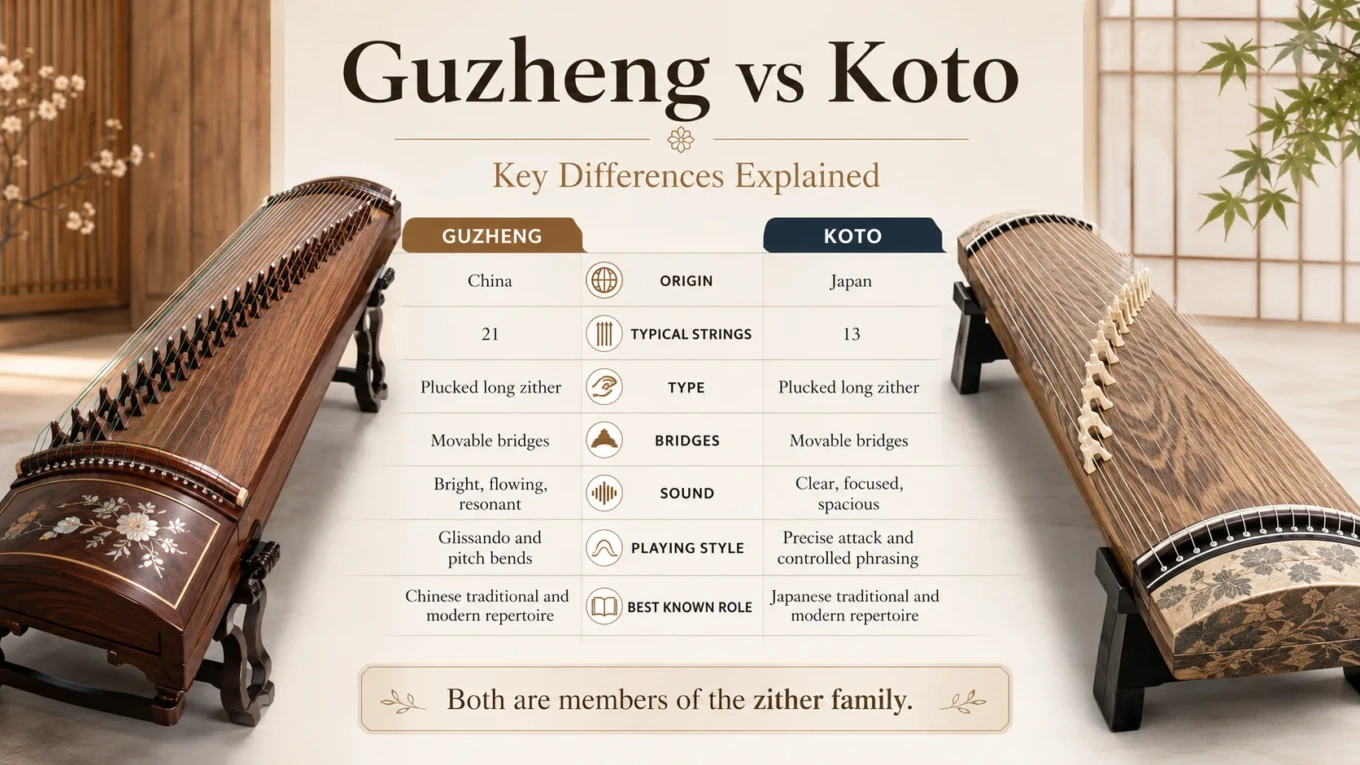
Guzheng vs Koto: Key Differences Explained
Guzheng and koto look closely related at first: both are long East Asian plucked zithers[1] with strings running along a wooden body. The main difference is not simply “Chinese versus Japanese.” It lies in string count, bridge layout, tuning habits, playing technique, musical setting, and the way each instrument shapes pitch after the string is plucked.
The guzheng is most strongly associated with Chinese music, while the koto is most strongly associated with Japanese music. Both belong to the wider zither family, but each developed its own construction standards, sound ideals, notation habits, and performance manners. A modern guzheng usually has more strings than the standard koto, and it often supports faster ornamental gestures, broad pitch bends, and sweeping textures. The standard koto, especially the 13-string form, tends to emphasize a more spacious playing logic, with great attention to attack, decay, silence, and controlled left-hand inflection.
Guzheng and Koto in Simple Terms
A guzheng is a Chinese plucked long zither[2] with strings stretched over individual movable bridges. A koto is a Japanese plucked long zither, also built with movable bridges, but commonly known in its 13-string form. Both are chordophones[3], meaning their sound comes from vibrating strings.
The family resemblance is real. The differences are also real.
| Feature | Guzheng | Koto |
|---|---|---|
| Main cultural association | China | Japan |
| Common modern string count | Often 21 strings, though older and regional forms vary | Most often 13 strings in the standard form; 17-string bass koto and other modern forms also exist |
| Bridge system | Individual movable bridges under each string | Individual movable bridges, commonly called ji in Japanese contexts |
| Typical playing hand division | Right hand often plucks; left hand often bends, presses, ornaments, and may also pluck in modern technique | Right hand commonly plucks with fingerpicks; left hand adjusts pitch and color by pressing or releasing strings |
| Common sound impression | Bright, flowing, resonant, often suited to glissando and wide bends | Clear, focused, refined, often marked by controlled space and precise attacks |
| Beginner confusion | Often mistaken for “Chinese koto” in casual speech | Sometimes called a “Japanese harp,” though organologically it is a zither |
Classification Note: Both instruments are zithers because the strings run along the body rather than away from a neck. Calling either one a harp can be convenient in casual speech, but it blurs the structure. A harp has strings that rise from the soundbox in a different physical arrangement.
Shared Family, Different Instrument Logic
Guzheng and koto share a long wooden body, a resonating body[4], strings, and movable bridges[5]. Each bridge sets the speaking length of a string and helps transfer vibration into the body. This is one reason the two instruments may look similar even to musicians who know other string instruments well.
Yet their musical logic differs. On both instruments, the player can tune open strings[6] before performance by moving bridges and adjusting tension. During performance, the player can press the string on one side of the bridge to bend the pitch, add vibrato, or create a small ornamental slide. The guzheng tradition often uses this left-side string area with broad, fluid gestures. Koto playing also uses left-hand pressure, but the aesthetic may place greater weight on measured timing, phrase shape, and the color of individual tones.
Neither instrument should be reduced to a single sound. Regional schools, repertoire, teaching lineages, modern compositions, and amplified stage use all change how each instrument behaves in practice.
Origins and Cultural Setting
The guzheng is one of the best-known Chinese zithers. Its name includes zheng, a term used for related Chinese long zithers in several historical and regional contexts. Older zheng forms did not all match the 21-string concert guzheng familiar today, so it is safer to describe the modern instrument as one important current form rather than the only form.
The koto is a Japanese long zither closely tied to court, chamber, solo, and ensemble traditions. Historical koto culture includes courtly settings, later domestic and professional music, and modern concert use. The standard 13-string koto remains central, but it is not the only form. Larger modern instruments, including 17-string bass koto, are used for expanded range and ensemble depth.
The two instruments are historically related through the movement and transformation of East Asian zither types, yet they are not interchangeable. A koto is not simply a smaller guzheng, and a guzheng is not a koto with more strings. Their repertoires, tunings, right-hand attacks, left-hand gestures, and teaching methods developed in distinct musical cultures.
Construction: Body, Soundboard, and Materials
Both instruments use a long wooden body with a soundboard[7] that receives vibration through the bridges. Wood choice, carving, thickness, internal space, bridge fit, and string material all help shape tone. The effect is practical rather than magical: a responsive body supports resonance[8], sustain, and projection, while poor setup can make even a well-made instrument feel dull or uneven.
Guzheng Body and Materials
Modern guzheng bodies are usually long, slightly curved, and built to support many strings under firm tension. Paulownia is often used for the top in many Chinese zither traditions because it is light and resonant, though construction details vary by maker and model. Decorative end panels, carved details, lacquered surfaces, and fitted tuning hardware can differ widely.
The soundboard must balance clarity and sustain. A guzheng that is too stiff may lose warmth; one that is too soft or poorly braced may lack focus. Players often notice this in the lower strings, where the instrument needs enough body depth to support a full tone.
Koto Body and Materials
The koto is also strongly associated with paulownia wood. Many traditional and museum examples show a long body with a hollowed or resonating structure, individual bridges, and decorative end areas. Older instruments may use silk strings, ivory or bone components, lacquer, inlay, or other materials depending on period and status. Modern koto often use synthetic strings and non-ivory bridge materials for practical and ethical reasons.
The standard koto body is often longer than many beginners expect. It is not a small table instrument. In traditional playing, it may be set low before a seated performer; in modern performance, stands are also common.
Luthier’s Note: Movable bridges do more than tune pitch. Their height, fit, spacing, and contact with the soundboard affect response. A bridge that leans, slips, or sits poorly can make a string buzz, lose sustain, or feel unstable under the hand.
Strings and Range
The modern guzheng most often seen in concerts and teaching studios has 21 strings. This does not mean every guzheng has always had 21 strings. Historical and regional instruments may have fewer or different string layouts, and modern experimental models may vary.
The standard koto is most often described as a 13-string instrument. That form is central to much koto teaching and repertoire. The 17-string koto, often used for lower range, is also well established in modern ensemble settings. Other extended-range koto forms exist, but they should not be treated as the default when comparing guzheng vs koto.
String count affects more than range. It changes hand movement, spacing, chord shapes, glissando patterns, and how much pitch material can be prepared on the instrument before a piece begins. A guzheng with more strings can offer a broader prepared pitch field, while the 13-string koto often relies on carefully chosen tunings and left-hand pitch shaping within a more compact layout.
Movable Bridges and Tuning
Both guzheng and koto use movable bridges, but the traditions around tuning are different. Each string has a bridge that can be moved to change its sounding length. Fine tuning also depends on string tension. Before playing, musicians arrange the bridges according to the mode, piece, school, or ensemble need.
Many guzheng pieces use pentatonic tuning[9] as a base, with left-hand techniques supplying additional notes through bending and pressing. This makes the instrument feel open and fluid under the hands. Sweeps across adjacent strings can produce clear scalar patterns without fretting.
Koto also uses named tunings, and tuning choice is deeply tied to repertoire. Rather than thinking of the koto as “fixed,” it is better to think of it as a retuned instrument. The bridges are set for the piece or musical context, then the player works within that setup through plucking, pressing, and phrasing.
Why Both Instruments Can Sound Flexible Without Frets
Neither the common guzheng nor the standard koto uses frets[10] in the way a guitar or concert zither may. Pitch flexibility comes from bridge placement, string tension, and hand pressure. The player can raise pitch after plucking by pressing the string segment on the non-playing side of the bridge. This gives both instruments a vocal quality, but each tradition controls that quality differently.
On guzheng, wide bends, falling tones, tremolo, and glissando can create a highly flowing texture. On koto, pitch bends and vibrato often sit inside a phrase with strong attention to timing and tone decay. These are broad tendencies, not hard rules.
Playing Technique: Fingerpicks, Hands, and Gesture
Guzheng players commonly wear fingerpicks[11] on several fingers of the right hand, often attached with tape. The right hand plucks, rolls, tremolos, and sweeps across the strings. The left hand bends and ornaments, and in modern technique it may also pluck actively, allowing denser textures and two-hand passages.
Koto players commonly use plectra[12], often worn on the thumb, index finger, and middle finger of the right hand. These picks shape a clear attack. The left hand presses, releases, and colors the strings, especially on the side of the bridge opposite the main plucking area.
The physical feeling differs. Guzheng technique often gives beginners a clear sense of sweep and flow early on, though refined control takes long study. Koto technique can feel more restrained at first, especially because the right-hand attack, posture, and left-hand timing require careful coordination. In both cases, tone quality depends on small details: finger angle, pick contact, bridge stability, and how the player releases pressure after a bend.
Sound and Timbre
Guzheng tone is often described as bright, ringing, and full, especially in modern concert instruments with metal-nylon strings. Its glissando effects are easy to recognize, but the instrument is not limited to decorative sweeps. Skilled players produce singing melodies, rhythmic passages, layered textures, and strong dynamic contrast.
Koto tone is often clearer and more contained, with a dry-to-resonant balance shaped by string material, bridge position, body wood, room acoustics, and playing style. The attack of the right-hand picks can be crisp, while the decay of the note may become an expressive part of the phrase.
Listening Note: To hear the difference, listen for how each instrument treats the space after a note. Guzheng phrases often connect notes through bends, tremolo, and sweeping motion. Koto phrases often draw attention to attack, resonance, decay, and silence between gestures.
Repertoire and Musical Role
Guzheng appears in solo music, ensemble music, conservatory repertoire, regional styles, contemporary compositions, film scoring, and cross-cultural projects. Modern guzheng education often includes both traditional pieces and newer works that use fast two-hand technique, extended range, and dramatic dynamic shifts.
Koto appears in solo, chamber, vocal-accompaniment, ensemble, and contemporary settings. It has a strong relationship with Japanese art music traditions, but modern composers and performers have also expanded its role. The 17-string bass koto adds lower-register support in many modern ensembles.
These roles affect instrument design. A concert guzheng may be built for projection, speed, and wide expressive bends. A koto may be chosen for a particular school, repertoire, tone color, or ensemble function. Neither instrument has one fixed musical identity.
Notation, Learning, and Beginner Experience
Beginners often notice the string count first. A 21-string guzheng can seem more complex visually, but its common pentatonic layouts can make simple melodies approachable. The challenge comes later: left-hand intonation, clean tremolo, even tone, fast passages, and expressive control all require patient practice.
The koto’s 13 strings may look simpler, but the playing system is not automatically easier. Tuning names, right-hand pick control, posture, left-hand pressure, and traditional phrasing can be demanding. A beginner may play a simple melody fairly soon, yet a mature koto sound needs careful attention to timing and release.
For both instruments, tuning is part of musicianship. Moving bridges is not a repair task; it is a normal musical act. A player learns how bridge position, pitch, string feel, and tone response work together.
Common Misunderstandings
“Guzheng Is the Chinese Koto”
This phrase is understandable but imprecise. Guzheng and koto are related East Asian zithers, yet each has its own name, history, repertoire, and technique. Calling the guzheng a Chinese koto hides the identity of the guzheng and can confuse readers about construction and musical practice.
“Koto Is a Japanese Harp”
The koto is sometimes called a Japanese harp in casual English, but structurally it is a zither. Its strings run along the body, and each string rests on a bridge. That physical arrangement matters because it explains how the instrument is tuned and played.
“More Strings Means a Better Instrument”
String count is not a quality ranking. A 21-string guzheng is not better than a 13-string koto because it has more strings. It is designed for a different musical system. A finely made 13-string koto can offer great nuance, and a poorly set up multi-string instrument can still sound weak.
“Both Instruments Use the Same Tuning”
They do not share one universal tuning. Both use movable bridges, and both may use pentatonic pitch patterns, but the actual setup depends on the piece, school, mode, and performer. Treating either instrument as having a single fixed tuning gives a false picture.
Guzheng vs Koto for New Learners
A beginner choosing between guzheng and koto should start with musical interest rather than only difficulty. The guzheng may appeal to players who enjoy flowing gestures, wide bends, bright resonance, and a large prepared pitch range. The koto may appeal to players who enjoy focused tone, measured phrasing, Japanese repertoire, and the expressive use of silence and decay.
Practical access matters too. Lessons, instrument availability, tuning support, replacement strings, and repertoire books may differ by region. A good teacher can prevent poor hand habits on either instrument. A stable beginner instrument, correctly placed bridges, and reliable tuning tools matter more than decorative features.
- Choose guzheng if the desired sound is bright, sweeping, and strongly associated with Chinese zither repertoire.
- Choose koto if the desired sound is focused, spacious, and strongly associated with Japanese zither repertoire.
- Do not choose only by string count. Choose by repertoire, teacher access, and the sound that keeps practice interesting.
Collector’s and Museum Notes
Museums often classify both guzheng and koto under plucked long zithers or related chordophone categories. This helps compare their structure without erasing their cultural names. A museum label may emphasize material, period, place, maker, and classification, while a musician may focus more on tuning, school, and repertoire.
Older koto and guzheng-family instruments may include materials no longer favored or legally practical in new instrument making, such as ivory components on some historical examples. Modern makers commonly use synthetic, plastic, bone substitute, or other safer materials. When evaluating an older instrument, condition matters: cracks, warped boards, missing bridges, unstable tuning pins, and damaged string anchors can affect both playability and conservation value.
Decorated instruments should not be judged only as visual objects. On zithers, the body is the sound-producing structure. Heavy repair, poor refinishing, or badly fitted hardware can reduce musical response even when the surface looks attractive.
Which One Sounds Better?
Neither instrument is better in an absolute sense. Guzheng and koto answer different musical questions. The guzheng often offers a broader modern string field and highly fluid ornamental language. The koto offers a distinct Japanese zither voice built around tuned strings, right-hand pick attack, left-hand pressure, and phrase space.
The better choice depends on the listener or player. For flowing glissando, broad bends, and a ringing concert sound, guzheng may feel more immediate. For spare phrasing, crisp articulation, and a tone world shaped by decay and timing, koto may feel more direct.
Glossary of Technical Terms
- Plucked Zither: A zither whose strings are sounded by plucking rather than bowing or striking. Guzheng and koto are both plucked zithers because their strings run along the body and are played with fingers or picks.
- Long Zither: A zither type with an elongated body and strings running lengthwise. Many East Asian zithers, including guzheng and koto, fit this structural description.
- Chordophone: An instrument that produces sound through vibrating strings. In the zither family, the strings are attached to or stretched across a body rather than a separate neck like many lutes.
- Resonating Body: The part of the instrument that receives string vibration and helps amplify it. On guzheng and koto, the long wooden body supports tone, sustain, and projection.
- Movable Bridge: A bridge that can be shifted to change the sounding length and pitch of a string. Guzheng and koto both use individual movable bridges under their strings.
- Open String: A string sounded without stopping it against a fingerboard or fret. On guzheng and koto, open strings are tuned before performance, then shaped by hand pressure during playing.
- Soundboard: The vibrating top surface of a string instrument. In long zithers, bridge contact with the soundboard is central to how string energy becomes audible tone.
- Resonance: The way an instrument’s body supports and extends string vibration. In zither instruments, resonance depends on body shape, wood, bridge fit, strings, and setup.
- Pentatonic Tuning: A tuning based around five main notes within an octave. Many guzheng setups use pentatonic patterns as a base, with extra pitch color created through bending and pressing.
- Frets: Raised markers or bars that divide string length into set pitches on some instruments. Common guzheng and standard koto forms do not use frets; pitch is shaped through bridges, tuning, and hand pressure.
- Fingerpicks: Picks worn on the fingers to pluck strings with clarity and volume. Guzheng players commonly use taped-on fingerpicks, especially for modern concert technique.
- Plectrum: A pick used to pluck a string. Koto players commonly use plectra on selected right-hand fingers to shape attack and articulation.
FAQ
Is guzheng the same as koto?
No. Guzheng and koto are related plucked long zithers, but they are different instruments. The guzheng is associated with Chinese music and commonly appears today with 21 strings, while the standard koto is associated with Japanese music and commonly has 13 strings.
Which is easier to learn, guzheng or koto?
Neither is automatically easier. Guzheng may feel approachable for simple pentatonic melodies and sweeping gestures, while koto may look simpler because of its standard 13-string layout. Both require careful tuning, hand control, tone work, and proper instruction.
Why do guzheng and koto both have movable bridges?
Movable bridges let the player set the pitch of each string before performance. They also help transfer vibration into the body. By pressing strings on one side of the bridge, players can bend notes and add expression after plucking.
Does the koto always have 13 strings?
The standard koto is widely known as a 13-string instrument, but it is not the only form. The 17-string bass koto and other modern variants are also used, especially in ensemble and contemporary music.
Does the guzheng always have 21 strings?
Many modern concert guzheng instruments have 21 strings, but historical, regional, and experimental forms can differ. It is best to describe 21 strings as a common modern setup rather than a rule for every guzheng-related instrument.
Is koto a harp or a zither?
The koto is a zither. It may be called a Japanese harp in casual English, but its structure is different from a harp because its strings run along the body and rest on movable bridges.