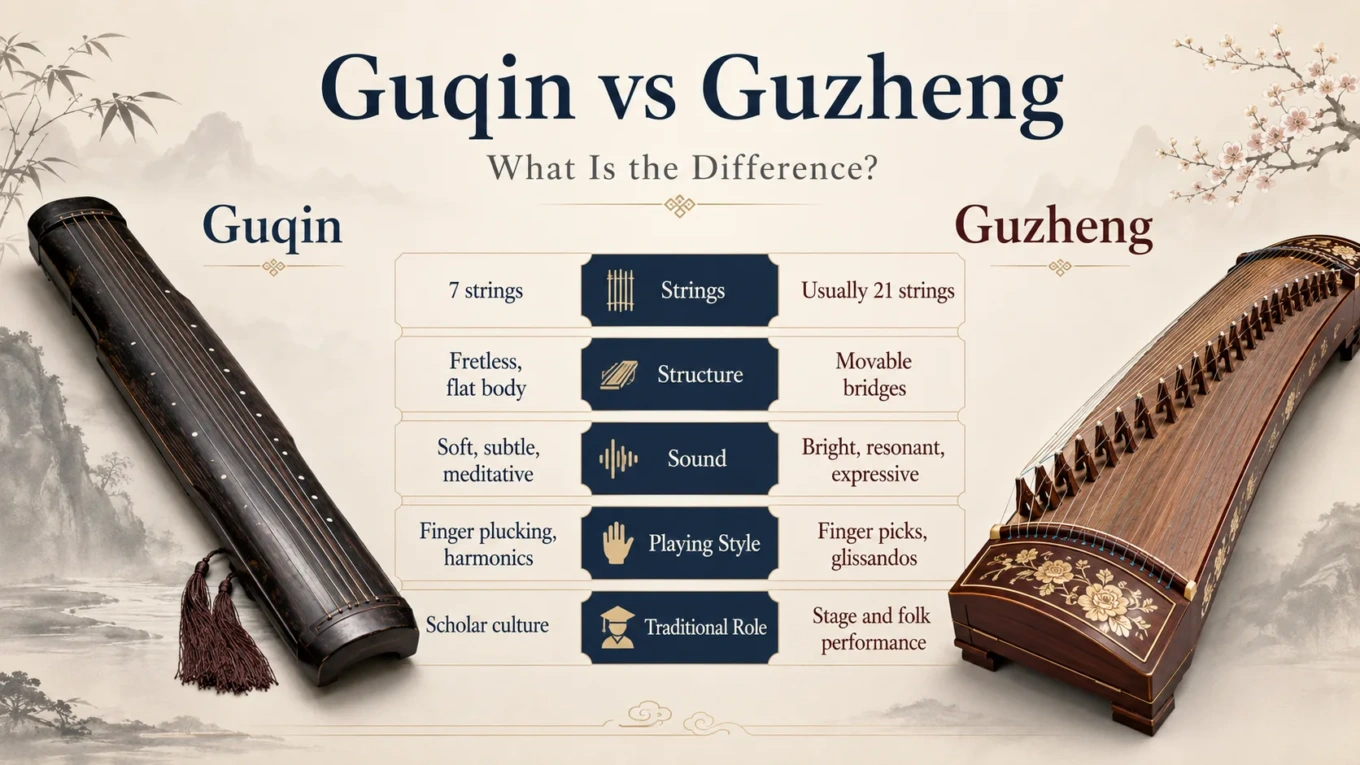
Guqin vs Guzheng: What Is the Difference?
Guqin and guzheng are both Chinese plucked zithers, but they are not close substitutes. The guqin is a quiet seven-string instrument played without movable bridges, using open tones, stopped tones, slides, and harmonics. The guzheng is a brighter, louder zither with many more strings, each passing over a movable bridge, and it is often played with fingerpicks. Their shapes may look related from a distance, yet their construction, tuning logic, technique, and musical roles differ sharply.
Guqin vs Guzheng: The Core Difference
The easiest way to separate the two instruments is to look at the strings and bridges. A guqin has seven strings stretched over a long, low body with no frets and no movable bridges. A guzheng usually has many more strings, often 21 on modern concert instruments, and each string rests on its own movable bridge.
Both belong to the broad zither[1] family because their strings run along the body rather than away from it like a harp or lute. In organology[2], both are chordophones[3], but their playing systems are different enough that a musician trained on one cannot simply transfer the same technique to the other.
| Feature | Guqin | Guzheng |
|---|---|---|
| Strings | Usually 7 strings | Modern instruments commonly have 21 strings, with other counts also used |
| Bridge System | No movable bridges; strings pass over fixed end supports | Each string normally has its own movable bridge |
| Playing Touch | Bare fingers; sliding and stopping on the surface are central | Often played with fingerpicks; left hand presses strings for bends and ornaments |
| Sound Character | Quiet, dry, subtle, and close in sound | Bright, ringing, resonant, and more projecting |
| Musical Setting | Often associated with solo, reflective playing | Used in solo music, ensembles, stage performance, and modern arrangements |
| Visual Markers | Long flat body, 13 hui position markers, no raised bridge row | Larger arched body with a visible row of bridges under the strings |
Classification Note: “Zither” is a broad family term here, not a claim that guqin and guzheng are the same instrument. The family resemblance comes from string placement and body layout; the musical logic comes from each instrument’s own bridge, tuning, and touch system.
What Is a Guqin?
The guqin, often simply called qin in older Chinese sources, is a long, low, seven-string zither. It has no frets[4] and no movable bridge[5]. The player plucks the strings with the fingers, then shapes the sound by stopping, sliding, and lightly touching the strings at marked positions.
One of the guqin’s most recognizable features is the row of 13 hui[6], small inlaid markers that guide finger placement. These do not work like frets. They show where harmonics[7] and stopped tones can be produced, while the exact sound still depends on touch, pressure, and movement.
The guqin’s body is shallow and refined in outline. Traditional descriptions often refer to an upper board and lower board, with wutong wood commonly associated with the top in many documented instruments. Wood choice can shape resonance[8], but the final sound also depends on age, thickness, lacquer, string type, and the maker’s work.
How the Guqin Produces Sound
The guqin uses three main sound types: open strings[9], stopped strings[10], and harmonics. Open strings give the basic pitches. Stopped tones are made by pressing a string against the smooth playing surface. Harmonics are made by lightly touching the string at specific points and plucking with control.
Slides are especially important. A player may pluck a note and then move the left hand along the string to create glissando[11], a continuous change in pitch. This gives the guqin much of its vocal and speech-like quality.
What Is a Guzheng?
The guzheng, also called zheng, is a larger plucked Chinese zither with a row of movable bridges placed under the strings. Modern guzhengs commonly have 21 strings, although historical and regional forms use different numbers. The body is broader and more resonant than a guqin, with a curved soundboard[12] that helps the instrument project.
Each string normally passes over an individual bridge. Moving that bridge changes the string’s sounding length and therefore its pitch. This bridge-based layout gives the guzheng a very different tuning and playing feel from the guqin.
In many modern settings, the right hand plucks the strings on one side of the bridges while the left hand presses the strings on the other side to create pitch bending[13], vibrato[14], and ornaments. Many players wear fingerpicks[15], often taped to the fingers, to produce a clear and projecting tone.
How the Guzheng Produces Sound
The guzheng’s sound comes from long strings stretched across a resonating body[16]. The bridge row divides the active playing area from the area used for pitch shaping. The player plucks one side and presses the other.
This creates a sound world built around ringing attacks, bends, tremolo, arpeggios, and flowing melodic lines. The guzheng can sound delicate, but it is generally more outward and stage-friendly than the guqin.
Construction: Flat Surface vs Bridge Row
The guqin’s construction invites direct contact between the player’s left hand and the string surface. Since there are no movable bridges or frets, the left hand must locate notes by touch, marker position, and trained ear. The smooth top allows long slides and fine pitch movement.
The guzheng is built around its bridges. The row of bridges is not decoration; it is the tuning mechanism and the visual center of the instrument. Each bridge supports a string, and careful bridge placement sets the scale.
Why the Bridge Difference Matters
On the guqin, pitch control often comes from the finger moving along the string after the note begins. On the guzheng, pitch shaping often comes from pressing the string section beyond the bridge after a note is plucked.
That single difference changes everything: posture, hand shape, tuning method, ornament, sustain, and musical texture.
Luthier’s Note: A guqin maker must pay close attention to the playing surface because the left hand moves across it constantly. A guzheng maker must also consider bridge stability, string tension, soundboard response, and how the movable bridges transfer vibration into the body.
Strings and Tuning
The guqin usually has seven strings. Older practice is closely associated with silk strings[17], though modern players may use metal-nylon or other modern string types depending on preference and availability. The instrument’s tuning can be adjusted for different repertory, but the seven-string layout remains central to its identity.
The guzheng has more strings and a different tuning logic. A modern 21-string guzheng is often tuned to a pentatonic scale[18], with missing scale tones produced through left-hand pressure. Some modern repertory and instrument designs extend or alter this setup, but the bridge-based pentatonic layout remains familiar to many players.
String material also affects feel. Modern guzheng strings often use nylon-wound steel[19] or related multi-material designs that give strength, volume, and a bright attack. Guqin strings tend to support a more intimate touch, where small changes in pressure and angle can be heard clearly.
Playing Technique and Hand Roles
Guqin playing depends on refined contact. The right hand plucks with the fingers. The left hand stops notes, slides, touches harmonics, and shapes the end of the sound. Much of the music lives in the space after the pluck: the slide, the release, the slight change in pressure, and the silence around the tone.
Guzheng technique is more visibly divided between plucking and bending. The right hand often plays the main notes with fingerpicks, while the left hand adds pressure-based ornaments. In modern styles, both hands may play rapid patterns, chords, and independent lines on the plucking side.
Common Technique Differences
- Guqin: bare-finger plucking, stopped tones, harmonics, long slides, quiet dynamic control.
- Guzheng: fingerpicked plucking, bridge-based tuning, left-hand bends, tremolo, arpeggiated textures.
- Guqin: the left hand often travels along the sounding string after plucking.
- Guzheng: the left hand often presses the non-plucked string section to change pitch and color.
Sound: Intimate Guqin, Ringing Guzheng
The guqin has a close, restrained sound. It is not designed mainly for volume. Its beauty depends on attack, decay, sliding pitch, harmonic color, and the relation between tone and silence. In a small room, the instrument can reveal very fine details.
The guzheng has a more ringing and projecting voice. Its larger body, greater number of strings, and bridge system give it a broad range of textures. It can produce rippling patterns, sharp accents, bending ornaments, and sustained resonance across many strings.
Listening Note: If the sound is quiet, dry, sliding, and sparse, it may be guqin. If the sound is bright, flowing, and filled with ringing string patterns, it is more likely guzheng.
Cultural Role and Musical Setting
The guqin has long been associated with solo cultivation, poetry, calligraphy, and scholarly life. This does not mean it belongs only to one social image, but it helps explain why its repertory often values restraint, nuance, and personal interpretation.
The guzheng has a broader public sound in many modern contexts. It appears in solo concert works, ensemble settings, education, stage arrangements, and cross-genre music. Its volume and visual bridge layout also make it easier for audiences to recognize.
Both instruments carry deep Chinese musical histories, yet they entered cultural life through different musical habits. The guqin often asks the listener to lean in. The guzheng often fills the space more directly.
Why People Confuse Guqin and Guzheng
The confusion usually begins with translation. Both may be described as Chinese zithers in English, and both are long plucked string instruments placed horizontally. Photographs can make them seem more similar than they are.
Names also contribute to the problem. Guqin and guzheng both begin with “gu,” meaning “ancient” in this naming context, but the second part names different instruments. Qin and zheng are separate instrument identities, not two sizes of the same object.
How to Tell Them Apart Quickly
- Look for a bridge row. A visible row of movable bridges usually means guzheng.
- Count the general number of strings. Seven strings point to guqin; many strings point to guzheng.
- Look at the left hand. Sliding along the string surface suggests guqin. Pressing strings behind bridges suggests guzheng.
- Listen for volume and texture. Sparse sliding tones suggest guqin; bright cascading patterns suggest guzheng.
Which Instrument Is Easier for Beginners?
Many beginners find the guzheng more immediately accessible because the bridge layout and pentatonic tuning can produce pleasing melodies early. The use of fingerpicks may feel unfamiliar at first, but the instrument gives a clear response.
The guqin can be more demanding in the beginning because tone production, left-hand position, tablature reading, and subtle control matter from the start. Its quietness also exposes small errors. That difficulty is part of the instrument’s character, not a flaw.
A beginner choosing between them should not ask only which one is easier. The better question is which sound world feels more compelling: the guqin’s close, sliding, reflective voice or the guzheng’s bright, resonant, melodic range.
How Museums and Musicians Describe Them
Museums often describe the guqin as a qin or seven-string zither with a long lacquered body, hui markers, and no bridge row. Its form is closely tied to symbolic naming, material choices, and a long literati tradition.
The guzheng is usually described as a zheng or plucked board zither with multiple strings and movable bridges. Museum and collection notes may mention older string counts, regional forms, or earlier materials, so a single modern 21-string description should not be treated as the only historical form.
For careful identification, the bridge system is more reliable than the general word “zither.” Both instruments fit under that large family term, but the bridge layout reveals the practical difference.
Guqin and Guzheng Compared with Related East Asian Zithers
The guzheng is often discussed alongside the Japanese koto, Korean gayageum, Vietnamese đàn tranh, and other bridge zithers. These instruments are not identical, but the idea of strings passing over movable bridges makes them easier to compare structurally.
The guqin is more distinct because it lacks the guzheng-style bridge row and uses a smooth playing surface for stopped tones and slides. It may be grouped with zithers in classification, but its touch system sets it apart from many other East Asian bridge zithers.
This is why “Chinese zither” is helpful only as a starting point. It should not replace the actual instrument names.
Practical Choice: Guqin or Guzheng?
Choose guqin if the desired sound is quiet, subtle, sliding, and strongly connected to solo study. It suits a listener who enjoys small details, slow development, and the physical feel of shaping pitch directly on the string.
Choose guzheng if the desired sound is bright, resonant, melodic, and more immediately projecting. It suits a player who enjoys flowing patterns, strong plucked tone, visible hand movement, and a larger pitch range.
Neither instrument is the “better” zither. They answer different musical questions.
Glossary of Technical Terms
Zither: A string instrument in which the strings run along or across the body rather than extending from a neck. In this context, guqin and guzheng are both zithers, but their playing systems are different.
Organology: The study and classification of musical instruments. It helps explain why guqin and guzheng can belong to the same broad family while still being separate instruments.
Chordophone: A musical instrument that produces sound through vibrating strings. Zithers, lutes, harps, and bowed string instruments are all chordophones, though their structures differ.
Fret: A raised marker or strip that fixes pitch when a string is pressed against it. The guqin has no frets, so pitch depends on finger placement and touch.
Movable Bridge: A bridge that can be repositioned to change the speaking length and pitch of a string. The guzheng relies on movable bridges; the guqin does not.
Hui: The 13 position markers on a guqin. They guide the player to harmonic and stopped-note positions but do not function as frets.
Harmonic: A clear, bell-like tone made by lightly touching a string at a precise point while plucking. Harmonics are central to guqin technique and also appear in other zither traditions.
Resonance: The way an instrument’s body responds to string vibration and strengthens or colors the sound. Wood, body shape, string tension, and construction all affect resonance.
Open String: A string sounded without being stopped by the left hand. Open strings provide basic pitches and resonance on many zither-family instruments.
Stopped String: A string whose sounding length is changed by pressing it with the finger. On the guqin, stopped strings allow sliding tones and many pitch positions on the smooth surface.
Glissando: A continuous slide from one pitch to another. On the guqin, glissando is produced by moving the left hand along the string after plucking.
Soundboard: The vibrating top surface of a string instrument. On zithers such as the guzheng, the soundboard helps transfer string energy into a larger, resonant tone.
Pitch Bending: The act of raising or shaping a note after it is sounded. Guzheng players often bend pitch by pressing the string section on the left side of the bridge.
Vibrato: A controlled wavering of pitch used to animate a sustained note. On many zithers, it is created by subtle pressure changes rather than by moving along a fingerboard.
Fingerpick: A small plectrum worn on the finger to pluck a string. Guzheng players commonly use fingerpicks to create a clear, bright attack.
Resonating Body: The hollow or partly hollow body that receives vibration from the strings and shapes the instrument’s sound. The guzheng’s large body helps produce its projecting voice.
Silk String: A traditional string material made from twisted silk. Silk strings are closely associated with older guqin practice, though modern alternatives are also used.
Pentatonic Scale: A five-note scale common in many musical traditions. Modern guzheng tuning often uses a pentatonic layout, with extra tones produced through pressing techniques.
Nylon-Wound Steel String: A modern string type using a steel core with nylon wrapping or related layered construction. It is common on many modern guzhengs because it offers volume, durability, and a bright tone.
FAQ
Is guqin the same as guzheng?
No. Both are Chinese plucked zithers, but the guqin has seven strings and no movable bridges, while the guzheng has many strings and a row of movable bridges.
Which is older, guqin or guzheng?
Both have long histories in Chinese music. The guqin is especially associated with early scholarly and solo traditions, while zheng-type instruments also appear in early Chinese musical history. Exact historical claims should be treated carefully because forms, names, and string counts changed over time.
Does the guqin have frets?
No. The guqin has hui markers, but they are not frets. They guide finger placement for harmonics and stopped tones while leaving pitch control to the player’s touch.
Why does the guzheng have so many bridges?
Each guzheng string normally rests on its own movable bridge. These bridges set pitch, support the strings, and transfer vibration into the body.
Which instrument is louder?
The guzheng is usually louder and more projecting. The guqin is quieter and more intimate, with much of its expression coming from slides, harmonics, and subtle tone changes.
Can a guzheng player easily learn guqin?
Some musical awareness will help, but the technique is very different. A guzheng player must learn guqin finger placement, sliding, stopped tones, harmonics, and a quieter approach to sound.