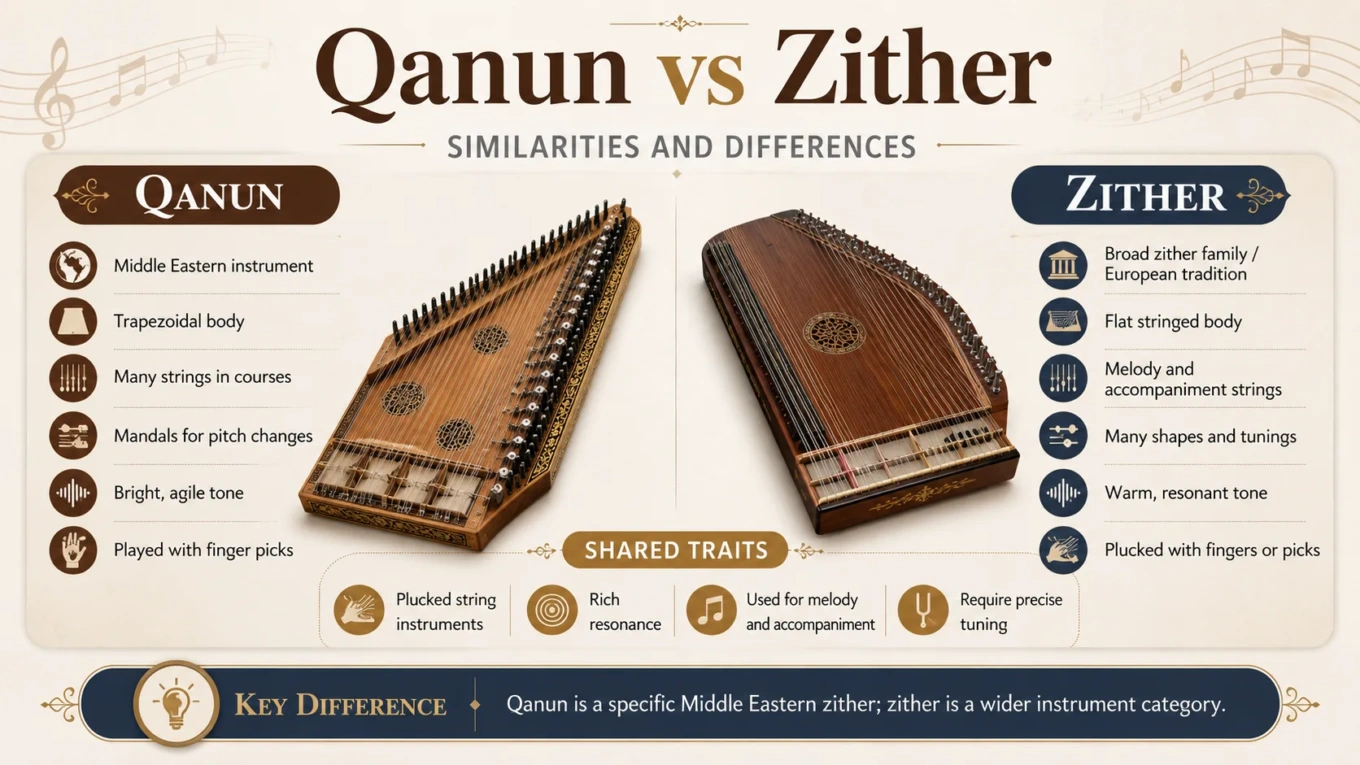
Qanun vs Zither: Similarities and Differences
A qanun and a concert zither can look like two unrelated instruments, yet organologically they belong much closer together than their different musical traditions suggest. The qanun is itself a form of plucked zither: a chordophone[1] whose strings run across a flat resonating body rather than along a projecting neck. The confusion begins because the word zither has two common uses. It can describe a broad family of string instruments, or it can refer more narrowly to the European concert zither. In a practical “qanun vs zither” comparison, the useful comparison is therefore qanun vs European concert zither.
Both instruments place many strings across a shallow wooden body and are normally played horizontally. From there, their designs move in different directions. The qanun organizes strings into grouped courses, uses small pitch-changing levers on many modern instruments, and is closely associated with Arabic maqam and Turkish makam traditions. The concert zither combines fretted melody strings with a separate field of open accompaniment and bass strings.
Classification Note: A qanun should not be described as an instrument that merely resembles a zither. It belongs within the zither family. The meaningful differences are found in its string layout, pitch-control system, construction, technique, sound, and musical use.
Why the Qanun Is Classified as a Zither
In instrument classification, zithers are placed among simple chordophones[2]. The defining structural idea is that the strings stretch across or along the primary string-bearing body without the separate neck-and-body arrangement found on instruments such as guitars, lutes, and ouds.
The qanun fits that description. Its strings extend across a rigid, usually trapezoidal body. They remain approximately parallel to the plane of the body and pass over a bridge before reaching their anchoring and tuning points.
Within the wider zither classification, instruments can be divided further according to their body, resonator, string arrangement, and method of sounding the strings. The term board zither[3] is useful for instruments built around a rigid board-like string bearer. A box zither[4] adds a hollow resonating box beneath or around that string-bearing structure.
The concert zither also belongs within this broad structural family. Calling one instrument “qanun” and the other simply “zither,” however, can hide the fact that one name identifies a particular regional instrument while the other can identify either a particular European instrument or an entire organological family.
Qanun and Concert Zither Side by Side
| Feature | Qanun | Concert Zither |
|---|---|---|
| Family | Plucked zither | Plucked, fretted zither |
| Body | Usually broad and trapezoidal | Usually asymmetrical, with an integrated fretboard area |
| String Layout | Strings grouped into multiple courses | Fretted melody strings plus open accompaniment and bass strings |
| Pitch Control | Separate courses plus movable levers on many modern instruments | Frets change the sounding length of melody strings |
| Typical Plucking | Both hands, often with finger-mounted plectra | Fretted melody commonly plucked with a thumb plectrum; other fingers handle open strings |
| Pitch Tradition | Closely linked with maqam and makam practice | Closely linked with Western tonal and chromatic practice |
| Regional Association | Middle East, Turkey, North Africa, and neighboring traditions | Central European and Alpine traditions, with later use elsewhere |
The table shows why body shape alone is not enough for identification. The strongest differences appear when the string system and pitch mechanism are examined.
The Body Layout Gives the First Visual Clue
The Qanun Uses a Broad Trapezoidal Platform
A qanun normally has a wide trapezoidal body that places a large number of strings within easy reach of both hands. One edge carries tuning hardware, while the oblique side commonly carries rows of small pitch levers. Strings cross the soundboard[5] and are supported by a bridge[6].
The body is more than a convenient platform for the strings. Its enclosed air space, soundboard, bridge arrangement, and string tension work together to project the plucked strings. Construction details differ among makers and regional forms, so one qanun should not be treated as a universal specification for all others.
Historical qanuns can also show construction features that differ from many current instruments. Museum examples document bridges resting partly on skin or membrane sections, while modern workshop practices vary. These differences matter when comparing historical specimens with instruments made for contemporary performance.
The Concert Zither Divides Its Surface by Musical Function
A concert zither presents a different visual logic. Along the side nearest the player is a small group of fretted strings[7] used for melody. Beside them lies a much larger spread of open strings[8] used for accompaniment, harmony, and bass notes.
Many concert-zither forms use five fretted melody strings, although the total number and organization of the remaining strings depend on instrument type, period, maker, and tuning system. The instrument therefore looks less like one uninterrupted field of equal-purpose strings and more like two playing systems sharing one body.
This is one of the easiest ways to distinguish the instruments visually: a qanun does not have the concert zither’s conventional fretted melody section.
Qanun Strings Work in Courses
The large apparent string count on a qanun can be misleading if every visible string is imagined as a separate note. Qanun strings are normally arranged in courses[9], meaning that several closely spaced strings are treated together as one pitch group.
Many qanuns use three strings in a course. A player normally plucks those strings together rather than treating each member of the group as an independent melodic string. Historical and modern instruments vary, so statements such as “a qanun always has 72 strings” are too rigid. Museum instruments with 72 strings arranged as 24 triple courses are documented, but other qanuns use different totals.
Grouping strings this way changes both playing feel and sound. Several strings begin vibrating almost simultaneously, producing a fuller attack than a comparable single string. Small differences in tuning, material, tension, and vibration between members of a course can also add complexity to the sustained sound.
Concert Zither Strings Are Divided by Function Instead
The concert zither’s organization is based less on repeated strings for one pitch and more on what each string group is expected to do.
- Fretted melody strings allow the player to form changing pitches with the left hand.
- Open accompaniment strings provide harmony without being stopped against frets.
- Bass strings extend the instrument into a lower register.
This separation affects technique. A concert-zither player can carry a melodic line on the fretted section while the right hand reaches across different open-string groups for harmony and bass support.
Mandals and Frets Change Pitch in Different Ways
The small metal levers near one side of a modern qanun are among its most recognizable features. In Turkish terminology they are commonly called mandals[10]. Arabic qanuns use related lever systems, though terminology, lever counts, interval layouts, and workshop practices can differ.
A mandal changes the effective vibrating length of a string course by engaging or disengaging a small contact point. This raises or lowers the available pitch for that course according to the instrument’s setup. Because the levers can be operated during performance, the player can prepare or alter pitch positions without stopping to retune the string at its tuning peg.
A concert-zither fret works differently. The player presses a melody string against a fret, temporarily shortening its vibrating length. The same string can therefore produce a sequence of pitches as the left hand moves along the fretboard.
Luthier’s Note: A qanun mandal is not simply a movable version of a zither fret. A fret is contacted by the player’s finger while a note is being stopped. A mandal changes the pitch configuration available to an entire string course and can remain in that position for later notes.
The Two Instruments Ask the Hands to Do Different Jobs
Qanun Technique
The qanun is usually played with both hands working across the string field. Players commonly wear a plectrum[11] on or around each index finger, although playing practices and accessories vary.
Because the strings are laid out across a broad horizontal surface, the hands can move rapidly between registers. Alternating strokes, repeated notes, ornaments, arpeggiated figures, and rapid passages can all be produced without a fretboard.
The player may also operate mandals during a piece. This creates a separate mechanical task that a concert-zither player does not encounter in the same form: the hands are not only choosing which strings to pluck but may also be changing the pitch configuration of selected courses as the music progresses.
Concert Zither Technique
On the concert zither, the left hand generally handles the fretted melody strings. It presses those strings against the fretboard to select notes. The right-hand thumb commonly plucks the melody string with a ring-mounted or thumb plectrum, while other fingers reach the open accompaniment and bass strings.
The technique therefore divides melody and accompaniment in a very visible way. The qanun’s surface is more uniform: both hands work directly over courses spread across the same broad string field.
Tuning Reflects the Different String Systems
Neither instrument has one universal tuning shared by every historical and regional version, and a qanun-versus-zither comparison does not need a full tuning chart to show the difference.
A qanun is tuned course by course to establish its basic pitch layout. Mandal positions then give the performer additional pitch choices around those tuned notes. The exact number of available lever positions and the interval each position represents depend on instrument design and regional practice.
The concert zither uses another arrangement. Its melody strings can produce multiple notes because they pass across frets, while its accompaniment and bass strings normally remain open. Those open strings must therefore be tuned individually to the harmonic system for which the instrument is set up.
This creates two contrasting forms of pitch organization:
- Qanun: many pre-tuned courses with mechanical pitch adjustment.
- Concert zither: a small fretted melody group combined with many fixed-pitch open strings.
Maqam and Makam Shape the Qanun’s Pitch System
The qanun’s lever system makes more sense when considered alongside maqam and makam[12] practice. These modal traditions organize melody through characteristic pitch relationships, melodic paths, phrases, and ornamental behavior. They should not be reduced to the idea of a Western scale played with a few altered notes.
Qanun makers and performers use lever systems that provide access to pitch positions required by their musical tradition. The exact mechanical arrangement is not identical across Turkish and Arabic qanuns, and not every instrument divides intervals in precisely the same way.
Descriptions that simply label every lever movement as a “quarter tone” can therefore be misleading. Actual pitch practice, instrument setup, regional theory, and performance style are more detailed than that label suggests.
Concert zithers developed around a different pitch environment. Their fretted melody strings and open accompaniment strings are suited to Western tonal and chromatic systems. This does not make one instrument more flexible than the other; each design solves a different set of musical needs.
Why Their Sounds Are Easy to Tell Apart
Both instruments produce sound by plucking strings attached to a resonating wooden body, yet their resonance[13] and overall timbre[14] can be noticeably different because their strings, bridges, bodies, and playing methods are organized differently.
The Qanun’s Course-Based Sound
When several strings in one course are sounded together, the note has more than one vibrating source. This helps create the qanun’s dense, clear plucked character. Fast alternating strokes and ornaments can add an animated surface to the sound without requiring the player to change notes through a fretboard.
The bridge and soundboard transfer the vibration from many highly tensioned strings into the body. Material choices and construction can shape the response, but simple claims such as one wood species automatically producing one fixed tonal quality should be treated carefully.
The Concert Zither Separates Melody from Harmonic Support
The concert zither can present a more obvious distinction between the articulated melody line and the surrounding open-string accompaniment. A fretted melody string is stopped and plucked, while separately tuned open strings provide chords, bass movement, or broken harmonic patterns.
Listening Note: Rather than listening only for “bright” or “soft” tone, listen to how notes are organized. Qanun passages often reveal the blended attack of grouped courses and fast ornamentation. Concert-zither playing often makes the contrast between fretted melody and open-string harmonic support easier to hear.
What Qanun and Concert Zither Have in Common
Their differences are easier to understand when the shared structure is kept in view.
- Both are chordophones whose sound begins with vibrating strings.
- Both belong within the broad zither family.
- Both use a relatively flat resonating body rather than a guitar-like projecting neck.
- Both can carry many more strings than common necked string instruments.
- Both use bridges to couple string vibration to the body.
- Both are commonly played in a horizontal position.
- Both use plucking as a primary method of sounding the strings.
- Both depend on carefully organized string groups rather than one identical string repeated across the instrument.
These common features explain why the qanun fits comfortably within zither classification even though its appearance, music, and playing technique differ strongly from the European concert zither.
The Musical Roles Developed in Different Traditions
Qanun in Middle Eastern and Eastern Mediterranean Music
The qanun is widely associated with Arabic, Turkish, and related musical traditions. It appears in ensembles, accompaniment settings, instrumental repertory, and solo performance. Its large pitch range and responsive plucking technique allow it to support melodic lines, ornaments, rapid passages, and harmonic textures according to the musical setting.
The instrument’s spelling also changes with language and transliteration. Qanun, qānūn, and Turkish kanun can refer to closely related forms of the instrument. Regional instruments should not be assumed to have identical dimensions, lever arrangements, tuning practices, or construction.
Concert Zither in Central European Music
The concert zither is closely associated with Central European practice, especially German-speaking and Alpine regions. Its design lets one player combine a fretted melody with a broad field of accompaniment strings.
Historical makers produced many related zither forms, which means not every European instrument labeled “zither” has the exact construction of a modern concert zither. Museum collections contain fretted zithers, chord zithers, harp zithers, fretless forms, and other designs. The narrower comparison here concerns the concert-zither tradition rather than every European instrument carrying the zither name.
History Does Not Make “Which Is Older?” a Simple Question
The broad zither concept is older than either modern instrument form, so comparing the age of “qanun” with the age of “zither” as though they were two equivalent species creates a terminology problem.
The word qānūn appears in medieval sources, while the familiar trapezoidal form represented by surviving museum qanuns developed later. Museum scholarship has associated the recognizable modern form with developments in Egypt or Syria around the eighteenth century, followed by regional construction traditions across the Middle East and nearby areas.
The concert zither in its familiar Central European form belongs to a different development. Its present arrangement grew from earlier European zithers and became closely associated with nineteenth-century instrument making and concert practice.
Older names, earlier relatives, and modern standardized forms therefore need to be separated. The date when a word appears is not automatically the date when today’s instrument acquired its present construction.
Frets and Mandals Are the Most Useful Identification Detail
For someone looking at an unfamiliar instrument, body shape helps, but the pitch-control hardware usually settles the identification faster.
Look for These Features on a Qanun
- A broad trapezoidal body.
- A dense field of strings arranged in repeated courses.
- No conventional fretboard.
- Rows of small movable levers near one side on many modern instruments.
- A long bridge running across much of the string field.
- A playing layout designed for both hands to pluck directly over the strings.
Look for These Features on a Concert Zither
- An asymmetrical flat body.
- A clearly visible fretboard beside the player.
- A small set of melody strings crossing that fretboard.
- A larger fan or field of open accompaniment and bass strings.
- No qanun-style bank of pitch levers.
- A playing system that visibly separates fretted melody from open-string accompaniment.
Qanun, Psaltery, and Santur Are Not Interchangeable Names
The qanun is sometimes discussed alongside the psaltery and santur because all can appear as flat, many-stringed instruments. Their methods of producing and controlling notes are different enough that the names should not be exchanged.
| Instrument | How Strings Are Sounded | Useful Identifying Feature |
|---|---|---|
| Qanun | Plucked | Grouped courses and, on many modern forms, rows of pitch levers |
| Psaltery | Usually plucked in the forms most often compared with qanun | Generally lacks the developed qanun-style mandal system |
| Santur | Struck with light beaters | Strings are arranged for hammering rather than direct finger-plectrum playing |
Santur is especially easy to separate by playing method. It belongs to the broader group of struck zithers, whereas the qanun is plucked directly. A historical psaltery can be structurally closer to the qanun, but the modern qanun’s course layout, regional pitch systems, and lever mechanism give it a more specific identity.
Where the Comparison Matters Most
Four differences account for most of what a listener, player, or instrument researcher needs to distinguish.
Instrument Name
Qanun identifies a particular instrument tradition. Zither can identify either an entire organological family or, in narrower everyday usage, a European instrument such as the concert zither.
String Organization
The qanun normally groups strings into courses. The concert zither separates a small fretted melody section from a much larger set of individually tuned open strings.
Pitch Control
Qanun players use separately tuned courses and, on many instruments, mandals that alter available pitch positions. Concert-zither players create melody pitches by pressing strings against fixed frets.
Musical Language
The qanun developed around maqam, makam, and related regional practices. The concert zither developed within Central European tonal traditions. Construction and musical language therefore reinforce each other rather than functioning as unrelated features.
Frequently Asked Questions
Is a Qanun a Type of Zither?
Yes. The qanun is classified within the broad zither family. It has strings stretched across a flat resonating body and does not use the projecting neck-and-body layout of a lute or guitar.
Is a Qanun the Same as a Concert Zither?
No. They belong to the same broad instrument family, but their string arrangements, pitch systems, techniques, body layouts, and musical traditions are different. The qanun uses grouped courses and often pitch levers, while the concert zither uses fretted melody strings alongside open accompaniment strings.
Does a Qanun Have Frets?
It does not use a conventional concert-zither or guitar-like fretboard. Pitch selection comes from separately tuned courses and, on many modern qanuns, movable mandals that alter the available pitch of a course.
Why Does a Qanun Have Several Strings for One Note?
Its strings are commonly grouped into courses, often with three closely spaced strings working together. The grouped strings produce one musical pitch while contributing a fuller combined response than a single string alone.
How Many Strings Does a Qanun Have?
There is no single string count for every qanun. Historical examples include instruments with 72 strings in 24 triple courses, while other historical and modern instruments use different numbers of courses and strings.
Is a Qanun the Same as a Santur?
No. A qanun is normally plucked directly with the hands and plectra. A santur is a struck zither whose strings are sounded with small beaters. The similar flat, many-stringed appearance can make them look related, but the playing systems are clearly different.
Glossary of Technical Terms
[1] Chordophone: An instrument whose primary sound source is a vibrating string. Zithers, lutes, harps, and many bowed instruments belong to different branches of this broad group.
[2] Simple Chordophone: A classification used for zithers in which the string-bearing structure does not depend on a separate neck-and-body arrangement. Additional resonating parts may be present without changing that basic structural relationship.
[3] Board Zither: A zither in which a rigid board functions as the main string-bearing structure. Different board-zither forms can use open strings, frets, movable bridges, plectra, fingers, or beaters.
[4] Box Zither: A zither built with a hollow box-like resonator associated with the string-bearing board. The enclosed body helps receive and project vibration transferred from the strings.
[5] Soundboard: A relatively thin resonating surface that receives vibration through the bridge or other contact points. Its construction affects how efficiently string energy is transferred into audible sound.
[6] Bridge: The structure that supports strings above the instrument body and transfers their vibration toward the soundboard or resonator. Bridge design differs widely across the zither family.
[7] Fretted String: A string whose sounding length can be shortened by pressing it against marked or raised fret positions. On the concert zither, a small group of melody strings is played this way.
[8] Open String: A string sounded without being stopped against a fret or fingerboard. Concert zithers use numerous open strings for accompaniment and bass functions.
[9] Course: A group of two or more strings treated as a single playing unit. Qanuns commonly use multiple-string courses rather than assigning every visible string to a completely separate note.
[10] Mandal: A small movable pitch lever used on Turkish kanuns and related qanun designs. Engaging or releasing a mandal alters the effective sounding length and available pitch of its string course.
[11] Plectrum: A small hard implement used to pluck a string. Qanun players commonly use plectra associated with the index fingers, while concert-zither technique commonly uses a thumb-mounted plectrum for melody strings.
[12] Maqam and Makam: Related modal systems used in Arabic and Turkish musical traditions. They involve characteristic pitch relationships, melodic behavior, phrases, and ornaments rather than functioning simply as fixed Western-style scales.
[13] Resonance: The response of the instrument body and its components to string vibration. On zithers, the soundboard, enclosed body, bridge, strings, and construction all contribute to how vibration develops and projects.
[14] Timbre: The audible character that helps distinguish two instruments even when they play the same pitch. String material, course arrangement, attack, bridge design, body response, and technique can all shape a zither’s timbre.