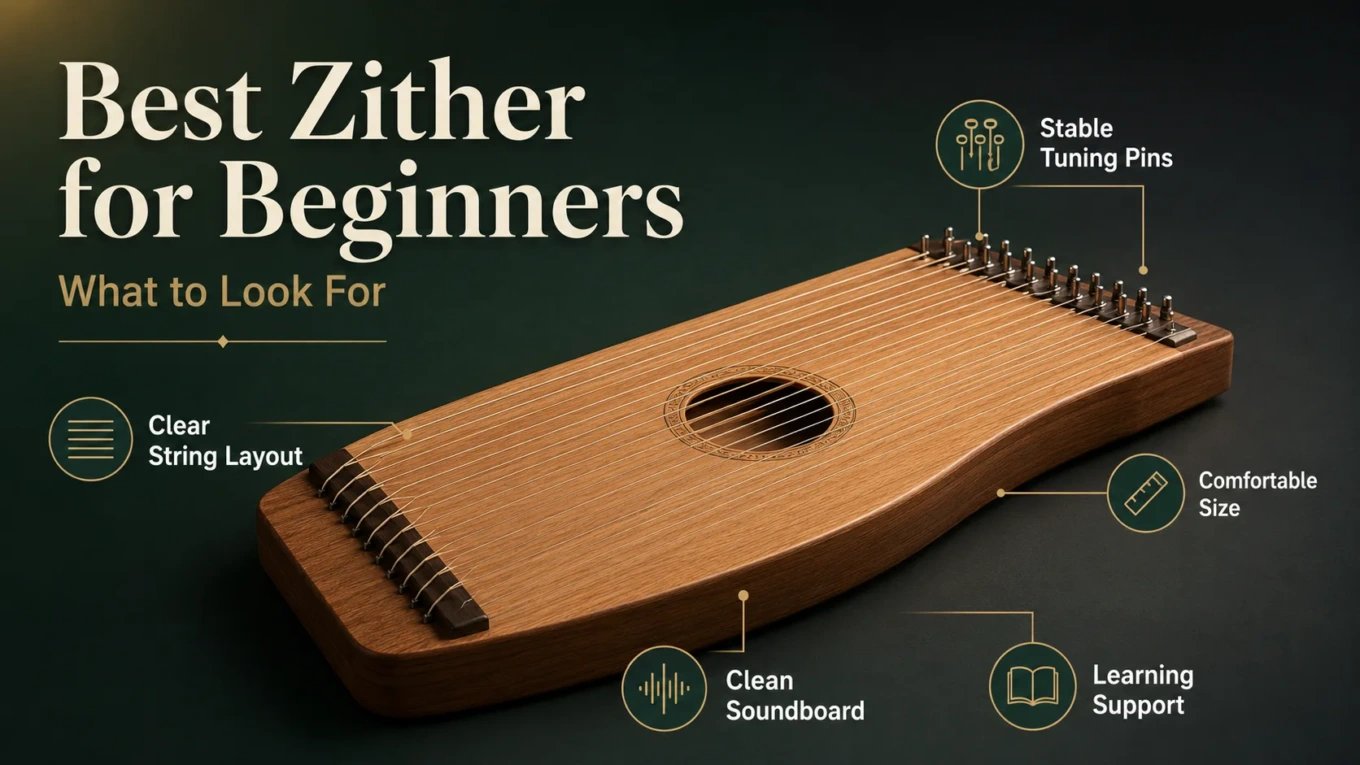
Best Zither for Beginners: What to Look For
The best zither for beginners is usually not the most ornate one, the oldest one, or the instrument with the largest number of strings. A beginner needs a zither[1] that stays in tune, has clear string spacing, fits the player’s musical goal, and does not turn every practice session into a repair lesson.
The word “zither” can mean two things. In a narrow European sense, it often points to the concert zither: a flat string instrument with melody strings, accompaniment strings, and a fretted area. In a broader organological sense, it describes a family of chordophones[2] in which strings run across or along a body without a projecting neck. That wider family includes instruments as different as the kantele, guzheng, koto, autoharp, psaltery, dulcimer, qanun, and santur.
For a first instrument, the practical question is simple: which kind of zither lets a new player learn real musical control without fighting the instrument?
Best Beginner Choice for Most Players
For most new players who want a gentle start, a small board zither, kantele-style zither, psaltery, or simple lap zither is usually the easiest entry point. These instruments tend to have fewer strings, a visible layout, and a direct connection between hand movement and sound.
A full concert zither can be beautiful, but it asks for more coordination. The player must manage melody, accompaniment, fretted notes, and plucked open strings in one sitting position. That is rewarding later, but it can feel crowded at the beginning.
Practical answer: choose a simple, well-built zither with clear tuning access, stable strings, and a layout you can understand by looking at it. If the instrument makes sense before you play a note, it is usually a better first zither.
Beginner Zither Types Compared
| Zither Type | Beginner Fit | Main Strength | Main Challenge |
|---|---|---|---|
| Small board zither | Very approachable | Simple layout, easy string visibility | Limited range on very small models |
| Kantele-style zither | Excellent for first study | Clear tuning logic and gentle playing feel | Regional tunings and sizes vary |
| Psaltery | Good for melody learning | Often direct and visually clear | Some models are narrow or delicate |
| Autoharp | Good for chordal playing | Chord buttons help beginners accompany songs | More mechanical parts to check |
| Concert zither | Better after basic experience | Wide harmonic range and refined technique | Complex string layout and steeper learning curve |
| Guzheng or koto | Best with teacher support | Expressive tone and established learning traditions | Large size, movable bridges, and specialized technique |
What to Look For First
A Clear String Layout
A beginner zither should make the strings easy to identify. On some instruments, each string simply sounds one pitch as an open string[3]. On others, a fretted string[4] section lets the player stop a string with the left hand to create different notes.
For first practice, fewer strings are often better than many strings. A small instrument with five to fifteen strings may teach pitch, rhythm, and hand control faster than a larger instrument with a beautiful but confusing layout.
A Stable Soundboard and Soundbox
The soundboard[5] is the vibrating top that helps the strings speak. On box-shaped zithers, the soundbox[6] gives the tone more body. Cracks, loose braces, warped tops, rattles, and separated seams can make a beginner instrument frustrating even if it looks attractive.
Wood choice can shape resonance[7], but construction matters more than a romantic wood label. A neatly built plywood student instrument may serve a beginner better than a poorly repaired older zither with “fine wood” in the description.
Comfortable Tuning Access
Tuning[8] is part of zither ownership. The tuning pins should turn firmly, not slip, grind, or feel frozen. If a beginner cannot tune the instrument without anxiety, practice becomes harder than it needs to be.
Some zithers use a simple diatonic layout, while others use chromatic, modal, regional, or piece-specific arrangements. A first instrument should come with a clear tuning chart or a teacher-approved layout. Guesswork is not a learning method.
String Count: Fewer Can Be Better
Large string counts can look impressive, but they are not always beginner-friendly. More strings mean more tuning work, more visual crowding, and more chances for accidental noise.
A small kantele-style instrument or simple board zither can teach clean plucking, damping, listening, and pitch awareness. Those skills transfer well to larger instruments later.
When More Strings Make Sense
More strings can help when the player already knows what musical role they want. An autoharp supports song accompaniment through chord bars[9]. A concert zither gives separate melody strings[10] and drone or accompaniment strings[11]. A guzheng or koto offers a wide range through movable bridges[12].
Those are not beginner problems by themselves. They only become problems when the instrument asks for more setup knowledge than the player has.
Check the Playing Method Before Buying
Not every zither is played the same way. Some are plucked with bare fingers. Some use a plectrum[13] or fingerpicks. Some are struck with small hammers. Some rare forms are bowed.
A beginner should choose a playing method that matches the kind of music they want to learn:
- For simple melodies: a psaltery, small board zither, or kantele-style instrument can be a gentle start.
- For singing accompaniment: an autoharp or chord zither may feel more useful.
- For European zither technique: a concert zither is the correct path, but teacher guidance helps.
- For East Asian long zither traditions: choose the specific instrument, such as guzheng or koto, rather than a generic “zither.”
Construction Details That Matter
Bridge Fit and String Height
Bridges transfer string vibration to the body. They should sit cleanly, without leaning, buzzing, or cutting too sharply into the strings. On instruments with movable bridges, every bridge should stand securely and allow pitch adjustment without wobbling.
String height, sometimes called action[14], affects comfort. If the strings sit too high, pressing or plucking can feel stiff. If they sit too low, buzzing may appear. The ideal height depends on the zither type, but the instrument should feel playable rather than resistant.
Strings and Courses
Some instruments use single strings. Others group strings into courses[15], where two or more strings may be tuned together or used as one musical unit. Courses can create a fuller sound, but they also mean more tuning points.
A beginner should not avoid courses entirely. The point is to understand what the instrument asks. A simple single-string layout is usually easier for first learning; courses become more appealing once the player wants a broader texture.
Clean Hardware
Look closely at tuning pins, hitch pins, bridges, chord mechanisms, and string anchors. Rust, loose parts, deep cracks, or missing pins can turn a cheap instrument into an expensive repair project.
Older zithers can be excellent, but they should be judged as instruments, not decorations. A wall-hanging zither is not always ready to play.
Which Zither Is Easiest to Learn?
The easiest zither is the one with the fewest hidden tasks. A five-string or ten-string kantele-style instrument, a small board zither, or a simple psaltery often gives a beginner the fastest path from touch to tone.
An autoharp can also be easy in a different way. The chord mechanism lets the player press a labeled button and strum. That helps with songs, but the instrument still needs tuning and occasional mechanical care.
Concert zithers, guzheng, koto, and qanun-family instruments can be learned by beginners, but they reward more structured study. Their size, tuning systems, bridges, and hand techniques are less forgiving when learned casually.
Instrument Size and Practice Space
A first zither should fit the room, the table, and the player’s hands. Large instruments can sound satisfying, yet they also need stands, cases, storage space, and careful handling.
Small does not mean toy-like. A well-made small zither can teach tone control, damping, basic scales[16], and steady rhythm. For children, small hands, or apartment practice, compact size can be an advantage.
Tone: What a Beginner Should Listen For
A good beginner zither should have an even timbre[17] across the strings. It does not need to be loud. It does need to speak clearly.
Listen for three things:
- Each string should ring without a harsh buzz.
- Notes should fade naturally rather than stopping suddenly.
- The lowest and highest strings should feel related, not like they belong to different instruments.
Some instruments include sympathetic strings[18] or complex resonance systems, but those are not needed for a first zither. Clear tone matters more than decorative complexity.
What to Avoid in a Beginner Zither
- A very cheap instrument with no tuning tool, no tuning chart, and no maker information.
- An antique zither sold mainly as decor, especially if strings, pins, or bridges are missing.
- A large concert zither bought only because it looks impressive.
- A regional instrument bought without access to learning material in a language the player can use.
- Any zither with obvious cracks, warped wood, loose hardware, or unstable tuning pins.
Beginner Buying Checklist
| Feature | Good Sign | Warning Sign |
|---|---|---|
| String layout | Clear spacing and understandable note order | Crowded strings with no tuning chart |
| Tuning pins | Firm movement and stable pitch | Slipping, rusted, or frozen pins |
| Body | Solid, clean, no buzzing or open cracks | Warped top, rattles, separated joints |
| Learning support | Basic chart, method book, teacher, or clear online lessons | No reliable way to learn the tuning or technique |
| Size | Fits lap, table, or stand comfortably | Too large to store, tune, or practice often |
| Accessories | Tuning key, picks if needed, case or safe cover | Missing basic tools or unusual parts |
Best Choice by Learning Goal
If You Want the Easiest Start
Choose a small board zither, kantele-style zither, or simple psaltery. These instruments keep the learning task narrow: tune the strings, pluck cleanly, and learn where pitches sit.
If You Want to Accompany Songs
Choose an autoharp or chord zither. The chord system can help with folk songs, hymns, and simple accompaniment patterns. Check the chord buttons carefully, because a sticky or misaligned mechanism can make the instrument unreliable.
If You Want Classical European Zither Technique
Choose a concert zither only if you are ready for a more formal learning path. The reward is a wide musical range, but the player must handle fretted melody playing and open accompaniment strings together.
If You Want Guzheng, Koto, or Another Regional Tradition
Choose the actual tradition-specific instrument, not a generic substitute. A guzheng, koto, gayageum, or đàn tranh has its own bridge system, playing posture, tuning habits, and repertory. A “beginner zither” label on a sales page may not explain those differences.
New or Used: Which Is Better?
A new beginner zither is often safer when it comes with a tuning chart, accessories, and return options. A used zither can be a fine choice if the instrument is playable and the buyer can inspect the structure.
Used concert zithers deserve extra care. Missing strings, worn frets, damaged tuning pins, and unclear tuning systems can make them hard for a beginner to restore. If the seller cannot show that the instrument holds pitch, treat the purchase as a repair project.
Luthier’s Note: a stable, modest instrument is usually better for learning than a fragile instrument with historical charm. Beginners need repeatable sound more than decorative age.
How Much Complexity Is Enough?
A beginner zither should have enough range to play simple music, but not so much complexity that setup becomes the main activity. For many players, the best first instrument has a small number of strings, a visible pitch pattern, and a tone that encourages daily practice.
Once the player knows their preferred sound, the next instrument can be more specialized: concert zither for European fretted technique, guzheng for Chinese long-zither repertory, koto for Japanese music, autoharp for chordal accompaniment, or dulcimer-family instruments for struck-string playing.
Glossary of Technical Terms
[1] Zither
A zither is a string instrument whose strings run across or along the body without a separate projecting neck. The word can refer narrowly to European zithers or broadly to a large family of related chordophones.
[2] Chordophone
A chordophone is an instrument that produces sound through vibrating strings. Zithers are chordophones, but not all chordophones are zithers.
[3] Open String
An open string sounds its fixed pitch without being stopped by the player’s finger. Many beginner zithers rely heavily on open strings.
[4] Fretted String
A fretted string passes over a fingerboard with frets, allowing the player to create different notes on the same string. Concert zithers often use fretted melody strings.
[5] Soundboard
The soundboard is the vibrating top surface that helps project the sound of the strings. Its condition affects clarity, sustain, and response.
[6] Soundbox
A soundbox is a hollow body that helps amplify the string vibration. Many board and box zithers use a shallow soundbox rather than a deep resonating body.
[7] Resonance
Resonance is the way the body of the instrument responds to string vibration. In zithers, good resonance supports a clear ringing tone without uncontrolled buzzing.
[8] Tuning
Tuning is the arrangement of pitches across the strings. Zither tunings vary widely by instrument type, regional tradition, and musical use.
[9] Chord Bars
Chord bars are mechanical bars on an autoharp that mute unwanted strings when a chord button is pressed. They help beginners play accompaniment patterns more easily.
[10] Melody String
A melody string is used for the main tune. On concert zithers, melody strings often run over a fretted section near the player.
[11] Drone String
A drone string provides a repeated or sustained pitch that supports the melody. Some zithers use drone or accompaniment strings to create harmonic depth.
[12] Movable Bridge
A movable bridge can be repositioned to adjust pitch, string length, or tuning layout. Long zithers such as koto and guzheng commonly use movable bridges.
[13] Plectrum
A plectrum is a pick used to pluck strings. Some zither players use a thumb pick, fingerpicks, or hand-held plectra depending on the instrument.
[14] Action
Action refers to the height and playing resistance of the strings. Comfortable action helps beginners play cleanly without strain or buzzing.
[15] Course
A course is a group of strings treated as one musical unit. Some zither-family instruments use courses to create a fuller or brighter sound.
[16] Scale
A scale is an ordered set of pitches used to build melodies. Many beginner zithers are tuned to a simple scale so new players can find notes quickly.
[17] Timbre
Timbre is the color or character of a sound. In zithers, timbre can range from bright and bell-like to warm, dry, or nasal depending on construction and playing method.
[18] Sympathetic String
A sympathetic string vibrates in response to other played strings rather than being directly plucked every time. These strings can enrich resonance but are not needed on a first beginner instrument.
FAQ
Is a zither easy to learn?
A simple zither can be easy to start, especially if it has few strings and a clear tuning chart. Concert zithers and large regional zithers need more structured practice.
What is the best zither for a complete beginner?
A small board zither, kantele-style zither, or simple psaltery is often the best first choice. These instruments let beginners focus on clean sound, pitch, and rhythm before handling more complex layouts.
Should a beginner buy a concert zither?
A beginner can start on a concert zither, but it is not the easiest path. The player must learn fretted melody playing, open accompaniment strings, tuning habits, and hand coordination together.
Is an autoharp a zither?
In broad instrument classification, an autoharp is usually treated as a zither-family instrument because its strings run across the body. Its chord-bar mechanism makes it different from many simple plucked zithers.
How many strings should a beginner zither have?
There is no single ideal number. For a first instrument, fewer strings are often easier because tuning and note-finding are simpler. Five to fifteen strings can be enough for early study, depending on the instrument type.
Can beginners tune a zither by themselves?
Yes, if the instrument has stable tuning pins and a clear tuning chart. A tuning key and electronic tuner help, but beginners should avoid instruments with stuck, slipping, or damaged pins.