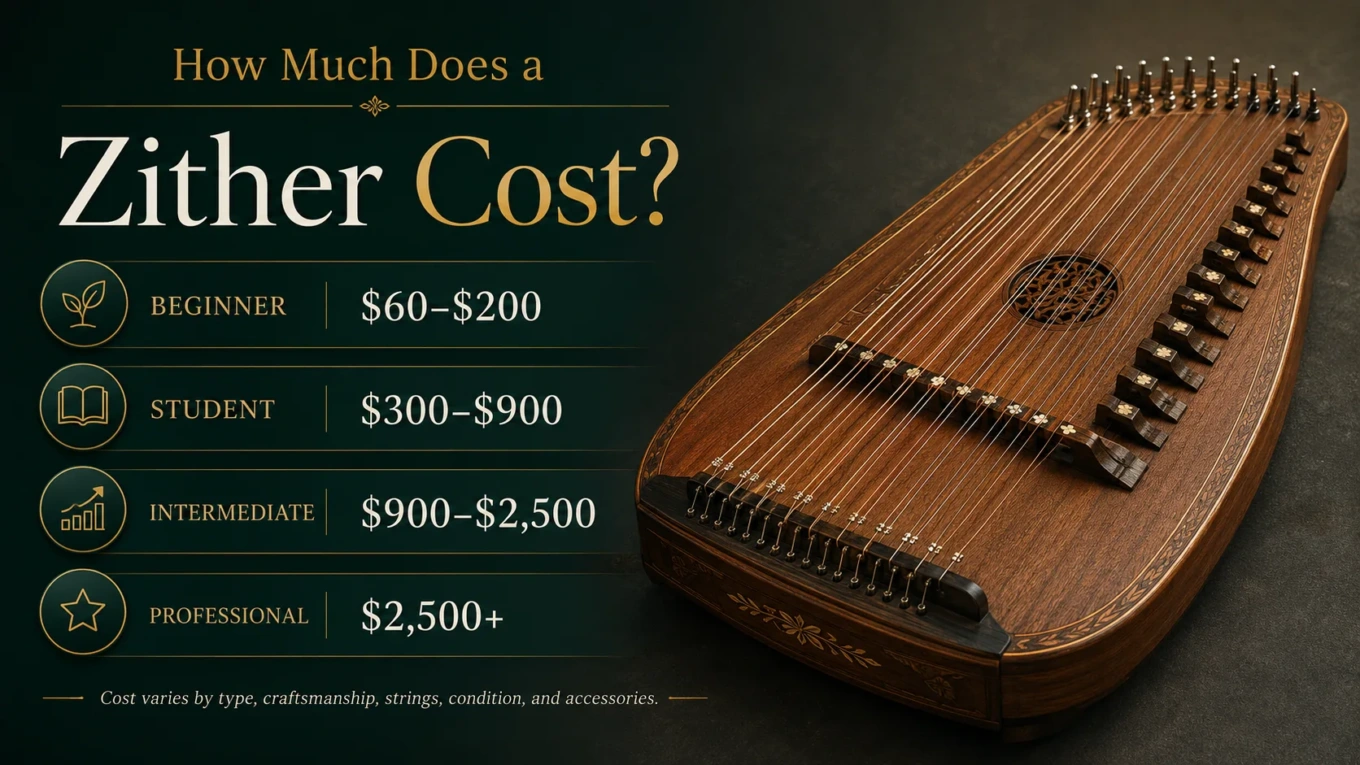
How Much Does a Zither Cost?
A zither can cost less than a casual beginner guitar, or it can cost as much as a fine handmade string instrument. The price depends first on what kind of zither is meant: a small lap zither for simple melodies, an autoharp, an Alpine concert zither, a guzheng, a koto, a qanun, a psaltery, a dulcimer, or another member of the zither[1] family. A safe modern budget is about $60–$200 for a simple beginner lap zither, $300–$900 for many playable student instruments, $900–$2,500 for serious intermediate models, and $2,500+ for professional, handmade, restored, or region-specific instruments.
Typical Zither Cost by Type
The word “zither” does not name one single instrument. It names a broad group of chordophones[2] where strings run across, along, or over a body without a separate guitar-like neck. Because of that, prices vary more than beginners often expect.
| Zither type | Beginner range | Intermediate range | Professional or collector range | Best for |
|---|---|---|---|---|
| Simple lap zither or song zither | $60–$180 | $180–$400 | $400+ | Casual learning, children, folk melody practice |
| Autoharp | $250–$500 | $500–$900 | $900–$1,800+ | Chordal song accompaniment |
| Concert or Alpine zither | $300–$800 used | $800–$2,000 | $2,000–$6,000+ | Traditional European zither playing |
| Guzheng | $350–$750 | $750–$1,500 | $1,500–$5,000+ | Chinese plucked zither repertoire |
| Koto | $700–$1,300 | $1,300–$3,500 | $3,500–$8,000+ | Japanese koto study and performance |
| Qanun or kanun | $600–$1,200 | $1,200–$2,800 | $2,800–$7,000+ | Middle Eastern, Turkish, Armenian, Arabic, and related traditions |
| Hammered dulcimer | $400–$900 | $900–$2,000 | $2,000–$5,000+ | Folk, early music, and hammered-string playing |
| Psaltery or bowed psaltery | $100–$300 | $300–$800 | $800–$2,000+ | Simple plucked or bowed melody playing |
These ranges should be read as practical shopping bands, not fixed rules. Regional makers, exchange rates, shipping, import tax, wood grade, and included accessories can move the final price by a wide margin.
Why Zither Prices Vary So Much
The first price driver is construction. A small lap zither may have a flat board, simple tuning pins, light strings, and a modest soundboard[3]. A concert zither or koto uses a larger resonating body[4], more demanding wood selection, careful string scaling, and finer finishing.
The second driver is the string system. A European concert zither often combines fretted strings[5] for melody with open strings[6] for accompaniment. That makes the instrument more complex than a very simple children’s lap harp. A guzheng or koto uses movable bridges[7], and a qanun adds many small pitch-changing levers. More parts mean more labor, more setup time, and more ways for quality to differ.
The third driver is whether the instrument is built for real tuning stability. Cheap decorative zithers may look playable, but the pins can slip, the bridge[8] placement may be rough, and the tone may be thin. A good student instrument does not need museum-grade ornament, but it should tune cleanly, hold pitch, and respond evenly across the strings.
Beginner Zither Cost
A beginner who simply wants to explore the zither family can start around $60–$180 with a small lap zither, song zither, or psaltery-style instrument. These are usually compact, light, and easy to store. They are suitable for learning basic plucking, simple melody reading, and the feel of open-string resonance.
That low range has limits. Many budget lap zithers use thin bodies and light hardware. They may be pleasant for casual playing, but they usually do not offer the tonal depth, volume, or tuning comfort needed for serious study.
For a better beginner instrument, $300–$900 is a more useful range. This is where playable autoharps, basic guzhengs, small hammered dulcimers, and some used concert zithers begin to make sense. The instrument should arrive with a tuning tool, spare strings if possible, and a clear tuning chart.
Student and Intermediate Zither Cost
Many learners reach the most satisfying value in the $700–$1,500 range. Instruments here often have better wood, cleaner hardware, more stable tuning pins, and a stronger voice. The difference is not only loudness. A better zither responds faster under the fingers, separates notes more clearly, and makes practice less tiring.
For guzheng, this range often covers reliable student and intermediate 21-string models. For autoharp, it can include more refined chord-bar action[9], better damping pads[10], and pickup-equipped models. For hammered dulcimer, it may cover a practical package with hammers, stand, case, and tuning wrench.
Concert zithers are harder to price because many are sold second-hand. A well-kept student concert zither can be a good buy, but repair condition matters. Old strings, loose tuning pins, cracked tops, lifting bridges, or warped bodies can turn a low purchase price into a costly restoration.
Professional Zither Cost
Professional zithers usually begin around $1,500–$2,500 for many modern folk and regional instruments, then rise sharply. Handmade concert zithers, high-grade guzhengs, koto made with selected paulownia, qanuns with refined lever systems, and custom dulcimers can pass $5,000. Rare, historical, or finely restored instruments may cost more.
At this level, buyers pay for controlled resonance, clean sustain, balanced registers, stable hardware, and a maker’s judgment. Decoration can raise the price, but it should not be confused with sound quality. In many cases, the best money goes into wood selection, joinery, bridge accuracy, string spacing, and final setup.
Used Zither Cost
Used zithers can be excellent values. They can also be traps. A second-hand autoharp at $150 may need strings, felt, cleaning, and setup. A concert zither at $300 may be playable, or it may need work by a luthier[11]. A koto or guzheng sold cheaply online may have missing bridges, damaged feet, poor packing, or shipping damage.
For used instruments, the real question is not only “How much does a zither cost?” It is “How much will this zither cost after it is playable?”
| Item or service | Typical cost | Why it matters |
|---|---|---|
| New strings | $20–$250+ | Large multi-string instruments can be expensive to restring. |
| Tuning wrench or key | $10–$40 | Many used instruments arrive without the correct tool. |
| Autoharp felt replacement | $40–$150+ | Worn felt can make chords muddy or uneven. |
| Bridge set for guzheng or koto | $40–$200+ | Missing or poor bridges limit tuning and tone. |
| Case or padded bag | $50–$400+ | Large zithers are vulnerable in transport. |
| Professional setup | $75–$300+ | Setup can correct string height, damping, tuning feel, and minor issues. |
| Major repair | $200–$1,000+ | Cracks, loose joints, unstable pins, and structural faults can cost more than the instrument. |
What Should a Beginner Actually Spend?
For a first serious zither, the best target is usually $300–$900. Below that, the instrument may be fine for curiosity, but the quality can be uneven. Above that, a beginner should know which tradition they want to study before spending more.
A practical beginner budget looks like this:
- $100–$200 for a casual lap zither or psaltery-style instrument.
- $300–$600 for a basic but playable autoharp, small hammered dulcimer, or entry guzheng.
- $600–$1,200 for a stronger student instrument with better tuning stability and tone.
- $1,200+ only if the buyer has chosen a specific path, teacher, repertoire, or maker.
For children or casual home use, a small lap zither can make sense. For adult study, spending a little more often prevents frustration. Poor tuning stability can make even simple practice feel confusing.
Cost by Playing Tradition
Alpine and Concert Zither
A concert zither[12] is usually more expensive than a simple lap zither because it has separate melody and accompaniment areas. Student models are often found used, while newer or custom instruments can be costly. Buyers should check the frets, tuning pins, body condition, and whether the string layout matches available learning material.
Guzheng
A beginner guzheng often starts around $350–$750, while better student and intermediate instruments often sit between $750 and $1,500. Professional models vary widely. Price differences may reflect paulownia wood quality, carving, lacquer work, string feel, bridge quality, and brand reputation.
Koto
A koto is usually more expensive to buy and ship because it is large. Student models often begin around $700–$1,300, while finer instruments can cost several thousand dollars. The buyer should check whether bridges, plectra, a stand or feet, and a case are included.
Qanun or Kanun
A qanun can be costly because of its lever system. Many qanuns use small pitch levers, often called mandals[13] in Turkish usage, to adjust notes during performance. Good lever alignment, clean intonation[14], and stable construction matter more than decorative inlay.
Autoharp
An autoharp[15] is one of the more accessible zither-family instruments for singers because chord buttons simplify accompaniment. New student models often fall in the $350–$700 range, while better models and electric versions cost more. Used autoharps should be checked for worn felts, missing bars, buzzing strings, and weak tuning pins.
Hammered Dulcimer
A hammered dulcimer is a zither-family instrument played with small hammers. Beginner packages often start around $400–$900. Larger instruments with more courses[16], better stands, and more balanced tone can move into the $1,000–$2,500 range.
What Makes a Zither Worth More?
Good zithers tend to share several traits. The soundboard is responsive without feeling fragile. The tuning pins turn firmly. The strings sit at a playable height. The bridges are shaped cleanly and placed with care. The body does not buzz under normal playing pressure.
Material also matters, but not in a simple “expensive wood is always better” way. Paulownia is valued in many East Asian zithers because it is light and resonant. Spruce, maple, walnut, cherry, and other woods may appear in European and American instruments. The maker’s design and seasoning of the wood often matter more than a glamorous species name.
Craft details change price as well. Hand-cut ornament, inlay, lacquer, carved ends, custom tuning systems, and regional decoration can raise the cost. These features may be culturally and visually meaningful, but they should not replace basic playability.
What to Check Before Buying
Before buying any zither, ask for clear photos of the top, back, bridges, tuning pins, strings, and any cracks. For large instruments, ask how it will be packed. A long koto, guzheng, or qanun can be damaged if shipped like ordinary household goods.
- Check whether the instrument is full-size or miniature.
- Confirm that all strings, bridges, tuning tools, and accessories are included.
- Ask whether the instrument holds tuning.
- Look for cracks, lifted seams, loose bridges, or warped wood.
- For autoharp, ask about felt condition and chord-bar movement.
- For qanun, ask whether the levers move smoothly and return cleanly.
- For guzheng and koto, confirm that the bridge set is complete.
If the seller cannot answer basic condition questions, price the instrument as a risk. A low price is not always a bargain.
Accessories That Add to the Cost
The instrument price is only part of the budget. A zither may need fingerpicks, plectra[17], hammers, a tuning wrench, spare strings, a stand, a padded bag, or a hard case. Lessons and method books also matter, especially for concert zither, guzheng, koto, and qanun.
Shipping can be a major cost for long instruments. A small psaltery may ship cheaply. A full-size koto or guzheng needs stronger packaging and may face oversize shipping fees. Imported instruments may also carry customs duty or local tax.
Is a Cheap Zither Worth Buying?
A cheap zither can be worth buying if expectations are modest. For casual melody playing, a simple lap zither can be enjoyable and low-risk. For serious study, very cheap instruments often become limiting.
The warning signs are easy to spot: strings that will not tune, sharp hardware, bridges that slip constantly, a body that rattles, unclear string spacing, or a seller who describes every zither as “professional” without giving construction details.
A better choice is usually a plain student instrument from a maker or shop that understands the instrument. Plain and playable beats ornate and unstable.
How Much Should You Pay for Your First Zither?
Most first-time buyers should choose the lowest price that still gives them a stable, tunable, repairable instrument. For simple exploration, that may be $100–$200. For adult learning, $400–$900 is often a healthier budget. For tradition-specific study, such as guzheng, koto, qanun, or concert zither, it is wise to ask a teacher or experienced player before buying.
The right zither cost is not the highest price. It is the point where the instrument stops fighting the player.
FAQ
How much does a beginner zither cost?
A simple beginner lap zither can cost about $60–$200. A more serious student zither, autoharp, guzheng, or small hammered dulcimer often costs about $300–$900.
Why are some zithers so expensive?
Higher prices usually come from better wood, more stable tuning hardware, larger bodies, finer bridge work, handmade construction, regional craft traditions, and more careful setup. Decoration can also raise the price, but it should not be the only reason to pay more.
Is a used zither a good choice?
A used zither can be a good choice if it is structurally sound and complete. The buyer should check strings, tuning pins, bridges, cracks, felts, cases, and setup needs before treating the listed price as the final cost.
Which zither is cheapest to start with?
Small lap zithers, song zithers, and simple psalteries are usually the cheapest. They are good for basic melody playing, but they do not replace a concert zither, guzheng, koto, qanun, or hammered dulcimer for tradition-specific study.
How much does a professional zither cost?
Many professional zithers begin around $1,500–$2,500 and can pass $5,000. Handmade concert zithers, fine guzhengs, koto, qanuns, and custom hammered dulcimers can cost much more depending on maker, materials, condition, and region.
Should a beginner buy the cheapest zither available?
Not always. The cheapest option may be fine for curiosity, but a beginner who wants to learn seriously should choose an instrument that holds tuning, has safe hardware, and includes the needed accessories.
Glossary of Technical Terms
Zither: A broad family of string instruments in which the strings run across or along a body without a separate neck. The family includes simple lap zithers, concert zithers, guzheng, koto, qanun, psalteries, dulcimers, and autoharps.
Chordophone: An instrument that produces sound through vibrating strings. Zithers are chordophones because their tone comes from strings set into motion by plucking, striking, bowing, or strumming.
Soundboard: The vibrating top surface of many string instruments. In zithers, the soundboard helps turn string vibration into audible tone and strongly affects volume, sustain, and color.
Resonating body: The hollow or shaped body that supports and amplifies string vibration. Its size, wood, thickness, and construction help explain why two zithers with similar string counts can sound very different.
Fretted string: A string played over fixed frets, allowing the player to stop the string at measured pitch points. Concert zithers often use fretted melody strings alongside open accompaniment strings.
Open string: A string sounded without being stopped by the fingers. Many zithers rely on open strings for drones, chords, accompaniment, or scale patterns.
Movable bridge: A bridge that can be shifted to change string length and pitch. Guzheng and koto use movable bridges as part of their tuning and tonal design.
Bridge: A support that holds the string above the body and transfers vibration into the soundboard. Bridge shape, placement, and material affect tone and tuning accuracy.
Chord-bar action: The mechanism on an autoharp that lowers felted bars onto selected strings. When the player presses a chord button, unwanted strings are muted and the chosen chord remains.
Damping pad: A small felt or soft material used to mute strings. On autoharps, worn damping pads can make chords unclear because they no longer silence the right strings cleanly.
Luthier: A maker or repairer of string instruments. A luthier may handle cracks, loose joints, bridge work, string-height problems, and tuning-pin issues on zither-family instruments.
Concert zither: A European zither type often associated with Alpine traditions. It commonly has fretted melody strings and a larger group of open accompaniment or bass strings.
Mandal: A small pitch-changing lever used on many Turkish kanuns and related qanun instruments. Mandals let the player adjust notes during performance without fully retuning the string.
Intonation: The accuracy of pitch relationships across an instrument. On zithers, intonation depends on string length, bridge placement, tuning stability, fret placement where present, and lever accuracy where used.
Autoharp: A zither-family instrument with chord bars that mute selected strings. It is often used for song accompaniment because pressing a chord button allows the player to strum a clean harmony.
Course: A single string or group of strings treated as one musical unit. Hammered dulcimers often describe size through course numbers, which helps indicate range and layout.
Plectrum: A pick used to pluck strings. Zither-family instruments may use fingerpicks, hand-held picks, nail-like plectra, hammers, or bare fingers depending on the tradition.