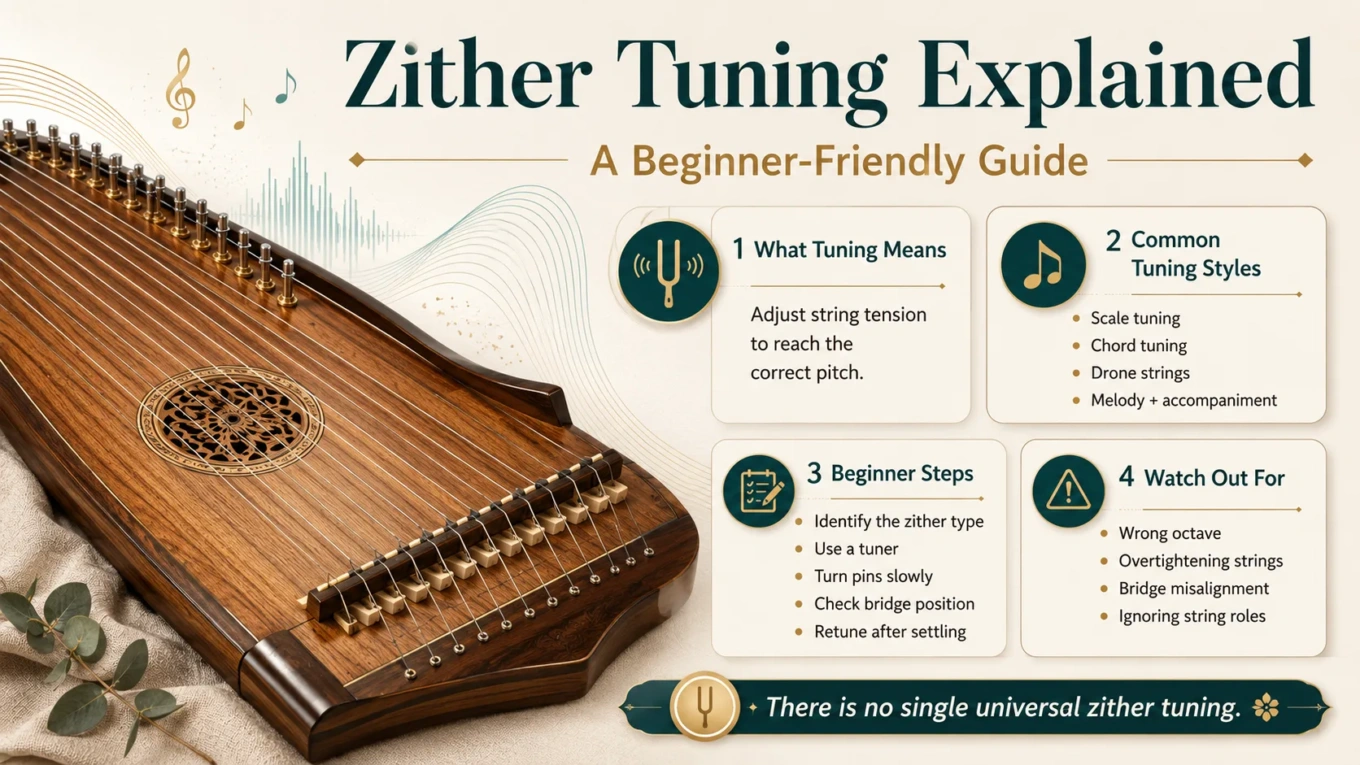
Zither Tuning Explained: A Beginner-Friendly Guide
Zither tuning is not one single system. The word “zither” can describe a broad zither family[1] of instruments, from simple board zithers to concert zithers, autoharps, psalteries, kanteles, guzhengs, kotos, qanuns, santurs, and dulcimers. Each type places its strings across or along a resonating body, but the way those strings are tuned depends on structure, musical tradition, and playing method.
For a beginner, the first useful idea is simple: zither tuning means setting each string to the pitch it is expected to produce when played open. Some zithers use repeated patterns. Some use scales. Some use chords. Some combine melody strings, accompaniment strings, and drones. A tuner helps, but understanding the layout matters just as much as turning the tuning pins.
What Zither Tuning Means
In organology, many zithers are treated as chordophones[2] in which the strings are supported by the body of the instrument rather than by a neck. Tuning is the act of adjusting string tension so each string reaches a chosen pitch[3]. Tightening a string usually raises the pitch. Loosening it lowers the pitch.
That basic rule applies across the family, but the practical result can look very different. A small psaltery may have one string per note. A concert zither[4] may separate melody and accompaniment areas. A guzheng or koto may use movable bridges to shape the scale. An autoharp may tune strings to a chromatic layout while chord bars select which strings ring.
Zither tuning therefore answers three related questions:
- What note should each string produce?
- Is the instrument tuned by scale, chord, drone, course, or register?
- Does the bridge, fret, chord bar, or playing technique change how tuning is used?
Beginner’s Note: A zither can sound “out of tune” even when most strings are close. One low string, one slipped pin, or one movable bridge placed slightly off its mark can disturb the whole sound.
Why There Is No Universal Zither Tuning
The zither family is too wide for one tuning chart. The term may refer narrowly to the European concert zither, or broadly to instruments whose strings run over a resonating body. This broad use includes plucked, struck, fretted, fretless, bridged, unbridged, and mechanically damped instruments.
A board zither[5] may tune its strings stepwise along a scale. A box zither[6] may use its hollow body to support a larger set of strings. A hammered dulcimer may tune paired strings in courses. A qanun may use levers or small mechanisms to alter pitch during performance. A guqin uses a very different logic, with open notes, stopped notes, and harmonics.
For that reason, beginner tuning should always begin with the exact instrument type, not the word “zither” alone.
| Instrument Type | Typical Tuning Logic | Beginner Concern |
|---|---|---|
| Concert Zither | Melody strings and accompaniment strings may follow different note layouts. | Do not tune all strings as one continuous scale. |
| Psaltery | Often one open string[7] per note, commonly arranged in scale order. | Match the printed note map or maker’s chart. |
| Autoharp | Strings are tuned to notes, while chord bars damp selected strings. | Tune the strings first; chord buttons do not tune the instrument. |
| Guzheng, Koto, or Related Long Zither | Movable bridges can define string length and scale placement. | Bridge position and string tension work together. |
| Hammered Dulcimer or Santur | Strings may be grouped in courses[8], often struck with hammers. | Strings in the same course must match closely. |
The Parts That Affect Tuning
Tuning is not only a matter of strings. The instrument’s body, pins, bridges, and string layout all shape how tuning behaves.
Strings and Tension
A zither string must hold enough tension to sound clearly, but not so much that it risks breakage or strain on the instrument. Steel, brass, bronze, nylon, silk, and synthetic strings appear in different zither traditions and modern builds. The correct string material and gauge depend on the instrument.
Replacing a missing string with a random string is risky. A string that is too heavy may pull too hard. A string that is too light may sound weak or fail to reach the intended pitch cleanly.
Tuning Pins
Many zithers use tuning pins[9], sometimes called wrest pins, to hold string tension. The pin turns in a pin block or similar structural area. A small movement can make a large pitch change, especially on short strings.
Beginners often turn too far. Slow movement is safer. Bring the pitch up gradually, then check again after the string settles.
Bridges and String Length
A bridge[10] lifts the string and helps transfer vibration into the body. On some zithers the bridge is fixed. On others, especially many East Asian long zithers, a movable bridge[11] controls the vibrating length of each string.
Moving a bridge usually changes pitch because it changes the active string length. Shorter active length raises pitch. Longer active length lowers it. This is why tuning a guzheng or koto may involve both bridge placement and peg adjustment.
Soundboard and Resonance
The soundboard[12] is the vibrating face of many zithers. It does not “set” the pitch in the same direct way as string tension does, but it shapes how the tuned string speaks. A responsive soundboard can make small tuning differences easier to hear.
Wood choice, thickness, aging, and construction can shape resonance[13], but claims about tone should be cautious. The whole instrument works as a system.
Basic Tuning Concepts Beginners Should Know
Before tuning any zither, a beginner should understand a few musical terms. These terms appear on tuning charts, maker instructions, and tuner displays.
Pitch Names
Western note names usually use the letters A, B, C, D, E, F, and G, with sharps and flats between many of them. A digital tuner may show C, C♯, D, E♭, and so on. Some traditions use other naming systems, including solfège, numbered notation, or regional note names.
The same sounding pitch may be named differently depending on system. For example, C♯ and D♭ can refer to the same tuner target in many modern equal-tempered settings.
Octaves
An octave[14] is the distance between two notes with the same letter name at different heights. A zither with many strings may have several Cs, several Gs, or repeated notes in different registers.
This matters because tuning a string to “C” is not enough. It may need to be middle C, a lower C, or a higher C.
Intervals
An interval[15] is the distance between two pitches. Some zither tunings rely on repeated intervals, such as fifths, fourths, or whole steps. Others use chord shapes or scale patterns.
When a chart says that adjacent strings move by whole steps, half steps, fifths, or fourths, it is describing intervals.
Scales and Modes
A scale[16] is an ordered set of notes. Many zithers are tuned to a scale rather than to a full chromatic set. Pentatonic tuning is common in some long zither traditions, while diatonic tuning appears in many European and American folk zithers.
A mode[17] is a scale pattern with its own tonal center and feel. Some traditional tunings are better described as modal than simply “major” or “minor.”
How to Tune a Simple Zither
A simple beginner zither usually has strings arranged in a visible order, often with note labels near the strings. The safest method is to follow the maker’s tuning chart rather than guess from appearance.
- Place the instrument on a stable surface.
- Find the printed note map, manual, or trusted tuning chart for that exact model.
- Use a tuner that can read individual notes.
- Pluck one string clearly and softly.
- Turn the tuning pin in very small movements.
- Approach the target pitch from below when possible.
- Retune after a short pause, because new adjustments can settle.
Some small zithers are delicate. If a string suddenly feels too tight, stop and check the octave. Many broken strings come from tuning to the right letter name in the wrong register.
Drone, Melody, and Accompaniment Strings
Not all zither strings have the same role. Some act as drone strings[18], some as melody strings[19], and others support chords or accompaniment patterns.
Drone strings often repeat or sustain a stable pitch while the melody changes above or around them. Melody strings carry the main tune. In some instruments, accompaniment strings provide bass notes, chord tones, or rhythmic support.
This division is especially important for the concert zither. Its fretted strings[20] can be stopped with the left hand to produce melody, while open accompaniment strings provide harmony and bass. A beginner who treats every string as part of one simple scale will misunderstand the instrument’s layout.
Classification Note: The same word “zither” may point to a family category or to a specific European instrument. Tuning instructions should always name the instrument type, not just the family.
Tuning Concert Zither
The concert zither has one of the more detailed tuning systems in the family. It usually combines a fretted fingerboard area with open accompaniment strings. The fretted section supports melody playing, while the open strings provide basses and harmonies.
Modern concert zithers are commonly associated with standardized tunings, but older instruments, regional practice, and maker variation can differ. Some instruments also need setup work before accurate tuning is possible.
Why the Concert Zither Feels Different
On a concert zither, the player does not simply tune a row of strings and pluck them as a scale. The layout separates musical functions. The fretted melody strings may be tuned like a small fingerboard system, while the open strings cover bass and chordal ranges.
This makes the instrument flexible, but it also makes beginner tuning more demanding. A full tuning chart is needed. The chart should match the string count and layout of the instrument.
Common Beginner Mistakes
- Tuning only the melody strings and ignoring the open accompaniment section.
- Using a chart for a different string count.
- Assuming an antique zither still holds modern standard setup.
- Overtightening old strings before checking condition.
- Ignoring loose pins, cracks, or structural movement.
Antique concert zithers should be handled with care. Some were built for string materials, pitch standards, or tension levels that may not match modern expectations.
Tuning Long Zithers with Movable Bridges
Long zithers such as guzheng, koto, gayageum, and đàn tranh often use individual movable bridges. The player or tuner places each bridge at a measured or marked point, then adjusts the string until it reaches the target pitch.
These instruments are often tuned to scale patterns rather than a full chromatic row. Pentatonic tunings are common in many modern teaching contexts for some of these instruments, but exact pitch sets vary by tradition, repertoire, region, school, and instrument design.
Bridge Placement Matters
If a bridge sits in the wrong position, the string may tune poorly or feel uneven. A string may reach the tuner reading but still have poor response, unstable bending range, or weak tone. This is why bridge layout is part of tuning on these instruments.
Some players also press the string on one side of the bridge to bend notes or create ornaments. That performance technique depends on a workable balance between tension, bridge position, and string length.
Tuning Autoharp and Chord Zithers
The autoharp is often described as a zither because its strings run across a resonating body and are not mounted on a neck. Its tuning, however, is tied to a chord-bar mechanism. The strings are tuned to individual notes, while chord bars damp the notes that do not belong to the selected chord.
This means the buttons do not tune the instrument. They only decide which tuned strings are allowed to ring. If the strings are out of tune, the chords will sound rough even if the mechanism works properly.
Some chord zithers use printed song sheets, numbered strings, or chord groups. Beginners should tune from the chart supplied for the instrument, because similar-looking models may not share the same string plan.
Tuning Dulcimers, Santurs, and Other Struck Zithers
Struck zithers use hammers or small beaters rather than only plucking. Hammered dulcimers, santurs, and related instruments may group several strings together for each note. These grouped strings form a course, and each string in the course should match the others closely.
If one string in a course is slightly off, the note can shimmer in an unwanted way or sound blurred. Some traditions value a living, bright interaction between strings, but a badly mismatched course will still be hard to play in tune.
Bridge layout can also divide the string into more than one playable length. On many hammered instruments, one side of a bridge may produce a different pitch relationship from the other side. The tuning chart must reflect that layout.
Tuning by Ear and Tuning with a Device
A digital tuner is useful for beginners, especially when many strings need attention. It gives a clear pitch reading and helps avoid large mistakes. Yet the ear remains important because a tuner may not understand the musical role of the note, the octave, or the slight pitch color used in a tradition.
For Western equal temperament[21], a chromatic tuner usually works well. For some traditional systems, a teacher, maker, or tradition-specific chart may be more reliable than a generic tuner preset.
When Tuning by Ear Helps
- Matching strings within the same course.
- Checking octaves between repeated notes.
- Balancing drones against melody strings.
- Hearing whether chords sound settled.
- Adjusting after new strings stretch.
Tuning by ear does not mean guessing. It means listening for relationships after the rough pitch has been set.
Why New Strings Go Out of Tune
New strings stretch. They may fall flat several times before they settle. This is normal on many zithers. After fitting a new string, tune it gradually, let it rest, and return to it later.
Temperature and humidity can also affect tuning stability. Wood moves with climate. Metal strings react to temperature. Pin blocks and soundboards may shift slightly across seasons. A well-made instrument still needs regular tuning.
Luthier’s Note: A string that refuses to hold pitch may not be the only problem. The cause may be a slipping pin, poor string winding, a worn hitch point, a cracked area near the pin block, or a bridge that is not seated well.
Safe Tuning Habits
Zithers can have many strings under tension. Careful tuning protects the instrument and the player.
- Use the correct tuning wrench or key for the pins.
- Turn pins in small movements.
- Check the octave before tightening a string far above its current pitch.
- Replace damaged strings with suitable gauges.
- Keep the instrument on a stable surface while tuning.
- Do not force a pin that feels stuck.
- Retune gently after transport or climate change.
Old instruments need extra caution. If the body shows cracks, lifting bridges, loose pins, or warped areas, tuning to full pitch may cause damage. A maker or repairer should inspect the instrument before high-tension tuning.
How to Read a Zither Tuning Chart
A tuning chart is a map. It may show string numbers, pitch names, octaves, courses, bridge positions, or chord groups. Some charts read from the player’s side. Others read from the audience side or from left to right across the instrument.
Before tuning, check three things:
- Orientation: Which side of the instrument does the chart assume?
- String Numbering: Does string 1 start from the lowest, highest, nearest, or farthest string?
- Octave Marking: Does the chart use scientific pitch notation, solfège, numbers, or another system?
Scientific pitch notation[22] uses note names plus numbers, such as C4 or A4. Many tuners use this system. It helps prevent octave errors.
Common Tuning Patterns in the Zither Family
Different zithers organize pitch in different ways. The patterns below are not universal, but they help beginners recognize what they are seeing on a chart.
Diatonic Layouts
A diatonic[23] zither layout uses notes from a seven-note scale, such as a major scale. Some simple zithers and folk instruments use this because it makes familiar melodies easy to find.
Chromatic Layouts
A chromatic[24] layout includes all twelve notes of the modern Western pitch set within an octave. Some instruments use chromatic stringing, while others add levers, frets, or alternate strings to reach altered notes.
Pentatonic Layouts
A pentatonic[25] layout uses five main notes per octave. Several long zither traditions use pentatonic tunings in many teaching and performance settings, though repertoire may require retuning or altered scale forms.
Chord-Based Layouts
Some zithers organize strings around chords rather than stepwise scales. Autoharps and chord zithers are the most familiar examples for many beginners. The tuning must support the chord mechanism or printed chord plan.
How Related Zithers Differ in Tuning Logic
Zither tuning becomes clearer when related instruments are compared by function rather than appearance.
| Instrument | What Tuning Supports | What Not to Assume |
|---|---|---|
| Concert Zither | Fretted melody playing plus open harmony and bass strings. | It is not tuned like a simple lap harp or psaltery. |
| Guzheng | Scale layout, bridge placement, and pitch bending. | It is not identical to koto or gayageum tuning. |
| Autoharp | Chord-bar damping over tuned strings. | The chord buttons are not tuning controls. |
| Hammered Dulcimer | Courses, bridge divisions, and struck-note clarity. | One string per visible note is not always the rule. |
| Qanun | String courses, regional pitch practice, and pitch-altering mechanisms on many modern examples. | It should not be reduced to a generic “zither tuning.” |
Beginner Troubleshooting
The Tuner Shows the Right Letter, but the String Sounds Wrong
The string may be in the wrong octave. Check whether the chart asks for C3, C4, or C5 rather than only “C.” It may also be the wrong string, especially if the chart orientation is misunderstood.
The Pitch Jumps While Turning the Pin
The pin may be tight, or the string may be catching at a bridge, nut, or hitch point. Move slowly. If the pitch jumps sharply, stop and inspect the string path.
A Course Sounds Wavy or Uneven
Two or more strings in the same course may not match. Tune each string separately, then listen to the course as one note.
The Instrument Goes Flat After a Few Minutes
New strings may be stretching. Old pins may be slipping. Climate change can also affect tuning. If the same string drops repeatedly, inspect the winding and pin fit.
The Zither Sounds Dull Even When Tuned
Tuning solves pitch, not every tone problem. Old strings, weak contact at the bridge, poor damping, worn felts, or structural issues can affect sound.
Care Before and After Tuning
Regular tuning is easier when the instrument is cared for well. Keep the zither away from extreme heat, direct sunlight, and damp storage. Sudden climate change can affect wood, glue joints, strings, and tuning pins.
Wipe strings gently after playing if the instrument’s materials allow it. Dust around bridges with care. Do not move movable bridges without noting their original positions. On instruments with many bridges, a small accidental shift can change the tuning layout.
For older or collectible instruments, document the current stringing before replacing anything. Photos, string numbers, and pitch notes can prevent confusion later.
What Beginners Should Tune First
The best first step depends on the instrument. For a simple labeled zither, start with the lowest or first marked string and move in chart order. For an autoharp, tune all open strings before testing chord bars. For a hammered dulcimer, tune one course at a time. For a long zither with movable bridges, check bridge placement before final tuning.
A beginner does not need to learn every tuning system in the zither family. The practical goal is narrower: identify the instrument, find the correct chart, tune slowly, and listen for relationships between strings.
Glossary of Technical Terms
Zither Family
The zither family includes instruments whose strings run across or along a resonating body without a separate neck in the usual lute or guitar sense. The term can be broad, so tuning must be tied to the exact instrument type.
Chordophone
A chordophone is an instrument that produces sound from vibrating strings. Zithers are chordophones, but not all chordophones are zithers.
Pitch
Pitch is the highness or lowness of a sound. In tuning, each string is adjusted until it reaches the intended pitch.
Concert Zither
The concert zither is a European zither with fretted melody strings and open accompaniment strings. Its tuning is more complex than that of many simple board zithers.
Board Zither
A board zither has strings stretched over a flat or board-like body. Some are simple melody instruments, while others have more complex layouts.
Box Zither
A box zither has a hollow resonating body that supports the strings. The box shape helps project and color the sound.
Open String
An open string sounds without being stopped by a finger, fret, lever, or other pitch-changing action. Many zither tuning charts give the required pitch of each open string.
Course
A course is a group of two or more strings tuned to the same note or a related pitch and played as one musical unit. Hammered dulcimers, santurs, and qanuns often use courses.
Tuning Pin
A tuning pin holds a string under tension and is turned with a tuning key or wrench. Its grip and fit affect tuning stability.
Bridge
A bridge supports the string and helps transfer vibration into the instrument body. On some zithers it is fixed; on others it can be moved to adjust string length and tuning behavior.
Movable Bridge
A movable bridge can be repositioned under a string. Many long zithers use movable bridges to set scale layout, string length, and playing response.
Soundboard
The soundboard is the vibrating surface that helps amplify and shape the sound. In many zithers, string vibration reaches the soundboard through the bridge.
Resonance
Resonance is the way the body of the instrument responds to string vibration. It affects sustain, loudness, and tone color, though it does not replace accurate tuning.
Octave
An octave is the distance between two notes with the same name at different pitch levels. Zither players must watch octaves because tuning to the correct letter name alone may still be wrong.
Interval
An interval is the distance between two pitches. Zither tuning patterns often use intervals such as fifths, fourths, whole steps, and half steps.
Scale
A scale is an ordered set of notes used as a pitch basis for music. Many zithers are tuned to a scale rather than to a random string order.
Mode
A mode is a scale pattern with a particular tonal center and character. Some zither traditions use modal tunings that do not fit neatly into simple major or minor labels.
Drone String
A drone string provides a repeated or sustained pitch while other strings carry changing notes. Drones can give a zither tuning a stable tonal center.
Melody String
A melody string carries the main tune. On some zithers, melody strings are separated from accompaniment or drone strings.
Fretted String
A fretted string is played against frets, allowing one string to produce several pitches. Concert zithers use fretted strings for melody playing.
Equal Temperament
Equal temperament is a modern tuning system that divides the octave into twelve equal steps. Many electronic tuners use it as their default reference.
Scientific Pitch Notation
Scientific pitch notation names a note and its octave, such as A4 or C4. It helps zither players avoid tuning a string to the right note name in the wrong register.
Diatonic
Diatonic tuning uses the notes of a seven-note scale, often like the white-key pattern on a piano in a given key. Some beginner zithers use diatonic layouts for easier melody playing.
Chromatic
Chromatic tuning includes all twelve semitone steps within an octave. Some zithers include chromatic strings or mechanisms to reach altered notes.
Pentatonic
Pentatonic tuning uses five main notes per octave. It appears in many zither traditions, though exact note choices and performance practice vary.
FAQ
Can beginners tune a zither by themselves?
Yes, many beginners can tune a simple zither with a correct chart, a tuner, and careful pin movement. Instruments with many strings, movable bridges, courses, or antique construction may need help from a teacher, maker, or repairer.
Is every zither tuned the same way?
No. Zither tuning depends on the instrument type. A concert zither, autoharp, guzheng, psaltery, and hammered dulcimer all use different tuning logic.
Why does my zither go out of tune so quickly?
New strings stretch, old pins may slip, and climate changes can affect the body and string tension. If one string keeps falling flat, check the winding, pin grip, bridge contact, and string condition.
Do I need a special tuner for zither?
A chromatic tuner is enough for many beginner tasks, especially on instruments using Western pitch names. Some traditional tunings may need a teacher’s reference, a maker’s chart, or an instrument-specific tuning app.
What happens if I tune a string to the wrong octave?
The string may become too loose, too tight, or break. Always check octave markings such as C3, C4, or A4 when a chart provides them.
Are movable bridges part of tuning?
Yes, on many long zithers. Movable bridges affect string length, pitch response, and playing feel, so bridge placement and string tension must be treated together.