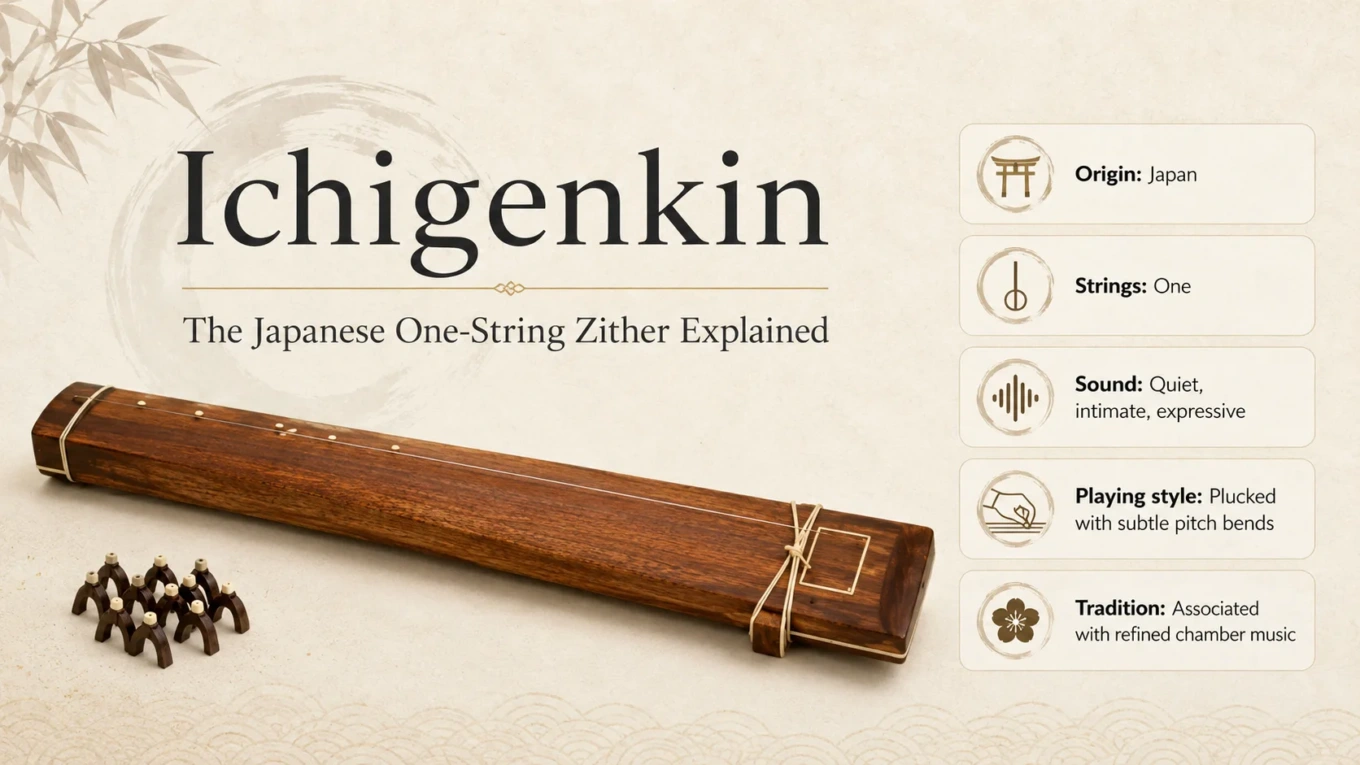
Ichigenkin: The Japanese One-String Zither Explained
The ichigenkin is a Japanese one-string zither[1] whose quiet voice comes from a narrow wooden plank, a single string, and a refined left-hand sliding technique. It is a plucked chordophone[2], but it does not behave like the larger multi-string koto most readers know. Its music depends on touch, pressure, space, and vocal phrasing rather than a spread of many strings.
What Is the Ichigenkin?
The ichigenkin, also written ichigen-kin or 一絃琴, is a Japanese one-string zither. The name can be read literally as “one-string kin,” with kin or koto belonging to a wider Japanese vocabulary for stringed instruments. That naming can cause confusion, because the ichigenkin is not the same instrument as the 13-string koto.
Organologically, the ichigenkin is usually described as a plucked long zither[3]. The string runs along the length of a slender wooden body, and the body itself helps project the sound. In many documented examples, the wooden plank works as the soundboard[4] rather than as a large hollow box.
The instrument is known for an unusually direct design: one string, one main bridge[5], a tuning peg[6], and two small playing tools worn on the fingers. Its apparent simplicity is misleading. The player must shape pitch and expression with fine control of the left hand.
| Feature | What It Means |
|---|---|
| Instrument Type | Japanese one-string plucked zither |
| Usual Body Form | Long, narrow, slightly curved wooden plank |
| Stringing | One string, traditionally silk in many descriptions |
| Pitch Method | The left hand changes pitch with a tube-like slide rather than fixed frets |
| Common Role | Solo music and vocal accompaniment, sometimes paired with shakuhachi in recorded examples |
| Related Names | Ichigen-kin, ichigenkin, and sometimes sumagoto in reference contexts |
Names, Spelling, and Translation
The spelling ichigenkin is common in English, while ichigen-kin appears in museum catalogues and instrument databases. Both forms point to the same instrument. The Japanese characters 一絃琴 combine ideas of “one,” “string,” and a stringed instrument name related to kin or koto.
The term koto needs careful handling. In everyday English, “koto” often means the long Japanese 13-string zither with movable bridges. In Japanese naming history, however, related words could be used more broadly for string instruments. For that reason, “one-string koto” is understandable, but Japanese one-string zither is usually clearer for readers comparing it with other zither-family instruments.
Classification Note: The ichigenkin belongs with zithers because its string runs along the body that supports it. It is not a lute, because it has no projecting neck used as the main string-bearing part.
Construction and Body Shape
The ichigenkin body is typically a slim wooden board, often described as slightly curved. Some documented examples are around a meter long, though surviving instruments and modern builds can vary. Museum records show 19th-century examples made from wood, bamboo, shell, coral, gut, silk, and ivory, depending on the object and its fittings.
Many descriptions point to kiri, or paulownia, as a favored wood. Some makers and modern builders may also use other woods, including Japanese cedar in certain discussions of construction. Wood choice can shape response and feel, but it should not be treated as a single fixed rule for every ichigenkin.
Unlike a box zither with a large hollow resonating chamber[7], the ichigenkin is often described as having little or no chambered body. That helps explain why the sound is intimate rather than loud. The plank form gives the instrument clarity, but it does not produce the broad volume expected from a koto, qanun, santur, or hammered dulcimer.
The Single String
The string is traditionally described as a raw silk string[8] in many accounts. Some museum examples list gut or silk depending on the object. Modern replacement strings may depend on the maker, school, and availability, so it is better to speak of a traditional silk association rather than a universal rule.
Because there is only one string, the instrument cannot use the layered string layout found in many other zithers. There are no courses, no bank of drone strings, and no separate melody-string group. The musical line comes from one vibrating length, shaped by plucking and sliding.
Bridge, Peg, and String Path
The single string is held under tension between the peg end and the far end of the instrument. A small bridge lifts the string above the surface. The height is low enough for close contact and sliding, but high enough for the string to vibrate freely.
The tuning peg sets the base tension. From there, the performer adjusts pitch during performance with the left hand. This gives the ichigenkin a playing logic closer to a slide technique than to a fretted board instrument.
Luthier’s Note: On a one-string zither, small changes matter. Bridge height, string material, peg stability, and board curvature can change how easily the string speaks and how smoothly the left hand can shade the pitch.
How the Ichigenkin Is Played
The right hand plucks the string with a tube-like plectrum[9] worn on the index finger. The left hand uses a separate tube-like slide[10], often described historically as ivory, worn on the middle finger. Both tools are commonly called rokan in descriptions of the instrument.
The left-hand tube touches or lightly depresses the string to change pitch. It should not be imagined as pressing the string firmly against a fingerboard in the manner of a violin or guitar. The ichigenkin has no frets[11], so the player listens closely and places the slide with care.
The open string[12] provides the starting pitch. Sliding away from that point creates expressive movement. A controlled glissando[13] is not just decoration here; it is part of the instrument’s normal vocabulary.
Touch, Pressure, and Pitch
The ichigenkin asks for a refined balance between plucking force and left-hand pressure. Too much pressure can stop the string from speaking freely. Too little can make the pitch unclear. The player shapes notes by listening to the point where contact, pitch, and sustain meet.
This is why the ichigenkin is not automatically easy just because it has one string. The technical demand shifts from managing many strings to controlling a single string with great precision.
Tuning and Pitch Logic
The base pitch is set by the single peg, but specific practice may vary by school, voice, piece, and instrument. It is not safe to give one universal tuning for all ichigenkin music. The more useful point is that the instrument does not rely on a row of preset strings.
On a multi-string zither, each string may provide a fixed pitch or a pitch area. On the ichigenkin, the player starts from one string and creates the melody through contact, sliding, and controlled pressure. The instrument’s pitch system is therefore physical and vocal in feel: the hand follows the line rather than selecting from a set of many strings.
Sound, Volume, and Musical Character
The ichigenkin produces a quiet, focused sound. Its limited volume makes sense when its construction is considered. A narrow plank body does not move air like a large soundbox, and one string cannot create the density of many strings sounding together.
The reward is detail. The listener can hear the attack of the pluck, the changing pressure of the slide, and the small shifts in resonance[14] as the note opens and fades. Its timbre[15] is often described as restrained, thin in volume, and rich in pitch movement.
Listening Note: The ichigenkin is best heard as a line instrument, not as a harmony instrument. Listen for slides, slight bends, pauses, and the way the sung voice can meet the single string.
Historical Setting and Transmission
Museum records often describe the ichigenkin as probably developing in the 17th century. It is also documented in 19th-century collections, which helps show that the instrument had an active life beyond a single short period. Some sources describe it as popular in earlier centuries and still present into the early 20th century, before becoming rare.
The ichigenkin is often associated with small-scale cultivated performance rather than large public ensemble use. Modern descriptions connect it with literati circles, samurai culture, priests, and vocal practice. These labels should be read carefully: they point to the instrument’s refined social setting, not to one fixed ownership group.
Today, the ichigenkin is rarely heard compared with the koto, shamisen, shakuhachi, or biwa. Its tradition has survived through specialist players and small lines of transmission. Recorded examples also help preserve how the instrument sits beside voice and, in some cases, shakuhachi.
How It Differs from Related Japanese Zithers
The ichigenkin sits near several Japanese zither types, but it should not be merged with them. The number of strings, body form, bridge system, and playing tools make real differences.
| Instrument | Main Difference |
|---|---|
| Ichigenkin | One string; pitch shaped with a slide-like left-hand tube |
| Koto or Sō | Usually many strings; pitch layout shaped with movable bridges[16] |
| Yakumogoto | Two-string zither form associated with later development and religious use in some accounts |
| Nigenkin | Two-string zither; related by name and form but not identical in playing logic |
| Guqin | Chinese seven-string fretless zither; sometimes mentioned as a possible older influence, but not the same instrument |
Ichigenkin and Koto
The koto known to many readers is a longer, louder, multi-string zither. It uses separate strings and movable bridges to set scale patterns. The ichigenkin has one string and no bridge row. It creates melodic motion through sliding, not through choosing among many tuned strings.
Ichigenkin and Guqin
The Chinese guqin is sometimes mentioned when discussing the ichigenkin’s possible background. The comparison is understandable because both are fretless zithers that use left-hand pitch shaping. Even so, the guqin has seven strings, a different body, a different notation culture, and its own long tradition. The ichigenkin should be treated as a Japanese instrument with its own playing method.
Ichigenkin, Yakumogoto, and Nigenkin
Two-string relatives such as the yakumogoto and nigenkin show how Japanese makers and players explored small zither forms. These instruments share the reduced-string idea, but the extra string changes the musical options. The ichigenkin remains the most radical form because every pitch gesture comes from one string.
Materials and Ethical Reading of Museum Objects
Historical ichigenkin objects may include ivory fittings, shell, coral, silk, gut, bamboo, and wood. These materials appear in museum records because they describe old instruments as collected and catalogued. They should not be read as a buying list for modern makers.
Modern players and builders may use substitutes for materials that are restricted, unavailable, or no longer acceptable in contemporary craft. The musical principle is the same: a smooth slide surface, a suitable plucking surface, a stable string, and a responsive wooden body.
What Beginners Should Know
The ichigenkin is a specialist instrument. A beginner may understand its layout quickly, but learning the touch takes time. The challenge is not fingerboard geometry or chord shapes. The challenge is control.
- One string does not mean one note.
- The left-hand slide must find pitch by ear.
- The instrument is quiet and suits close listening.
- Vocal phrasing matters in much of the known repertoire.
- Reliable instruments and teachers may be difficult to find outside specialist circles.
For a new learner, the first useful goal is not speed. It is a clean pluck, a stable open tone, and a controlled slide that moves without scraping or choking the string.
Collector’s and Museum Notes
Surviving ichigenkin examples vary in length, width, decorative material, and fittings. Some 19th-century museum instruments are listed as long zithers, while later examples may show school-specific or maker-specific details. This variety is normal for a rare traditional instrument with a small but durable transmission.
A collector should look closely at the string path, peg condition, bridge, board curvature, and tool set. The playing tubes are not decorative extras; they are part of how the instrument works. Missing or replaced fittings can change both playability and historical interpretation.
Collector’s Note: Measurements alone do not identify the quality or school of an ichigenkin. Wear patterns, underside details, cutaways, tool materials, and inscriptions may be just as useful when reading an old instrument.
Common Misunderstandings
“One String Means It Has a Limited Musical Range”
The range is not created by multiple strings. It is created by the interaction between the open string, the left-hand slide, and the player’s ear. The result is a flexible melodic line rather than a set of separate string pitches.
“It Is Just a Small Koto”
The ichigenkin is better understood as a related zither type, not as a reduced koto. It does not use the normal koto bridge system, string count, or right-hand fingerpick pattern.
“It Must Be Loud Because It Is a Zither”
Zither volume varies widely. A qanun, hammered dulcimer, koto, or autoharp can project more strongly because of body size, string count, and playing force. The ichigenkin belongs to a quieter chamber-like sound setting.
Glossary of Technical Terms
[1] Zither: A string instrument in which the strings run along the body rather than along a separate neck. In the zither family, the body supports the strings and often helps amplify them.
[2] Chordophone: A musical instrument that produces sound through vibrating strings. Zithers, lutes, harps, and bowed instruments are all chordophones, but their body shapes and playing methods differ.
[3] Long Zither: A zither with an elongated body and strings running along its length. The ichigenkin is often placed in this group because of its narrow plank form.
[4] Soundboard: The part of a string instrument that receives vibration from the string and helps project sound. On the ichigenkin, the wooden plank itself can function as the main soundboard.
[5] Bridge: A small support that lifts the string and transfers vibration toward the body. In the ichigenkin, the bridge helps define the string’s vibrating length and response.
[6] Tuning Peg: A peg or turning device used to adjust string tension. On a one-string instrument, this single peg sets the base pitch from which the performer shapes the melody.
[7] Resonating Chamber: A hollow space inside an instrument that can strengthen and color the sound. Many ichigenkin descriptions stress that it lacks a large chamber, which helps explain its quiet voice.
[8] Raw Silk String: A traditional string material made from silk fibers. In zither contexts, silk strings often give a softer attack and different feel from modern metal or synthetic strings.
[9] Plectrum: A tool used to pluck a string. The ichigenkin uses a tube-like plectrum worn on the right index finger rather than a flat pick held between the fingers.
[10] Slide: A smooth object used to touch or press a string and change its sounding pitch. On the ichigenkin, the left-hand tube works in this way, allowing continuous pitch movement.
[11] Frets: Raised markers or bars that divide a string into fixed pitch positions. The ichigenkin has no frets, so pitch depends on ear, hand placement, and sliding control.
[12] Open String: A string sounded without left-hand stopping or sliding contact. On the ichigenkin, the open string provides the reference pitch before the player shapes other notes.
[13] Glissando: A smooth slide from one pitch to another. In ichigenkin playing, sliding is part of the instrument’s normal expressive language, not merely an ornament.
[14] Resonance: The way an instrument’s body and materials respond to string vibration. On the ichigenkin, resonance is subtle because the body is small and usually plank-like.
[15] Timbre: The tone color of a sound. The ichigenkin’s timbre is shaped by its single string, wooden body, quiet projection, and sliding contact.
[16] Movable Bridges: Bridges that can be shifted to tune strings or set scale patterns. Many koto-family instruments use movable bridges, while the ichigenkin does not rely on a row of them.
FAQ
Is the ichigenkin really a zither?
Yes. The ichigenkin is a zither because its string runs along the body that supports it. More specifically, it is usually described as a Japanese one-string plucked long zither.
Is the ichigenkin the same as a koto?
No. The ichigenkin is related to Japanese zither vocabulary, but it is not the same as the common 13-string koto. The koto uses many strings and movable bridges, while the ichigenkin uses one string and a slide-like left-hand technique.
How many strings does an ichigenkin have?
The ichigenkin has one string. That single string is enough for melodic playing because the performer changes pitch with a tube worn on the left hand.
Does the ichigenkin have frets?
No. The ichigenkin is fretless. Pitch is controlled by listening and by placing the left-hand slide with care.
Is the ichigenkin easy to learn?
Its layout is simple, but the playing technique is demanding. A beginner must learn clean plucking, smooth sliding, accurate pitch, and quiet control rather than chord shapes or many string positions.
What is the rokan on the ichigenkin?
Rokan refers to the small tube-like playing tools used with the instrument. One is used to pluck the string with the right hand, and the other is used by the left hand to touch and slide along the string.