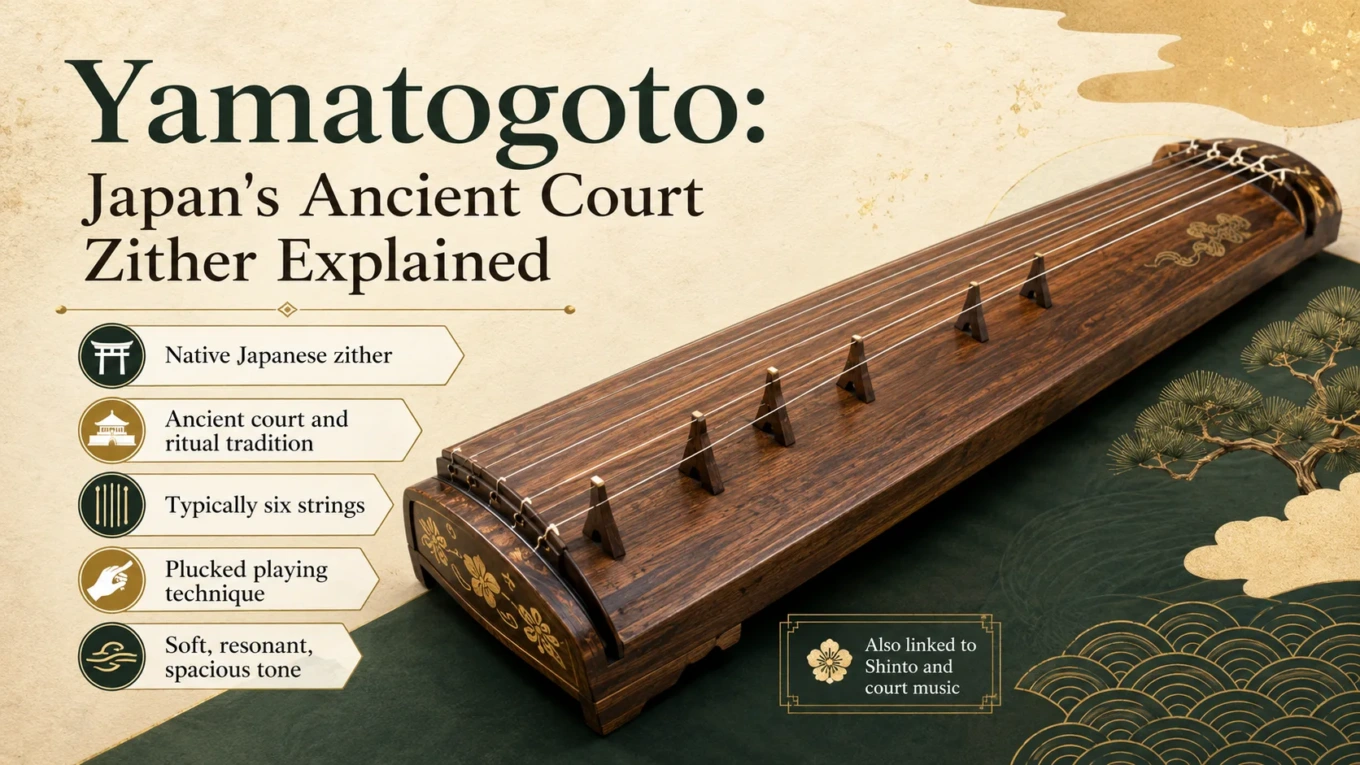
Yamatogoto: Japan’s Ancient Court Zither Explained
Yamatogoto, also called wagon, is a Japanese court zither with a narrow body, usually six strings, and a playing style tied closely to old song-and-dance traditions rather than solo display. It belongs to the zither side of the chordophone[1] family, but it should not be treated as a smaller version of the modern koto. Its structure, naming, bridges, performance role, and court setting give it a separate identity.
The instrument is best known under two names. Yamatogoto can be understood as “Yamato koto,” with Yamato pointing to Japan in an older cultural sense. Wagon uses characters often read as “Japanese koto” or “Japanese zither.” Both names mark the instrument as a native-style Japanese zither rather than a court instrument brought from continental Asia. That distinction matters, because many other instruments in Japanese court music have documented links with China, Korea, or wider East Asian transmission.
What Is the Yamatogoto?
The yamatogoto is a long, plucked bridge zither[2] used in Japanese court and shrine-related repertories. In many documented forms it has six strings, although some descriptions mention seven-string forms in older or broader classification contexts. The common court form is not built around large melodic range. It supports song, accent, pulse, and ritual movement.
Its body is long and narrow, with strings running along the length of the instrument. The player plucks the strings with a plectrum-like tool and uses the other hand to damp, touch, or sometimes pluck. The sound is dry, bright, and rhythmically clear when compared with the broader resonance associated with the thirteen-string koto.
| Feature | Common Description |
|---|---|
| Main names | Yamatogoto, wagon, sometimes written as Yamato-goto or wa-gon in romanized form |
| Instrument family | Plucked long zither in the chordophone family |
| Typical string count | Usually six strings in the better-known court form; some sources note seven-string variants or descriptions |
| Main setting | Japanese court and shrine-related song-and-dance repertories, especially native-style court music |
| Playing tool | A small spatula-like plectrum called kotosaki |
| Bridge style | Individual bridges, traditionally noted for forked twig-like forms in some court instruments |
| Main musical role | Support for song, rhythmic accent, and formal dance movement rather than modern solo virtuosity |
Why It Is Called Japan’s Ancient Court Zither
The phrase “ancient court zither” is useful, but it needs careful handling. The yamatogoto is old in cultural memory and belongs to court-linked music, yet surviving instruments and descriptions come from different periods. Museum records, court-music teaching sources, and instrument histories usually describe it as a native Japanese string instrument associated with formal song and dance.
Its court role is especially clear in gagaku[3], the Japanese court music tradition that includes native-style songs and dances as well as forms shaped by continental repertories. The yamatogoto is mainly connected with the native-style side, including ritual and song-dance settings. It is not a general-purpose folk zither, and it is not usually treated as a modern concert instrument.
Classification Note: The word koto can confuse readers. In English, “koto” often means the thirteen-string Japanese zither. In older Japanese usage, however, koto could refer more broadly to stringed instruments. The yamatogoto is a zither, but it is not the same instrument as the modern sō-no-koto usually called koto in English.
Names, Spellings, and Translation Issues
Yamatogoto, Yamato-goto, wagon, and wa-gon may all appear in English-language writing. The difference is often a matter of romanization, spacing, and translation style. The Japanese characters also carry cultural meaning, so a direct translation such as “Japanese zither” can be too plain unless the court and native-style context is kept in view.
The name wagon can look strange to English readers because it resembles the English word “wagon.” It is unrelated. In this instrument name, wa points toward Japan, while gon reflects a reading linked to koto or zither terminology.
Some sources also connect the instrument with the name azumagoto. That term should be read carefully, because names for older Japanese zithers can shift according to period, repertoire, and source. In a museum or organology context, yamatogoto and wagon are the clearest terms for this court zither.
How the Yamatogoto Fits within the Zither Family
The yamatogoto is a zither because its strings run along a body that supports the whole sounding length. It does not have a neck like a lute, and the player does not stop the strings against a fingerboard in the way a shamisen or guitar player would. The instrument’s shape places it near other East Asian board and long zithers, but its court use and bridge design separate it from better-known relatives.
In broad organology, it can be described as a plucked long zither. The strings lie across a soundboard[4] and pass over individual bridges. The body acts as a resonating body[5], giving the plucked strings enough projection for formal indoor or shrine-related performance.
This construction places the yamatogoto in conversation with the koto, guqin, guzheng, gayageum, and đàn tranh, but only at the family level. It does not share the same string count, playing vocabulary, tuning practice, or social use as those instruments.
Body Shape and Construction
The yamatogoto body is long, narrow, and slightly tapered in many museum examples. A documented nineteenth-century museum instrument measures about 190 cm in length, with a width that narrows from one end to the other. This should not be treated as a universal measurement for every yamatogoto, but it gives a useful sense of scale: the instrument is long like a court zither, not small like a portable lap instrument.
Materials vary by source and example. Museum records list hinoki, or Japanese cypress, for at least one preserved wagon, along with silk, cotton, and metal components. Some modern or workshop descriptions mention paulownia for the body. Both references should be read as evidence of real construction practice rather than a single fixed rule for every instrument.
The body must be light enough to resonate yet stable enough to hold string tension. Like other wooden zithers, its sound depends on several interacting parts: wood thickness, body cavity or carved form, bridge contact, string material, and the way the instrument is supported during performance. Wood choice can shape resonance, but it should not be treated as the only source of tone.
The Soundboard and Resonating Body
The upper wooden surface receives vibration from the strings through the bridges. This is why bridge contact matters so much. A string may be well tuned, but if its bridge does not sit cleanly or the body does not respond evenly, the tone can lose clarity.
The yamatogoto does not aim for the long, bending resonance heard in some other Asian zithers. Its voice is more formal and restrained. It helps mark rhythm, support a sung line, and add a clear plucked color within a court texture.
Strings and String Layout
The most familiar yamatogoto form has six open strings[6]. These strings are not laid out for the same kind of scale-based melodic playing associated with many modern zithers. Instead, the instrument is tied to fixed patterns, song support, and controlled resonance.
Older string materials are usually discussed in relation to silk. Silk strings give a different attack and decay from modern synthetic strings. They can sound less metallic and more textured, but they also respond strongly to humidity, age, and tension. In a historical setting, string feel is part of the instrument’s identity, not just a replaceable detail.
The yamatogoto has no fingerboard. It also does not use fretted stopping in the way a fretted lute does. The player shapes sound through plucking, damping, rhythmic placement, and pattern rather than wide pitch bending or chordal accompaniment.
Bridges: The Most Recognizable Structural Detail
One of the yamatogoto’s most distinctive features is its bridge system. Each string has its own movable bridge[7], but these bridges are not simply the neat, standardized triangular pieces many people associate with the koto. Some court instruments are known for bridges made from forked pieces of wood, often described as twig-like or branch-like forms.
These bridges support the strings and help set their sounding length. Because the bridges are separate, the instrument can be adjusted, but it should not be imagined as a modern experimental tuning board. Its use is bound to court repertory and inherited patterns.
Luthier’s Note: A movable bridge does two jobs at once. It sets pitch by changing the vibrating length of the string, and it transfers vibration into the wooden body. On a yamatogoto, the bridge shape also carries historical character, so replacing it with a generic bridge would change more than the tuning setup.
Frets, Pitch, and Tuning Logic
The yamatogoto is a fretless zither[8]. There are no raised frets that divide the string into fixed semitone positions. This does not mean the instrument is vague or casual in pitch. It means pitch organization comes from string tuning, bridge placement, and repertoire practice rather than from fretted stopping.
Descriptions of yamatogoto tuning should be handled with care. The instrument’s strings are linked to court song patterns and inherited formulas. A simple Western-style scale chart can mislead readers because the yamatogoto is not mainly a scale-running solo instrument.
Its string order is also not best understood as a modern low-to-high keyboard-like layout. Some descriptions note that the strings follow a preset melodic or formulaic sequence rather than a plain ascending scale. This helps explain why the instrument’s technique emphasizes pattern, accent, and resonance control.
How the Yamatogoto Is Played
The yamatogoto is usually plucked with a plectrum[9] called kotosaki[10]. The kotosaki is often described as small and spatula-like. Its shape gives a firm attack, useful for formal patterns and clear support of song.
The left hand has an active role. It can damp strings, pluck individual strings, or shape patterns. In a typical arpeggiated style, several strings may be muted so that only one remains ringing. This creates a controlled texture rather than a wash of sound.
Two ideas are especially useful for understanding the technique:
- Damping: the player stops selected strings from continuing to ring, which keeps the texture clean.
- Patterned plucking: the player follows fixed or formula-like movements that match song and dance rather than free solo improvisation.
- Accent placement: the instrument can mark moments in the sung line and help define the formal movement of the piece.
Arpeggio and Damping Technique
An arpeggio[11] on the yamatogoto is not just a decorative sweep. It can be a controlled gesture in which the player lets one string speak while other strings are muted. The result is rhythmic and selective.
Damping[12] is therefore part of the instrument’s grammar. Without it, the six strings would blur more easily. With it, the yamatogoto can support the vocal line while keeping a clear ceremonial texture.
Glissando and Resonance Control
Some descriptions of yamatogoto technique mention a fast glissando[13] across the strings, followed by damping so that only the final string continues to sound. This gesture shows the instrument’s special balance: a broad sweep is allowed, but the final resonance is controlled.
This is different from using glissando mainly for show. On yamatogoto, the gesture remains tied to timing, formal placement, and the surrounding vocal or dance structure.
Performance Position and Court Use
In many court settings, the yamatogoto player sits on the floor. Some outdoor or shrine-related dance pieces may involve a standing player, with the instrument supported by attendants holding either end. This detail helps show that the yamatogoto is not only an object of sound; it is also part of a visible performance arrangement.
The instrument is closely linked with mi-kagura[14] and other native-style court song-and-dance forms. It can support male dance and vocal performance in formal ceremonial settings. In this role, it does not compete with the voice. It follows, accents, and supports.
Japanese court music includes several types of repertory. The yamatogoto belongs most naturally with native-style song and dance rather than with every type of gagaku performance. It may appear in wider court contexts, but its identity remains strongest where the song line and formal movement require its specific color.
Sound Character: What to Listen For
The yamatogoto has a plucked tone with clear attack and short-to-moderate decay. It is not usually praised for huge volume or wide melodic reach. Its value lies in placement, texture, and the way each pluck sits inside the ceremony or song.
Listeners used to the modern koto may expect flowing melodic lines, pitch bends, and large resonant gestures. The yamatogoto asks for a different kind of attention. Listen for the contact between plectrum and string, the stop-start control of resonance, and the relationship between plucked sound and vocal rhythm.
Listening Note: The yamatogoto often makes more sense when heard as part of a full court texture. Its tone may seem spare on its own, but within song and dance it gives shape, pulse, and ceremonial color.
Yamatogoto and Gagaku
Gagaku contains instrumental music, dance music, and vocal forms. The yamatogoto is not the loudest or most widely recognized instrument in that soundscape. Wind instruments such as the hichiriki and shō often draw more attention, while percussion shapes timing. The yamatogoto belongs to the string group, but its function is narrower than the general category might suggest.
Within native-style repertories, the instrument can accompany song and dance. It supports the vocal line[15] and adds accents at selected points. This makes it different from a solo zither used mainly for melodic elaboration.
Terms such as Kuniburi-no-utamai[16] help place the instrument on the native-style side of court performance. These forms are associated with older Japanese songs and dances, distinct from court repertories with strong continental roots.
Yamatogoto, Koto, and Sō: Where the Confusion Starts
The yamatogoto and the koto are both Japanese zithers, but they are not interchangeable. The modern instrument called koto in English usually refers to the thirteen-string sō. It has more strings, a wider repertory, and a stronger presence in solo, chamber, and modern performance contexts.
The yamatogoto is narrower in string count and more restricted in function. It belongs to old court and shrine-linked repertories. Its bridge forms, plectrum use, and performance logic reflect that setting.
| Feature | Yamatogoto / Wagon | Modern Koto / Sō |
|---|---|---|
| Common string count | Usually six in the better-known court form | Commonly thirteen in standard modern form |
| Main use | Court and shrine-related song-and-dance support | Solo, ensemble, teaching, classical, and modern repertories |
| Bridge identity | Individual bridges, with forked twig-like forms noted in historical examples | Individual movable bridges of a more standardized type |
| Playing character | Patterned support, damping, accent, controlled resonance | Melodic playing, tuning systems, ornaments, bends, ensemble textures |
| Learning context | Rare and specialized | Much more available to students and performers |
How It Differs from Other East Asian Zithers
The yamatogoto shares the long-zither idea with instruments such as guzheng, koto, gayageum, and đàn tranh. The family resemblance is easy to see: long body, strings stretched along the top, bridges, and plucked technique. The deeper difference lies in use.
Guzheng and đàn tranh traditions often use movable bridges for melodic tuning and expressive left-hand pitch work. The Korean gayageum has its own body form, string materials, and playing vocabulary. The Japanese koto has a wide solo and ensemble repertory. The yamatogoto remains much more closely tied to court song-dance support.
The guqin comparison is also limited. Both are East Asian zithers with deep historical associations, but the guqin has no movable bridges and uses a very different left-hand technique. The yamatogoto should be understood on its own terms rather than as a Japanese equivalent of a Chinese instrument.
Materials and Making Traditions
Historical and museum examples show that yamatogoto construction can involve fine woodwork, silk strings, and fittings tied to court practice. Hinoki appears in at least one museum record. Paulownia appears in some modern workshop descriptions. Maple is often mentioned in relation to bridge material, especially because of the forked-branch bridge tradition.
These material notes are useful, but they should not be turned into rigid rules. Older instruments, restored instruments, modern reconstructions, and court-use instruments may differ. The safest description is that the yamatogoto is a wooden long zither with individual bridges and a stringing system suited to formal plucked accompaniment.
Why Forked Bridges Matter
The forked bridge is not only a visual feature. It changes how the string sits, how vibration travels into the body, and how the instrument looks within court performance. The bridge’s natural form also reflects a different design language from the polished, uniform bridges of many later zithers.
For a curator, this feature helps identify the instrument. For a player, it affects setup and response. For a listener, it helps explain the yamatogoto’s direct, clear attack.
Myth, Memory, and Cultural Position
The yamatogoto appears in Japanese cultural memory with links to early mythic stories and court identity. Such stories should be read as cultural meaning, not as modern technical history. They show how the instrument was valued and imagined, especially as a native Japanese zither.
Its association with Shinto-related music and court ceremony gives it a status different from common domestic instruments. It is not widely encountered in everyday music education, yet it remains present in discussions of Japanese court culture, old song-dance forms, and museum collections.
The safest way to describe its cultural role is this: the yamatogoto is a rare native-style Japanese zither preserved mainly through court and shrine-related repertories, where it supports song, movement, and ceremony.
How Museums Describe the Yamatogoto
Museum descriptions usually focus on three points: classification, materials, and use. A yamatogoto may be cataloged as a plucked long zither or chordophone-zither. Its materials may include wood, silk, cotton, and metal. Its use may be described in relation to mi-kagura or formal imperial Shinto music.
Museum language also helps correct a common misunderstanding. The yamatogoto is not just “an old koto.” It is a specific court zither with its own bridge system, sound, and performance role. A museum label may be short, but the classification points to a deeper organological identity.
Collector’s Note: A yamatogoto should be identified by more than string count. Body taper, bridge form, string attachment, material, provenance, and performance context all matter. A six-string long zither is not automatically a court wagon unless the construction and cultural setting support that identification.
What Beginners Should Know
The yamatogoto is not a common beginner instrument. Students interested in Japanese zithers usually begin with the modern koto because teachers, instruments, notation, and repertory are much easier to find. The yamatogoto belongs to a more specialized court-music setting.
Still, learning about the yamatogoto helps beginners understand why “Japanese zither” is not one single thing. It shows that the zither family includes court instruments, ritual instruments, solo instruments, folk instruments, and modern concert instruments. They may share a basic structural idea, but they do not share one playing method.
For listening or study, focus on these points:
- The instrument usually supports song rather than carrying a long solo melody.
- The bridge system is part of its identity, not only a tuning device.
- The left hand controls resonance as much as pitch.
- The instrument belongs most naturally to court and shrine-linked repertories.
- Its difference from the modern koto is cultural, structural, and musical.
Common Misunderstandings
“Yamatogoto Is Just Another Name for Koto”
This is too broad. The yamatogoto is a type of Japanese zither, and older naming can use koto in a wider sense. But the modern koto and the yamatogoto are different instruments. They differ in string count, repertory, playing method, and cultural setting.
“It Is Played Like a Modern Thirteen-String Koto”
The family resemblance can mislead. The yamatogoto uses patterned plucking, damping, and court accompaniment logic. Modern koto technique includes a much wider range of melodic, harmonic, and ornamental practices.
“Six Strings Means It Must Be Simple”
Fewer strings do not mean a weaker musical role. The yamatogoto’s difficulty lies in timing, restraint, tone control, and knowing how the part fits the voice and dance.
“All Japanese Zithers Came from the Same Source”
Japanese zither history includes native-style instruments, instruments shaped by continental transmission, and later developments. The yamatogoto is usually discussed as a native Japanese string instrument, while the better-known koto has a different historical background.
Glossary of Technical Terms
[1] Chordophone: An instrument whose sound comes from vibrating strings. In the zither family, the strings are supported by the body rather than by a separate neck.
[2] Bridge Zither: A zither in which the strings pass over bridges that help define pitch and transfer vibration to the body. The yamatogoto uses individual bridges for its strings.
[3] Gagaku: Japanese court music, including instrumental, dance, and vocal forms. The yamatogoto is linked especially with native-style song-and-dance repertories within this larger court tradition.
[4] Soundboard: The wooden surface that receives string vibration through the bridges. On a yamatogoto, the soundboard helps turn small plucked string movements into audible tone.
[5] Resonating Body: The body of the instrument that supports and shapes the sound after the string is plucked. Its wood, thickness, and contact with the bridges affect response.
[6] Open String: A string sounded without being stopped against a fingerboard or fret. The yamatogoto relies on open strings, tuning, bridge position, and damping rather than fretted fingering.
[7] Movable Bridge: A bridge that can be repositioned to adjust the sounding length and pitch of a string. In yamatogoto context, movable bridges also carry historical and visual identity.
[8] Fretless Zither: A zither without raised frets that divide the strings into fixed stopping points. The yamatogoto is fretless, so pitch organization comes from tuning and bridge placement.
[9] Plectrum: A tool used to pluck strings. The yamatogoto uses a small plectrum rather than being played only with bare fingers.
[10] Kotosaki: The small spatula-like plectrum used to play the yamatogoto. Its firm attack suits the instrument’s patterned court accompaniment style.
[11] Arpeggio: A gesture in which several strings are sounded in succession rather than all at once. On the yamatogoto, arpeggio technique often works with damping so that only selected resonance remains.
[12] Damping: The act of stopping a string from ringing after it is plucked. Yamatogoto players use damping to keep the texture clear and to control which string continues to sound.
[13] Glissando: A quick sweep across several pitches or strings. On the yamatogoto, a glissando may be followed by damping so that the final string is the one left resonating.
[14] Mi-kagura: Formal imperial Shinto music connected with court ceremony. The yamatogoto is associated with this setting as an accompaniment instrument for song and dance.
[15] Vocal Line: The sung melodic part that an accompanying instrument supports. In yamatogoto performance, the instrument often follows and accents the voice rather than replacing it.
[16] Kuniburi-no-utamai: Native-style Japanese court songs and dances. The yamatogoto is closely tied to these repertories, where it supports formal movement and vocal performance.
FAQ
Is the yamatogoto the same as the koto?
No. The yamatogoto is a Japanese zither, but it is not the same as the thirteen-string instrument commonly called koto in English. The yamatogoto usually has fewer strings, a narrower court role, and a different playing style.
How many strings does a yamatogoto have?
The best-known court form usually has six strings. Some descriptions mention seven-string forms, so it is safer to describe the instrument as usually six-stringed rather than claiming one rule for every source.
What music is the yamatogoto used for?
It is mainly linked with Japanese court and shrine-related song-and-dance repertories, especially native-style forms within gagaku. Its role is to support song, accent movement, and add a controlled plucked color.
Does the yamatogoto have frets?
No. The yamatogoto is fretless. Pitch and sound are shaped through tuning, bridge placement, open strings, plucking, and damping rather than fretted stopping.
Why are the bridges of the yamatogoto unusual?
Some historical and museum examples use individual bridges described as forked twig-like pieces, often linked with maple. These bridges are part of the instrument’s sound setup and also help identify its older court-zither character.
Can beginners learn the yamatogoto easily?
It is not usually a beginner’s instrument because teachers, instruments, and repertory are specialized. Students interested in Japanese zithers often start with the modern koto, then study the yamatogoto as part of court-music history and organology.