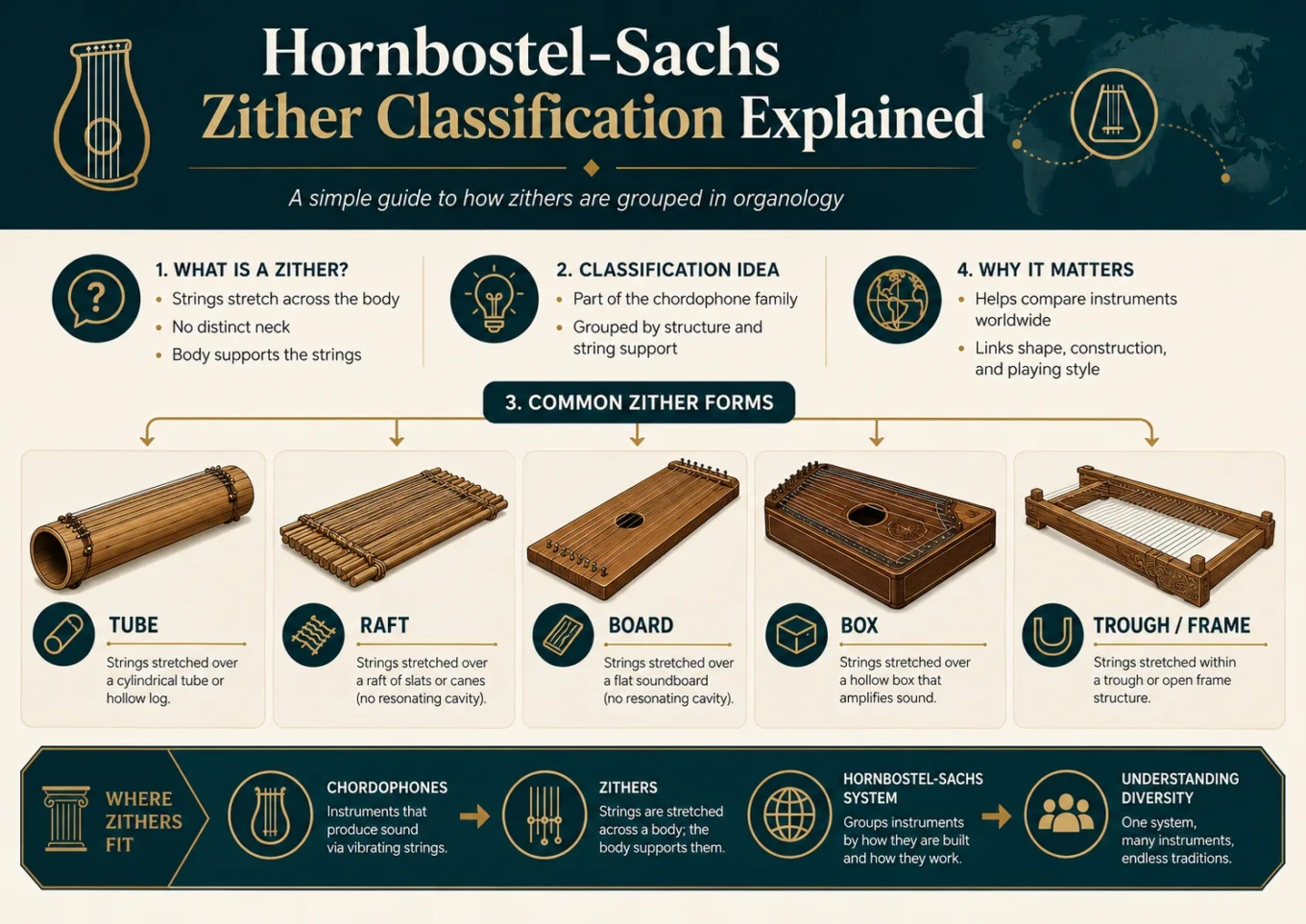
Hornbostel-Sachs Zither Classification Explained
Hornbostel-Sachs places zithers inside the chordophone family, but it uses the word zither in a wider technical sense than everyday music language. In this classification, a zither is not only the European concert zither. It is a type of string instrument whose strings are stretched across, along, or over a body that acts mainly as a string-carrying surface rather than as a necked lute, harp, lyre, or bowed fiddle.
The useful number to remember is 31: simple chordophones or zithers. That number explains why instruments as different as a concert zither, kantele, qanun, santur, guzheng, koto, guqin, gayageum, đàn tranh, psaltery, dulcimer, autoharp, and some keyboard instruments may appear near one another in organology, even though their music, construction, and playing methods can be very different.
What Hornbostel-Sachs Means by Zither
The Hornbostel-Sachs classification[1] is an organology[2] system. It sorts instruments by how sound is produced and by the physical relationship between the sounding material and the instrument body.
In this system, zithers belong to 3 chordophones[3]. A chordophone produces sound through stretched strings. Within that large family, zithers are placed under 31 simple chordophones[4].
The word simple does not mean easy, plain, or less developed. It means the instrument can be understood as a string bearer[5], or as a string bearer with a resonator[6] that is not treated as the defining structural feature in the same way as the body of a lute or harp.
Classification Note: In common speech, “zither” often means a European concert or Alpine zither. In Hornbostel-Sachs, “zither” is broader. It names a structural idea: strings arranged on a bearer without a projecting neck like a guitar, violin, or lute.
The Basic Hornbostel-Sachs Path for Zithers
A zither classification usually starts with a short numerical path. Each number narrows the instrument’s place in the system.
| Number | Category | Meaning for Zithers |
|---|---|---|
| 3 | Chordophones | Sound comes from one or more stretched strings. |
| 31 | Simple Chordophones or Zithers | The instrument is mainly a string bearer, with or without a detachable or non-integral resonating part. |
| 311 | Bar Zithers | The string bearer is bar-shaped. |
| 312 | Tube Zithers | The string bearer has a vaulted or tube-like surface. |
| 313 | Raft Zithers | The string bearer is made from canes tied together like a raft. |
| 314 | Board Zithers | The string bearer is a board or board-like surface. |
| 315 | Trough Zithers | The strings stretch across the mouth of a trough-like body. |
| 316 | Frame Zithers | The strings stretch across an open frame. |
The numbers are not a quality ranking. They do not say which instrument is older, more refined, louder, or more difficult. They describe structure.
Why Zithers Are “Simple” Chordophones
A simple chordophone can often be reduced, in classification terms, to strings and a bearer. The sound-producing apparatus[7] remains understandable even when the resonating part is considered separately.
This is different from a guitar or violin. A guitar has a neck, a body, and strings arranged in a lute-like structure. A violin has a neck, a resonating body, a bridge, and bowed strings in a composite form. Hornbostel-Sachs places such instruments outside the zither branch because the body and neck form a different kind of construction.
Many zithers do have carefully made bodies. A concert zither may have a flat wooden soundbox. A qanun has a thin resonating table and many strings. A santur or hammered dulcimer has a box that carries bridges and strings. These instruments are not “bodyless.” The classification point is about how the strings relate to the bearer, not about whether the instrument has a refined body.
311 Bar Zithers
A bar zither[8] has a bar-shaped string bearer. This branch includes musical bows and stick zithers. It is one of the clearest ways to see how broad the technical word zither can be.
In a bar zither, the bearer is narrow rather than broad like a board. The strings may run along a flexible bow, a rigid stick, or a similar elongated support. Some examples use added resonators, often made from natural or crafted materials, but the bar-like support remains the main structural clue.
Why Bar Zithers Matter in Classification
Bar zithers show that Hornbostel-Sachs is not based on modern shop categories. A listener may not call a musical bow a zither in casual speech, but the classification may place it under the zither side of the chordophone family because of how the string and bearer work together.
This is also why museum labels sometimes surprise readers. The museum label may be using an organological category rather than the instrument name used by players in a local tradition.
312 Tube Zithers
A tube zither[9] uses a rounded, vaulted, or tube-like string-bearing surface. Hornbostel-Sachs divides this group into whole-tube and half-tube forms.
In a whole-tube zither, the string carrier is a complete tube. In a half-tube zither, the strings run along a curved surface rather than across a flat board. Some catalogues use this branch for East Asian long zithers when the body is read as a curved or half-tube-like bearer, though exact classification can vary by museum record and revision.
That point matters for instruments such as guzheng, koto, guqin, gayageum, and đàn tranh. These are often described in English as board zithers because they look like long boards to a modern viewer. In Hornbostel-Sachs records, however, they may appear under half-tube zither categories because the classification is reading the arched body shape and the relationship between strings and surface.
Idiochord and Heterochord Tube Zithers
Tube zithers may also be described as idiochord[10] or heterochord[11]. In an idiochord instrument, the string is cut or raised from the same material as the bearer. In a heterochord instrument, the string is made from a separate material.
This distinction is mainly structural. It does not tell the listener whether the sound is soft, bright, dry, or resonant. It tells the cataloguer how the strings are made and attached.
313 Raft Zithers
A raft zither[12] has a string bearer made from canes or similar elements tied together in a raft-like form. The instrument is classified by the construction of the bearer, not by a modern national instrument label.
This branch is useful because it shows how Hornbostel-Sachs looks at the physical object before it looks at style. A raft zither may have a local name, a regional playing method, and a musical role that cannot be understood from the number alone. The number only says how the strings are supported.
314 Board Zithers
A board zither[13] has a board as its string bearer. This is the branch many readers expect when they think of zithers, especially flat or box-like instruments placed on a table, lap, stand, or floor.
Board zithers include several familiar forms, but not all of them look or sound alike. Some are plucked with fingers or a plectrum[14]. Some are struck with hammers. Some use buttons, bars, or keyboard actions. Some have open strings only, while others include fretted areas, chord mechanisms, or complex bridge systems.
True Board Zithers
In true board zithers, the plane of the strings is usually parallel with the board-like bearer. A box zither[15] is a board zither with a box-shaped resonating body. European concert zithers, many psalteries, autoharps, hammered dulcimers, santurs, qanuns, and related instruments may be handled in or near this part of the classification, depending on the exact object and catalogue method.
The same broad branch can include plucked, struck, and mechanically sounded instruments. This surprises many readers because everyday music categories often separate instruments by playing technique. Hornbostel-Sachs first asks how the instrument is built, then adds details about how it is sounded.
Board Zither Variations
Hornbostel-Sachs also separates certain board zither variations, including ground zithers and harp zithers. These categories depend on how the strings meet the board or how the bearer is arranged. They are not the same as the modern marketing names used for many instruments.
For zither family study, the main value of 314 is that it explains why many flat-bodied instruments can be structurally related while still having very different musical identities.
315 Trough Zithers
A trough zither[16] has strings stretched across the mouth of a trough-like body. The trough may be shallow, carved, hollowed, or otherwise shaped so the opening becomes the main area across which the strings are laid.
This branch shows the difference between a zither and a lute very clearly. A lute-like instrument projects strings from a neck across a resonating body. A trough zither places the strings across the opening of a bearer that is itself trough-shaped.
Some trough zithers use added resonators. Others rely on the body itself. As with other zither branches, the classification should not be read as a complete musical description. It gives the structural placement first.
316 Frame Zithers
A frame zither[17] has strings stretched across an open frame. The frame supports the strings, and a separate or attached resonating element may be present in some forms.
Frame zithers can be confused with harps because both may involve open spaces and visible string spans. Hornbostel-Sachs separates them by the relationship between the plane of the strings and the resonating surface. In a harp, the strings usually run in a plane that is perpendicular to the sound table. In a frame zither, the strings belong to the zither principle: they are stretched across the frame rather than rising from a neck or harp body.
How to Read a Zither Number
A Hornbostel-Sachs number works like a narrowing address. The first digit gives the main sound family. Later digits give the structural type. Extra suffixes may describe how the instrument is sounded or whether a keyboard or mechanism is present.
| Element | What It Tells You | Example of Meaning |
|---|---|---|
| 3 | Main family | The instrument is a chordophone. |
| 31 | Main zither branch | The instrument is a simple chordophone or zither. |
| 314 | Bearer shape | The instrument is a board zither. |
| 314.122 | Board zither with box resonator | The instrument is a true board zither with a box-shaped resonating body. |
| Suffixes such as -4, -5, -6, or -8 | Sounding method or mechanism | The instrument may be struck, played by bare fingers, played with a plectrum, or fitted with a keyboard, depending on the suffix used. |
A number should always be read with the object in view. A catalogue entry for a santur, qanun, or autoharp may include a detailed number because the instrument has a clear construction and playing method. A broad family name, by itself, may need a more cautious label.
Why the Same Instrument Can Be Described in Different Ways
Classification can vary because instrument names are not always precise structural labels. A single word may refer to a family, a regional form, a modern concert model, or a historical type.
The word zither is the best example. In one context, it means the European concert zither. In another, it means a wide class of simple chordophones. In a museum database, it may appear as a technical branch. In a shop, it may describe a specific plucked instrument with melody and accompaniment strings.
Translation also adds confusion. English terms such as “dulcimer,” “psaltery,” “zither,” and “harp” have been applied differently in different periods and regions. A local instrument name should not be erased by a classification term. The Hornbostel-Sachs label is a tool for comparison, not a replacement for the instrument’s own name.
Concert Zither in Hornbostel-Sachs
The European concert zither is often treated as a resonated board or box zither. Its flat body, strings arranged over the body, and mixture of melody and accompaniment areas fit the zither principle.
Unlike a guitar, it has no neck projecting away from the body. The strings run over the main body surface. Some strings are stopped against frets, while many others sound as open accompaniment strings.
This gives the concert zither an unusual place in classification. It is clearly a zither in common European usage and also fits the broader Hornbostel-Sachs idea of a simple chordophone.
Fretted and Open String Areas
Many concert zithers combine fretted strings[18] with open strings[19]. The fretted area supports melody playing. The open strings provide accompaniment, bass, or chordal support depending on the tuning and model.
This does not move the instrument out of the zither family. Frets change how the player stops pitch; they do not turn the instrument into a lute, because the overall string-bearing layout remains zither-like.
Qanun, Santur, Dulcimer, and Autoharp in the Same Broad Branch
Hornbostel-Sachs can place instruments with different playing methods near one another because it begins with structure. This is why the qanun, santur, hammered dulcimer, psaltery, and autoharp can all be discussed in relation to board or box zither forms, even though they are not the same instrument.
- Qanun: A plucked zither associated with Middle Eastern, North African, and related musical traditions, often built with many strings and pitch-changing devices in some modern forms.
- Santur: A struck zither known in several regional traditions, with strings sounded by light hammers.
- Hammered dulcimer: A struck box zither in many classification contexts, related in playing logic to other hammered zithers but not identical to every regional santur-type instrument.
- Psaltery: A plucked or sometimes bowed zither-type instrument, depending on the form and period.
- Autoharp: A chorded box zither with a damping mechanism that helps select chord groups.
These instruments share a structural idea: strings lie across a bearer or soundbox rather than running along a neck. Their musical systems, repertoire, tunings, string counts, and cultural settings differ widely.
Guzheng, Koto, Guqin, Gayageum, and Đàn Tranh
Long East Asian zithers can be hard to place in casual English because they often look like long boards. In organological records, some are classified as half-tube zithers, especially when the body is treated as a curved or vaulted surface rather than a flat board.
Guzheng, koto, gayageum, and đàn tranh often use movable supports under the strings. The exact build, string number, scale system, materials, and performance practice vary by tradition and period. Guqin has a different playing surface and a different performance practice; it is not simply a smaller guzheng.
The common zither link is structural, not cultural sameness. These instruments should not be reduced to one generic “Asian zither” type. Each has its own name, technique, repertoire, and craft vocabulary.
Movable Bridges and Pitch Layout
A movable bridge[20] can support a string while also shaping scale layout and pitch adjustment. On many long zithers, moving the bridge changes the speaking length of the string and therefore the pitch.
The presence of movable bridges does not create a separate Hornbostel-Sachs family by itself. It is a construction detail within the broader zither layout.
What Hornbostel-Sachs Does Not Tell You
A classification number is useful, but it does not describe the full instrument. It does not tell the reader exactly how the music sounds, how hard the instrument is to learn, what repertoire it carries, or how players think about it within a living tradition.
It also does not give one universal string count, tuning, or material list. A zither may have five strings, thirteen strings, twenty-one strings, thirty or more strings, or many more depending on the instrument type. Some zithers use metal strings, some use silk or synthetic strings, and some use gut, nylon, or other materials in specific contexts.
A catalogue number should be paired with the instrument name, region, date, materials, body shape, and playing method. Without those details, the word zither can become too broad to be useful.
Construction Details That Affect Classification
Hornbostel-Sachs looks closely at physical relationships. For zithers, the most useful details are the string bearer, body shape, resonating part, string material, and sounding method.
String Bearer Shape
The bearer may be a bar, tube, raft, board, trough, or frame. This is the main reason the zither branch divides into 311 through 316.
Resonating Body
A resonator box[21] can make the instrument louder and fuller, but classification asks whether it is structurally integral in the relevant sense. A box zither may have a carefully built soundbox while still remaining a simple chordophone.
Soundboard and Bridges
The soundboard[22] helps transmit string vibration into the body. A bridge[23] supports the string and transfers vibration. In some zithers, each string has its own bridge. In others, a long bridge or set of bridges serves groups of strings.
Bridge design affects feel, sustain, and tuning behavior, but it is only one part of the classification picture.
How the Strings Are Sounded
Some zithers are plucked with fingers. Some are plucked with picks. Some are struck with hammers. Some are bowed. Some use a keyboard or chord-bar mechanism.
Hornbostel-Sachs can add suffixes for sounding method, but the main zither category still comes from construction. A hammered dulcimer and a plucked qanun may both be zither-related even though the player’s movement is different.
Tuning and String Layout in Zither Classification
Tuning[24] helps musicians play the instrument, but it usually does not decide the main Hornbostel-Sachs branch. A concert zither tuning, a guzheng tuning, a koto tuning, and a qanun tuning belong to different musical systems and instrument traditions. They should not be treated as interchangeable.
Some zithers use single strings. Others use groups of strings called a course[25], where two or more strings may be tuned together or in related pitches. Some instruments use repeated pitches, drone strings, bass strings, or melody strings. These details affect performance more than the top-level classification.
For this reason, a classification entry should never replace a tuning description. It can say that an instrument is a zither type, but it cannot tell the player how to tune it.
Timbre and Resonance Are Not the Main Sorting Tools
Timbre[26] matters to listeners and players, but Hornbostel-Sachs does not sort zithers mainly by tone color. A santur may have a bright struck attack. A guqin may have a quiet, sliding, intimate sound. A concert zither may mix ringing accompaniment strings with a fretted melody line. These sound differences are real, but they do not replace the structural categories.
Wood choice, string material, bridge height, body thickness, and playing technique can shape resonance. Still, safe classification depends on visible and measurable construction more than subjective sound description.
Luthier’s Note: Two zithers with the same broad classification can feel very different under the hand. String tension, bridge pressure, body stiffness, and surface finish may change response even when the Hornbostel-Sachs branch stays the same.
Common Misreadings of Zither Classification
“Every Zither Is a Concert Zither”
This is the most common mistake. The concert zither is one zither type. Hornbostel-Sachs uses zither for a much wider structural branch.
“Every Flat String Instrument Is a Board Zither”
Not always. Some long zithers may be treated as tube or half-tube zithers because of the body shape. Classification depends on the specific construction, not only the view from above.
“Playing Method Decides the Main Category”
Playing method matters, but it usually appears after the main structural placement. Plucked, struck, bowed, and keyboard-operated instruments can all appear in zither-related branches.
“A Classification Number Explains the Whole Instrument”
It does not. The number gives a structural address. The full identity also needs the instrument name, region, materials, tuning, playing technique, and musical use.
How Museums and Researchers Use the Term
Museums often use Hornbostel-Sachs numbers to make large collections searchable and comparable. A catalogue can group instruments by structure even when they come from different languages, periods, and musical settings.
This is helpful, but it can also feel odd to musicians. A player may think first in terms of repertoire, technique, teacher lineage, and regional name. A curator may also need a classification number, material description, measurements, and construction type.
Both views matter. The classification helps compare instruments. The local instrument name preserves musical identity.
Where Zither Classification Helps Most
Hornbostel-Sachs zither classification is most useful when a reader needs to understand why different instruments appear in the same family. It helps answer questions such as:
- Why can a dulcimer, qanun, autoharp, and concert zither all be related in classification?
- Why are some East Asian long zithers not always listed as board zithers?
- Why does a museum label use “simple chordophone” for an instrument with a well-built body?
- Why does the word “zither” mean one thing in common speech and another in organology?
The best reading is balanced: the Hornbostel-Sachs number explains the structure, while the instrument name explains the musical and cultural identity.
FAQ
What is the Hornbostel-Sachs number for zithers?
The main Hornbostel-Sachs number for zithers is 31, meaning simple chordophones or zithers. Subgroups include 311 bar zithers, 312 tube zithers, 313 raft zithers, 314 board zithers, 315 trough zithers, and 316 frame zithers.
Is a concert zither the same as every Hornbostel-Sachs zither?
No. A concert zither is one specific European zither type. Hornbostel-Sachs uses “zither” more broadly for a structural family of simple chordophones.
Why are some zithers called simple chordophones?
They are called simple chordophones because the instrument can be understood mainly as strings attached to a string bearer, with or without a resonating part. The word “simple” describes structure, not musical value or difficulty.
Are guzheng and koto board zithers?
They are often described casually as long zithers or board-like zithers, but Hornbostel-Sachs catalogues may place some long East Asian zithers under half-tube zither categories. The exact classification depends on the instrument’s body shape and the catalogue system used.
Is a hammered dulcimer a zither in Hornbostel-Sachs?
In many classification contexts, a hammered dulcimer is treated as a struck box or board zither. The playing method is different from a plucked zither, but the strings still lie across a zither-like body.
Does tuning affect Hornbostel-Sachs classification?
Tuning usually does not decide the main Hornbostel-Sachs category. Classification is based more on construction, string arrangement, body shape, and how the strings are supported.
Glossary of Technical Terms
Hornbostel-Sachs Classification: A system that groups musical instruments by how they produce sound and how their parts are built. For zithers, it places them under chordophones and then under simple chordophones.
Organology: The study of musical instruments, including their construction, classification, materials, and use. In zither study, organology helps separate instrument names from structural types.
Chordophone: An instrument whose sound comes mainly from vibrating strings stretched between fixed points. Zithers, lutes, harps, lyres, and bowed string instruments are all chordophones, but they are not built in the same way.
Simple Chordophone: A chordophone built mainly as strings attached to a string bearer, with any resonator treated as non-integral in the classification sense. Zithers are the main simple chordophone group in Hornbostel-Sachs.
String Bearer: The part of the instrument that supports the strings. In zithers, this may be a board, tube, bar, trough, frame, or raft-like structure.
Resonator: A part that helps amplify or shape the sound of vibrating strings. In zither classification, the resonator may be present without changing the instrument into a lute or harp.
Sound-Producing Apparatus: The parts that directly create the sound, especially strings and their supports. In zither classification, this idea helps explain why a detachable or secondary resonator does not always define the instrument family.
Bar Zither: A zither whose string bearer is bar-shaped. Musical bows and stick zithers belong in this part of the Hornbostel-Sachs zither branch.
Tube Zither: A zither whose string bearer is a tube or vaulted surface. Some long zithers may be placed in half-tube categories when their curved body shape fits that reading.
Idiochord: A construction type in which the string is made from the same material as the string bearer, often cut or raised from it. This term is most relevant to certain bar, tube, or raft zither forms.
Heterochord: A construction type in which the string is made from a material separate from the string bearer. Many familiar zithers use heterochord strings.
Raft Zither: A zither whose string bearer is made from canes or similar elements tied together like a raft. The category describes construction rather than a single musical tradition.
Board Zither: A zither whose string bearer is a board or board-like surface. Many flat-bodied zithers, box zithers, psalteries, and dulcimer-type instruments are discussed in relation to this branch.
Plectrum: A pick used to pluck strings. Some zithers use a handheld plectrum, finger picks, or plectrum-like mechanisms depending on the instrument type.
Box Zither: A board zither with a box-shaped resonating body. Concert zithers, autoharps, and hammered dulcimer-type instruments may be described through this structural idea when the object fits.
Trough Zither: A zither with strings stretched across the mouth of a trough-like body. The trough form is the main structural feature used for classification.
Frame Zither: A zither with strings stretched across an open frame. It may resemble a harp at first glance, but its string and frame relationship is classified differently.
Fretted String: A string that can be stopped against frets to change pitch. In concert zithers, fretted strings often serve melodic playing.
Open String: A string sounded without being stopped by the player’s finger. Many zithers use open strings for accompaniment, drones, basses, or fixed-pitch notes.
Movable Bridge: A bridge that can be repositioned to adjust pitch or string length. Many long zithers use movable bridges as part of their tuning and scale layout.
Resonator Box: A hollow box body that strengthens and colors the sound of the strings. In box zithers, it also forms the visible body of the instrument.
Soundboard: The vibrating surface that helps transmit string energy into the body. On many zithers, bridge placement and soundboard thickness affect response.
Bridge: A support that holds strings at a set height and transfers vibration toward the body or soundboard. Some zithers have fixed bridges, while others use movable or individual bridges.
Tuning: The pitch arrangement of an instrument’s strings. Zither tunings vary widely by instrument type, region, repertoire, and maker.
Course: A group of two or more strings treated as one musical unit. Some zithers use courses to add volume, color, or paired pitches.
Timbre: The tone color or sound character of an instrument. In zithers, timbre is shaped by strings, body, bridges, touch, and playing method, but it is not the main basis of Hornbostel-Sachs classification.