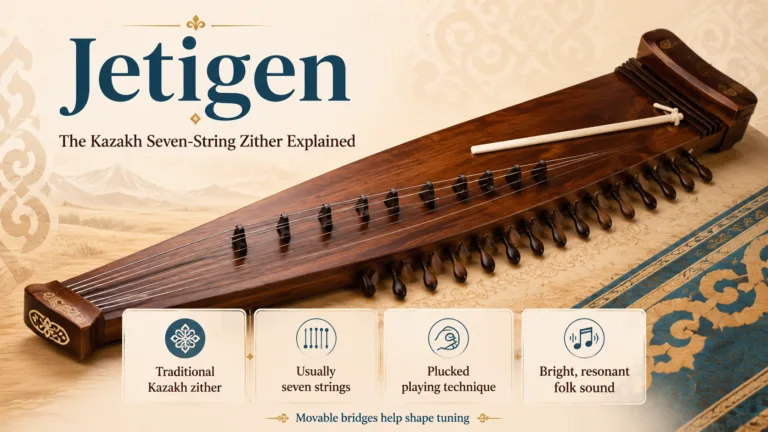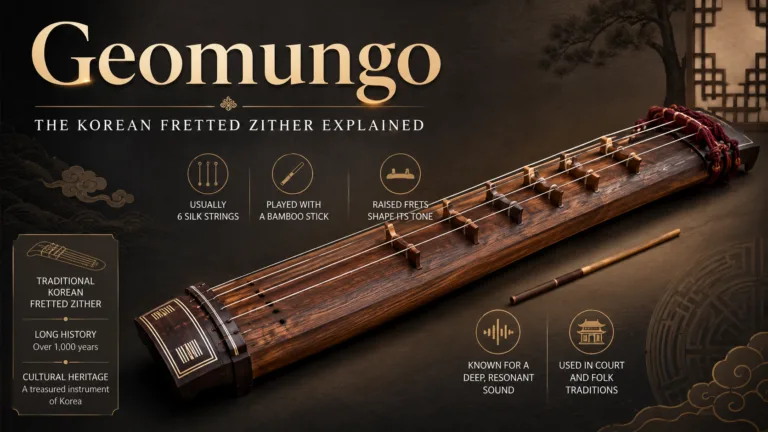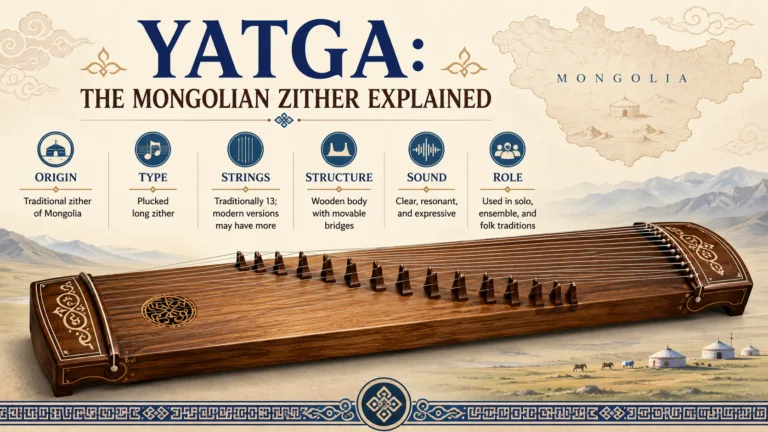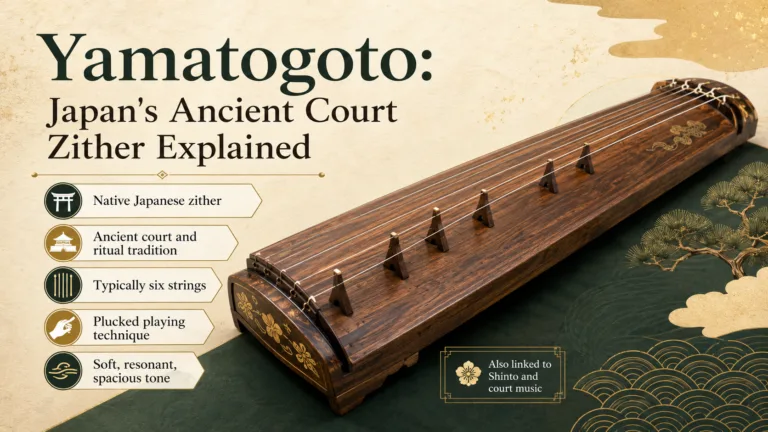
Se: The Ancient Chinese Zither Explained
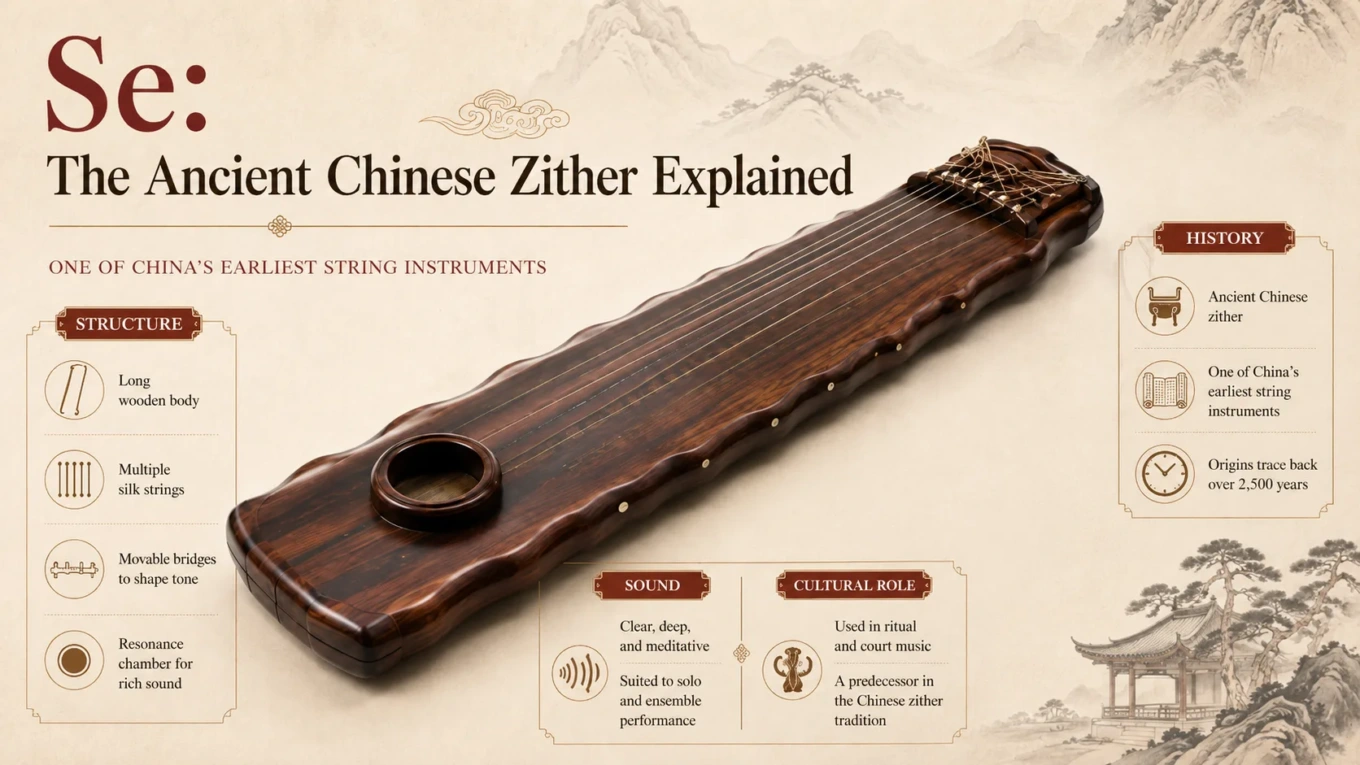
Se (瑟, pinyin: sè) is an ancient Chinese zither[1] known for its long wooden body, many strings, and movable bridges. In the broad organological sense, it belongs to the chordophone[2] family because its sound comes from vibrating strings stretched across a body. In a narrower Chinese musical context, it is one of the old court and literary zithers often discussed beside the qin, later guqin, but it should not be treated as the same instrument.
The se is not a common modern stage instrument. It is better understood through archaeology, early literature, museum collections, and modern reconstructions. That makes it different from the guzheng, koto, gayageum, or đàn tranh, which still have active performance traditions. The se helps explain how early East Asian long zithers used strings, bridges, lacquered wood, and formal music settings long before the modern zheng family took its present shape.
What Is a Se?
The se is an ancient Chinese plucked zither[3] with strings running along the length of a wooden body. Documented and excavated forms show that it could have many strings, often discussed as twenty-five in later descriptions, though historical and archaeological examples vary. Some textual traditions mention larger string counts, while surviving instruments and reconstructions show that no single design should be forced onto every se.
In basic playing logic, the se uses strings that sound when plucked. Each string can be given a pitch by its string length, tension, thickness, and the position of a bridge. This places it close to other long zithers, but its older construction, historical role, and cultural use set it apart.
| Feature | What It Means |
|---|---|
| Instrument Type | Ancient Chinese plucked zither in the chordophone family. |
| Chinese Name | 瑟, usually romanized as se or sè. |
| String Layout | Many strings stretched lengthwise across a wooden body; exact numbers vary by period and example. |
| Bridge System | Movable bridges help set string length and pitch. |
| Older String Material | Silk is associated with many early Chinese string instruments, including the se. |
| Modern Status | Rare in active performance; mainly known through historical study, ritual memory, museum material, and reconstructions. |
Why the Se Matters in Zither Classification
The se shows that “zither” is not one single instrument. In English, zither can mean a European concert zither, but in organology it also describes instruments whose strings run across a body without a projecting neck. The se belongs to this broad family because the body supports the strings directly.
Its closest Chinese relatives are not identical copies. The guqin has fewer strings and no movable bridges. The guzheng has movable bridges and a living modern tradition, but it developed into a different instrument with its own repertoire, technique, and sound ideal. The se stands earlier in the historical picture and is often encountered through early texts, excavated instruments, and ritual associations.
Classification Note: The se is best described as an ancient Chinese plucked zither with movable bridges. Calling it simply “a guzheng” hides the older construction and historical setting; calling it “a harp” is inaccurate because the strings do not rise from a separate neck or frame in the harp manner.
Name, Pronunciation, and Written Form
The character for se is 瑟. In modern pinyin it is written sè, with a falling tone. English-language writing often drops the tone mark and writes se. Older or reconstructed contexts may also use guse, meaning “ancient se,” especially when the writer wants to separate the historical instrument from later or modernized forms.
The name appears in early Chinese literary culture together with qin. The paired expression qin se became a familiar cultural reference, often connected with harmony, refinement, and formal music. That literary presence matters, but it should not replace the physical instrument. The se was not only a symbol in writing; it was also a built object with strings, bridges, lacquer, and a playing surface.
Historical Setting Without Treating Every Source as One Standard
The se is associated with early Chinese musical life, including Zhou and Warring States cultural settings. Excavated instruments from regions such as Hubei and Hunan show that long zithers were part of elite musical environments. The famous tomb of Marquis Yi of Zeng, dated to the late fifth century BCE, is often discussed because it preserved a large musical assemblage that included bells, chimes, winds, drums, and string instruments. The se belongs to this broader sound culture of tuned instruments and formal performance.
Early texts and later traditions do not always agree on string counts, origins, or exact forms. That is normal for an old instrument known through mixed evidence. Some accounts speak of twenty-five strings; others refer to larger numbers. Archaeological examples may differ again. A careful description should allow variation by period, region, and reconstruction method.
The instrument seems to have declined as a regular performance tool while related zithers, especially the zheng line, remained musically active and later took new regional forms. This does not mean the se was simply “replaced” in a straight line. It is safer to say that the se became rare while other Chinese and East Asian zithers developed stronger living traditions.
Construction: Body, Surface, and String Path
A se is usually described as a long wooden zither with a broad playing surface. The upper board functions as a soundboard[4], helping string vibration enter the instrument body. Beneath or within the body, a resonating body[5] supports the tone by giving the vibration a larger wooden structure to excite.
Ancient examples were often lacquered. Lacquer was not only decorative; it protected wood and formed part of the surface finish. Carved or painted details could appear on elite instruments, especially those made for formal settings. The exact degree of decoration depended on the period, region, owner, and workshop.
The strings run lengthwise. At the ends, older forms could use fixed bridges, posts, rods, holes, or other anchoring solutions. Surviving descriptions often mention end posts or grouped string attachments. These details are not small ornaments; they show how tension was managed before modern metal tuning hardware became normal on many later zithers.
The Role of the Movable Bridge
The most recognizable part of the se is the movable bridge[6]. A movable bridge stands under a string and changes the vibrating length of that string. Moving it closer to one end shortens the active length; moving it away lengthens it. This changes the pitch without requiring frets.
Because of this, the se is not a fretted instrument in the usual sense. Frets[7] are fixed or placed markers that shorten a string when the player presses the string down. The se works more like a movable-bridge board zither: the string is set up to sound at a chosen pitch, and the bridge helps define that pitch before or during setup.
Open Strings and Pitch Setup
Many se strings would have worked as open strings[8], meaning they sound at their prepared pitch when plucked without being stopped against a fingerboard. This is one reason the instrument can carry many strings: each string can supply a note or part of a scale pattern.
The player’s musical control depends on bridge placement, string selection, plucking technique, and sometimes left-hand contact on the strings. It is not the same logic as a violin, guitar, or lute, where one string can produce many notes through stopping along a neck.
Strings and Materials
Older Chinese zithers are strongly associated with silk strings[9]. Twisted silk gives a different feel from modern steel, nylon-wrapped steel, or synthetic strings. It tends to favor a softer attack and lower tension, though the exact sound depends on thickness, length, bridge design, and the body.
String thickness may have varied across the instrument. A thicker string can support a lower pitch, while a thinner string can support a higher pitch. This matters on a se because a large number of strings must be organized into a playable pitch layout. Some archaeological discussions of early zithers note graduated string gauges, which suggests that makers thought carefully about pitch range and string order.
The word course[10] should be used cautiously with the se. In many instruments, a course means one note made from one or more strings tuned together. A se is usually easier to describe as having many individual strings rather than paired courses, unless a specific reconstruction or museum record states otherwise.
Material Note: Wood choice, lacquer thickness, bridge height, and string material can shape resonance and playing feel. They should not be treated as fixed formulas. A museum object, a modern reconstruction, and a ritual display instrument may not respond in the same way.
How the Se Was Tuned
The se did not have one universal tuning for all periods. Tuning depended on the number of strings, the musical setting, the bridge layout, and the system of pitch[11] used by the players or ritual context. A se with many strings could support scale patterns, repeated registers, or organized tone groups, but surviving evidence does not justify one simple modern tuning chart for every se.
Many Chinese zither traditions make strong use of a pentatonic scale[12], but that does not mean every historical se was tuned in one fixed pentatonic arrangement. It is better to say that pentatonic organization is relevant to many Chinese musical contexts and that movable bridges would allow the instrument to be set for the needed tonal layout.
Why Bridge Placement Matters More Than a Fixed Tuning Peg System
On later modern zithers, metal tuning pins or pegs may draw attention first. On the se, bridge placement is central. The bridge divides the string path and helps define the sounding length. Tension and string gauge still matter, but the bridge gives the maker or player a visible way to organize pitch across the board.
This is one of the reasons the se looks related to the guzheng. Both use movable bridges, but their historical design, repertoire, and modern status differ. The shared bridge idea should not erase the differences.
How the Se Was Played
The se was plucked rather than bowed or struck with hammers. The player likely sat with the long body placed horizontally, selecting strings with the hands. Exact technique varies in modern reconstructions because the living performance chain is thin compared with the guqin or guzheng.
Several playing questions remain open:
- Whether a given historical player used bare fingers, nails, or small aids could depend on period and setting.
- How much left-hand pitch bending or damping was used may vary by reconstruction.
- Written music for the se is limited, so modern players often work from related zither knowledge, archaeology, and experimental practice.
- Some later references place the se beside the qin, suggesting ensemble or paired use in certain formal contexts.
The se should not be described as a beginner-friendly modern zither in the way a student guzheng, kantele, or autoharp might be. It is better suited to historical study, reconstruction, museum interpretation, and specialist performance projects.
Sound and Listening Character
The se likely offered a layered plucked tone shaped by many strings, wood resonance, and silk or silk-like string behavior. Its sound should not be imagined as identical to a modern guzheng. Modern guzhengs often use higher-tension strings and produce a bright, projecting tone suited to large stages. A reconstructed se may sound softer, broader, and more restrained, depending on its build.
Timbre[13] depends on the whole structure. A low bridge can reduce clearance and change attack. A tall bridge can alter tension angle and response. A lacquered surface may reflect vibration differently from unfinished wood. Silk strings produce a different pluck profile from metal strings.
Listening Note: When hearing a modern se reconstruction, listen for the relationship between pluck attack and decay. The note may not ring like a modern concert guzheng. Its value often lies in the spacing of pitches, the texture of multiple open strings, and the wood-supported resonance.
Se, Guqin, and Guzheng: Where the Confusion Starts
The se is often confused with the guqin and guzheng because all three are Chinese zithers. The confusion is understandable, but the differences are clear when construction is examined.
| Instrument | Basic Structure | Bridge and Playing Logic |
|---|---|---|
| Se | Ancient long zither with many strings; string counts vary in sources and examples. | Uses movable bridges to help set string pitch; rare in modern performance. |
| Guqin | Seven-string fretless zither with a narrow body and marked note positions. | No movable bridges; the player stops and slides strings on the surface. |
| Guzheng | Modern Chinese long zither, commonly with movable bridges and an active repertoire. | Movable bridges set pitch; right hand often plucks while left hand shapes notes. |
Se and Guqin
The guqin is a smaller, more intimate zither with seven strings in its standard modern form. It has no movable bridges. Instead, the player uses stopping, sliding, harmonics, and subtle touch on a long surface. The se, by contrast, uses many more strings and bridges to organize pitch across the instrument.
Literature often pairs qin and se, but that pairing should not be read as proof that the instruments were built or played in the same way. The phrase reflects cultural closeness, not structural sameness.
Se and Guzheng
The guzheng is the comparison most modern readers recognize because it also has movable bridges. Yet the guzheng is a living instrument with regional schools, modern conservatory technique, stage repertoire, and standardized student models. The se is older and much rarer.
It is reasonable to see a historical relationship between the se and later movable-bridge Chinese zithers. It is not accurate to collapse them into one instrument. The se belongs to an earlier layer of Chinese zither history, while the guzheng represents a later and still active line.
Archaeology and Museum Context
Museums and archaeological reports often describe the se through its physical remains: lacquered wood, string anchors, bridge positions, sound openings, and traces of old construction. These records matter because a musical instrument can change when copied through drawings, legends, or later performance assumptions.
Excavated se-type instruments help answer practical questions:
- How long and wide the body could be in a documented example.
- How strings were anchored at the ends.
- How bridges were arranged across the board.
- Whether string gauges changed from one side to another.
- How lacquer, carving, and body shape related to elite musical settings.
Because many ancient organic materials decay, not every detail survives. Strings may be lost, bridges may have shifted, and lacquer can crack or lift. For this reason, a museum description should be read as evidence of a particular object, not as a rule for every se ever made.
Collector’s Note: A modern object labeled “se” may be a reconstruction, ritual display instrument, educational model, or experimental performance instrument. Construction details should be checked carefully: bridge count, string material, body shape, anchoring method, and whether the maker follows a known archaeological model.
Regional Echoes Beyond China
The se also appears in East Asian naming and ritual memory outside China. Korean seul, Japanese shitsu, and Vietnamese sắt are often connected with the same written character or related court and ritual contexts. These should be treated as regional terms and traditions, not as proof that every instrument had the same dimensions, sound, or use.
In Korea, the seul is especially associated with Confucian ritual music. In Japan and Vietnam, related names appear in historical or limited contexts. The shared written heritage shows how court instruments, ritual models, and written musical culture traveled, but each region adapted and preserved such instruments differently.
Common Misunderstandings About the Se
It Is Not Simply an Older Guzheng
The se and guzheng share the idea of a long body and movable bridges, but they do not share the same modern identity. The guzheng has a living repertoire and modern pedagogy. The se is mostly reconstructed through historical and material evidence.
It Was Not Always Built with One String Count
Twenty-five strings are often mentioned, but historical sources and physical evidence point to variation. Some descriptions refer to larger numbers, while excavated or reconstructed examples may show other counts. Treat “25-string se” as a common reference point, not a universal law.
It Was Not a Harp
A harp has strings rising from a neck or frame. A se has strings running along a body. It is a zither, not a harp, even if both are string instruments.
It Is Not Easy to Recreate from Text Alone
Old descriptions may name string counts or cultural use, but they do not always explain bridge height, exact tuning, string thickness, or playing technique. Reliable reconstruction needs physical evidence as well as textual study.
What Beginners Should Know
A beginner searching for the se may expect an instrument that can be bought and learned like a guzheng. In most cases, that is not realistic. The se is rare, and many available examples are reconstructions or display-oriented instruments. A player interested in Chinese zither technique may find the guzheng or guqin easier to access.
For historical interest, the se is still worth studying. It teaches several useful ideas:
- Chinese zither history includes more than the modern guzheng and guqin.
- Movable bridges were part of older instrument design, not only later concert practice.
- String count is not enough to identify an instrument.
- Literary fame and surviving performance tradition are different kinds of evidence.
- Museum objects can show construction details that short written descriptions leave out.
The best way to understand the se is to compare construction rather than names alone. Look at the body, bridge system, string path, material, and playing method. Those details give the instrument its identity.
Glossary of Technical Terms
[1] Zither
A zither is a string instrument whose strings run across a body rather than along a separate neck. In the se, the long wooden body directly supports the strings and helps shape the sound.
[2] Chordophone
A chordophone is any instrument that produces sound through vibrating strings. The se is a chordophone because its musical tone comes from plucked strings.
[3] Plucked Zither
A plucked zither is a zither played by pulling and releasing the strings with fingers, nails, or picks. The se belongs in this group rather than the struck zither group of instruments played with hammers.
[4] Soundboard
The soundboard is the upper wooden surface that receives vibration from the strings. On a se, it helps transfer string energy into the body of the instrument.
[5] Resonating Body
The resonating body is the wooden structure that supports and amplifies string vibration. In long zithers such as the se, body shape and internal space can affect tone and sustain.
[6] Movable Bridge
A movable bridge is a small support placed under a string that can be shifted to change the vibrating length. On the se, movable bridges are central to pitch layout and visual identity.
[7] Frets
Frets are fixed or placed markers that help shorten a string when it is pressed down. The se is normally described through movable bridges rather than frets.
[8] Open String
An open string sounds without being pressed against a fingerboard. Many se strings are best understood as prepared open strings set to chosen pitches through bridge placement and string setup.
[9] Silk String
A silk string is made from twisted silk fibers, a material linked with older Chinese string instruments. Silk changes the feel, attack, and decay compared with modern metal or synthetic strings.
[10] Course
A course is one playable note made from one string or a group of strings tuned together. The term should be used carefully for the se, since many descriptions treat its strings as individual rather than paired courses.
[11] Pitch
Pitch is the perceived highness or lowness of a note. On the se, pitch is shaped by string length, tension, thickness, and the position of the movable bridge.
[12] Pentatonic Scale
A pentatonic scale uses five main tones. Many Chinese musical contexts use pentatonic organization, but the se should not be assigned one fixed tuning without reference to a specific source or reconstruction.
[13] Timbre
Timbre is the tone color of an instrument: bright, soft, dry, ringing, or muted. On the se, timbre depends on strings, wood, bridge design, lacquer, and playing touch.
FAQ
Is the Se a Type of Zither?
Yes. The se is a zither because its strings run along a wooden body rather than along a separate neck. More precisely, it is an ancient Chinese plucked zither.
Is the Se the Same as the Guzheng?
No. The se and guzheng both use long bodies and movable bridges, but they are not the same instrument. The guzheng has a living modern tradition, while the se is mainly known through early texts, archaeology, ritual memory, and reconstruction.
How Many Strings Did the Se Have?
There was no single fixed number for every se. Twenty-five strings are often mentioned, but historical descriptions and surviving evidence point to variation by period, region, and instrument type.
Was the Se Played Like the Guqin?
Not exactly. The guqin usually has seven strings and no movable bridges, while the se uses many strings and movable bridges. The two instruments were culturally linked, but their construction and playing logic differ.
Can People Still Learn the Se Today?
Learning the se is possible only in a specialist sense. It is rare, and modern players usually depend on reconstructions, historical study, and related zither knowledge rather than a large living teaching tradition.
Why Is the Se Important for Understanding Chinese Zithers?
The se shows that Chinese zither history includes older many-string instruments beyond the modern guzheng and guqin. Its bridges, strings, lacquered body, and literary presence reveal an early layer of East Asian zither design and musical culture.