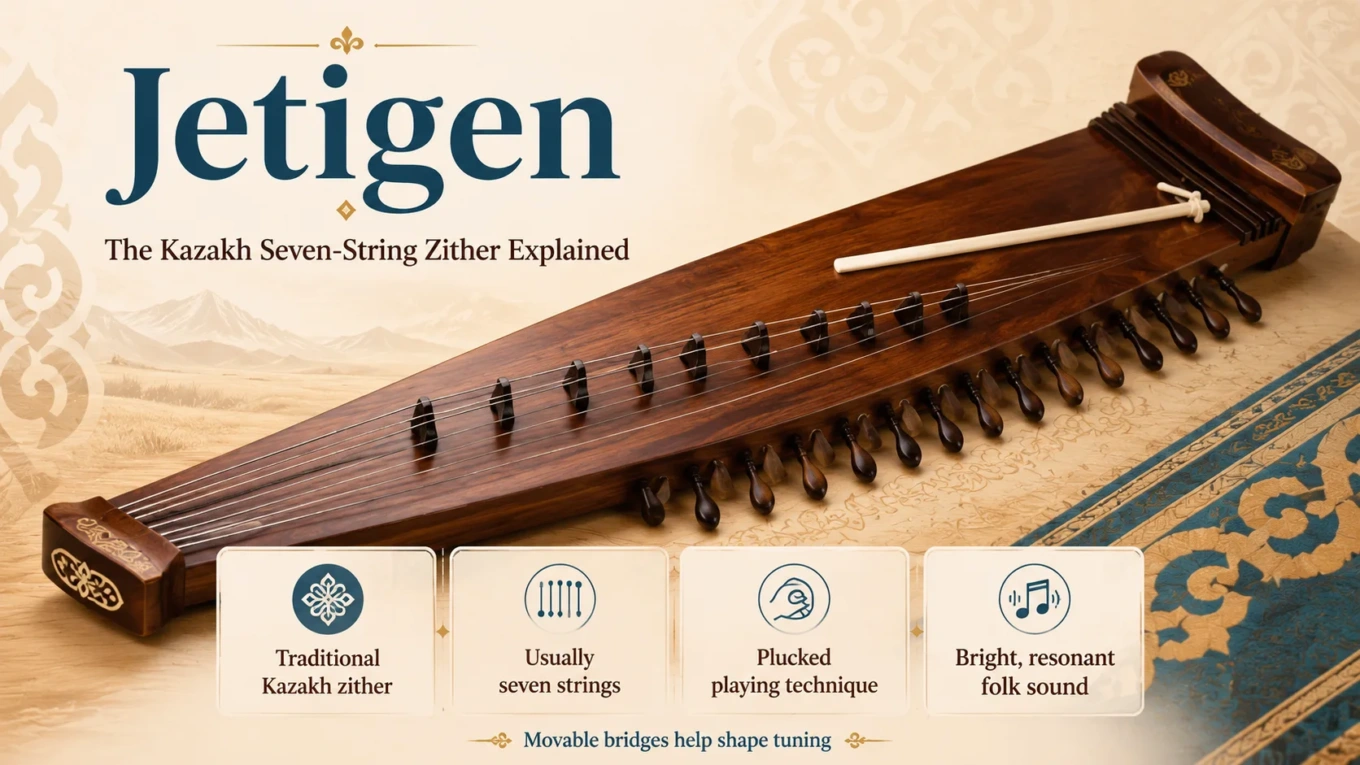
Jetigen: The Kazakh Seven-String Zither Explained
What Is the Jetigen?
The Jetigen, often written zhetygen or zhetigen, is a Kazakh seven-string box zither[1]: a long, low wooden instrument with strings stretched across the body rather than along a neck. Its older form is usually described with seven strings, which fits the Kazakh word zheti, meaning seven. Modern stage and reconstructed forms may vary, but the seven-string idea remains central to how the instrument is named, taught, and remembered.
The instrument belongs to the larger family of plucked zithers[2]. It is set horizontally, and the player draws sound from open strings by plucking them with the fingers. Unlike a dombra, it does not have a long neck or fingerboard. Unlike a harp, its strings run across a hollow body rather than rising from a frame.
For readers trying to place it inside instrument classification, the Jetigen is best understood as a Kazakh chordophone[3] in which the instrument body supports both the strings and the sound. That simple description matters because English-language descriptions sometimes call it a “harp-like” instrument. The shape may invite that comparison, but its structure is zither-like.
Main Details Worth Knowing
| Feature | Description |
|---|---|
| Main Region | Kazakhstan, with related Central Asian names and forms appearing in nearby traditions. |
| Common English Spellings | Jetigen, zhetygen, zhetigen, dzhetigan, and jetigan. |
| Instrument Family | Plucked zither; more precisely, often described as a box zither. |
| Traditional String Count | Seven strings in the older named form; modern versions can differ. |
| Body Type | Oblong wooden box or trough-like body that acts as the resonating body[4]. |
| Playing Method | Plucked with the fingers while the instrument rests horizontally. |
| Pitch Control | Older descriptions mention movable supports under the strings; many modern instruments use more regular bridge and peg systems. |
| Living Heritage Status | Kazakhstan’s National Inventory of Intangible Cultural Heritage includes the art of playing the zhetigen and making the instrument. |
Names, Spellings, and the Idea of Seven
The name zhetygen is commonly explained through the Kazakh word zheti, meaning seven. This connects the instrument to its older seven-string layout. English spelling varies because the name has been transliterated from Kazakh and Russian-based spellings in different ways. Jetigen, zhetygen, and zhetigen usually refer to the same Kazakh instrument in English-language sources.
The spelling choice does not change the organological point: the instrument is a zither with strings stretched over a wooden body. A page may use Jetigen for ease of English reading, while a museum label may prefer zhetygen. Both spellings can be useful as long as the instrument is not confused with unrelated lutes, harps, or bowed instruments.
Classification Note: The number seven is part of the name and older instrument image, but it should not be treated as a rigid rule for every modern performance instrument. Reconstructed, orchestral, and experimental versions may use altered string counts or updated hardware.
Why It Belongs to the Zither Family
A zither is generally understood as a string instrument in which the strings run along or across the body without a separate neck. The Jetigen fits that idea clearly. The strings are not stopped on a fingerboard as they are on the dombra. They are stretched above a body that supplies the main resonating space.
This places the Jetigen near a wider group of long and box-shaped Asian zithers, including instruments such as the guzheng, koto, gayageum, yatga, and đàn tranh. These names should not be treated as versions of one instrument. Each has its own construction habits, playing technique, repertory, and cultural use. The link is structural: strings over a resonating body, sounded mainly by plucking.
The Jetigen is usually much simpler in visual layout than large modern concert zithers with many mechanical parts. Its identity comes from a direct relationship between wood, string, support, hand position, and resonance.
Body Shape and Resonating Design
The Jetigen is commonly described as oblong and box-shaped. Older accounts often describe a body hollowed from a single piece of wood. In that form, the body itself acted like a trough or open wooden resonator. Later forms are described with a covered top, or soundboard[5], which helps transmit string vibration into the body.
The body is not merely a holder for the strings. Its length gives the strings room to vibrate, and its hollow space colors the sound. Wood choice, wall thickness, and top construction can shape resonance, but documented examples do not support one fixed recipe for every Jetigen. Museum pieces, reconstructions, and performance instruments may differ in detail.
From Hollowed Box to Covered Soundboard
Descriptions of the older Jetigen often note a very plain body: a long wooden box, hollowed out, with no separate upper soundboard and no refined peg system. The strings were stretched across or along the top and tensioned in a direct way.
Later instruments are usually described with a thin wooden lid or top. This changes the instrument from a bare hollowed body into a more controlled resonating box. A covered body can give the instrument a clearer and more even response, especially when each string has its own support point.
Bridges, Asyks, and Pitch Control
A bridge[6] lifts a string above the body and helps pass vibration into the soundboard. In the Jetigen, one of the most distinctive older tuning ideas is the use of movable bridges[7] or supports under the strings. Some traditional descriptions identify these supports as asyks[8], small ankle bones used in Kazakh games and craft culture.
Moving a support changes the vibrating length of the string. If the support shortens the vibrating part of the string, the pitch rises. If it lengthens the vibrating part, the pitch falls. This is a practical system rather than a decorative detail; it shows how the Jetigen’s pitch system can be adjusted without a fretted neck.
Modern instruments may use more stable wooden bridges, tuning pins, or other hardware. A tuning peg[9] lets the player or maker adjust string tension. Even when pegs are present, bridge placement still matters because the bridge defines the working length and speaking quality of the string.
Strings, Tuning, and Musical Layout
The older Jetigen is associated with seven strings. Historical descriptions sometimes mention horsehair strings, while modern examples may use different materials depending on maker, performance setting, and availability. It is safest to describe the instrument as a seven-string zither in its traditional named form, not as a single standardized design with one universal string material.
Each string normally works as an open string[10]. The player does not press the string to a fingerboard to create the main pitch. Instead, the instrument is prepared by tuning the strings before performance. The player then plucks the tuned strings to create melody, drone-like support, or repeated rhythmic figures depending on the piece.
Seven Strings as a Musical Reference Point
Seven strings give the Jetigen a focused pitch range. That small string count also shapes how the player thinks. The instrument does not invite the same dense layout as a large guzheng or qanun. It asks for careful selection of pitches, clean articulation, and control of resonance.
In many educational explanations, the seven strings are tied to narrative memory: each string receives an identity through story, song, or lament. This does not prove a single origin date, but it does show how instrument structure and oral tradition can support each other.
Tuning by Supports and Tension
The Jetigen can be tuned through a mix of string tension and string length. Tension is adjusted by pulling, tying, or using pegs, depending on the instrument. String length is shaped by bridge or support placement. This makes the instrument different from a fixed-fret instrument, where the fret positions already define many of the available pitches.
The exact scale pattern[11] may depend on the piece, the teacher, the reconstructed model, or the ensemble setting. A careful description should avoid giving one tuning as if it applies to every Jetigen.
How the Jetigen Is Played
The Jetigen is played horizontally. It may rest on the player’s lap, on a low support, or on a stand, depending on the instrument and performance context. The player plucks the strings from above, usually with the fingers. Some modern players may adapt technique to stage needs, but the basic gesture remains direct: finger to string, string to body, body to sound.
Playing Position
The horizontal position lets the player see the full string layout. It also makes bridge position visible. This matters on an instrument where tuning and support placement are part of the working design. A beginner can often understand the instrument’s logic by looking at it from above.
The player’s hands do not have the same roles as on a necked lute. There is no left hand pressing strings along a fingerboard while the right hand plucks. Instead, both hands may be used around the string field for plucking, damping, repeating tones, or shaping the decay of the sound.
Plucking Technique and Hand Control
Jetigen playing depends on clean plucked articulation[12]. A string can sound warm or pointed depending on where it is plucked and how firmly the finger releases it. Plucking near a bridge often gives a firmer, brighter attack. Plucking farther from the bridge can bring a rounder sound.
Damping is just as useful as sounding. A player can stop a string with a fingertip to shorten its sustain[13]. This keeps overlapping tones from clouding a phrase, especially when the instrument is tuned to related pitches that ring together easily.
Luthier’s Note: On a small zither with few strings, bridge height, string spacing, and top response are easy to hear. A tiny change in bridge fit can affect clarity, buzzing, and balance between strings.
What the Jetigen Sounds Like
The Jetigen is often valued for a soft, clear, and lyrical timbre[14]. Its tone is not usually described as loud or percussive in the way a hammered dulcimer can be. The sound is closer to a gently plucked long zither: present, clean, and shaped by the resonance of the wooden body.
The small number of strings can make the instrument sound open. Rather than filling every moment with many notes, the Jetigen gives space to the decay of each tone. That space is part of its musical character.
Listening Note: Listen for the way one plucked tone remains in the body after the finger leaves the string. On a well-balanced instrument, the note does not simply stop; it settles into the wood and fades evenly.
History, Legend, and Cultural Setting
The Jetigen is connected with Kazakh traditional music and with the broader instrument culture of Central Asia. It appears in cultural education, museum displays, folk ensembles, and heritage performance. Its older form is often presented as a simple wooden zither whose seven strings carry both musical and narrative meaning.
Reliable documentation for very early dates is limited, so the instrument’s history should be handled with care. It is better to describe the Jetigen as an old Kazakh zither tradition with documented modern revival and museum interest than to assign a precise origin century without strong evidence.
Zhetigen as Living Cultural Heritage in Kazakhstan
Kazakhstan’s National Inventory of Intangible Cultural Heritage includes Art of playing the zhetigen and making zhetigen among the country’s traditional craft knowledge and skills. The listing treats performance and instrument making as parts of the same living tradition rather than separating the musical practice from the work of the maker.
The National Museum of the Republic of Kazakhstan describes the older zhetygen with seven strings, horsehair in historical examples, and movable asyks placed beneath the strings for tuning. That description matches the older construction features associated with the instrument while also placing them inside a cultural practice that continues to be documented in Kazakhstan.
The Seven-Song Legend
A well-known legend links the Jetigen to a father who creates music after the loss of seven sons, adding strings as the story unfolds. In cultural retellings, the seven strings are tied to seven named pieces or songs. The tale should be read as a heritage narrative, not as a technical construction manual.
Still, the story helps explain why the instrument’s seven-string identity is memorable. It gives the string count a human and musical meaning, while the instrument itself remains a practical zither built from wood, strings, and supports.
Museum and Revival Context
Museums often describe the Jetigen through construction: wooden body, seven strings, plucked playing, and movable support points. That curatorial language is useful because it separates the instrument from vague labels such as “harp-like” or “ancient string instrument.” The more exact description is stronger: a Kazakh plucked box zither with an older seven-string identity.
In present-day performance, the Jetigen can appear in folk ensembles, educational concerts, and stage arrangements. Some versions are reconstructions inspired by older descriptions. Others are adapted for modern tuning stability and ensemble volume. The name remains tied to Kazakh musical heritage even when the instrument is updated for current performers.
A recent example came in Brussels on 3 July 2026, when the DOMBRAssadors ensemble performed at the Embassy of Kazakhstan in Belgium ahead of National Dombra Day. Kazakhstan’s official account of the event lists the zhetigen alongside dombra, sazsyrnai, shankobyz, kobyz, and dauylpaz, combined on stage with European instruments including oboe, violin, and accordion. The performance shows the zhetigen functioning in a current ensemble setting rather than only as a museum or reconstruction subject.
How It Differs from Related Instruments
The Jetigen shares the broad zither idea with several instruments, but it should not be merged with them. Its smaller seven-string reference point, Kazakh naming, and older support system give it a distinct profile.
| Instrument | How It Relates to the Jetigen |
|---|---|
| Dombra | A Kazakh plucked lute with a neck and fingerboard; the Jetigen is a neckless zither. |
| Kobyz | A bowed Kazakh string instrument; the Jetigen is normally plucked. |
| Guzheng | A Chinese long zither with many strings and movable bridges; structurally related as a zither, but different in repertory, scale habits, size, and technique. |
| Koto | A Japanese long zither; it shares the long zither concept but belongs to another musical tradition. |
| Gusli | A Slavic plucked zither family; some descriptions compare playing posture or general plucked-zither logic, not cultural identity. |
| Autoharp | A chorded zither with mechanical chord bars; the Jetigen does not use that chord-bar system. |
What Beginners Should Know
The Jetigen is visually easy to understand because its strings, supports, and body are exposed. That does not make it careless or simple to master. The challenge is control: even tone, clean damping, balanced string response, and tuning awareness.
- Start with the layout: learn which string gives which pitch before trying fast patterns.
- Listen to decay: the space after a note is part of the phrase.
- Check bridge position: small support changes can alter pitch and clarity.
- Avoid forcing volume: the instrument rewards a controlled pluck more than a hard pull.
- Study related repertory with care: Kazakh ensemble music, solo pieces, and reconstructed teaching material may use different setups.
A beginner coming from guitar or dombra may expect fretting. That habit does not transfer directly. A beginner coming from guzheng or koto may understand the bridge concept more easily, but still needs to learn the Jetigen’s smaller layout and Kazakh musical context.
Care and Collecting Notes
A Jetigen is a wooden string instrument, so stable humidity and gentle handling matter. The body, bridges, and string knots or pegs all work together. A dry or uneven environment can affect tuning and body response, especially on instruments with thin tops or movable supports.
Collectors should pay attention to whether an instrument is a playable modern build, a decorative replica, a museum-style reconstruction, or a student model. These categories can look similar in photographs. The best clues are bridge fit, string spacing, top construction, peg stability, and whether the maker has built the instrument for real tuning pressure.
Collector’s Note: An older-looking Jetigen is not automatically an old instrument. Many examples are recent reconstructions made to show historical form. That can still be valuable, but it should be described accurately.
Common Misunderstandings
“Jetigen” Does Not Mean Every Kazakh String Instrument
Kazakh music includes several string instruments, including the dombra, kobyz, sherter, and Jetigen. The Jetigen is the zither in this group, not a general word for Kazakh strings.
Seven Strings Are Central but Not the Whole Story
The older named form is seven-string, yet the instrument’s identity also depends on body shape, playing method, bridge logic, and cultural use. String count alone is not enough to identify a Jetigen accurately.
It Is Not Simply a Kazakh Guzheng
The guzheng comparison helps with basic shape, but it can mislead. The Jetigen has its own name, story, construction history, and musical setting. Shared zither structure does not erase those differences.
FAQ
Is the Jetigen a zither?
Yes. The Jetigen is a Kazakh plucked zither, often described more specifically as a box zither because its strings run over a wooden resonating body without a separate neck.
Why is the Jetigen called a seven-string instrument?
The traditional name is tied to seven strings, and the Kazakh word zheti means seven. Older descriptions and legends both reinforce that seven-string identity, though modern versions may differ.
Is the Jetigen the same as the zhetygen?
Yes, in most English usage these spellings point to the same Kazakh instrument. Zhetygen, zhetigen, and Jetigen are transliteration variants.
How is the Jetigen tuned?
Traditional descriptions mention tuning by moving supports under the strings and adjusting tension. Modern instruments may also use pegs or other hardware. There is no single tuning that should be applied to every Jetigen.
Is the Jetigen related to the guzheng or koto?
It is related in the broad zither-family sense: strings lie across a resonating body and are plucked. It is not the same instrument as the guzheng or koto, and it belongs to a Kazakh musical setting.
Can beginners learn the Jetigen?
Beginners can understand the layout fairly quickly, but good playing takes careful listening. Clean plucking, damping, tuning awareness, and respect for the instrument’s musical context are the main early skills.
Glossary of Technical Terms
Box Zither: A zither whose strings run over a hollow box-like body. In the Jetigen, this body supports the strings and helps create resonance.
Plucked Zither: A zither sounded by pulling and releasing the strings with the fingers or a plectrum. The Jetigen belongs here because its normal sound comes from plucking, not bowing or hammering.
Chordophone: A musical instrument that produces sound through vibrating strings. Zithers, lutes, harps, and bowed strings are all chordophones, but their body layouts differ.
Resonating Body: The part of an instrument that receives string vibration and makes it audible with more color and volume. On the Jetigen, the wooden box or trough performs this job.
Soundboard: A thin top surface that helps spread string vibration into the body. Later Jetigen forms are often described with a wooden top or lid that works like a soundboard.
Bridge: A support that lifts a string and transfers vibration into the body. Bridge height and fit can affect pitch clarity, response, and buzzing.
Movable Bridge: A bridge or support that can be shifted to change the vibrating length of a string. This idea is central to many long zithers and appears in descriptions of Jetigen tuning.
Asyk: A small ankle bone used in Kazakh traditional games and, in some descriptions of the Jetigen, as a support under the strings. Its placement can help adjust pitch.
Tuning Peg: A peg or pin used to adjust string tension. Some modern Jetigen forms use pegs to make tuning more stable than older tying or pulling methods.
Open String: A string sounded without pressing it against a fingerboard. Jetigen strings usually work this way, with the pitch set before playing.
Scale Pattern: The ordered set of pitches used for a piece or tuning. On the Jetigen, the pattern may change according to the instrument, teacher, or repertory.
Plucked Articulation: The character of a note created by the plucking action. Finger angle, force, and plucking point can make the Jetigen sound warmer, sharper, shorter, or more open.
Sustain: The length of time a note continues after it is plucked. The Jetigen’s sustain depends on string material, body response, bridge fit, and damping by the player.
Timbre: The tone color of an instrument. The Jetigen is often associated with a clear, gentle, and lyrical timbre shaped by wood, string tension, and plucking style.