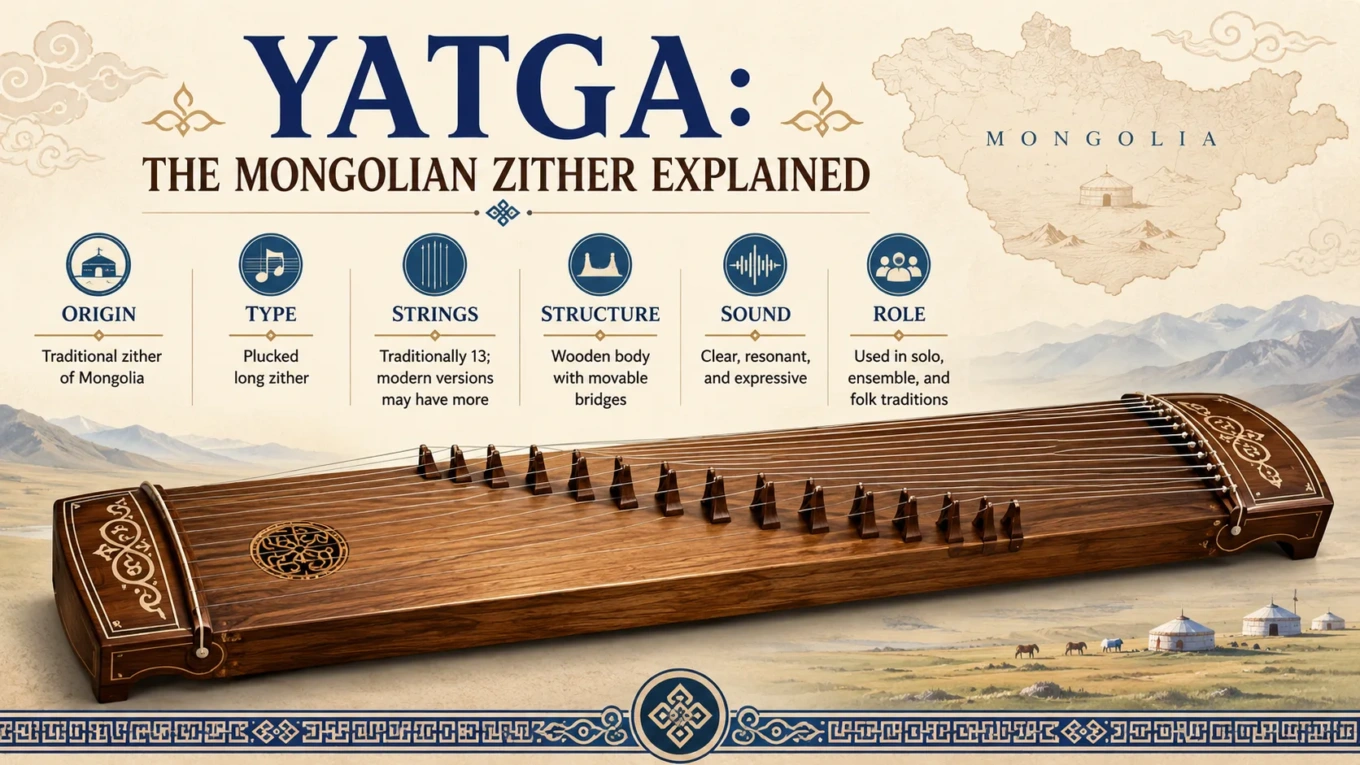
Yatga: The Mongolian Zither Explained
The yatga is a Mongolian plucked zither[1] with long strings stretched over a wooden body and raised by individual bridges. It belongs to the wider family of Asian long zithers, but its shape, playing feel, repertory, and Mongolian naming give it a separate identity. The instrument is often compared with the guzheng, koto, gayageum, and đàn tranh, yet a yatga is not simply a Mongolian copy of any one of them.
What Is a Yatga?
The yatga is a traditional Mongolian string instrument played by plucking. In organological terms, it is a chordophone[2], because its sound comes from vibrating strings. More specifically, it is usually described as a type of box zither[3] or long plucked zither, depending on the source and the exact instrument form being discussed.
A typical yatga has a long wooden body, strings running along its length, and a row of movable bridges[4]. The player plucks the strings on one side of the bridges and can press or bend the strings on the other side to shape pitch and tone. This gives the instrument a flexible, vocal quality rather than a fixed keyboard-like sound.
The name is also written in several ways in English, including yatga, yatuga, and sometimes related regional spellings. These spelling differences usually reflect transliteration rather than different instruments, although related zithers across Inner Asia may have their own local names, construction habits, and repertories.
Main Details Worth Knowing
| Feature | Common Description |
|---|---|
| Instrument Type | Plucked Mongolian zither, often treated as a long box zither or half-tube zither. |
| Sound Source | Strings stretched over a resonating wooden body. |
| Bridge System | Individual movable bridges support the strings and help set pitch. |
| Playing Method | Usually plucked with the right hand, while the left hand bends, presses, ornaments, or sometimes plucks. |
| String Count | Varies by period, region, and modern design; 13-string and 21-string forms are often mentioned in contemporary descriptions. |
| Tuning | Often associated with pentatonic tuning, though modern instruments and ensembles may use other layouts. |
Classification in the Zither Family
The yatga fits the broad zither idea because its strings run across the body of the instrument rather than along a separate neck. In a lute, such as a guitar or tovshuur, the neck is part of the playing system. On a yatga, the body itself carries the strings and supports the bridge arrangement.
Many descriptions call the yatga a half-tube zither[5] because some forms have a gently convex upper surface and a body shape that suggests a long hollowed or arched form rather than a flat board. Other descriptions call it a box zither because the body works as a hollow resonator. Both labels can be useful, as long as they do not erase the instrument’s local Mongolian identity.
Classification Note: The word zither can mean a broad instrument family or a narrower European instrument. For the yatga, the broader organological meaning is intended: a chordophone whose strings lie across the body rather than along a separate neck.
Body Shape and Construction
A yatga usually has a long wooden resonating body[6]. One end may be angled downward or shaped differently from the other, a detail often noted in descriptions of Mongolian forms. The upper surface supports the strings and transmits their vibration into the body, where the sound gains volume and color.
The soundboard[7] is especially important. It is the part of the body that responds most directly to string vibration. On a well-made instrument, the soundboard must be light enough to vibrate but stable enough to hold the pressure of many strings and bridges. Wood choice can shape resonance, but it should not be treated as a single magic cause of tone. Body thickness, bridge fit, string material, tension, and playing technique all matter.
Older and regional descriptions mention silk, gut, or horsehair among historical string materials, while modern instruments may use metal or synthetic strings depending on maker, school, and performance setting. This shift is common in many zither traditions. It often reflects louder concert needs, more stable tuning, easier maintenance, and adaptation to modern ensembles.
The Bridge Layout
The bridge row is one of the easiest ways to recognize the yatga. Each string normally has its own bridge. Moving a bridge changes the speaking length of the string and helps set the basic pitch. Pressing the string on the left side of the bridge can raise the pitch, add ornament, or create a gentle bend.
This is why the yatga does not feel like a fixed-pitch instrument even when its open strings[8] are tuned before performance. The tuned string gives a starting note; the player’s hands give the line its motion.
Strings, Tuning, and Range
There is no single yatga string count that applies to every historical and modern instrument. Some older references describe smaller instruments with fewer strings. Modern stage instruments are often described with 21 strings, and 13-string forms are also documented. Other counts may appear in regional or newly built instruments.
The yatga is commonly linked with pentatonic tuning[9]. A five-note layout suits many melodic patterns associated with Mongolian and Inner Asian repertories, but it should not be assumed that every yatga is tuned in exactly the same way. Ensemble use, teaching systems, composition, and regional style can lead to different arrangements.
Basic tuning is usually handled by tuning devices at the end of the instrument, while fine placement can be adjusted through bridge position. This combination lets the instrument keep a stable layout while still allowing the player or teacher to adapt it for a piece.
Why the Missing Notes Matter
On a pentatonic instrument, not every step of a seven-note Western scale is present as an open string. That does not make the instrument limited. It changes the playing logic. The musician can use string bending, ornaments, and alternate tuning to reach expressive notes outside the basic open-string layout.
On many long zithers, the space around the bridge becomes a second musical area. The right hand may pluck the main sounding side, while the left hand shapes the string on the other side. This is a major reason the yatga can sound fluid even when its bridge layout looks orderly and fixed.
How the Yatga Is Played
The yatga is usually placed horizontally, either on stands or with one end supported by the player, depending on instrument size and performance setting. The higher-pitched strings are commonly placed toward the player’s right-hand side. The right hand plucks, while the left hand works the string beyond the bridge.
Players may use bare fingernails, fingertips, or plectra[10], depending on school and instrument design. Modern stage playing can involve sharper attack and clearer projection, while more intimate playing may favor a softer touch.
- Plucking sets the string into motion and gives the note its first shape.
- Pressing changes tension and can raise pitch after the note begins.
- Sliding and bending create ornaments rather than simple note-to-note movement.
- Arpeggiated patterns can fill space without turning the instrument into a chord machine.
- Left-hand damping can shorten resonance when a cleaner phrase is needed.
A skilled player does not only choose notes. The player controls the life of each note: attack, bend, release, decay, and silence.
Sound and Listening Character
The yatga can produce a clear plucked sound with a smooth decay. The movable bridge system helps create a tone that is bright at the attack but flexible after the pluck. When the left hand presses behind the bridge, the note can lean upward in pitch, giving the melody a singing contour.
The instrument’s timbre[11] depends on string material, bridge height, body design, and touch. Metal or synthetic strings may give more brilliance and projection. Softer string materials can give a warmer, less metallic response, though exact results vary by maker and setup.
Listening Note: A yatga phrase often carries motion after the pluck. Listen for small bends, pressed ornaments, and changes in resonance rather than only the first struck pitch.
Names, Regional Use, and Cultural Setting
The yatga is associated with Mongolian musical culture, including solo performance, ensemble music, stage arrangements, and teaching contexts. Historical descriptions often connect certain forms of the instrument with courtly or ceremonial settings, while modern use is broader and may include folk groups, conservatory training, concert arrangements, and cross-cultural projects.
Some sources mention symbolic string counts in older court contexts, especially the idea of a 12-string form tied to rank or hierarchy. Such details should be read carefully. They tell us that the yatga had cultural meaning beyond sound, but they do not mean every yatga in every period followed the same rule.
In modern Mongolia and among Mongolian communities elsewhere, the yatga can appear beside instruments such as the morin khuur, tovshuur, limbe, yoochin, and vocal traditions. Its role changes with the setting. It may carry melody, add color in an ensemble, support a singer, or stand as a solo concert instrument.
How the Yatga Differs from Related Instruments
The yatga belongs to a family of long bridged zithers found across East and Inner Asia. Comparisons are useful, but they can become misleading when they turn related instruments into one generic type.
| Instrument | Region or Tradition | Main Point of Difference |
|---|---|---|
| Yatga | Mongolian | Long plucked zither with Mongolian repertory, naming, and playing habits. |
| Guzheng | Chinese | Closely related long zither tradition with its own schools, tunings, and modern concert technique. |
| Koto | Japanese | Long bridged zither with Japanese notation, repertory, and performance practice. |
| Gayageum | Korean | Plucked zither tradition with Korean forms, stringing, and ornament patterns. |
| Đàn Tranh | Vietnamese | Vietnamese long zither with its own modal language and left-hand ornament style. |
The yatga and guzheng are often compared because both use long bodies, movable bridges, and plucked strings. The comparison is fair at the family level. It becomes too simple if it treats the yatga only as a version of the guzheng. Mongolian performance practice, repertory, instrument naming, and musical setting give the yatga its own place.
Traditional and Modern Forms
Yatga construction has not stayed frozen. Many traditional instruments changed during the twentieth century as musicians, makers, schools, and ensembles adapted them for stage performance. Similar changes occurred with other Mongolian instruments and with related zithers in neighboring traditions.
Modern yatgas may have more strings than older forms, stronger hardware, brighter strings, and dimensions suited to concert halls or classroom use. Some are built for solo performance. Others fit ensemble settings where tuning stability and projection matter.
This creates a useful distinction:
- Older or regional yatga forms may have fewer strings, softer materials, and more local variation.
- Modern concert yatgas often use standardized string counts and stronger construction for teaching and stage use.
- Experimental or revival instruments may draw on older descriptions while using modern materials.
None of these forms should be treated as the only “real” yatga. Instrument traditions often survive by keeping older knowledge while allowing practical change.
Materials and Care
A yatga is sensitive to tension, humidity, bridge position, and string condition. Like many wooden zithers, it should be kept away from sudden temperature changes and very dry or damp storage. The bridges should sit firmly without leaning, and the strings should not be forced beyond a safe range.
Bridge movement is normal during tuning, but rough handling can mark the soundboard or weaken stability. Players and owners should move bridges with care, especially on instruments with a polished surface or delicate top wood.
Luthier’s Note: The bridge is small, but it carries a large job. Its contact with the soundboard affects pitch, clarity, sustain, and balance. A poorly seated bridge can make one string sound dull even when the string itself is in good condition.
What Beginners Should Know
The yatga can be approachable at the first stage because a pentatonic layout can make simple melodies sound natural. The harder part comes later: controlling bend, pressure, resonance, and timing. A beginner may play the correct open string and still miss the character of the phrase if the left hand remains stiff.
New players should pay attention to three habits early:
- Clean plucking: each note should start clearly without scraping across nearby strings.
- Controlled pressure: bending should be smooth, not sudden or uneven.
- Listening to decay: the space after the pluck is part of the music.
Reading staff notation or number notation may depend on the teacher and setting. Some modern teaching contexts adapt notation systems used for related zithers, while traditional learning may rely more on demonstration, listening, and repetition.
Museum and Collection Descriptions
In museum or catalog language, the yatga may appear under several labels: Mongolian zither, plucked zither, box zither, half-tube zither, or long zither. These labels describe structure, not the full cultural life of the instrument. A collection record may also list materials, string count, bridge count, region, maker, or date when known.
For identification, the most useful visible details are the long body, individual bridges, string layout, and playing orientation. Decorative carving or painted details can help with dating or regional study, but decoration alone is not enough to identify the instrument accurately.
When a source gives a precise string count, tuning, or date, it should be read as information about that example unless the source clearly states a wider rule. Yatga forms vary too much for one measurement to define the whole tradition.
Common Misunderstandings
“Yatga” Does Not Mean Every Mongolian String Instrument
Mongolian music includes several string instruments, including bowed, plucked, and struck types. The yatga is specifically a zither-like instrument with strings stretched along a resonating body. It is not the same as the morin khuur, tovshuur, or yoochin.
It Is Related to the Guzheng, but Not the Same Instrument
The yatga and guzheng share family traits: long body, bridges, and plucked strings. Their musical languages, teaching lineages, repertories, and cultural settings are different. The relationship is best understood as kinship, not identity.
String Count Is Not Fixed Across All Yatgas
Modern 21-string instruments are often discussed, but smaller and older forms are also documented. A careful description should say which form it means rather than giving one number as a universal rule.
Pentatonic Tuning Does Not Mean Simple Music
A five-note tuning can support subtle phrasing. Bends, ornaments, damping, bridge placement, rhythm, and tone color all add detail beyond the open-string scale.
Glossary of Technical Terms
- [1] Zither
- A string instrument in which the strings run across the body rather than along a separate neck. In the yatga, the body, strings, and bridge row form one playing surface.
- [2] Chordophone
- An instrument whose sound is produced by vibrating strings. The yatga is a chordophone because plucked strings create the tone.
- [3] Box Zither
- A zither with a hollow box-like resonating body. Many yatga descriptions use this term because the wooden body amplifies the strings.
- [4] Movable Bridge
- A bridge that can be shifted to adjust string length and pitch. On the yatga, each string commonly has its own bridge, allowing flexible setup and fine tuning.
- [5] Half-Tube Zither
- A zither with a body form that resembles part of a tube or an arched hollow shape. Some yatga forms are described this way because of their convex upper surface and long body.
- [6] Resonating Body
- The hollow or shaped body that amplifies string vibration. In a yatga, this body helps turn a plucked string into a fuller, carrying tone.
- [7] Soundboard
- The vibrating top surface of a string instrument. On a yatga, the bridges pass string energy into the soundboard, which helps shape volume and tone color.
- [8] Open String
- A string sounded without left-hand pressure or bending. On the yatga, open strings provide the basic tuned notes, while hand pressure can alter pitch and ornament the sound.
- [9] Pentatonic Tuning
- A tuning layout built around five notes per octave. Many yatga descriptions mention pentatonic tuning, though exact pitch sets can vary by instrument and musical setting.
- [10] Plectrum
- A small pick or plucking aid used to set strings in motion. Some yatga players use fingernails or fingertips, while others may use picks depending on style and training.
- [11] Timbre
- The tone color of a sound. On the yatga, timbre is shaped by strings, bridges, body design, touch, and the way notes are bent or allowed to resonate.
FAQ
Is the yatga a type of zither?
Yes. The yatga is a Mongolian plucked zither because its strings run along the body of the instrument and are sounded by plucking. It belongs to the broad zither family rather than the narrow European concert zither tradition.
How many strings does a yatga have?
There is no single number for every yatga. Modern examples are often described with 21 strings, while 13-string and other forms are also known. String count depends on period, maker, region, and performance use.
Is the yatga the same as the guzheng?
No. The yatga and guzheng are related long zithers with movable bridges, but they belong to different musical traditions. Their repertory, playing style, naming, and cultural setting are not the same.
How is the yatga usually played?
The player usually plucks the strings with the right hand and uses the left hand to press, bend, ornament, or damp the strings. This left-hand work gives the instrument much of its expressive pitch movement.
Is the yatga tuned pentatonically?
Many yatga descriptions mention pentatonic tuning, especially in traditional and teaching contexts. Modern instruments may use different layouts depending on the piece, ensemble, or teacher.
Can beginners learn the yatga easily?
Beginners can often start with simple plucked melodies, especially on a pentatonic layout. The deeper challenge is learning smooth pitch bending, clean plucking, bridge awareness, and control of resonance.