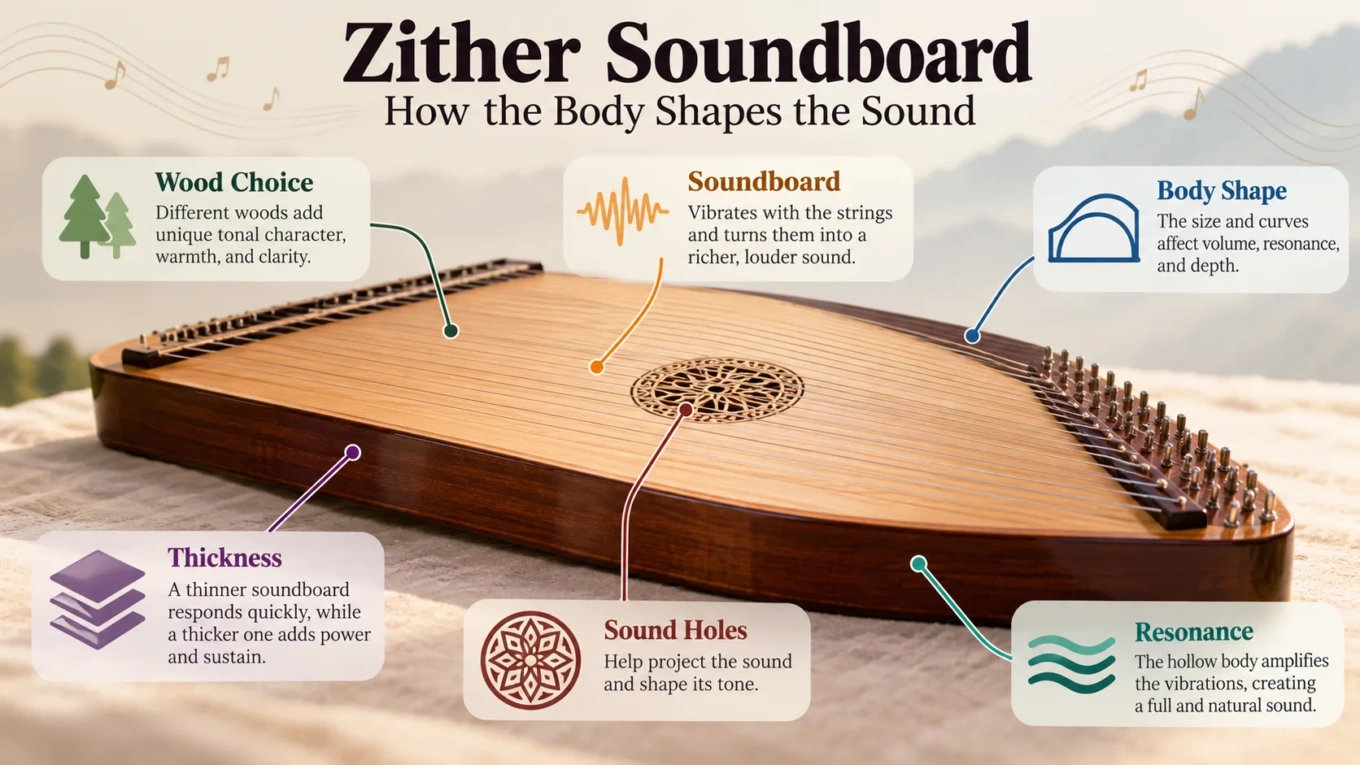
Zither Soundboard: How the Body Shapes the Sound
A plucked zither string produces only a modest amount of audible sound by itself. The fuller voice comes when string motion reaches a larger vibrating structure: the soundboard[1] or, in some zither forms, another part of the body that serves the same acoustic job. That surface bends, excites the surrounding air, interacts with the rest of the instrument, and gives the string a pattern of resonance that affects loudness, tone color, attack, and decay.
Here, “zither” is used in the broad organological sense of a chordophone[2] whose strings run across or along the body rather than along a separate projecting neck. The family includes very different structures. A European concert zither, a guzheng, a gayageum, a koto, a traditional five-string kantele, a psaltery, and a tube zither do not transfer string energy in exactly the same way. The useful question is therefore not whether every zither has one standard soundboard design, but how each body receives, distributes, and radiates vibration.
Why the String Needs the Body
A vibrating string is narrow. It can move quickly, but its surface area is too small to push much air efficiently at musical frequencies. The instrument body solves that problem through acoustic coupling[3]: force from the string is passed into a larger structure that can move more air.
Typical energy path: pluck or strike → string vibration → contact or support point → vibrating body surface → enclosed or surrounding air → radiated sound.
On many zithers, a bridge[4] forms the main connection between string and body. On others, the string terminates more directly on the body. The traditional five-string Finnish kantele is a useful example: it can work without a conventional bridge, with strings anchored through tuning pins at one end and a supporting bar at the other. Its sound therefore depends strongly on the way the string ends interact with the wooden structure.
This distinction matters because a soundboard is not an amplifier in the electronic sense. It is part of a mechanical system. The string, its supports, the wood, the body geometry, the air space, and even the way the instrument rests on a table or player can influence one another.
The Soundboard Is Not a Single Moving Panel
It is tempting to imagine a zither top moving up and down like one rigid sheet. Real soundboards behave differently. Different regions bend by different amounts at different frequencies. The resulting patterns are called modal vibrations[5].
At one frequency, a broad section of the top may move strongly while another region barely moves. At another frequency, the pattern may split into several smaller moving zones. Boundaries between areas moving in opposite directions can include nodes[6], where local motion is very small.
This helps explain why two strings on the same instrument can excite the body differently. Their pitches are different, but so are their positions, bridge locations, force directions, and harmonic contents. A note that lies near a strong body mode may gain more response than a nearby note that couples less effectively to the structure.
Measurements on kantele bodies show many closely spaced structural modes rather than one simple resonant frequency. Work on guzheng soundboards likewise shows that arching and plate geometry change the distribution of vibration modes. These findings fit a broader rule of wooden string instruments: the body has a frequency-dependent response, not one fixed “resonance.”
Mass, Stiffness, and Damping Shape the Response
Three mechanical properties help explain much of soundboard behavior: mass, stiffness[7], and damping[8].
- Mass affects how readily a surface can be accelerated. A heavier plate generally needs more force to reach the same motion, though mass distribution matters as much as total weight.
- Stiffness describes resistance to bending. A stiffer region tends to place some resonances higher in frequency and can limit motion under a given force.
- Damping describes how quickly vibrational energy is lost inside the material and through joints, contact points, finishes, air loading, and other pathways.
These properties work together. A very light soundboard is not automatically better, and a very stiff one is not automatically clearer. The maker needs enough movement to radiate sound while keeping the structure stable under continuous string tension.
This is also why wood species alone cannot predict the voice of an instrument. Two boards cut from the same species can differ in density, grain orientation, latewood-to-earlywood pattern, defects, moisture content, stiffness, and internal damping. Construction choices then add another layer.
Thickness Changes More Than Loudness
Changing soundboard thickness changes both mass and bending resistance. A thinner plate may move more easily in some frequency ranges, but removing material also changes mode frequencies, local strength, and the way force spreads around bridge or pin areas. If taken too far, thinning can create structural distortion or an uneven response.
A thicker plate usually resists bending more strongly. That can support high string loads, but the same surface may require more force to move. The acoustic result depends on the full design, not thickness in isolation.
Some soundboards are not uniform plates. Thickness may vary across the width or length, and long zithers may use a curved or arched top. Experimental work on paulownia guzheng boards has shown that changing arch height alters stiffness distribution and vibrational response. In practical terms, curvature is not merely a visual profile; it changes how the board carries load and how it bends.
Grain Direction Makes Wood Directional
Wood is anisotropic[9]: its mechanical properties differ with direction. A board normally resists bending differently along the grain than across it. Vibrational waves also travel through the material differently according to grain orientation.
That directional behavior is one reason straight, well-oriented grain is valued in many soundboards. It does not create one guaranteed tone. Instead, it gives the maker a more predictable relationship between strength, weight, and vibration.
Paulownia is widely documented in modern guzheng making and is also closely associated with many gayageum and koto bodies, although wood names and species descriptions can vary among traditions and records. European zithers may use spruce or other resonant softwoods in their tops, while other zither forms use locally available woods or a body material such as bamboo. These materials should not be treated as interchangeable recipes. A long arched light-wood board carrying individual movable bridges works under different structural conditions from the top of a shallow box zither.
The Bridge Controls How String Force Enters the Body
Where a bridge is present, it is more than a string support. It defines a contact route between the vibrating string and a much larger surface. Its mass, stiffness, footprint, height, fit, and location can all influence how force enters the body.
This transfer is often described through mechanical impedance[10]. In plain terms, the string and body do not move equally easily. The bridge sits between systems with very different masses and stiffnesses, so its geometry and contact conditions affect how energy is exchanged.
Very weak coupling can leave more energy in the string but drive the body less strongly. Stronger coupling can make the body respond more readily while also allowing string energy to leave faster. That is why louder attack, longer ringing, and stronger resonance do not always rise together.
Movable Bridges Change Both Geometry and Coupling
Guzheng, koto, gayageum, and several related long zithers use individual movable bridges. Moving one changes the string’s speaking length[11], which is one reason bridge position is part of tuning. It also changes where force enters the soundboard.
That second effect is easy to overlook. A bridge placed over one area of the board may sit near a region that moves strongly for a given frequency, while a different position may interact with another modal pattern. Bridge height and string geometry can also alter the break angle[12] and the downward component of string force.
The audible result cannot be predicted from bridge position alone because pitch, tension, string construction, playing force, and board response remain connected. Still, a movable bridge is acoustically active. It does not serve pitch alone.
String Tension Loads the Body Before a Note Is Played
A zither body is already carrying force before any string is plucked. Strings pull continuously between their anchor points, and a bridge can add a downward component where the string changes direction over its crest. With many strings, these forces become part of the structural design of the whole instrument.
This static load matters acoustically because a preloaded plate does not behave exactly like an unloaded piece of wood. Deflection, arching, joint stiffness, and the local condition around bridges or pins can change how the structure responds to small musical vibrations. A long curved soundboard can therefore serve two jobs at once: it provides a radiating surface and helps manage string load.
More tension is not a universal route to better tone. Tension must suit the string scale, body strength, bridge geometry, and intended pitch. What matters for the soundboard is the force pattern it actually receives and how the structure remains stable while vibrating around that loaded state.
The Air Inside a Hollow Zither Also Resonates
In a box or hollow-bodied zither, the wood does not work alone. As the top and other surfaces move, they compress and rarefy the enclosed air. This creates cavity resonance[13] and couples the air volume to the vibrating structure.
Body depth, internal volume, opening area, and plate flexibility all influence this interaction. A larger cavity does not automatically create “more bass.” Changing volume can move air-related resonances, but it also tends to come with changes in plate area, stiffness, body depth, and structural mass.
If the body has one or more sound openings, the lowest air response may show Helmholtz-type resonance[14], where air in the opening moves against the spring-like air volume inside the body. Real instruments are more complicated because the wooden surfaces are flexible and several air and structural modes can interact.
What the Soundhole Actually Does
A soundhole[15] should not be understood simply as a hole that “lets sound out.” Sound is already radiated by vibrating wood surfaces. The opening changes air motion and the acoustic behavior of the enclosed body.
Its area and location can therefore affect resonance, but decorative shape by itself does not prove a special acoustic advantage. Historic box zithers and psalteries may carry circular, geometric, carved, or rosette-like openings for a mixture of structural, acoustic, and decorative reasons.
The Back, Sides, and Internal Supports Are Part of the System
The top plate often receives most attention, yet the rest of a hollow body is not acoustically invisible. Vibrational energy can pass into the sides and back through joints. Those surfaces can move, absorb energy, or alter the boundary conditions of the soundboard.
Internal supports and bracing[16], when present, perform structural and acoustic jobs at the same time. A brace can limit local bending, spread load, change a modal pattern, or move a resonance to another frequency range. Zither designs vary widely, so guitar-style bracing should not be assumed.
How the instrument is supported during playing can matter as well. A body resting firmly on a table has different contact conditions from the same body supported at a few points or held partly against the player. Contact can suppress motion in some areas and leave other areas freer to vibrate. This is one reason laboratory measurements often specify how an instrument is suspended or supported.
Different Zither Bodies Create Different Resonance Paths
| Zither Form | Main Transfer Route | Acoustic Feature to Notice |
|---|---|---|
| European concert zither | Strings couple through bridges and body structure into a resonating top and hollow body. | Many strings share a complex plate-and-cavity system, so body modes can influence registers differently. |
| Guzheng, koto, gayageum | Individual movable bridges carry string force into a long wooden top. | Bridge position affects both speaking geometry and the place where each string excites the board. |
| Traditional five-string kantele | String terminations drive the body without a conventional bridge. | The termination geometry itself contributes to the characteristic vibration behavior. |
| Box zither or psaltery | Bridge, pins, or supports feed vibration into a shallow box structure. | Top, back, enclosed air, and any sound openings form a coupled resonating system. |
| Tube zither | Strings or string-like strips drive the tubular body, sometimes through small supports. | The tube wall may function as the main resonating structure rather than a separate flat soundboard. |
The table shows why “soundboard” must be used carefully across the zither family. In a concert zither or guzheng, a distinct top plate is easy to identify. In a tube zither, the body wall itself can fill much of the same acoustic role. In a board zither with little or no enclosed cavity, structural vibration may matter more than box-air behavior.
Why a Larger Body Does Not Simply Mean a Deeper Sound
Body size affects many variables at once. A larger instrument may provide more vibrating area and a larger air volume, but it can also have different plate thickness, arching, string lengths, bridge positions, bracing, and total string load.
Low-frequency sound requires effective motion over enough radiating area, yet size alone does not guarantee it. Radiation efficiency[17] depends on how the vibrating structure couples to the air at each frequency. A large, very stiff panel may move less than a smaller, more compliant one. Conversely, a large flexible surface may support lower modes that a compact design cannot reproduce in the same way.
This is why simple rules such as “bigger body means more bass” or “thinner top means more volume” fail when moved from one zither design to another.
How Body Design Changes Attack, Sustain, and Tone Color
The body affects more than overall loudness. It helps shape how a note begins, how long different partials remain audible, and how energy is distributed across the spectrum.
Sustain[18] depends partly on how quickly energy leaves the string and how quickly the body loses that energy. A strongly coupled resonance can make one frequency band bloom quickly yet decay sooner. A weakly coupled string may ring for a long time while sounding less present in the room.
The attack transient[19] is the brief, complex beginning of a note. Bridge hardness, plucking point, plectrum or fingertip contact, and the high-frequency response of the soundboard all influence this first moment. Two instruments tuned to the same pitch can therefore differ immediately in clarity, sharpness, or softness before their sustained tones settle.
Long multi-string zithers can also develop sympathetic vibration[20]. A played string can excite other strings through the shared body when their frequencies or partials align closely enough. The soundboard is the mechanical meeting place that allows this interaction to become audible.
Construction Changes and Their Likely Acoustic Effects
| Construction Change | Mechanical Effect | Possible Audible Result |
|---|---|---|
| Thinner soundboard | Reduces mass and often lowers bending resistance, depending on material and geometry. | May increase response in some ranges, but excessive thinning can reduce stability or create uneven behavior. |
| Greater arch or curvature | Redistributes stiffness and changes how load travels through the plate. | Can shift modal frequencies and alter which regions respond strongly. |
| Heavier or stiffer bridge | Changes the mass and impedance of the string-to-body connection. | Can alter attack, energy transfer, and balance across partials. |
| Stronger internal support | Restricts bending in selected areas and changes structural boundaries. | May suppress one response while strengthening or shifting another. |
| Different soundhole area | Changes the motion of cavity air and its interaction with the flexible body. | Can move an air-related resonance and change low-frequency response. |
| More damping | Removes vibrational energy faster. | Can shorten ringing and reduce strong resonant peaks; it may also control unwanted persistence. |
No row works as a stand-alone prediction. A bridge change that helps one instrument may hinder another because plate mass, string tension, contact area, body geometry, and wood properties are different. Instrument making is therefore a process of balancing interacting parts rather than maximizing a single acoustic property.
Why Two Similar Zithers Can Sound Different
Two instruments built to the same outline can still differ audibly. Natural wood variation is one reason, but not the only one.
- Actual density and stiffness can vary from one soundboard blank to another.
- Grain orientation and local thickness can change modal patterns.
- Bridge fit and contact area can alter coupling.
- Glue joints can change local stiffness and damping.
- String material, gauge, tension, and age change the force driving the body.
- Small differences in arching or internal support can move resonances.
- Moisture content can change wood mass, dimensions, and mechanical properties.
- Repairs, replacement parts, and long-term deformation can change the original structure.
Humidity deserves careful wording. Wood gains and loses moisture with the surrounding air, and that can alter dimensions and mechanical response. It does not mean every humidity change produces an obvious tonal shift, nor does older or drier wood automatically sound better. The effect depends on the instrument, the amount of change, and the structure as a whole.
What Makers Are Balancing in a Zither Body
A useful soundboard must do several jobs that can pull in different directions. It needs enough flexibility to respond to the strings, enough stiffness to maintain shape, enough strength to survive long-term load, and a distribution of mass that supports the intended response across the instrument’s range.
The bridge or string termination must also deliver force without creating unstable contact. The body needs joints and supports strong enough for service, yet every added piece can change mass, stiffness, or damping. On hollow designs, the air cavity adds another layer of interaction.
This is why the characteristic voice of a zither cannot be assigned to one wood species, one soundhole shape, or one thickness measurement. The audible result emerges from the relationship among strings, coupling points, vibrating surfaces, enclosed air, structural supports, and playing contact. The soundboard is central in many designs, but it speaks as part of the whole body.
Glossary of Technical Terms
Soundboard. The main vibrating surface that receives string energy and helps radiate sound. On many box and long zithers it is the top plate, while other forms may use the body wall itself for much of the same job.
Chordophone. An instrument whose primary sound begins with vibrating strings. Zithers form a broad chordophone group in organological classification.
Acoustic Coupling. The transfer of vibrational energy between parts of an instrument, such as from a string through a bridge into a soundboard.
Bridge. A support that defines or helps define the vibrating string length and transfers string force into the body. Zither bridges may be fixed, shared, individual, or movable.
Modal Vibration. A characteristic pattern in which a structure bends or moves at a particular resonant frequency. Zither soundboards support many such patterns across the musical range.
Node. A region of very small motion within a vibration pattern, often lying between areas that move in different directions.
Stiffness. Resistance to deformation or bending. In a zither body, stiffness affects structural stability and the frequencies at which plates and supports prefer to vibrate.
Damping. The loss of vibrational energy over time. Wood, joints, finishes, air, string supports, and player contact can all contribute to damping.
Anisotropy. Direction-dependent material behavior. Wood is strongly anisotropic, so its stiffness and vibration properties differ along and across the grain.
Mechanical Impedance. A measure of how a structure resists vibrational motion when force is applied. It helps describe why energy does not pass from a zither string into the body equally at every frequency.
Speaking Length. The active section of a string that produces the intended pitch between its effective endpoints. Moving an individual bridge changes this length on many long zithers.
Break Angle. The angle formed where a string changes direction over a bridge or similar support. It contributes to the direction and amount of force applied at that contact point.
Cavity Resonance. Resonant motion of the air inside a hollow instrument body. It can interact with the vibrating soundboard, back, and sound openings.
Helmholtz-Type Resonance. A low-frequency air resonance produced when air at an opening moves against the compressible air inside a cavity. Flexible instrument walls make the real behavior more complex than the simplest textbook model.
Soundhole. An opening in a hollow instrument body that affects air motion and cavity behavior. It is not simply an exit through which all sound leaves the instrument.
Bracing. Internal strips, bars, or supports used to reinforce a vibrating plate or control its bending. Their layout varies widely among zither designs.
Radiation Efficiency. How effectively structural vibration produces sound in the surrounding air. The same amount of plate motion does not radiate equally well at every frequency.
Sustain. The period during which a musical tone remains audible after its initial excitation. On a zither, it depends on both string losses and the way energy is exchanged with the body.
Attack Transient. The brief beginning of a note, when the spectrum and amplitude change rapidly after a string is plucked or struck.
Sympathetic Vibration. Vibration in an unplayed string caused by energy from another sounding string passing through the shared instrument body.