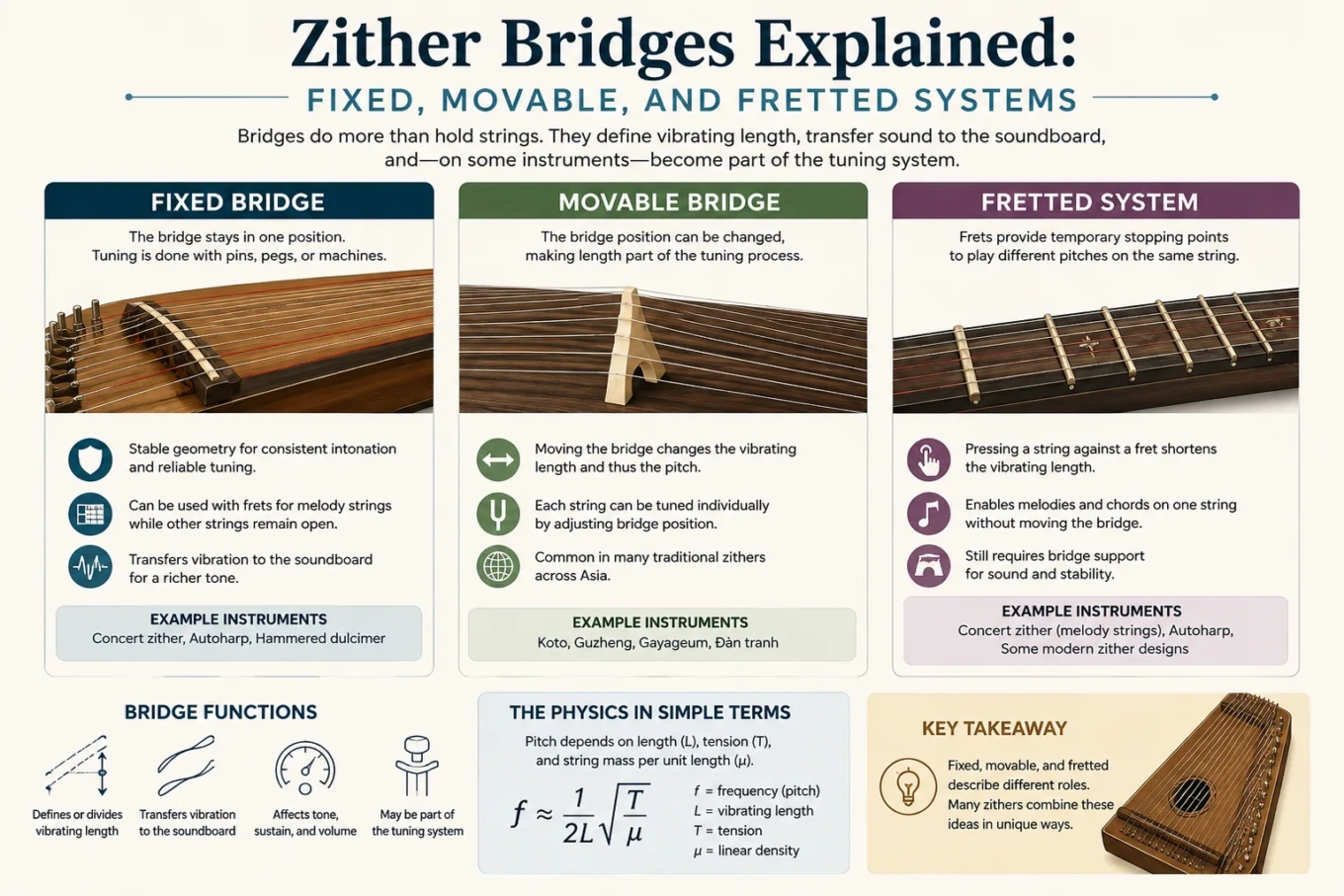
Zither Bridges Explained: Fixed, Movable, and Fretted Systems
A zither bridge does more than hold strings above the body. It helps define the speaking length[1] of a string, transfers vibration toward the soundboard, and, on some instruments, becomes part of the tuning system itself. The terms fixed bridge, movable bridge, and fretted are often grouped together, but they do not describe three equivalent bridge types. Fixed and movable describe what the bridge can do physically; fretted describes how a player shortens a string to obtain different pitches.
This distinction explains why a concert zither can have a fixed bridge and frets at the same time, while a koto can use movable bridges without frets. Some zithers combine arrangements that do not fit neatly into either pattern.
Structural distinction: a bridge establishes or divides a vibrating string length. A fret creates a temporary stopping point when the string is pressed against it. A fretted zither still needs bridge support.
What the Bridge Controls
A stretched string produces pitch according to several interacting properties: its vibrating length, tension, and mass per unit length. The bridge matters because it normally marks one boundary of the part of the string that is free to vibrate.
In a simplified ideal-string model:
f ≈ (1 / 2L) × √(T / μ)
Here, f is frequency, L is vibrating length, T is string tension, and μ is linear density[2], meaning the mass of the string per unit of length.
If length becomes shorter while the other values remain unchanged, pitch rises. If tension rises while length and string mass remain unchanged, pitch also rises. Real instruments are more complicated because moving a bridge can alter both geometry and tension at the same time.
The bridge also provides a mechanical route between string and body. A string vibrating freely in the air moves very little air by itself. Through the bridge, part of that motion reaches the soundboard[3], whose larger surface can radiate the vibration more effectively.
Fixed Bridges Keep the Main Geometry Stable
A fixed bridge[4] is installed in a position that is not normally changed as part of routine tuning. The strings may be tuned with pins, pegs, machines, levers, or another mechanism, while the bridge remains where the maker intended it to sit.
Fixed does not mean acoustically passive. Bridge height, contact with the soundboard, saddle shape, and exact position can all affect string geometry. On a fretted instrument, bridge placement also has a direct relationship with intonation.
One Bridge Can Support Several String Groups
European concert zithers show why bridge terminology needs care. Their melody strings run above a fretboard, while accompaniment, bass, and other open strings occupy a separate part of the body. Documented museum instruments use fixed bridge structures or saddles for these string groups even though only the melody section is fretted.
The result is a mixed pitch architecture on one soundbox:
- melody strings can produce several pitches by being stopped against frets;
- open accompaniment strings normally produce their tuned pitches without fretting;
- both sections still depend on stable bridge geometry.
Calling the entire instrument simply a “fretted bridge system” would therefore blur two separate mechanisms.
A Fixed Bridge Can Also Divide a String
The hammered dulcimer provides another arrangement. On many forms, strings cross bridges placed on the soundboard rather than terminating immediately at them. A treble bridge can divide a string course into playable sections on both sides.
That means a fixed bridge is not always an endpoint. It can function as a dividing bridge[5], creating two effective vibrating lengths from the same stretched course. In common hammered-dulcimer layouts, pitches found on opposite sides of a treble bridge may be arranged a fifth apart, although layouts vary among instrument traditions and makers.
Movable Bridges Make Position Part of the Tuning System
A movable bridge[6] can be repositioned on the soundboard rather than being permanently fixed at one scale location. Long zithers such as koto, guzheng, gayageum, and đàn tranh provide familiar examples of instruments in which individual strings pass over separate movable supports.
Moving one of these bridges changes the geometry of that string. If the active vibrating section becomes shorter, its pitch tends to rise; if it becomes longer, its pitch tends to fall. Final tuning still involves string tension, so bridge placement and tuning hardware work together rather than acting as completely independent controls.
Why Individual Bridges Change the Instrument’s Layout
When every string has its own bridge, the soundboard becomes part of an adjustable geometric system. Bridge spacing must leave room for adjacent strings and for the player’s hands, while each bridge needs stable contact with the body.
A movable bridge therefore has several jobs at once:
- support the string at the required height;
- define the main vibrating section of that string;
- transfer vibration to the body;
- remain stable under string tension;
- allow the instrument to be configured for the required tuning.
The bridge is not normally moved continuously while a note is sounding. It is positioned during tuning or setup, then remains stable while the instrument is played.
The String Beyond the Bridge Can Remain Musically Useful
On several East Asian long zithers, the string continues beyond the movable bridge. This non-primary section is not merely unused excess string. Depending on the instrument and technique, the player can press or manipulate the string on one side of the bridge to change tension in the sounding section.
This produces pitch bending[7], ornaments, inflections, and other controlled pitch movements. The exact technique differs among koto, guzheng, gayageum, and related instruments, so they should not be treated as interchangeable versions of one design.
Fretted Systems Shorten the String Without Moving the Bridge
A fret[8] works differently from a movable bridge. The bridge stays in its established position. When a player presses a string onto a fret, that fret becomes the effective starting boundary of the sounding portion of the string.
| String State | Effective Vibrating Section | Result |
|---|---|---|
| Open string | Nut or upper support to bridge | Full designed speaking length |
| Fretted note | Pressed fret to bridge | Shorter speaking length and higher pitch |
The fret therefore does not replace the bridge. It temporarily changes one end of the speaking length while the bridge continues to define the other.
Why Bridge Position Matters on a Fretted Zither
Fret locations are calculated in relation to a designed scale length[9]. If the effective bridge position does not match that geometry, notes can become progressively sharp or flat as the player moves along the fretboard.
String height also matters. Pressing a string toward a fret stretches it slightly. Excessive action[10] can therefore make fretting harder and can pull a note sharper than intended. Action that is too low can increase the chance of unwanted contact or buzzing.
For that reason, fret spacing, bridge position, string height, string properties, and setup need to work as a system. Correct fret positions alone do not guarantee good intonation.
Some Zithers Combine Bridges and Frets in Unexpected Ways
The bridge categories become especially useful when they are treated as construction features rather than rigid instrument families. A zither can combine movable supports, fixed supports, frets, levers, or multiple vibrating sections in the same design.
Geomungo: Movable Bridges and Frets on One Zither
Geomungo is a particularly clear example of why “movable” and “fretted” should not be treated as opposites. A documented Korean museum example has six strings, three movable bridges, and sixteen convex frets. Three strings are supported by the movable bridges, while the other three pass over the fretted area.
The instrument therefore contains both construction principles at once. The bridge arrangement describes how certain strings are supported; the frets describe how other strings can be stopped to produce different pitches.
Qanun: Fixed Bridge, Adjustable Pitch Levers
Qanun adds another distinction. Its strings pass across a bridge, while adjustable mandals[11] near the tuning side can alter pitch by changing the effective conditions of a string course.
The mandals are neither movable bridges nor conventional frets. They are a separate pitch-adjustment mechanism. This matters when identifying a zither from photographs: visible pitch hardware near the strings should not automatically be classified as bridgework.
Hammered Dulcimer: A Bridge as a Pitch Divider
On a hammered dulcimer, the player does not press strings to frets and normally does not reposition bridges during performance. Yet a bridge may separate a course into two playable lengths. Its location helps establish the interval relationship between the two sections.
This design is mechanically different from both a koto-style individual movable bridge and a concert-zither fretboard.
How Bridge Systems Compare Across Zither Traditions
| Instrument | Bridge Arrangement | Pitch Control Related to the Bridge |
|---|---|---|
| Concert zither | Fixed bridge or saddle system | Frets shorten melody strings; other strings remain open |
| Koto | Individual movable bridges | Bridge placement sets string length; string pressure can modify pitch |
| Guzheng | Individual movable bridges | Placement, tension, and left-hand string manipulation interact |
| Gayageum | Individual movable bridges | Bridge placement establishes tuning geometry; string pressure allows inflection |
| Qanun | Fixed bridge | Separate levers provide fine pitch changes |
| Hammered dulcimer | Fixed dividing bridges | Bridge position establishes playable string divisions |
| Geomungo | Mixed arrangement | Documented forms combine movable bridges and fretted strings |
The table also shows why bridge construction should not be used as a shortcut for musical identity. Two zithers can both use movable bridges while differing in tuning practice, string materials, body construction, repertoire, and playing technique.
Bridge Placement Affects More Than Pitch
Moving or shaping a bridge changes more than the nominal note of a string. The bridge sits at one of the most mechanically active points of the instrument.
Downward Force and Break Angle
The string usually changes direction as it passes across a bridge or saddle. The angle formed around that contact point is the break angle[12]. Its geometry contributes to the force pressing the bridge toward its supporting surface.
Greater angle does not automatically mean better sound. The body, bridge, string tension, and intended construction all need to tolerate the resulting load. Different zither traditions solve this geometry in different ways.
Bridge-to-Soundboard Contact
A movable bridge generally needs stable contact across its feet or base. If it tilts, twists, or sits unevenly, its geometry changes and mechanical contact with the soundboard may become less consistent.
Fixed bridges also depend on controlled contact, but their installation can use a different structural approach because they are not intended to be repositioned during ordinary setup.
Bridge Mass and Stiffness
A bridge has its own mass and stiffness. Both influence how vibration passes between string and body. A heavier bridge is not automatically warmer, and a lighter bridge is not automatically brighter; those simple rules ignore the soundboard, strings, bridge dimensions, contact area, and frequencies involved.
Material can shape mechanical behavior, but material name alone cannot predict the final tone of a zither.
String Spacing and Playing Clearance
On instruments with one bridge per string, bridge placement also establishes local string spacing. A bridge that drifts sideways may change the relationship between neighboring strings even if the approximate pitch remains usable.
On fretted instruments, bridge geometry contributes to alignment between the string path and the fretboard. Poor alignment can place a string too close to an edge or move it away from the intended fret position.
Why Movable Bridges Can Lean or Shift
A movable bridge stands under continuous string load while remaining intentionally removable. Stability comes from its shape, its contact with the soundboard, and the direction of the forces acting through the string.
| Observation | Possible Effect |
|---|---|
| Bridge leaning noticeably | Changed string geometry or reduced stability |
| Bridge feet not sitting evenly | Uneven contact with the soundboard |
| Bridge shifted sideways | Changed string spacing or alignment |
| Deeply worn string notch | Altered string height or restricted string seating |
| Fixed bridge placed incorrectly | Possible scale-length or intonation error |
| Very high fretted-string action | More string stretching when notes are pressed |
These signs do not identify one fault in every instrument. Bridge profiles, normal lean, string angles, and setup practices differ, particularly among traditional long zithers. An unfamiliar bridge should not be repositioned solely because it looks asymmetrical.
Identifying the System From the Instrument Itself
A few structural clues usually reveal what kind of bridge arrangement is present.
- One separate support beneath each string: this often indicates an individual movable-bridge arrangement, especially on long board zithers.
- Many strings crossing one continuous support: this suggests a shared fixed bridge or saddle, although the string may remain playable on the other side.
- Strings running over raised frets before reaching a bridge: the instrument uses a fretted pitch system together with bridge support.
- Small adjustable levers beside string courses: these may be pitch-changing hardware rather than bridges or frets.
- A bridge standing between two playable string areas: it may function as a dividing bridge.
- Different string groups following different paths: the instrument may combine more than one pitch architecture.
The last point is especially useful with concert zithers and other mixed designs. The structure of one string group should not automatically be used to describe every string on the instrument.
Why “Fixed, Movable, and Fretted” Needs Careful Terminology
Fixed versus movable answers one question: Can the bridge itself normally be repositioned?
Fretted versus fretless answers another: Does the player stop a string against predetermined raised positions to select pitches?
An instrument can therefore be:
- fixed-bridge and fretted;
- fixed-bridge and fretless;
- movable-bridge and fretless;
- or a mixed design in which different strings use different systems.
Even movable bridges and frets can coexist on the same zither, as documented geomungo construction demonstrates. Bridge terminology works best when it describes the actual path of each string rather than forcing the entire instrument into a single label.
Glossary of Technical Terms
[1] Speaking length: The section of a string that vibrates to produce the main pitch. On a zither it may run between a nut and bridge, between a fret and bridge, or between other defined support points.
[2] Linear density: The mass of a string per unit of length. Together with tension and vibrating length, it helps determine the frequency produced by a stretched string.
[3] Soundboard: The vibrating surface of an instrument body that receives energy from the strings, often through a bridge. Zither soundboards vary widely in form and construction.
[4] Fixed bridge: A bridge installed at a stable design position and not normally moved as part of routine tuning. Other mechanisms may still change string pitch.
[5] Dividing bridge: A bridge that separates a stretched string into more than one usable vibrating section. Hammered dulcimer layouts provide a familiar example.
[6] Movable bridge: A removable or repositionable string support whose location can help establish the effective string length and tuning geometry. Individual movable bridges occur on several East Asian long zithers.
[7] Pitch bending: A controlled change in sounding pitch produced after or around the attack of a note. On some movable-bridge zithers, pressing a string section can change tension in the sounding section.
[8] Fret: A raised element that provides a predetermined stopping position for a string when it is pressed. It shortens the active vibrating length without requiring the bridge to move.
[9] Scale length: The designed vibrating length of an open string between its main endpoints. On fretted zithers, fret placement is calculated in relation to this length.
[10] Action: The height relationship between a string and the fretting surface. Excessively high or low action can affect playability, pitch accuracy, and unwanted string contact.
[11] Mandal: An adjustable lever used on modern Turkish qanun forms to alter the pitch of a string course. It is a pitch-control device rather than a movable bridge or conventional fret.
[12] Break angle: The change in direction of a string as it passes over a bridge, saddle, or similar support. It contributes to the mechanical force acting on that support.