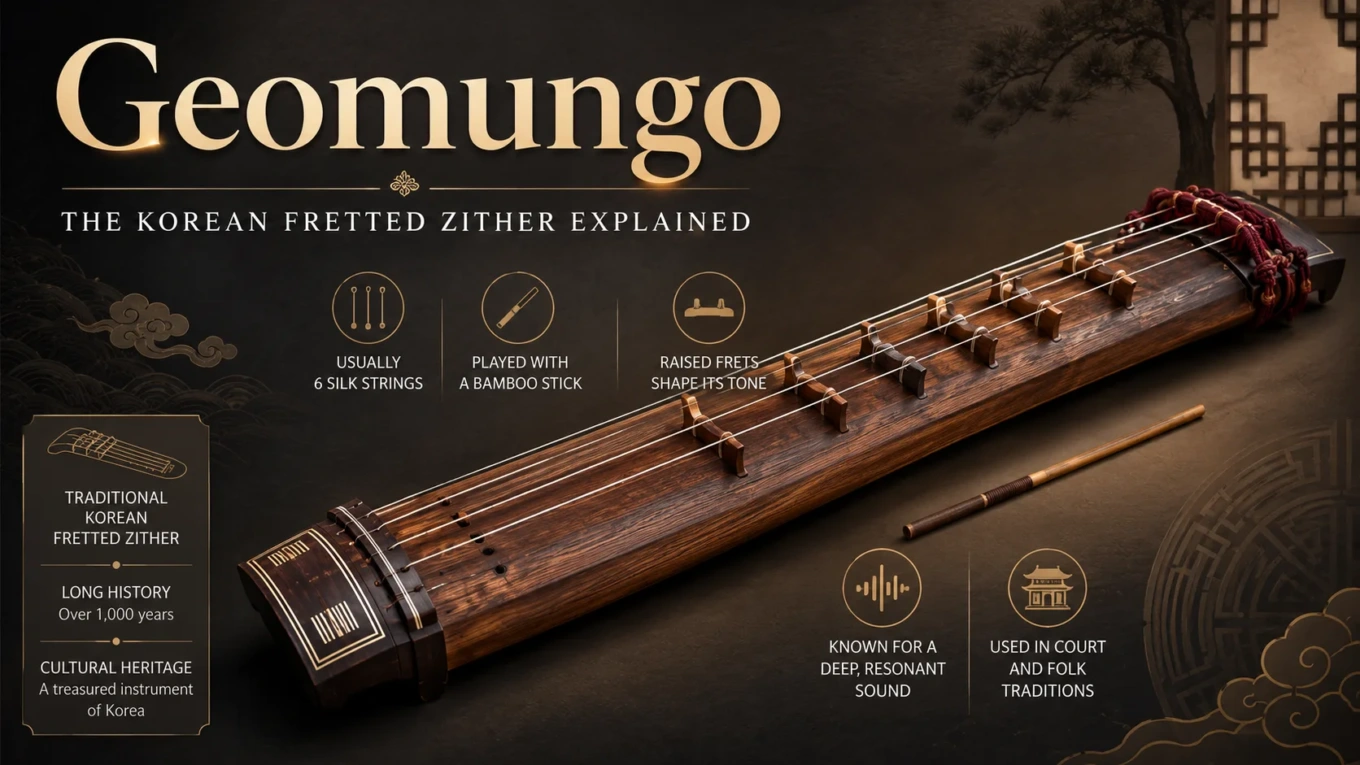
Geomungo: The Korean Fretted Zither Explained
Geomungo is a Korean fretted zither[1] with a long wooden body, six strings in its standard form, raised frets, movable bridges, and a short bamboo stick used to pluck and strike the strings. It belongs to the broad zither family because its strings run across the length of the body rather than along a neck, yet it does not play like a guzheng, koto, gayageum, or European concert zither.
The instrument is known in Korean as geomungo or komungo. Older names such as hyeongeum and hyeonhakgeum appear in musical and museum contexts, often linked with the idea of a “black zither” or “black crane zither.” Those names carry cultural memory, but the instrument itself is best understood through its construction: a hollow wooden body, a fretted playing area, selected open strings, and a percussive right-hand technique.
What Is the Geomungo?
The geomungo is a Korean plucked and struck chordophone[2]. In a standard traditional form, it has six strings, sixteen raised frets[3], and three movable bridges. Its body acts as a long resonator[4], so the sound is shaped by both the string vibration and the wooden chamber beneath it.
The right hand uses a short bamboo plectrum[5], commonly called a suldae. This gives the geomungo a firm attack and a dry, articulate edge. The left hand presses and ornaments the strings over the frets, allowing bends, slides, and pitch shading that would not be possible on a simple open-string board zither.
| Feature | Common Description | Why It Matters |
|---|---|---|
| Instrument Type | Korean fretted zither | It belongs to the zither family but uses raised frets and a stick technique. |
| Standard String Count | Usually six strings in traditional form | Modern versions may alter the string count, so six is the standard reference rather than a universal rule. |
| Frets | Sixteen convex frets in many standard examples | The frets help define stopped pitches and support the instrument’s deep, shaped melodic style. |
| Bridges | Three movable bridges in the traditional layout | They support selected strings and help set pitch and string height. |
| Playing Tool | Bamboo stick called suldae | It allows both plucking and striking, giving the instrument its percussive character. |
| Body Material | Paulownia is widely documented for the hollow body | The light wood supports resonance without making the body overly heavy. |
Why It Is Called a Fretted Zither
A zither, in the broad organological sense, is a string instrument whose strings stretch across the body rather than along a separate neck. The geomungo fits that broad definition. It is fretted because part of its playing system uses raised supports under the strings to create stopped notes.
This is where the geomungo differs from many East Asian long zithers. A gayageum, guzheng, koto, or đàn tranh usually depends on movable bridges under each string and left-hand pressure on the string section beyond the bridge. The geomungo instead combines bridge-supported strings with fretted strings, creating a more angular playing surface and a lower, weightier sound.
Classification Note: The word “zither” can mean different things in different contexts. In European usage, it may point to the concert zither. In organology, it can describe a wider family of instruments whose strings run across the body. The geomungo belongs to the wider family, but its Korean construction and playing method are distinct.
Body Shape and Materials
The geomungo has a long, rectangular wooden body. The upper plate functions as a soundboard[6], while the hollow space below helps carry and color the vibration. Paulownia wood is often associated with the body because it is light, resonant, and common in several East Asian zither traditions.
The instrument’s surface is not simply a flat string bed. It includes raised frets, bridge positions, and a protected striking area. The player’s stick can contact the string with force, so many geomungo descriptions mention a covered or reinforced area near the playing zone. That detail matters because the right hand does not merely brush the strings; it can make a sharply defined attack.
Soundboard and Resonating Body
The soundboard receives energy from the strings and passes it into the body. Wood choice can shape resonance, sustain, and response, but the effect depends on construction, string tension, bridge placement, and playing technique. It is safer to speak of a working relationship between material and design rather than crediting one wood with a fixed sound.
The geomungo’s voice is often described as low, firm, and percussive. Those qualities come from the whole system: string thickness, body size, frets, bridges, right-hand stick work, and left-hand pressure.
Strings, Frets, and Movable Bridges
In many standard descriptions, the geomungo uses six strings. Some strings are supported by movable bridges[7], while others pass over the fretted area. This mixed layout gives the instrument two kinds of behavior: open-string resonance and stopped, shaped melodic playing.
The movable bridges are often called anjok. The raised frets are called gwae. These parts are not decorative. They control string height, pitch behavior, and the physical feel under the hand.
The Role of the Suldae
The suldae[8] is a short bamboo stick held in the right hand, usually between the fingers. It plucks, strikes, and accents the strings. This makes the geomungo more percussive than many finger-plucked zithers.
A soft finger attack can produce a rounded tone on other zithers, but the suldae creates a clean edge. The player can make notes speak with weight, then use the left hand to bend, press, or color the pitch.
Anjok and Gwae
Anjok[9] are the movable bridges that support selected strings. Their name is often translated as “goose feet,” referring to their shape. The gwae[10] are raised frets used for stopped playing.
This combination is one reason the geomungo cannot be reduced to “a Korean guzheng” or “a Korean koto.” It shares the wider zither idea, but the frets and stick technique lead to a different musical logic.
How the Geomungo Is Played
The geomungo is usually played while seated, with the instrument placed horizontally. The right hand works with the suldae, while the left hand presses and ornaments the strings. Some notes sound as open strings[11]; others are shaped as stopped notes[12] over the frets.
The technique can include plucking, striking, damping, bending, sliding, and controlled pressure. The result is not a smooth stream of identical notes. A geomungo line often has a tactile shape: attack, pitch color, silence, and decay all matter.
Left-Hand Pressure and Ornament
The left hand does more than find pitch. It shapes the note after the string has sounded. A player can press into a note, release it, add a bend, or create a vocal-like inflection. This gives the geomungo a flexible melodic style even though it has fixed frets.
Because the strings sit high above the surface, pressing cleanly takes strength and control. Some playing traditions use protective finger support, such as a leather aid, to help the left hand manage pressure against the strings.
Right-Hand Attack
The right hand gives the geomungo its clear edge. The suldae can produce a strong attack followed by a short decay, especially when compared with softer finger-plucked instruments. This supports both melodic playing and rhythmic articulation.
Listening Note: When listening to geomungo, notice the space after each attack. The silence between notes is often as informative as the pitch itself. The instrument can sound measured, dry, resonant, and forceful without needing fast passages.
Tuning and Pitch Layout
Geomungo tuning[13] depends on repertoire, school, and performance setting. Court-related styles, solo traditions, and modern works may use different pitch choices or transpositions. It is better to treat published tunings as documented examples rather than as one fixed rule for every geomungo.
The important point for a first understanding is not one exact tuning chart. It is the relationship between open strings, fretted strings, movable bridges, and left-hand pressure. The player works with a layout that supports deep tones, ornamental pitch movement, and rhythmic attack.
Sound and Timbre
The geomungo has a low, dry, and grounded timbre[14]. Its sound often feels more percussive than shimmering. That does not mean it lacks subtlety. The subtlety comes through pressure, timing, decay, and the way a note changes after it begins.
Compared with a gayageum, the geomungo usually has a darker and more angular character. Compared with a guzheng or koto, it tends to place more attention on the weight of attack and the physical shaping of individual tones. These are broad listening differences, not rigid rules for every performer or composition.
History and Cultural Setting
The geomungo is closely associated with Korean musical history and with the Goguryeo cultural sphere in older accounts. Later historical writing connects the instrument with Wang San-ak, who is said to have adapted an earlier seven-string instrument. The exact origin story is not treated the same way by every source, so careful descriptions usually say the geomungo is associated with early Korean court and literati musical culture rather than reducing it to a single invention date.
In Korean tradition, the geomungo has often been linked with scholarly self-cultivation. That does not mean it was only a private instrument or only used by one social group. It appears across court, literati, solo, and ensemble contexts, and it remains part of Korean traditional music education and performance.
Jeongak, Sanjo, and Ensemble Use
The instrument appears in jeongak[15], a refined court and literati-related musical sphere, and in sanjo[16], a solo instrumental genre with changing rhythmic cycles and expressive melodic development. It may also appear in ensemble settings with other Korean instruments.
These settings ask different things from the instrument. A slow, formal piece may highlight restraint and tone control. A sanjo performance may bring out sharper rhythm, broader pitch motion, and more visible contrast between attack and ornament.
Notation and Learning Context
The geomungo has been linked with older notation practices, including forms of tablature[17] that show playing actions and string positions rather than only abstract pitch. Modern learners may also encounter staff notation, oral instruction, and teacher-led demonstration.
For beginners, the main challenge is not only memorizing notes. It is learning how the right-hand suldae and the left-hand pressure work together. The instrument asks the player to control timing, force, pitch bend, damping, and tone release.
How It Differs from Related Zithers
The geomungo sits near several better-known zithers in family terms, but its playing logic is separate. The raised frets and bamboo stick create a different hand relationship from many long bridged zithers.
| Instrument | Shared Feature | Main Difference |
|---|---|---|
| Gayageum | Korean long zither family | Usually finger-plucked with movable bridges; the geomungo uses raised frets and a bamboo stick. |
| Guzheng | East Asian bridged zither shape | The guzheng is mainly bridge-based and finger-plucked; the geomungo has a fretted system and a stronger struck-plucked attack. |
| Koto | Long zither with movable bridges | The koto uses movable bridges under its strings; the geomungo combines bridge support with raised frets. |
| Guqin | Linked in some historical origin accounts | The guqin is a fretless Chinese seven-string zither with a different playing surface and technique. |
| Concert Zither | Broad zither classification | The European concert zither uses a fretboard and accompaniment strings; the geomungo uses Korean frets, bridges, and suldae technique. |
Common Misunderstandings
It Is Not Just a Korean Gayageum
The gayageum and geomungo are both Korean zithers, but they do not use the same playing method. The gayageum is more closely associated with finger-plucked bridge-zither technique. The geomungo has raised frets and a bamboo stick, giving it a lower and more percussive feel.
It Is Not Simply a Guqin Copy
Historical accounts often connect the geomungo with an earlier seven-string instrument, and the guqin appears in many discussions of its background. That connection should not erase the geomungo’s own Korean structure. Its frets, bridges, string layout, and suldae technique create a separate instrument identity.
Six Strings Is the Standard, Not the Only Modern Possibility
The traditional geomungo is usually described as a six-string instrument. Some modernized versions add strings or use newer string materials. Those versions should be identified as modern developments rather than treated as the default historical form.
What to Notice on a Real Instrument
A close look at a geomungo shows how practical the design is. The long body supports the strings, the frets guide the left hand, the movable bridges help set string behavior, and the strike area protects the top from the suldae.
- Look for the raised frets: They are central to the instrument’s identity.
- Notice the bridge arrangement: Not every string behaves in the same way.
- Watch the right hand: The bamboo stick shapes rhythm and attack.
- Watch the left hand: Pressing and release can change the sound after the note begins.
- Listen for decay: The note’s ending often carries as much character as its opening.
Luthier’s Note: The geomungo’s sound depends on more than string count. Body depth, top thickness, bridge fit, fret shape, string material, and playing force all affect the response. A museum example, a teaching instrument, and a modern concert instrument may feel different under the hand.
Modern Use and Adaptation
The geomungo remains active in Korean traditional music, education, and new composition. Some performers use modernized instruments with added strings or changed materials. Others keep close to traditional construction and repertoire.
Modern adaptation does not make the older instrument obsolete. It shows that the geomungo has a flexible playing identity: it can support formal repertoire, solo improvisatory forms, ensemble textures, and experimental writing while still being recognized by its frets, long body, and suldae technique.
Glossary of Technical Terms
- Fretted Zither: A zither with raised frets or fret-like supports used to define stopped pitches. The geomungo is a fretted zither because part of its string system is played over raised frets.
- Chordophone: A musical instrument that produces sound through vibrating strings. Zithers, lutes, harps, and bowed strings all fall within this broad category.
- Fret: A raised support that helps define pitch when a string is pressed. On the geomungo, the frets are large and convex rather than small metal strips like those on many guitars.
- Resonator: The part of an instrument that strengthens and colors string vibration. In the geomungo, the hollow wooden body works as the resonating chamber.
- Plectrum: A tool used to pluck or strike strings. The geomungo uses a bamboo plectrum rather than relying only on fingertips.
- Soundboard: The vibrating top plate of a string instrument. On a geomungo, the wooden upper surface helps carry string vibration into the body.
- Movable Bridge: A bridge that can be repositioned to adjust string length, pitch, or response. The geomungo uses movable bridges for selected strings, unlike instruments where every pitch is controlled by a fixed fretboard.
- Suldae: The short bamboo stick used in geomungo playing. It gives the right hand a plucked and struck technique with a clear attack.
- Anjok: The movable bridge used on the geomungo. The term is often explained as “goose feet,” referring to the bridge shape.
- Gwae: The raised frets of the geomungo. They support stopped-note playing and give the left hand a physical structure for pitch control.
- Open String: A string sounded without being stopped by the left hand. Open strings can provide resonance, reference pitches, or strong low tones in zither playing.
- Stopped Note: A note made by pressing a string against a fret or playing surface to shorten its vibrating length. On the geomungo, stopped notes allow pitch shaping and ornament.
- Tuning: The pitch arrangement assigned to the strings before performance. Geomungo tuning can vary by repertoire and style, so one tuning should not be treated as the only valid form.
- Timbre: The tone color of an instrument. The geomungo’s timbre is often heard as low, dry, firm, and percussive.
- Jeongak: A refined Korean traditional music sphere associated with court and literati settings. The geomungo can appear in this type of formal repertoire.
- Sanjo: A Korean solo instrumental genre with expressive melodic development and rhythmic cycles. Geomungo sanjo highlights the instrument’s attack, bends, and tonal shading.
- Tablature: A notation system that shows playing positions or actions rather than only pitch names. Some geomungo traditions have used notation approaches that help describe how the instrument is physically played.
FAQ
Is the geomungo a zither?
Yes. The geomungo is a zither in the broad organological sense because its strings run across the body of the instrument. More precisely, it is a Korean fretted zither with movable bridges and a bamboo-stick playing technique.
How many strings does a geomungo have?
The standard traditional geomungo is usually described as having six strings. Some modern versions may use more strings or newer materials, so the string count should be understood by instrument type and period.
What is the difference between geomungo and gayageum?
The geomungo has raised frets and is played with a bamboo stick called a suldae. The gayageum is usually finger-plucked and depends more fully on movable bridges. Both are Korean zithers, but their sound, touch, and playing logic differ.
Is the geomungo played with fingers or a pick?
The right hand usually uses a bamboo stick rather than bare fingers. The left hand presses and ornaments the strings, so both hands shape the final sound.
Why does the geomungo sound percussive?
Its percussive sound comes from the suldae attack, string tension, body response, and the way players strike or pluck the strings. The note often has a clear beginning followed by controlled decay.
Is the geomungo the same as the guqin?
No. Historical accounts may connect the geomungo with earlier seven-string instruments, but the geomungo has its own Korean construction. It uses raised frets, movable bridges, and a bamboo-stick technique, while the guqin is a fretless Chinese zither with a different playing method.