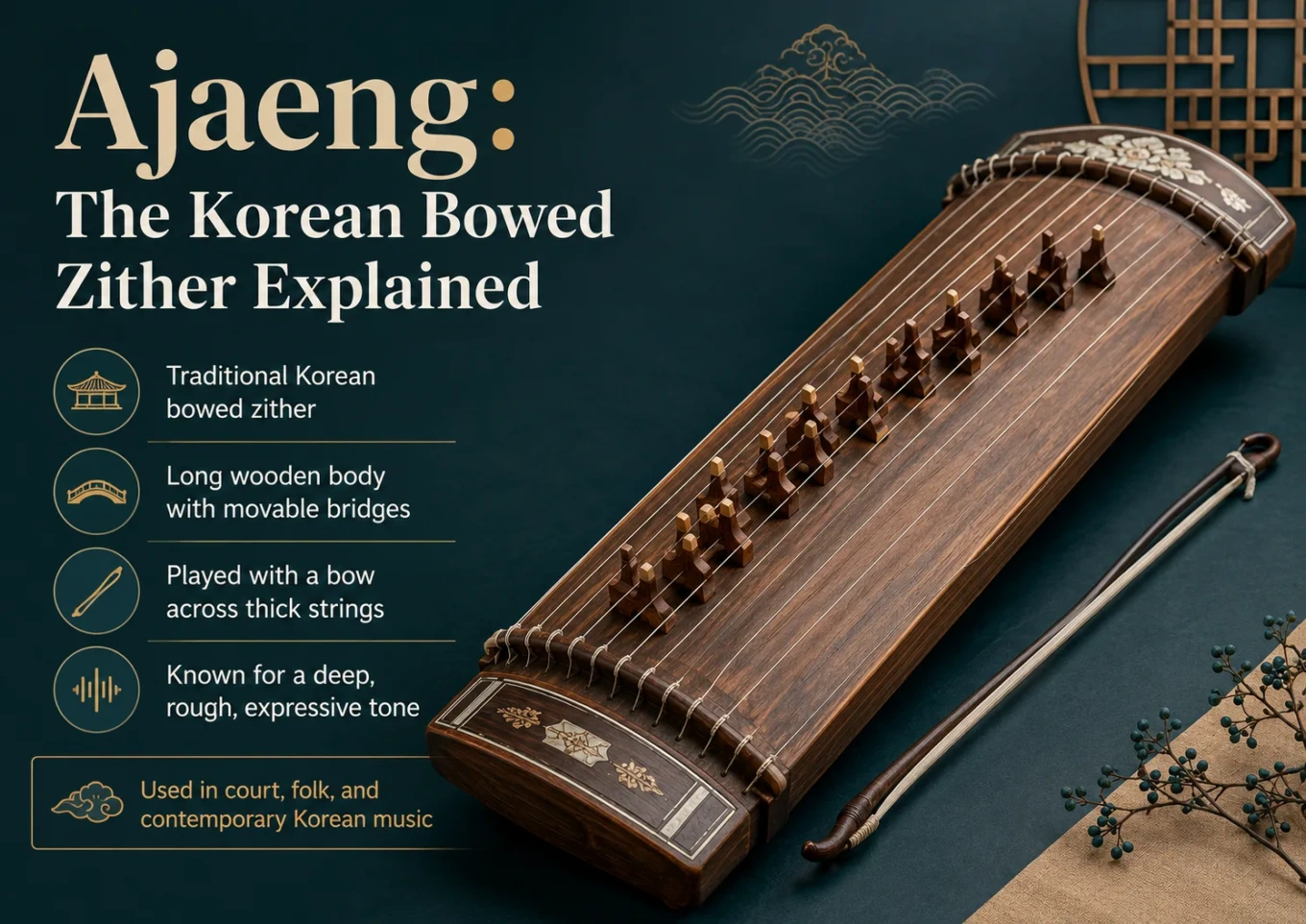
Ajaeng: The Korean Bowed Zither Explained
Ajaeng is a Korean bowed zither[1] with a long horizontal body, thick strings, and a low, textured voice. Instead of being plucked like a gayageum or struck like a hammered dulcimer, the ajaeng is sounded by drawing a bow across its strings. That single detail makes it one of the most distinctive members of the wider zither family.
The instrument is closely associated with gugak[2], the broad field of Korean traditional music. In ensemble settings, it often supports the lower range, giving the music a grounded, reedy, and slightly rough edge. In solo and folk-based forms, especially sanjo-related performance, the smaller ajaeng can become more flexible and vocal in character.
What Is an Ajaeng?
The ajaeng is a Korean string instrument whose strings run along a wooden body and rest on separate movable bridges[3]. In broad organological language, it belongs to the chordophone[4] family because its sound comes from vibrating strings. More narrowly, it is a zither because the strings stretch over the body of the instrument rather than along a neck.
Its most unusual feature is the bowing method. A traditional ajaeng is often played with a slender, rosined stick of forsythia wood. Some modern performers use a horsehair bow, which can produce a smoother attack and a more even sustained tone. The older wooden bow, by contrast, gives the ajaeng its famous gritty surface.
The word “zither” can cause confusion here. In European usage, zither sometimes means the concert zither of the Alpine tradition. In organology, the word can be broader: it can describe instruments whose strings lie across a board, box, tube, trough, or frame. The ajaeng belongs to that broader meaning, not to the European concert-zither tradition.
| Feature | Ajaeng Detail |
|---|---|
| Instrument Type | Korean bowed zither; a string instrument with the strings stretched over a long resonating body. |
| Common Traditional String Counts | Larger court-related forms are often described with seven strings, while smaller folk or sanjo forms are often described with eight. Modern instruments may use more strings. |
| Playing Method | Usually bowed by rubbing the strings with a rosined wooden stick or, in some modern playing, a horsehair bow. |
| Sound Role | Low, sustained, and grainy; often used for bass-range support, but also capable of expressive solo lines. |
| Main Related Korean Zithers | Gayageum and geomungo are related by broad zither classification, but they use different playing logic. |
Names, Spelling, and Korean Terms
Ajaeng is commonly written in English as ajaeng. In Korean it is written 아쟁, and the Hanja form is often given as 牙箏. The second character, 箏, is associated with zither-type instruments in East Asian naming traditions. Similar-looking names should not lead to the idea that these instruments are identical across countries.
The Chinese yazheng is often mentioned in historical discussions of the ajaeng. That connection helps explain the name and older court context, but the Korean ajaeng should be described on its own terms. Its structure, musical use, tone, and performance practice are shaped by Korean repertories and Korean instrument-making traditions.
Classification Note
Ajaeng is a zither by structure and a bowed instrument by technique. That double identity matters. Its body and bridge layout place it near other East Asian zithers, but its sound production is closer to bowed instruments because the player sustains tones through friction.
How the Ajaeng Is Built
The ajaeng has a long, slightly raised wooden body. Many documented examples use a paulownia front plate or soundboard[5], with harder wood often used for the back or supporting parts. Paulownia is also found in other Korean zithers, including the gayageum, because it is light and responsive enough for string vibration. Wood choice can shape resonance, but the final sound also depends on body shape, bridge placement, string material, and playing technique.
The body acts as a resonating body[6]. When a string vibrates, the bridge transfers energy into the wood. The body then gives the sound more volume and color. On the ajaeng, this process is especially easy to hear because the strings are bowed slowly and often speak with a broad, low vibration.
Strings and Bridges
Traditional descriptions often refer to twisted silk strings[7]. Modern instruments may use other materials depending on maker, repertory, and player preference. The strings are thick compared with many plucked zithers, and that thickness helps produce the instrument’s weighty tone.
Each string normally rests on its own bridge. In Korean zither terminology, these bridges are often called anjok[8], often translated as “goose-foot bridges” because of their shape. The bridge supports the string, sets part of the vibrating length, and helps tune the instrument by its placement.
This bridge system gives the ajaeng a different feel from a necked bowed instrument such as the violin or cello. The pitch layout is not shaped by a fingerboard. Each string already has its own pitch area, and the player uses bowing, bridge setup, and left-hand pressure or ornament to shape the line.
Body Shape and Playing Position
The ajaeng lies horizontally while the player sits on the floor or low to the instrument, depending on the performance setting. The long body lets the strings stretch across a broad surface, and the player reaches over the instrument to bow the strings.
Some museum examples list a body length around one and a half meters, but measurements vary by type and collection object. A large court-related ajaeng is not the same size as a smaller sanjo ajaeng. Modern extended-range forms can also differ in body depth, width, and string count.
The Bow: Why the Ajaeng Sounds Different
The traditional forsythia bow[9] is not the same as a Western violin bow. It is closer to a slim stick that is rubbed with rosin and drawn across the strings. This creates friction, which starts the string vibration. Because the contact surface is firmer than horsehair, the attack can sound raw, woody, and close to the string.
A horsehair bow[10] can soften that edge. Some contemporary performers choose it for smoother lines, especially in new compositions or chamber settings. The change of bow does not turn the ajaeng into a cello; it simply changes the way the string is set into motion.
Listening Note
Listen for the start of each tone. A wooden bow often gives the note a grainy entrance before the pitch settles. That surface noise is not a flaw in the instrument. It is part of the ajaeng’s identity.
Strings, Pitch, and Tuning
There is no single universal tuning for every ajaeng. Tuning depends on the type of instrument, the repertory, the ensemble, and the performer’s school. In older court-related settings, the ajaeng often serves a lower melodic or supporting role. In folk and solo practice, the tuning may be chosen for the mode and expressive needs of the piece.
Because the instrument uses bridges under the strings, tuning is closely tied to bridge placement. Moving a bridge changes the vibrating length of a string. A longer vibrating length lowers the pitch; a shorter one raises it. Fine adjustment also depends on string tension and the maker’s setup.
The strings are often treated as open strings[11], meaning the string can sound clearly without being stopped against a fingerboard. This is one reason the ajaeng’s pitch world feels different from bowed necked instruments. The player does not climb a fingerboard in the same way. Instead, musical shape comes from selected strings, bow pressure, ornaments, and careful control of pitch color.
Left-Hand Expression
The left hand can shape intonation[12], bend a pitch, or add vibrato[13] depending on technique and musical context. These gestures are not decorative extras. In Korean traditional performance, small pitch movements can carry much of the phrase’s expressive weight.
Some passages may also use sliding motion or a flexible approach to pitch. For that reason, writing about ajaeng only as a “seven-string instrument” misses much of how it actually speaks. The number of strings tells only part of the story; the bow and left-hand shaping complete it.
Main Types of Ajaeng
Two names appear often: daeajaeng[14] and sanjo ajaeng[15]. The terms are useful, but they should be handled with care because makers, repertories, and modern adaptations can blur simple categories.
Daeajaeng and Jeongak Ajaeng
The larger ajaeng is associated with jeongak[16], a refined court and literati-related music setting. It is often described as a seven-string instrument and tends to provide a low, sustained line within ensemble texture. Its tone is broad and weighty.
In this form, the ajaeng is not mainly a fast display instrument. It supports the slow-moving musical surface, reinforces the lower range, and helps bind the ensemble sound. The bowing can feel spare, but the control required is demanding.
Sanjo Ajaeng and Soajaeng
The smaller folk-related form is often called sanjo ajaeng or soajaeng. It is commonly described with eight strings and is used in sanjo[17], sinawi[18], and related performance contexts. Compared with the larger form, it can be more agile and more suited to expressive bends, faster passages, and solo lines.
Modern ajaengs may add strings for wider range or new repertory. Some performers use nine, ten, or more strings. These should be understood as modern or adapted forms rather than proof that the traditional instrument has one fixed string count.
| Form | Common Description | Typical Musical Use |
|---|---|---|
| Daeajaeng / Jeongak Ajaeng | Larger body, often seven strings in traditional descriptions. | Court and classical ensemble settings, lower-range support. |
| Sanjo Ajaeng / Soajaeng | Smaller body, often eight strings in traditional descriptions. | Folk-based repertory, sanjo, sinawi, and more flexible solo use. |
| Modern Ajaeng | May use extra strings, altered bodies, or a horsehair bow. | Contemporary composition, fusion settings, and expanded ensemble writing. |
What the Ajaeng Sounds Like
The ajaeng is known for a low, rough-edged timbre[19]. Its tone can be described as dark, reedy, woody, and nasal, but none of those words fully capture the friction of the bowed string against the bridge-supported body. The sound often has a grain that remains audible even during sustained notes.
That grain comes from several things working together: thick strings, low pitch, bow pressure, rosin, bridge contact, and body resonance. A softer modern bow may reduce some of the scratch, while a traditional wooden bow brings it forward.
The ajaeng can sound almost vocal in slow passages. It can lean into a note, bend its pitch, and let the tone swell or fade. In quicker folk-related playing, the sound becomes more biting and mobile. This range is one reason the instrument appears in both older ensemble settings and newer composition.
How It Differs from Related Korean Instruments
The ajaeng is best understood beside other Korean instruments, not as an isolated curiosity. It shares broad zither features with the gayageum and geomungo, yet it uses a very different sound-making method.
Ajaeng and Gayageum
The gayageum is a plucked Korean zither with movable bridges. Its sound is made with the fingers, and its lines often include plucking, ornaments, and pitch bends shaped by the left hand. The ajaeng also has bridges, but it is bowed. This gives it longer sustained tones and a lower, rougher sound.
Ajaeng and Geomungo
The geomungo is a Korean fretted zither, usually played with a short stick called a suldae. It has a strong plucked or struck attack and uses frets as part of its pitch system. The ajaeng has no comparable fretted playing logic. Its identity rests on bowed sound, thick strings, and a sustained lower range.
Ajaeng and Haegeum
The haegeum is also bowed, but it is not a zither in the same structural sense. It has a small sound box, a rod-like neck, and two strings, and it is held upright. The ajaeng lies horizontally and uses a long zither body with multiple bridge-supported strings. Both can sustain tones, but their construction and playing posture are very different.
Role in Korean Music
In court and classical ensemble settings, the ajaeng often carries or supports the low melodic line. It can make the ensemble sound thicker without overpowering the upper instruments. The tone is not clean in a polished modern-orchestral sense; it has a textured edge that helps it remain audible within a group.
In sanjo and folk-related music, the instrument can move more freely. The smaller ajaeng can bend, cry, slide, and pulse with the rhythmic cycle. Its role is not only bass support. It can become a lead melodic voice, especially when paired with drum accompaniment.
In contemporary Korean composition, the ajaeng offers composers a sound that does not neatly match Western string writing. It can sustain like a bowed instrument, but it responds like a zither. This makes notation, bowing, tuning, and pitch bending especially important for performers and composers to discuss.
How Museums and Instrument Researchers Describe It
Museum records often classify the ajaeng under stringed instruments and zithers, with notes on its bowed playing method. That wording is useful because it separates structure from technique. Structurally, the strings run along a zither body. Technically, the sound is produced by bowing.
Collection descriptions also show why exact measurements should not be copied carelessly from one instrument to every ajaeng. A museum object may represent a particular maker, date, repertory, or regional form. For a general description, it is safer to speak in terms of type: larger court-related ajaeng, smaller sanjo ajaeng, and modern adapted forms.
Collector’s Note
When identifying an ajaeng, look for the combination of a long zither body, individual movable bridges, thick strings, and a bowing setup. A plucked Korean zither with similar bridges is more likely to be a gayageum unless other features point elsewhere.
What Beginners Should Know
Ajaeng is not usually the first zither a casual beginner meets, especially outside Korea. It needs a teacher or a careful learning source because the sound depends on bow pressure, rosin use, bridge setup, tuning, and pitch control. A note can fail to speak clearly if the bow angle or pressure is off.
The instrument also teaches a different idea of “good tone.” A clean, smooth sound is not always the goal. Some repertories value the rough edge of the wooden bow. The player learns to control that edge rather than erase it.
Beginners comparing ajaeng with gayageum should not choose only by appearance. The gayageum is plucked and often easier to understand visually. The ajaeng asks the player to think like a zither player and a bowed-instrument player at the same time.
Common Misunderstandings
- Ajaeng is not a Korean cello. It can serve a low-range role, but its zither body, bridges, strings, and bowing method are different.
- Ajaeng is not the same as gayageum. Both are Korean zithers in a broad sense, but the gayageum is plucked and the ajaeng is bowed.
- Seven strings is not the whole story. Seven-string descriptions often refer to larger traditional forms; smaller and modern forms may differ.
- The rough sound is intentional. The wooden bow and thick strings produce a textured tone that belongs to the instrument’s voice.
- Modern bows do not erase the tradition. Horsehair bows are used by some performers for certain sounds, but the older wooden bow remains part of ajaeng identity.
FAQ
Is the ajaeng really a zither?
Yes. In the broad organological sense, the ajaeng is a zither because its strings run along the body of the instrument rather than along a separate neck. Its bowing method makes it unusual, but it does not remove it from the zither family.
How many strings does an ajaeng have?
Traditional descriptions often give seven strings for the larger court-related ajaeng and eight for the smaller sanjo ajaeng. Modern instruments may use more strings, so the exact number depends on the type and repertory.
What is the ajaeng bow made from?
The traditional bow is often a slender stick made from forsythia wood and treated with rosin. Some modern performers use a horsehair bow for a smoother tone.
Is ajaeng the same as gayageum?
No. The gayageum is a plucked Korean zither, while the ajaeng is bowed. They may both use movable bridges, but their sound, technique, and musical roles differ.
Why does the ajaeng sound rough?
The roughness comes from the contact between the bow and thick strings, especially when a rosined wooden bow is used. That textured sound is part of the instrument’s traditional character.
Is the ajaeng used only in old court music?
No. Larger forms are associated with court and classical ensemble contexts, but smaller sanjo ajaeng and modern adapted instruments are also used in folk-based music, solo performance, and new composition.
Glossary of Technical Terms
Bowed Zither
A zither-type instrument whose strings are sounded with a bow rather than by plucking or striking. The ajaeng is one of the clearest Korean examples of this playing logic.
Gugak
A broad term for Korean traditional music. It includes court, folk, vocal, instrumental, ritual, and modern concert forms, so the ajaeng’s role can change by repertory.
Movable Bridge
A bridge that can be repositioned under a string to adjust pitch and string length. Many East Asian zithers use separate movable bridges for each string.
Chordophone
An instrument class in which vibrating strings produce the primary sound. Zithers, lutes, harps, and bowed strings are all chordophones, but their structures differ.
Soundboard
The resonant top plate that receives string vibration through the bridges. On many Korean zithers, a light wooden soundboard helps amplify and color the tone.
Resonating Body
The wooden body that strengthens and shapes the sound after the string vibrates. On the ajaeng, the long body helps support a low, sustained tone.
Twisted Silk String
A traditional string type made by twisting silk fibers. In Korean zithers, silk strings can give a softer attack and a more textured tone than many modern synthetic or metal strings.
Anjok
The Korean name often used for the movable bridges on instruments such as gayageum and ajaeng. The term is commonly linked to a “goose-foot” shape.
Forsythia Bow
A slender wooden bow or stick traditionally used to sound the ajaeng. It is rubbed with rosin so it can grip the string and start vibration.
Horsehair Bow
A bow using horsehair, closer in material idea to many Western bowed-string bows. Some ajaeng performers use it for smoother sustained tone.
Open String
A string sounded without being stopped against a fingerboard. On the ajaeng, pitch is tied to string tuning, bridge placement, and expressive pressure rather than a necked fingerboard system.
Intonation
The accuracy and shaping of pitch. In ajaeng performance, intonation may include small bends and flexible pitch motion, not only fixed note centers.
Vibrato
A controlled pitch movement used to give life to a sustained tone. On zither-family instruments, vibrato can be shaped through string pressure and hand motion.
Daeajaeng
A larger ajaeng form associated with court and classical ensemble use. It is often described with seven strings and a lower, broad tone.
Sanjo Ajaeng
A smaller ajaeng form used in folk-related repertories and solo performance. It is often described with eight strings and a more flexible playing character.
Jeongak
A Korean classical music context linked with court and literati traditions. The larger ajaeng is often associated with this slower, refined ensemble setting.
Sanjo
A Korean solo instrumental genre usually accompanied by janggu drum. In ajaeng playing, sanjo favors expressive pitch bending, rhythmic growth, and a more soloistic voice.
Sinawi
A Korean folk-based ensemble style with flexible melodic interaction. The sanjo ajaeng can appear in this setting because its bowed tone can blend with other expressive melodic instruments.
Timbre
The tone color of an instrument. The ajaeng’s timbre is shaped by thick strings, bow type, rosin, bridges, and the long wooden body.