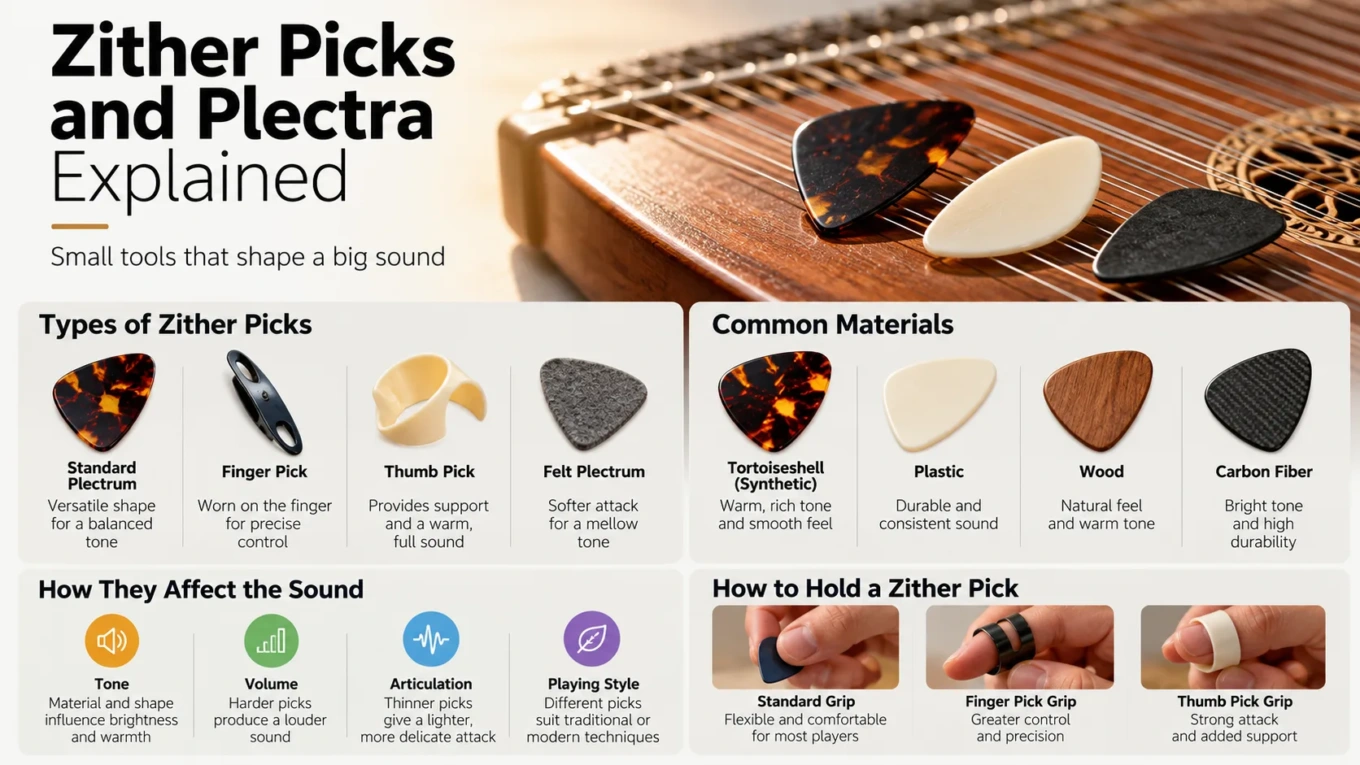
Zither Picks and Plectra Explained
A zither pick is not one standardized accessory. Depending on the instrument, a plectrum[1] may be held between the fingers, fitted to the thumb, taped to several fingertips, or mounted in finger rings. Those differences are part of the playing system itself. A concert zither thumb pick, a koto tsume, a guzheng finger pick, and a qanun plectrum all set a string into motion, but they are shaped, worn, and controlled in different ways.
The useful way to choose or understand a zither pick is therefore to begin with the exact instrument and playing tradition. Material and thickness matter, but only after the attachment method, fit, projection, string type, and expected technique have been considered.
One Name, Several Plucking Systems
Pick is the common English word; plectrum is the broader technical term for a small tool used to pluck a string. Within the zither family, however, the tool can be part of a very different hand technique from one instrument to another.
| Instrument | Typical Tool | How It Is Used |
|---|---|---|
| Concert zither | Thumb ring or thumb plectrum | Worn on the right thumb for the fretted melody strings |
| Koto | Tsume | Worn on the right thumb, index, and middle fingers |
| Guzheng | Finger picks | Usually secured to the fingers with tape |
| Qanun / kanun | Ring-mounted plectra | Held by rings on the index fingers |
| Some psalteries and simple board zithers | Fingers, nails, or handheld pick | Held in the hand or played without an attached pick |
This table applies to plucked zithers. A hammered dulcimer or santur produces sound with beaters rather than plectra, while a bowed zither uses a bow. Those tools create string motion by different methods and should not be grouped with picks simply because all three contact strings.
What the Pick Actually Does to the String
A plucked string is displaced from its resting position and then released. The pick controls part of that process: how far the string is displaced, how much surface touches it, how smoothly the edge leaves it, and how accurately the player can repeat the movement. The moment the string leaves the pick affects the attack[2], while the rest of the instrument shapes what happens after that initial impulse.
Four physical features deserve more attention than the label printed on a package:
- Tip shape: a narrower or broader end changes the contact area and the way the pick approaches the string.
- Edge condition: a smooth, intact edge usually releases the string more predictably than a chipped or rough one.
- Projection: the distance the pick extends beyond the finger affects leverage and control.
- Stiffness: a more flexible pick bends during contact; a stiffer one transfers finger motion more directly.
None of these variables acts alone. The same pick can feel different on strings with different diameters, surfaces, and tension[3]. Playing angle and hand motion can also change the result more than a small difference in material.
Useful distinction: a pick that physically fits the hand is not automatically correct for the instrument. The traditional technique may depend on a particular attachment system, orientation, or shape.
Concert Zither: The Thumb Plectrum Has a Specific Job
On a concert zither, the right thumb normally uses a thumb plectrum to pluck the fretted melody strings[4]. The left hand stops those strings against the frets to select pitches, while other fingers of the right hand can pluck open accompaniment and bass strings. The plectrum therefore belongs to a divided right-hand technique rather than serving as a general pick for every string on the instrument.
The thumb attachment matters because the pick must stay aligned while the hand moves across the melody strings. If the ring rotates, the contact angle changes from note to note. If it is painfully tight, the player may compensate with unwanted thumb tension. If too much of the blade projects beyond the thumb, the pick can feel slow or catch more deeply than intended.
Historic concert zithers were often supplied with thumb picks as part of the normal playing equipment. Modern examples can differ in ring construction, blade shape, and material, so the useful comparison is not simply “metal versus plastic.” Fit and geometry come first.
Why a Guitar Pick Is Not a Direct Substitute
A flat guitar pick can pluck a zither string, but that does not make it equivalent to a concert-zither thumb plectrum. A handheld pick occupies the thumb and index finger together, while a fitted thumb plectrum leaves the hand arranged for the instrument’s established right-hand division of labor. The difference is mechanical as well as traditional.
For occasional experimentation, a handheld pick may produce sound. For concert-zither technique, it changes the hand setup enough that it should be treated as a different method rather than a one-for-one replacement.
Koto Tsume: Shape Is Tied to Playing Tradition
Koto plectra are called tsume[5], literally associated with the idea of a nail or claw. Three are worn on the right hand: thumb, index finger, and middle finger. The plectrum plate is attached to a band around the finger, placing the working edge beneath the fingertip rather than over the natural fingernail.
Tsume are not all shaped alike. Two well-known koto traditions use visibly different forms. Ikuta-ryū commonly uses a more square-edged plectrum, while Yamada-ryū uses a rounder, nail-like form. That difference is not decorative. Shape works together with hand position and technique, so choosing by appearance alone can put the player at odds with the method being learned.
| Tradition | Typical Shape | Selection Priority |
|---|---|---|
| Ikuta-ryū | More square-edged | Match the school and teacher’s technique |
| Yamada-ryū | More rounded or nail-shaped | Match the school and teacher’s technique |
Modern tsume are often made from synthetic materials, while older examples and older descriptions may mention materials that were once customary. For present-day playing, shape, band fit, edge finish, and compatibility with the player’s school are more useful selection points than trying to reproduce an older material simply because it appears in museum descriptions.
The Band Is Part of the Plectrum System
A tsume that shifts around the finger changes its orientation at the string. The band must therefore hold the plate firmly enough for repeated plucking without forcing the finger into an uncomfortable position. The player is not merely holding a small pick; the pick and finger are working as one unit.
This becomes especially noticeable in repeated strokes and tremolo[6]. Small changes in rotation or projection can make successive contacts uneven even when the hand motion remains consistent.
Guzheng Finger Picks: Tape, Fit, and Projection
Modern guzheng technique commonly uses finger picks secured with tape. The exact set worn can depend on the playing method and repertoire, and contemporary technique may employ picks on both hands. This attachment system differs from koto bands and from a concert-zither thumb ring: the tape itself helps determine how securely each pick follows the finger.
A good fit is less about finding a universal size than matching the pick to the finger and controlling how far it extends beyond the fingertip. Too little projection can limit clean contact. Too much can reduce fine control and make the pick enter too deeply between adjacent strings.
Why Curvature Matters
Finger picks can be flat or shaped to follow the finger more closely. Curvature changes how the pick sits against the fingertip and how pressure from the tape is distributed. It can also influence the working angle at which the tip meets the string.
The aim is repeatability. A pick that twists during playing forces the hand to correct for a moving contact surface. A stable pick allows the same finger motion to produce a more consistent release[7].
Stiffness Is a Playing Variable, Not a Quality Grade
Players sometimes treat a thicker or harder pick as automatically better. That is too simple. A flexible pick yields more during contact, while a stiff pick bends less and can feel more immediate. Either can be useful depending on technique, string resistance, and player preference.
The more practical question is whether the pick returns predictably after each stroke and remains comfortable during fast patterns. Thickness by itself does not answer that.
Qanun and Kanun: Plectra Held by Finger Rings
The qanun, including the Turkish kanun tradition, uses a different arrangement again. Slender plectra are associated with rings worn on the index fingers, allowing both hands to pluck the courses[8] of strings. The ring and the plectrum should be considered together because a well-shaped blade cannot compensate for a ring that continually turns or sits at an unsuitable angle.
This system supports rapid alternation between the hands and precise work across closely spaced string groups. The plectrum is therefore narrower in function and handling than a general handheld pick.
Materials and exact shapes vary among makers and players. The reliable principle is mechanical: the blade needs a smooth working edge, controlled projection, and stable orientation on the index finger.
Handheld Picks Belong to Some Zithers, Not All of Them
Some psalteries and other plucked board zithers may be played with bare fingers, fingernails, or a small handheld pick. On those instruments, the pick can function much like a general plucking tool because the technique does not depend on a finger-mounted system.
This is why the phrase “zither pick” can be misleading in isolation. A seller, player, or museum record may be referring to a thumb-mounted concert-zither pick, three koto tsume, taped guzheng picks, qanun ring plectra, or a simple flat pick used on another type of zither.
Pick Shape Changes Contact Before It Changes Tone
Claims about pick sound are often stated too simply. A pointed pick is not guaranteed to sound “bright,” and a rounded pick is not guaranteed to sound “warm.” Shape first changes the mechanics of contact: how the edge reaches the string, how much surface is involved, and how the string leaves the edge.
Those mechanical differences can alter articulation[9], but the heard result also depends on the string, instrument, player, and room. A small change in pick angle may produce a larger audible difference than switching between two similar synthetic materials.
Pointed, Rounded, and Broad Edges
- Pointed tips can give a small contact area and precise placement, but an overly sharp or damaged point may feel less forgiving.
- Rounded tips spread contact over a broader curve and can pass the string with a different release feel.
- Broad or square edges may support techniques that use more of the plectrum face, as seen in certain koto traditions.
These are physical tendencies rather than fixed sound rules. The same geometry behaves differently when string diameter and tension change.
Material, Stiffness, and Edge Finish
Modern zither-family plectra can be made from metal and several synthetic materials. Traditional instruments also preserve older material practices in historical collections. For a player choosing a working pick, the most useful material properties are stiffness, surface smoothness, durability, and how easily the edge can remain clean.
| Property | What the Player Notices | What to Check |
|---|---|---|
| Stiffness | Amount of flex during the stroke | Control during repeated notes and strong attacks |
| Surface | Friction against the string | Whether contact feels smooth or grabby |
| Edge finish | Quality of the release | Chips, burrs, rough spots, or grooves |
| Wear resistance | How quickly the shape changes | Flattened tips or worn contact areas |
A hard material with a poor edge can perform worse than a softer material with a clean, well-shaped edge. Material names are therefore less informative than the finished working surface.
The String Changes How the Pick Feels
A plectrum never works in isolation. String construction changes resistance under the pick. Metal, synthetic, wound, and traditional string materials can have different surface textures and stiffness, while string gauge and tension alter how far the string moves before release.
The bridge[10] and soundboard then transmit the string’s vibration into the instrument. The pick starts the event, but it does not determine the entire tone. This is why copying another player’s pick material does not guarantee the same result on a different instrument.
Practical rule: change one variable at a time when comparing picks. If pick shape, thickness, projection, and hand angle all change together, it becomes difficult to tell which difference actually improved control.
Fit Problems Often Look Like Technique Problems
A poorly fitted pick can make a stable hand feel inconsistent. Before changing technique, it is worth checking whether the accessory itself is moving.
| Symptom | First Things to Check |
|---|---|
| Pick catches on the string | Projection, attack angle, rough edge |
| Pick rotates during playing | Ring, band, tape, or overall fit |
| Repeated notes feel uneven | Pick stability, projection, release angle |
| Finger becomes uncomfortable | Excessive ring or band pressure |
| Unexpected clicking appears | Contact depth, hard edge, angle, excess force |
| String feels scraped | Chipped tip, burr, groove, damaged edge |
Projection Is Easy to Overlook
Projection is the part of the pick that extends beyond the fingertip or ring. A longer projection increases leverage, but it also moves the working edge farther from the player’s natural sense of fingertip position. A shorter projection can feel more direct, provided enough pick remains available for clean contact.
There is no single correct projection for every zither. The right amount depends on the pick system, the player’s hand, string spacing, and technique.
Pick Angle Controls the Path of Release
The pick should not be thought of as a tiny hammer striking the string. In plucked technique, the string usually travels along the working surface for a short moment before it slips free. Changing the angle changes that path.
If the pick enters too deeply, the string may resist and then release abruptly. If only the very edge touches, the stroke may become less secure. A controlled angle lets the player displace the string without trapping it.
This is especially relevant when diagnosing a pick that seems “too hard” or “too noisy.” Before changing material, check whether the edge is meeting the string at a repeatable angle and depth.
Choosing a Zither Pick in the Right Order
Starting with material often leads to the wrong purchase because the larger compatibility questions have not yet been answered. A more reliable selection order is:
- Identify the exact instrument. Concert zither, koto, guzheng, qanun, psaltery, and other zithers do not share one universal pick.
- Identify the playing tradition. This matters most when a school or regional technique uses a particular plectrum form.
- Match the attachment system. Thumb ring, finger band, tape, ring-mounted blade, and handheld picks require different hand mechanics.
- Check fit. The pick should remain stable without painful pressure.
- Check projection and shape. These determine where the working edge sits in relation to the finger and string.
- Compare stiffness. Decide how much flex suits the instrument and technique.
- Then compare materials. Surface, durability, and edge finish are more useful than assumptions about material alone.
This order also makes substitutions easier to judge. A replacement does not need to look identical in every detail, but it should preserve the hand position and string contact needed by the technique.
When Two Picks Are Not Interchangeable
Several plectra can appear similar when viewed away from the instrument. Their attachment method reveals why they are not direct substitutes.
- A banjo-style thumb pick may resemble a concert-zither thumb pick, yet blade position and fit can differ enough to change the playing angle.
- A guzheng finger pick secured with tape is not the same system as a koto tsume fitted to a band.
- A koto tsume is not a qanun ring plectrum; the hand position and working edge are arranged differently.
- A flat guitar pick can pluck many strings but does not preserve finger independence where the traditional technique relies on a mounted plectrum.
Interchangeability should therefore be judged by function, not by whether two tools can both make a string sound.
Inspecting and Maintaining Plectra
Picks are small wear items, and minor damage can be felt before it becomes visually obvious. Inspect the working edge under good light. Look for chips, burrs, grooves, flattened areas, cracks, or a bent mounting ring.
Taped systems also need attention at the attachment point. If the tape no longer holds the pick securely, replacing the tape is more useful than compensating with extra finger pressure. Bands and rings should be checked for deformation that changes the pick angle.
Cleaning should suit the material. Dry wiping is often enough for routine handling residue. Aggressive polishing or reshaping can alter the edge geometry, so any corrective work should preserve the profile required by the instrument and playing tradition.
Glossary of Technical Terms
Plectrum
A small tool used to pluck a string. In zither-family instruments it may be handheld, fitted to the thumb, taped to a finger, or carried by a finger ring.
Attack
The beginning of a musical sound. With a plucked zither, pick shape, contact depth, hand speed, and release can all affect how the note begins.
String Tension
The pulling force carried by a tuned string. Higher or lower tension changes how strongly a string resists displacement under a finger or plectrum.
Fretted Melody Strings
The strings on a concert zither that pass over the fingerboard and frets. The left hand selects pitches while the right thumb plectrum normally sets these strings into motion.
Tsume
The finger-mounted plectra used to play the koto. They are worn on the right thumb, index finger, and middle finger, with shape varying between playing traditions.
Tremolo
A rapid repetition of a note or closely related plucking motion. Stable pick fit and controlled release help keep repeated strokes even.
Release
The instant when a displaced string slips free of the pick and begins vibrating independently. Edge shape, angle, and depth of contact influence this motion.
Course
A playing unit made from one string or, on some instruments, a group of strings treated together. Qanun strings are arranged in grouped courses rather than handled as unrelated single strings.
Articulation
The way individual notes begin, connect, and separate. In plucked zithers, the plectrum contributes to articulation through its contact and release behavior.
Bridge
The part that supports strings and transfers their vibration toward the resonating body. Some zithers use fixed bridges, while instruments such as koto and guzheng use movable bridges for individual strings.