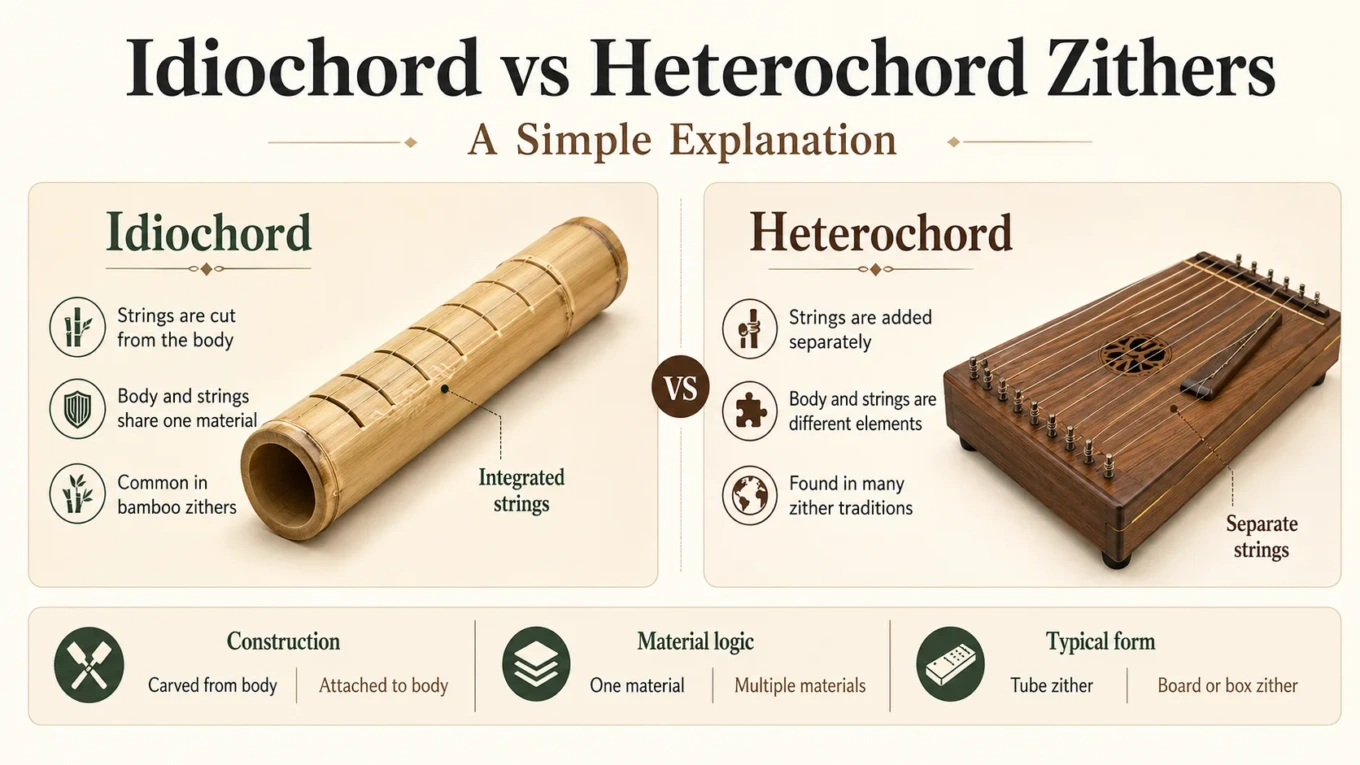
Idiochord vs Heterochord Zithers: A Simple Explanation
Idiochord[1] and heterochord[2] describe how the strings of a zither[3] relate to the body of the instrument. An idiochord zither uses strings made from the same material as the body, often lifted or cut from the surface itself. A heterochord zither uses separate strings added to the body, usually made from another material such as metal, gut, silk, nylon, or plant fiber.
This difference is easy to miss because both types can still look like zithers. The strings still run along, across, or around a body. The player may pluck, strike, or sometimes bow them. The main question is simpler: are the strings part of the body, or were they attached as separate strings?
Simple Definition
An idiochord zither has strings that come from the instrument’s own body material. On many bamboo examples, narrow strips of the outer skin are cut loose in the middle but remain attached at both ends. Small supports raise those strips so they can vibrate like strings.
A heterochord zither has strings that are separate from the body. They are fixed to the instrument, stretched over it, and tightened to pitch. Most well-known zithers today are heterochord instruments, including many board zithers, box zithers, concert zithers, qanuns, kotos, guzhengs, gayageums, psalteries, dulcimers, and autoharps.
Classification Note: Idiochord and heterochord are not names for two musical styles. They are construction terms used in chordophone[4] classification. They describe the relationship between the vibrating string and the string bearer[5].
Idiochord vs Heterochord Zithers
The contrast is clearest when the same general body shape can appear in both forms. A bamboo tube may carry strings cut from its own surface, making it idiochord. A similar tube may carry added metal or fiber strings, making it heterochord.
| Feature | Idiochord Zither | Heterochord Zither |
|---|---|---|
| String Material | The string is made from the same material as the body. | The string is a separate material added to the body. |
| Common Body Type | Often associated with bamboo tubes, half-tubes, or other plant-based bodies. | Found on many board, box, tube, trough, frame, and table-like zithers. |
| How the String Is Formed | A strip is cut, lifted, or separated from the body while remaining attached. | A separate string is tied, pinned, looped, wound, or otherwise fixed to the body. |
| Typical Tension Control | Often limited by the body material and small supports. | Usually adjusted by tuning pins, pegs, hitch pins, loops, or other fittings. |
| Common Confusion | May be mistaken for a percussion object if the body shape hides the string function. | May be treated as the “normal” zither form because separate strings are familiar. |
How an Idiochord Zither Works
In an idiochord zither, the body supplies both the support and the string material. Bamboo is a natural fit for this design because its outer layer can be cut into long, narrow strips while the tube remains strong enough to act as a resonator[6].
The maker does not attach a separate wire or cord. Instead, the maker raises the loosened strip away from the surface. Small wedges or sticks can act as simple supports. Once lifted, the strip has enough tension to vibrate when plucked or struck.
This creates a close link between material, shape, and sound. The same piece of bamboo may function as body, string source, and resonating chamber. That does not mean every idiochord zither sounds the same. Thickness, dryness, tube size, strip width, and bridge placement can all change the result.
Common Idiochord Forms
Idiochord zithers are often discussed in relation to tube zithers[7], especially bamboo examples from parts of Madagascar, Southeast Asia, and nearby island regions. Some forms are plucked. Others may be struck with light sticks. In many cases, local names and construction habits matter more than any single English label.
- Bamboo tube zithers: the tube acts as the body while lifted strips act as strings.
- Half-tube or trough-like forms: a split or opened body may still carry strings derived from the same material.
- Raft-like forms: several tubes or narrow bodies may be joined, with each part contributing to pitch and resonance.
Because these instruments can be made from local plant materials, museum labels may describe them with several terms at once: idiochord, tube zither, bamboo zither, raft zither, or a regional instrument name.
How a Heterochord Zither Works
In a heterochord zither, the strings are not cut from the body. They are fitted onto it. This allows the maker to choose a string material for strength, pitch range, sustain, or playing feel.
Separate strings can be tighter than lifted body strips in many designs. They can also be replaced more easily. A maker may use metal wire for brightness, silk or synthetic strings for a softer touch, or other materials depending on the instrument tradition. The body then carries, supports, and colors the vibration rather than supplying the string itself.
This is the form most readers will recognize in familiar zither-family instruments. A guzheng, koto, qanun, concert zither, psaltery, or hammered dulcimer does not use body strips as strings. Their strings are added components.
Why Separate Strings Changed Zither Design
Separate strings opened more options for pitch range, tuning layout, and repair. They also allowed makers to combine a wooden body with metal, silk, gut, or synthetic strings. That change can affect volume, sustain, and response, though the result depends on the whole instrument rather than string material alone.
In some regional traditions, instruments that once used idiochord construction later appeared with added strings. This should not be read as a simple movement from “old” to “new.” It is better understood as a practical change in material choice, repair habits, available supplies, and performance needs.
The Role of Bridges and Body Shape
A bridge[8] helps lift a string and transfer vibration into the body. On idiochord instruments, small sticks or wedges may raise the cut strip from the surface. On heterochord instruments, bridges can be fixed, movable, individual, or shared by many strings.
Bridge design matters because a zither string does not produce its full voice in isolation. The body receives part of the vibration and turns it into audible sound. On a wooden board zither, the soundboard[9] may be the main vibrating plate. On a tube zither, the tube itself helps shape resonance.
Luthier’s Note: The idiochord/heterochord divide says where the string material comes from. It does not fully explain the sound. Body thickness, string length, bridge height, humidity, and playing method can matter just as much in the finished instrument.
What the Terms Do Not Tell You
Idiochord and heterochord are useful labels, but they do not answer every question about a zither. They do not automatically tell the player how the instrument is tuned, how many strings it has, or whether it is played for melody, rhythm, drone, or accompaniment.
| Question | Does the Label Answer It? | What to Check Instead |
|---|---|---|
| Are the strings part of the body? | Yes. | Idiochord means body-derived strings; heterochord means added strings. |
| How is the instrument tuned? | No. | Look at regional practice, string count, bridge layout, and tuning[10] hardware. |
| Is it plucked or struck? | No. | Check playing technique and local performance practice. |
| What does it sound like? | Only partly. | Listen for body material, string tension, bridge design, and timbre[11]. |
| Is it a tube, board, or box zither? | No. | Check the shape of the string-bearing body. |
Examples in the Zither Family
Many named instruments are heterochord zithers because they use separate strings. The guzheng, koto, gayageum, qanun, santur, hammered dulcimer, psaltery, and concert zither all fit this broad idea, even though they differ greatly in shape, string layout, bridge system, tuning, and playing technique.
Idiochord examples are less familiar to many Western readers, partly because they are often tied to bamboo construction and museum classification language. A bamboo tube zither with lifted strips from the tube surface is a clear idiochord example. If the same broad instrument type uses added metal strings, it becomes heterochord in construction.
Valiha as a Useful Example
The valiha associated with Madagascar is often used to explain this distinction because forms exist with body-derived bamboo strings and forms with added strings. A bamboo-strung form can be described as idiochord. A form fitted with separate metal strings is heterochord.
This does not make one form more authentic in a blanket sense. Instrument names can cover several construction types, and makers may adapt materials for durability, volume, availability, or personal preference. The name of the instrument and the string construction should be checked separately.
Why Familiar Zithers Are Usually Heterochord
Most classroom, concert, and recorded zither examples use attached strings. This includes instruments with movable bridges, frets, chord bars, or many string groups. A course[12] of strings may be tuned together or arranged for a scale, depending on the instrument.
Separate strings make it easier to build large pitch sets and replace broken strings. They also allow makers to use a body material that differs from the string material. A wooden soundbox with metal strings is a common heterochord pattern, but it is only one option among many.
Why the Difference Matters
The idiochord/heterochord distinction helps prevent a common mistake: treating all zithers as if they were built from the same logic. A tube zither with cut bamboo strips and a concert zither with metal strings both belong in the zither family in a broad organological sense, but their making process is very different.
For museum work, the terms help describe construction without relying only on regional names. For players, they help explain why two instruments with similar body shapes may feel and sound different. For makers, the terms point to different material problems: an idiochord maker works with the limits of one body material, while a heterochord maker balances body material against separate string material.
Material and Repair
Idiochord strings are part of the body, so repair can be difficult. If a lifted strip breaks, the damage may affect the whole instrument. Replacement is not as simple as tying on a new string.
Heterochord strings are separate, so they can often be replaced. The body may last through many string changes. This makes heterochord construction more flexible for instruments that need regular tuning, wider pitch ranges, or stronger projection.
Pitch and Tension
Idiochord strings are limited by the material from which they are cut. Their tension, thickness, and length depend on the body. The player or maker may adjust them with small bridges, wedges, or changes in playing pressure, but the range of adjustment is often modest.
Heterochord strings can be selected for length, gauge, and material. They may be tightened with pins, pegs, levers, loops, or other fittings. This gives many heterochord zithers a wider range of tuning systems, though each instrument tradition sets its own limits.
How to Identify the Type
A close visual check usually gives the answer. Look at the ends of the strings. If the string seems to grow out of the body material and remains attached at both ends as part of the same surface, the instrument may be idiochord. If the string is tied, pinned, looped, wound, or hooked onto the body, it is heterochord.
- Check the string ends. Body-derived strips point toward idiochord construction.
- Check the material. Bamboo strips on a bamboo tube suggest idiochord construction; metal or synthetic strings on a wooden or bamboo body suggest heterochord construction.
- Look for hardware. Tuning pins, hitch pins, pegs, or string loops usually indicate heterochord construction.
- Look at bridge use. Small wedges under body strips often appear on idiochord zithers; larger fitted bridges are common on many heterochord zithers.
- Do not rely only on the instrument name. Some named instruments appear in more than one construction style.
Collector’s Note: Museum labels may use both a local instrument name and a construction label. A label such as “bamboo tube zither” is helpful, but it may not say whether the strings are idiochord or heterochord unless the label describes the string material.
Sound and Playing Feel
Idiochord zithers often have a close, dry, material-centered voice because the strings and body are part of the same structure. The sound may be light, percussive, buzzing, warm, or short in sustain depending on the instrument. These qualities should not be generalized too far; bamboo thickness, bridge position, and playing method can change the result.
Heterochord zithers often allow more control over string tension and sustain. Metal strings may give a brighter attack. Silk, gut, or synthetic strings may respond differently under the fingers or plectrum. The body still matters: a box zither, board zither, and tube zither can all carry separate strings yet produce different tone colors.
Some zithers also use sympathetic strings[13], drone strings, melody strings, fretted strings, or chord mechanisms. Those features are separate from the idiochord/heterochord distinction. They describe musical layout rather than the source of the string material.
Common Misunderstandings
“Idiochord Means the Instrument Is Not a Chordophone”
This is a common wording trap. The “string” of an idiochord instrument may be cut from the body, but it still vibrates as a string-like element. In organological discussion, idiochord instruments can still be treated within the chordophone family when string vibration is the main sound source.
“Heterochord Means Western or Modern”
Not necessarily. Separate strings occur in many regions and historical periods. The term heterochord does not name a culture, period, or musical rank. It only says that the strings are separate from the body material.
“All Bamboo Zithers Are Idiochord”
No. A bamboo body can carry added metal, fiber, or synthetic strings. In that case, the instrument is heterochord even if the body is bamboo. The material of the string is the deciding point.
“The Terms Explain the Whole Instrument”
They explain only one part of construction. A full description should also mention body shape, bridge system, number of strings, playing technique, tuning method, and regional name where known.
Where the Terms Fit in Zither Classification
Zither classification often begins with body shape: board zither, box zither, tube zither, trough zither, frame zither, or raft zither. Idiochord and heterochord cut across those shape labels. They describe string origin rather than outline.
That means a tube zither may be idiochord or heterochord. A board zither is more often heterochord, but local forms and adapted instruments can complicate the label. A careful description combines both parts: for example, “idiochord bamboo tube zither” or “heterochord board zither.”
This layered naming is useful because the word “zither” itself has two common uses. In a narrow sense, it may refer to European concert zithers. In a broad sense, it refers to instruments whose strings are stretched along, across, or over a body without a separate neck in the guitar or violin sense. The idiochord/heterochord distinction belongs to the broad classification use.
Practical Difference for Learners
For a beginner, the terms help with identification more than playing technique. A learner does not need to memorize a classification chart before touching a zither. Still, knowing the difference can prevent confusion when comparing instruments from different regions.
A heterochord zither is usually easier to maintain because broken strings can often be replaced. Tuning may also be more direct if the instrument has pins, pegs, or levers. An idiochord zither may require more attention to the body material itself, especially if it is made from bamboo or another plant material that reacts to humidity and age.
Players should also avoid assuming that one type is easier. A simple heterochord psaltery can be easier to approach than a complex concert zither. A small idiochord tube zither may look simple but require a specific hand technique and knowledge of local playing practice.
Glossary of Technical Terms
Idiochord
An idiochord instrument has a vibrating string or string-like strip made from the same material as the body. In zither contexts, this often means a bamboo strip cut and lifted from the tube itself.
Heterochord
A heterochord instrument has strings made from material separate from the body. Many familiar zithers use this construction, with metal, silk, gut, nylon, or other strings fitted onto a wooden, bamboo, or composite body.
Zither
A zither is a chordophone in which the strings are stretched along, across, or over a body without a separate neck like a guitar or violin. The term may refer narrowly to European concert zithers or broadly to a large family of related instruments.
Chordophone
A chordophone is an instrument whose main sound comes from vibrating strings. Zithers, lutes, harps, lyres, and bowed strings all belong to this broad sound-producing family.
String Bearer
The string bearer is the part of an instrument that holds the strings under tension. In zithers, the body itself usually acts as the string bearer.
Resonator
A resonator helps amplify or color the vibration of the string. In many zithers, the body, tube, box, board, or sound chamber plays this role.
Tube Zither
A tube zither uses a tube-shaped body as the support for its strings. Some tube zithers are idiochord, with strings cut from the tube, while others are heterochord, with separate strings attached.
Bridge
A bridge supports the string and helps transfer vibration into the body. Zither bridges may be fixed, movable, individual, shared, simple wedges, or more developed fittings depending on the instrument.
Soundboard
A soundboard is a vibrating surface that helps project sound. On many wooden zithers, it is the top plate or main resonating surface under the strings.
Tuning
Tuning is the adjustment of string pitch. Zithers may use pins, pegs, movable bridges, string loops, or local methods depending on the instrument type.
Timbre
Timbre is the tone color of a sound. In zithers, timbre is shaped by string material, body shape, bridge design, playing method, and resonance.
Course
A course is a string or group of strings treated as one musical unit. Some zithers use single-string courses, while others pair or group strings for added volume or texture.
Sympathetic Strings
Sympathetic strings vibrate in response to other strings rather than being played directly most of the time. They appear in some string instruments to add resonance, but they are not required for a zither to be idiochord or heterochord.
FAQ
What Is the Main Difference Between Idiochord and Heterochord Zithers?
The main difference is string origin. In an idiochord zither, the strings come from the same material as the body. In a heterochord zither, the strings are separate pieces attached to the body.
Is a Bamboo Zither Always Idiochord?
No. A bamboo zither is idiochord only when its strings are made from the bamboo body itself. If separate metal, fiber, or synthetic strings are attached to the bamboo body, it is heterochord.
Are Most Familiar Zithers Heterochord?
Yes. Many widely known zithers use separate strings, including guzheng, koto, gayageum, qanun, psaltery, dulcimer, autoharp, and concert zither forms. Their construction details still vary widely.
Does Idiochord Construction Mean the Instrument Is Older?
Not by itself. Idiochord construction is often associated with plant-based making traditions, but the term does not prove the age of a specific instrument. Dating depends on evidence such as collection records, regional documentation, and physical study.
Can the Same Instrument Name Refer to Both Types?
Yes. Some named instruments appear in different construction forms. A name may stay the same while the string material changes from body-derived strips to added metal or fiber strings.
Do Idiochord and Heterochord Labels Affect How a Zither Is Played?
They can affect feel and maintenance, but they do not fully define playing style. A zither may be plucked, struck, bowed, or played with plectra depending on its regional form and design.