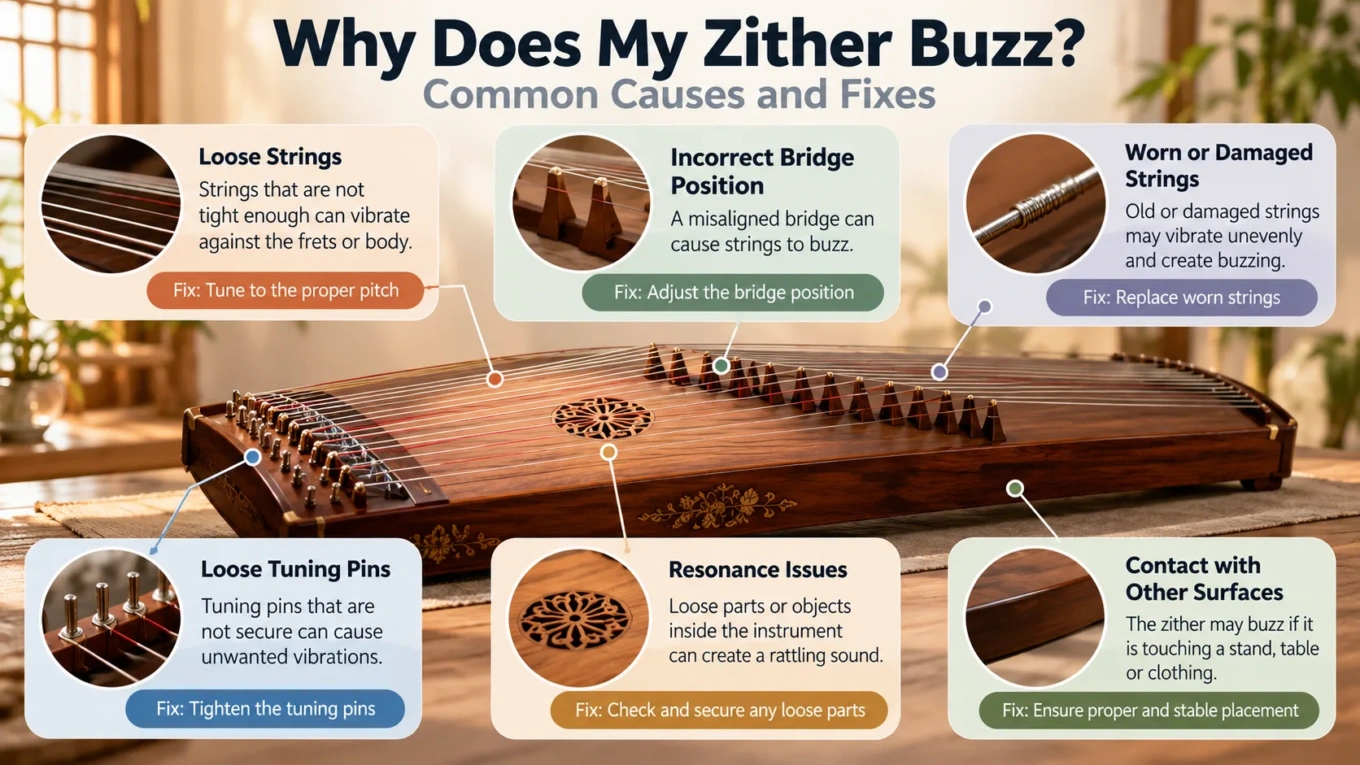
Why Does My Zither Buzz? Common Causes and Fixes
A zither buzz usually begins when a vibrating string, string end, bridge, fret, damping part, or loose component makes contact that should not occur. The sound may seem to come directly from the string being played even when another part is actually vibrating in response. The fastest way to diagnose the problem is therefore not to adjust the instrument immediately, but to identify which note triggers the noise, when it happens, and what makes it stop.
The word zither covers instruments with very different mechanical layouts. A concert zither has fretted melody strings and open accompaniment strings. Guzheng, koto, gayageum, and related long zithers use individual movable bridges. Autoharps add a mechanical damping system. Hammered dulcimers and santurs may place several strings in a single course. A repair that makes sense on one of these instruments can be irrelevant or harmful on another.
Diagnostic rule: Change only one thing at a time. If several strings, bridges, or mechanical parts are moved together, it becomes difficult to tell which change affected the buzz.
Identify the Pattern Before Touching the Setup
A buzz carries useful diagnostic information. Start by reproducing it several times under controlled conditions. Play the suspected string softly, then with normal force, then somewhat more firmly. If the instrument has stopped or fretted notes, compare the open string with several neighboring notes.
| What Happens | First Area to Inspect | Useful Test |
|---|---|---|
| One open string buzzes every time | String condition and contact points | Pluck it while lightly touching nearby non-speaking string sections |
| Open string is clean but certain stopped notes buzz | Frets, string clearance, or playing contact | Compare the affected position with the notes immediately above and below it |
| Buzz appears only when the string is played hard | Marginal clearance or weak contact at a support point | Compare soft and firm attacks |
| One pitch makes another part rattle | Loose component or sympathetic vibration | Repeat the pitch while gently touching suspected parts one at a time |
| Buzz began directly after restringing | String seating, winding, gauge, or bridge disturbance | Trace the complete path of the replaced string |
| Buzz began after a movable bridge was repositioned | Bridge seating, angle, groove, or neighboring clearance | Inspect the bridge without immediately moving it again |
| Only one autoharp chord produces the problem | That chord bar and its felt | Compare the same strings with another chord bar pressed |
| Several strings changed after transport or a weather shift | Setup or structural movement | Inspect bridges, top surface, joints, and tuning behavior before adjusting |
The pattern matters more than the apparent location of the sound. A string can excite a loose part several inches away through sympathetic resonance[1]. This is why touching or muting parts while repeatedly sounding the same note is often more revealing than listening from one position.
Make Sure the Noise Is Actually a Mechanical Buzz
Not every rough or unstable tone comes from two objects touching. Zithers with paired or grouped strings can produce a pulsing sound when strings intended to act together are slightly out of tune. A course[2] may contain more than one string, depending on the instrument. If those strings are close in pitch but not matched closely enough, audible beats can resemble a low buzz or shimmer.
Before searching for loose hardware on a hammered dulcimer, santur, or another multi-string arrangement, tune the affected group carefully and listen again. If the roughness slows as the pitches approach one another and disappears when they match, the problem was tuning rather than mechanical contact.
A mechanical buzz behaves differently. It often has a raspy, rattling, sizzling, or metallic edge. It may become stronger with a harder attack, disappear when a part is touched, or occur only at one particular pitch.
Use the Touch-and-Release Test
Reproduce the buzz and lightly touch one suspected area at a time. Do not press hard enough to alter the instrument’s setup. Useful places include:
- unused string sections beyond a bridge;
- a loose-looking cover or removable mechanical part;
- the string immediately beside a bridge or other contact point;
- neighboring strings that may be vibrating in response;
- autoharp chord-bar parts when the noise is linked to a particular chord;
- the table, stand, pickup cable, or other object touching the instrument.
If the buzz stops instantly when one area is touched and returns when the finger is removed, the search has narrowed sharply.
Trace the Entire String, Not Just the Part That Is Played
A plucked or struck string has a main vibrating section, but several other areas can create noise. The bridge[3] supports the string and transfers vibration into the body. Other designs may also use a nut, saddle, side bridge, pin, or similar bearing point[4] where the direction of the string changes.
Inspect the string from one end to the other. Look for a loose winding, kink, damaged surface, badly seated contact point, unusually loose end, or a section lying very close to another hard surface.
A Damaged String Can Buzz by Itself
Wound strings deserve close inspection. If the outer winding becomes loose, separated, flattened, or damaged, it can vibrate against the string core or produce an irregular contact point. The string may still hold pitch while sounding mechanically rough.
Also examine any area repeatedly contacting a fret or bridge. A visible flattened section, sharp kink, corrosion, or damaged winding makes string replacement a more sensible first step than altering the instrument.
Use the string type intended for the particular instrument. A replacement that merely fits the available length is not automatically suitable. Gauge, material, construction, and intended tension affect how widely the string vibrates and how it loads the instrument.
Look for Unstable Contact at a Bridge or Bearing Point
A string generally needs a clear, stable relationship with its intended support. Trouble can appear when it barely touches a hard surface and repeatedly strikes it during vibration. The result can be a raspy buzz that becomes much stronger under a firm pluck or hammer stroke.
The angle at which a string passes over a contact point is often called the break angle[5]. Exact geometry varies widely among zithers, so there is no universal correct angle. What matters during diagnosis is whether the string is firmly supported as intended or hovering close enough to an adjacent surface to strike it intermittently.
Avoid filing or deepening a bridge groove simply because a buzz appears nearby. Removing material changes the string’s height and contact geometry. It can solve the wrong problem while creating a new one.
Do Not Ignore the String Beyond the Playing Area
The short string section beyond a bridge can vibrate even when it is not intentionally played. This section is often described as the afterlength[6]. On instruments with many exposed strings, an afterlength may respond to another note and rattle against a bridge, saddle, neighboring string, or nearby component.
This produces one of the more confusing forms of zither buzz: playing one string seems to create a defect in that string, but muting a completely different string end removes the noise.
When testing, play the troublesome note repeatedly while lightly damping nearby unused string sections. If one of them silences the rattle, the active string may be perfectly healthy.
Concert Zither Buzzing Needs a Fretted-String Diagnosis
On a concert zither, the melody strings behave differently from the open accompaniment and bass strings. The melody side runs over a fingerboard with frets[7], so a buzz that appears only when a melody string is stopped should be investigated as a fretted-string problem before altering bridges or tuning hardware.
One Position Buzzes but the Notes Around It Are Clean
This pattern points toward a local issue. Possibilities include an uneven or loose fret, wear at the string’s contact point, damage to the string itself, or insufficient clearance over the next fret.
First check whether the noise remains when the note is stopped cleanly with normal finger pressure. An incompletely stopped string can chatter against a fret, but excessive pressure should not be needed to produce a normal note.
Several Neighboring Positions Buzz
When a group of adjacent stopped notes is affected, the problem may involve string height, fret level, or broader setup geometry rather than one isolated fret. The vertical clearance of the string above the fretted playing surface is often discussed as action[8].
Very low clearance can allow a vibrating string to reach a higher fret, especially under a stronger pluck. Raising tension is not a proper correction. If the correct string is fitted and normal playing pressure still produces repeated buzzing across several positions, the setup deserves inspection.
Open Note Clean, Fretted Note Noisy
This comparison is especially useful. A clean open note makes a permanently loose string winding or constant bridge contact less likely, while directing attention toward the fretted playing area. It does not prove that a fret is defective, but it sharply narrows the search.
Open Melody String and Open Accompaniment String Behave Differently
Do not apply the fretted-string diagnosis to the open accompaniment field. If an open accompaniment or bass string buzzes, examine its string path, contact points, winding, neighboring strings, and nearby fittings first.
Movable-Bridge Zithers Have Their Own Failure Pattern
Guzheng, koto, gayageum, đàn tranh, and several other long zithers use individual movable bridges[9], although their bridge forms, strings, setup practices, and playing techniques are not interchangeable. A buzz that begins after one bridge has been moved deserves immediate attention around that bridge.
Check Whether the Bridge Is Sitting Flat
A bridge should stand in the orientation intended for that instrument and make stable contact with the top. If it has rotated, tilted, or been disturbed during transport or tuning, inspect its seating before making further changes.
Do not assume that pushing it back by eye will restore the correct position. Bridge placement can affect pitch, string feel, bending range, and the effective speaking length[10] of the string.
Inspect the String’s Position on the Bridge
The string should sit where the bridge was designed to carry it. A string displaced toward the edge of a groove or resting imperfectly can create unstable contact. Check visually before attempting to move anything.
If a buzz appeared immediately after bridge adjustment, compare the bridge with adjacent bridges for obvious rotation or seating differences. The goal is to locate the change, not to make several new changes in search of a better sound.
Do Not Treat All Long Zithers as Mechanically Identical
A corrective procedure suitable for one guzheng setup should not automatically be transferred to a koto or gayageum. Bridge shape, string material, playing side, tension, and adjustment practice differ. When the diagnosis reaches actual bridge repositioning rather than simple inspection, instrument-specific setup information should take priority.
Autoharp Buzzing Often Reveals Itself Through the Chord Bars
An autoharp adds a mechanical layer that most open-string board zithers do not have. Pressing a chord bar[11] brings felt into contact with selected strings so that unwanted pitches are muted while the intended chord tones remain free.
This makes the timing of the buzz very informative.
Only One Chord Bar Causes the Buzz
If the instrument sounds clean until one particular chord button is pressed, inspect that bar before disturbing strings or tuning pins. Felt can become compressed, displaced, uneven, loose, or worn. A string that should be fully muted may then remain in partial contact with the felt and vibrate against it.
Press the bar normally and identify which string produces the noise. Compare the same string while another chord bar is used. A problem tied consistently to one bar points toward its alignment or felt contact.
The Buzz Happens With No Bar Pressed
Then the diagnosis changes. A felt edge may be touching a string when the mechanism is at rest, a loose mechanical part may be rattling, or the problem may be unrelated to the chord system.
The process of selectively stopping strings is damping[12]. A healthy damping system should stop unwanted vibration cleanly rather than leaving a string half free to rattle.
A Mechanical Rattle Is Not Always a Felt Problem
Chord-bar covers, bar guides, springs, buttons, and other fitted parts can also vibrate at particular frequencies. If touching the cover or another removable part immediately stops the noise, the string may only be exciting that component sympathetically.
Avoid indiscriminately tightening every fastener. Parts mounted in wood can be damaged by excessive tightening, and some movement may be part of the intended mechanism.
Hammered Dulcimer and Santur Buzzes Can Hide Outside the Played Note
Struck zithers with multiple strings per note require an extra diagnostic step: verify the tuning of the complete course before changing anything mechanical. Two closely pitched strings can create beating that is easily mistaken for a buzz.
If tuning is accurate and the rasp remains, examine string contact around bridges and other support points. A hard hammer attack produces a wider initial vibration than a gentle one, so marginal contact may become obvious only when the note is struck with normal playing energy.
One Course Can Trigger Another String Section
A note may set an unused string end or another course into sympathetic motion. Repeat the troublesome note while selectively muting nearby string sections. The vibrating part that creates the rattle may not belong to the note being struck.
String Spacing Matters
Where multiple parallel strings form one course, they should not collide during normal playing. If a buzz occurs only under an unusually hard strike, compare the spacing visually before altering any bridge or saddle. Bent hardware, displaced strings, or an incorrect replacement can reduce the gap between neighboring strings.
Permanent changes to a bridge, saddle, or string groove should not be the first response to a spacing problem.
A Buzz That Started After Restringing Usually Has a Clue
When an instrument was clean before a string change and noisy immediately afterward, begin with what changed. This is more efficient than treating the buzz as an unrelated defect.
- Confirm the replacement string. Check that its gauge, material, and construction suit the instrument and position.
- Inspect the winding. Make sure the string leaves the tuning pin cleanly and does not have a loose coil or projecting end.
- Trace each contact point. The string should follow the intended route over bridges, nuts, saddles, or other supports.
- Check nearby bridges. Restringing can accidentally disturb a movable bridge or alter a string’s seating.
- Look for a loose tail. A short free end near the tuning or anchoring area can create a metallic rattle.
- Retune before judging the final sound. New strings may need repeated small tuning corrections before their behavior becomes stable.
On some many-string zithers, the height at which a string winds around a tuning pin also changes how it approaches a nearby support. Rewinding is therefore not purely cosmetic. If correcting the winding requires unfamiliar pin work or changes bridge pressure, it is better treated as a setup task rather than improvised adjustment.
Playing Force Can Reveal a Clearance Problem
A string does not remain in one fixed line while sounding. It moves through an arc around its resting position, with the widest movement shortly after it is plucked or struck. A string that clears every nearby surface during soft playing may reach one of them when played harder.
Soft note clean, firm note buzzing often points toward marginal clearance, weak bridge contact, neighboring-string contact, or a string that is moving too close to another component.
Soft and firm notes both buzzing suggest more constant contact, string damage, or a part already loose enough to rattle under minimal excitation.
Only one pitch triggers a rattle elsewhere is a classic sign to investigate sympathetic vibration rather than immediately changing the string producing that pitch.
Check the Instrument’s Surroundings Before Repairing the Instrument
Wide, resonant zithers are commonly played on tables, stands, laps, or supports. An external object touching the body can buzz at a particular frequency and imitate an internal defect.
Before making mechanical adjustments, remove unnecessary contact with:
- music stands;
- pickup or microphone cables;
- case hardware;
- loose objects on the table;
- metal accessories resting against the body;
- unstable stands or furniture.
If appropriate for the instrument, repeat the troublesome note on another stable playing surface. A buzz that disappears completely has saved an unnecessary repair.
Several New Buzzes Can Point Beyond the Strings
A single noisy string often has a local explanation. Several strings developing similar symptoms within a short period deserves a wider inspection, especially after transport or a large environmental change.
The soundboard[13] carries bridge pressure and participates directly in vibration. Wood movement, a disturbed bridge, an opening joint, or another structural change can alter string clearance and mechanical contact across more than one note.
Look for visible changes before trying to compensate through tuning or bridge movement:
- a fixed bridge beginning to lift or separate;
- a new crack or open seam;
- a top surface that has changed shape noticeably;
- a loose or raised fret;
- a movable bridge that no longer sits normally;
- several strings suddenly losing normal clearance;
- tuning pins behaving differently at the same time as the buzz appeared.
Stop adjustment when buzzing appears together with visible structural movement. Raising tension, forcing a bridge, tightening hardware, or applying household glue can make the underlying problem harder to repair.
Use a Low-Risk Repair Order
Buzz diagnosis is safer when reversible checks come first. Work from observation toward adjustment.
- Retune the affected note or course. Eliminate beating and obvious pitch instability.
- Reproduce the buzz consistently. Record whether it depends on pitch, playing force, fretting, bridge position, or chord-bar use.
- Remove external contact. Check the stand, table, cable, cover, and nearby objects.
- Mute suspected secondary vibrations. Touch unused string sections and nearby components one at a time.
- Inspect the string. Look for winding damage, corrosion, kinks, loose ends, or an incorrect replacement.
- Inspect normal string contact points. Look for visibly poor seating without filing, bending, or reshaping parts.
- Check the mechanism specific to the instrument. Frets on a concert zither, movable bridges on long zithers, chord bars on an autoharp, or grouped strings on a struck zither each require different reasoning.
- Replace an obviously defective string with the correct type.
- Stop before structural alteration. Bridge reshaping, fret work, glue repair, pin-block work, and correction of distorted wooden parts belong beyond routine troubleshooting.
Fixes That Can Create a Second Problem
Filing a Bridge or Saddle
A groove that appears too high or shallow can be tempting to modify, but material removed from a bridge cannot be put back easily. The change may lower the string, alter its contact angle, affect pitch behavior, or create a new buzz.
Increasing String Tension to Clear a Buzz
Extra tension may temporarily change how a string behaves, but it does not correct a worn fret, loose part, wrong string, unstable bridge contact, or structural movement. Older zithers deserve particular caution because their present strings and tuning may not match the setup for which the instrument was built.
Moving Several Bridges at Once
On movable-bridge zithers, this destroys the diagnostic trail and may change several pitches or playing characteristics together. If one bridge was moved immediately before the noise appeared, investigate that bridge first.
Using Household Glue on a Loose Joint
A vibrating seam or lifting fixed bridge can certainly create noise, but filling the gap with general-purpose adhesive can interfere with proper repair. Structural joints under string tension need the correct fit, preparation, adhesive choice, and clamping method.
Randomly Tightening Screws
A fastener that is visibly loose may deserve inspection, but overtightening into wood can strip the hole, crush surrounding material, distort a cover, or stop a mechanical part from moving as intended.
When the Buzz Needs a Repairer Rather Than Another Test
Some buzzes remain harmless annoyances until their exact cause is found. Others accompany physical changes that should not be corrected by trial and error.
Professional inspection is sensible when the instrument shows:
- a lifting, split, or unstable fixed bridge;
- a crack in the top, back, side, or another loaded wooden area;
- an opening glue joint;
- a loose fret that visibly moves;
- several fretted positions buzzing because the playing surface has changed;
- a tuning pin that will not hold normal tension;
- a visibly distorted soundboard;
- repeated bridge movement that cannot be explained by normal adjustment;
- multiple new buzzes appearing together with structural or tuning changes;
- an antique instrument whose correct strings, pitch level, or previous repairs are uncertain.
Before handing the instrument over, note exactly which string and pitch trigger the noise, whether it occurs softly or only under a firm attack, whether the note is open or stopped, and which light touch makes the noise disappear. Those observations can be more useful than describing the instrument simply as “buzzing.”
Glossary of Technical Terms
[1] Sympathetic Resonance: Vibration produced in a string or component because another note excites one of its natural resonant frequencies. On a zither with many exposed strings, the part that rattles may be different from the string being played.
[2] Course: A single string or a group of strings treated as one musical unit. Some dulcimer- and santur-type instruments use multiple strings for the same note, so uneven tuning within a course can imitate a mechanical buzz.
[3] Bridge: A support that holds a string at its intended height and transfers vibration into the instrument body. Zither-family instruments may use fixed bridges, individual movable bridges, or several bridge systems.
[4] Bearing Point: A point where a string is supported or changes direction. Depending on the instrument, this may be a bridge edge, nut, saddle, side bridge, or another designed contact surface.
[5] Break Angle: The angle formed where a string passes over a bridge, saddle, or similar support. It affects how the string bears against that point, although suitable geometry differs between instrument designs.
[6] Afterlength: The portion of string outside the principal playing length, often between a bridge and an anchor or another support. It can sometimes vibrate sympathetically and produce a misleading rattle.
[7] Fret: A raised pitch-defining strip used beneath stopped strings. On concert zithers and other fretted zithers, uneven, worn, or loose frets can contribute to buzzing at particular positions.
[8] Action: The practical height and clearance of strings above a fretted playing surface. If clearance becomes too low, a vibrating string may touch a fret beyond the intended stopping point.
[9] Movable Bridge: A bridge designed to be repositioned as part of an instrument’s setup or tuning system. Guzheng, koto, gayageum, and several related zithers use individual bridges, but their exact setup practices differ.
[10] Speaking Length: The part of a string that vibrates to produce the principal played pitch. Moving a bridge changes this length on many movable-bridge zithers.
[11] Chord Bar: A mechanical bar used on an autoharp to bring felt pads against selected strings. Pressing a bar leaves the notes of the chosen chord available while damping other strings.
[12] Damping: Reducing or stopping string vibration through controlled contact. Autoharp felt, a player’s hand, and dedicated damper mechanisms can all perform this function in different zither-family instruments.
[13] Soundboard: A vibrating wooden plate that receives energy from the strings, commonly through one or more bridges. Changes in its shape, joints, or bridge contact can affect several notes rather than one string alone.