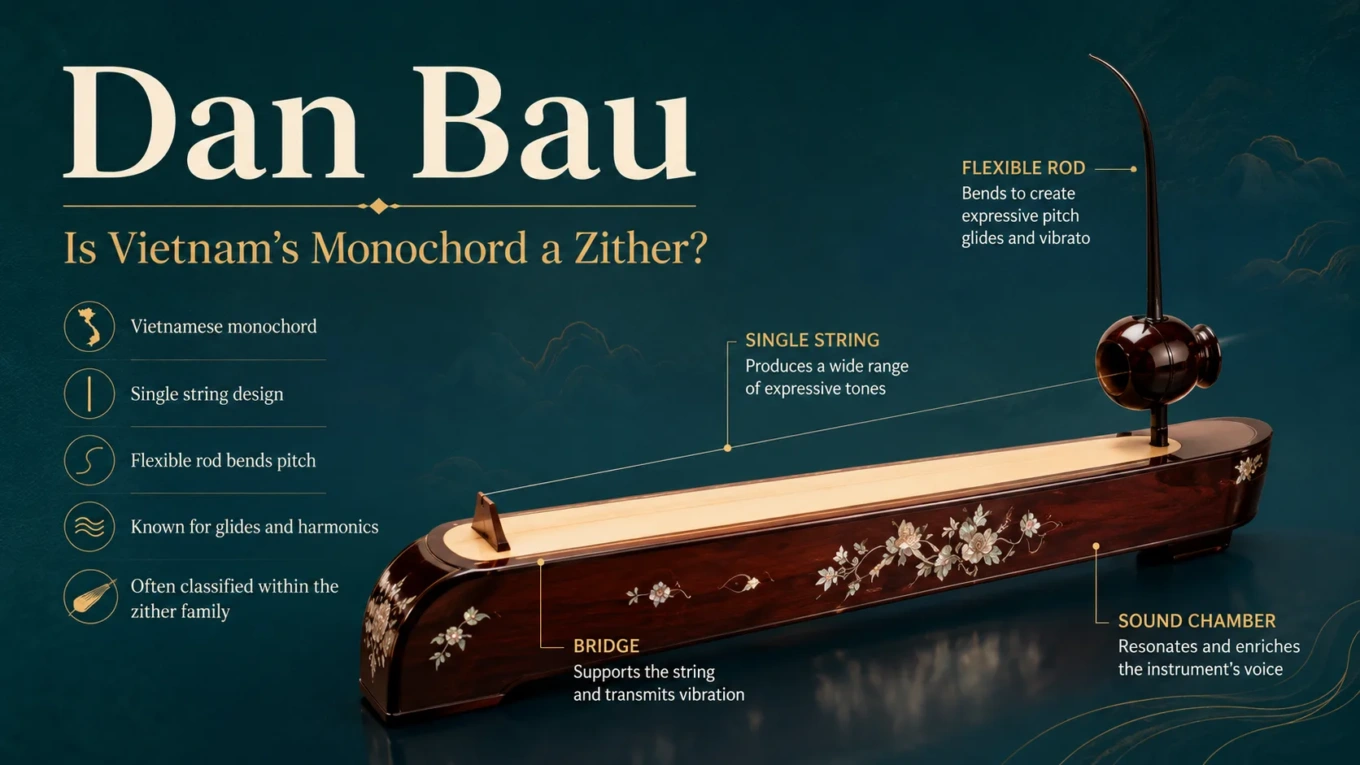
Dan Bau: Is Vietnam’s Monochord a Zither?
The dan bau is best understood as a Vietnamese monochord[1] and, in the broad organological sense, a type of zither[2]. It is not a zither in the narrow European sense of a concert zither with many strings and a fretted fingerboard. It belongs to the wider family of string instruments whose strings are stretched over, along, or across a sound-producing body rather than carried by a separate neck.
This distinction matters because the dan bau often looks too unusual for the word “zither” to feel obvious. It has only one string. Its pitch is shaped by a flexible rod and by harmonics rather than by a row of frets. Yet its construction still fits the broad zither idea: a string is stretched in relation to a resonating body, and the body helps project the sound.
Direct answer: yes, the dan bau can be called a monochord zither. The safest wording is “Vietnamese monochord zither,” because it names both the instrument’s one-string design and its place within the wider zither family.
Main Details Worth Knowing
| Feature | What It Means |
|---|---|
| Common English Name | Vietnamese monochord, dan bau, đàn bầu |
| Instrument Type | One-string chordophone[3], usually described as a monochord zither |
| Vietnamese Name | Đàn bầu, often linked with the older gourd-like resonator used on traditional forms |
| Related Name | Độc huyền cầm, meaning a one-string instrument in Sino-Vietnamese wording |
| String Count | One melody string, with pitch shaped by touch, plucking, and a flexible rod |
| Playing Method | Plucked with the right hand while the other hand bends pitch by moving the rod |
| Zither Connection | The string works with a resonating body[4] rather than with a separate neck like a lute |
Why the Word Zither Fits
In broad instrument classification, a zither is not defined by having many strings. It is defined by the relation between the string and the body. A lute, for example, has strings that run along a neck attached to a body. A harp has strings rising from a frame at an angle. A zither places the string or strings in a direct relation to the sound-producing body.
The dan bau fits that broader idea because its single string is attached in relation to a long body or sound box. The body is not just a handle or support. It helps the instrument resonate and gives the sound a place to form before it reaches the listener.
This is why the phrase monochord zither is useful. “Monochord” explains the single string. “Zither” explains the structural family. Together, the two words prevent a common mistake: treating the dan bau as if it were merely a one-string lute or a simple teaching monochord.
Where the Confusion Starts
The confusion comes from two different uses of the word zither.
- Narrow use: in some English-language contexts, “zither” may suggest the European concert zither, often with many strings and a fretted playing area.
- Broad use: in organology, “zither” can describe a larger group of chordophones where strings are stretched over a body, board, tube, trough, box, or frame.
The dan bau does not resemble a concert zither. It also differs from long East Asian board zithers such as the guzheng, koto, gayageum, and đàn tranh, which use many strings and movable bridges. But it still belongs near them in the wider zither family because its sound comes from a string-body relationship rather than from a necked string instrument design.
Classification Note: “Zither” should not be read here as a claim that the dan bau is played like an Alpine concert zither or built like a đàn tranh. It means the instrument belongs to a broad structural category of chordophones.
Names and Spelling: Dan Bau, Đàn Bầu, and Độc Huyền Cầm
The Vietnamese spelling is đàn bầu. In plain English text, it is often written as dan bau without tone marks or the crossed letter đ. Both forms point to the same instrument, though the Vietnamese spelling carries the proper pronunciation and tone marks.
The word đàn is a general Vietnamese word used for many musical instruments, especially string instruments. Bầu refers to a gourd, which helps explain older descriptions of the instrument as a “gourd zither.” Traditional forms used a gourd, coconut shell, or gourd-like resonator near the flexible rod. On many modern instruments, this part may be wooden or partly decorative rather than a simple natural gourd.
The name độc huyền cầm also appears in some contexts. It points to the one-string nature of the instrument. For an English reader, however, “Vietnamese monochord zither” is usually the clearest term because it identifies the instrument, the region, and the structure in one phrase.
How the Dan Bau Is Built
The dan bau has a long, narrow body that works as a soundboard[5] or sound box, depending on the form. Traditional examples are often described with a bamboo tube, a silk string, a flexible rod, and a gourd or coconut-shell resonator. Modern instruments often use a wooden body, a metal string, a tuning machine, and sometimes amplification.
One end of the string is fixed near a tuning device. The other end is connected to a flexible pitch-control rod[6]. This rod is not a neck in the lute sense. It does not carry frets or a fingerboard. Instead, it changes string tension when the player pushes or pulls it.
The gourd-shaped part near the rod is one of the instrument’s most recognizable visual features. On older forms, it had a clearer acoustic role as a resonator. On some modern stage instruments, the main wooden body and electronic amplification do more of the sound-projection work, while the gourd form remains part of the instrument’s identity and construction language.
Construction Elements That Shape the Instrument
- Long body: supports the string and helps the sound develop.
- Single string: provides the raw pitch material for the whole instrument.
- Flexible rod: lets the player bend pitch with fine control.
- Gourd or gourd-shaped cover: marks the traditional form and may support resonance depending on the instrument.
- Tuning device: sets the base pitch before playing.
- Pickup or amplifier on modern forms: helps the soft instrument carry in larger rooms or ensembles.
Why One String Can Produce Many Notes
The dan bau does not work like a one-string instrument that can only play one plain note. Its playing system depends on the natural harmonic[7] points of the string and on controlled pitch movement.
The player lightly touches the string at certain points, plucks it, and releases or shapes the sound. These light-touch points bring out overtones rather than the full open string. The other hand moves the rod to raise or lower the pitch. In skilled playing, a single plucked sound can bend, lean, swell, or fall in a way that feels close to sung melodic ornament.
This is one reason the dan bau is often described as having a vocal quality. The sound is not only a fixed plucked note. It is a moving note, shaped after the pluck.
The Bridge Question: Does the Dan Bau Have a Bridge?
Many zithers use visible bridges to support the strings and define vibrating length. The dan bau is different. It does not use a row of movable bridges like a guzheng, koto, gayageum, or đàn tranh. Instead, the flexible rod and contact points define how the string tension and vibration behave.
Some descriptions use bridge-related language because the string must pass across or attach through a support area. Still, it is more accurate to say that the dan bau uses a tension-changing rod rather than a movable bridge[8] system. The player’s left-hand motion changes pitch after the string is sounded.
How It Is Played
The dan bau is usually plucked with a small plectrum[9] or pick held by the right hand. The same hand may also touch harmonic points. The other hand holds or moves the rod, bending the pitch upward or downward.
Before the note is shaped, the string has a base pitch. This open string[10] pitch can vary by instrument, performer, teaching method, and musical setting. Some teaching materials describe C as a common base pitch, but the dan bau should not be treated as having only one fixed tuning. Performers may adjust the base note to suit a piece, ensemble, singer, or tonal range.
The tuning peg[11] or modern tuning machine sets that base tension. The rod then gives the player a flexible pitch range around the harmonic tones. This is why tuning the dan bau is not only about setting one pitch; it is also about giving the rod enough room to bend notes cleanly without making the string unstable.
Sound, Timbre, and Musical Character
The dan bau is known for a clear, focused timbre[12] with sliding pitch movement. Its sound can seem delicate when played acoustically, especially compared with louder struck or multi-string zithers. Modern instruments are often amplified so the tone can carry in ensemble and stage settings.
The instrument’s expressive range comes from pitch bending[13], touch pressure, plucking strength, and the timing of the rod movement. A note can start plainly, rise into a controlled bend, or settle downward with a vocal-like fall. This approach makes the dan bau very different from a fixed-pitch keyboard or a fretted instrument.
Listening Note: When listening to the dan bau, follow the movement inside each note. The expressive detail often happens after the pluck, not only at the moment the string is sounded.
How the Dan Bau Differs from Đàn Tranh
The dan bau and đàn tranh are both Vietnamese string instruments that can be discussed in relation to the zither family, but they are not the same type of instrument.
| Feature | Dan Bau | Đàn Tranh |
|---|---|---|
| String Layout | One string | Multiple strings |
| Pitch Method | Harmonics and rod-controlled bending | Open strings, plucking, and left-hand pressure near bridges |
| Bridge System | No row of movable bridges | Uses individual movable bridges |
| Common English Description | Vietnamese monochord zither | Vietnamese plucked board zither |
| Playing Feel | One-string melodic shaping | Multi-string melodic and ornamental playing |
The comparison helps clarify why “zither” is a family term, not a claim that all zithers work alike. The đàn tranh sits closer to the familiar image of an East Asian board zither. The dan bau sits at the one-string edge of the family.
How the Dan Bau Differs from a Concert Zither
A concert zither usually has many strings, including melody strings over a fretted area and accompaniment strings across the body. The dan bau has one string and no fretted fingerboard. Its musical logic depends on harmonics and flexible pitch, not on pressing a string against frets.
Both instruments can be called zithers in broad classification, but they belong to very different playing traditions. The concert zither is often associated with Central European forms, while the dan bau is associated with Vietnamese music. The shared family label should never erase those differences.
How the Dan Bau Differs from a Scientific Monochord
The word “monochord” can also refer to a measuring or teaching instrument used to show pitch ratios. That type of monochord may be built for demonstration rather than performance.
The dan bau is a musical instrument with a living performance practice. It uses one string, but it is not just a laboratory-style string stretched across a board. Its rod, plucking method, harmonic technique, body shape, and performance style make it a distinct Vietnamese instrument.
Tuning and Scale Use
The dan bau is often linked with pentatonic scale[14] patterns, but its pitch world should not be reduced to five fixed notes. The instrument can bend between pitch centers, shade notes, and shape ornaments that are central to its sound.
Because one string supplies the whole melody, tuning must support the musical mode, performer comfort, and ensemble setting. A teacher may start with a common base pitch for clarity, while a performer may retune for a piece or for a singer. Modern tuning machines make these adjustments easier than older peg or tied-string systems.
Materials and Modern Construction
Older descriptions of the dan bau often mention bamboo, silk string, and a gourd or coconut shell. These materials help explain the instrument’s name and early physical form. Modern acoustic dan bau instruments often use a wooden body and a metal string. Some modern instruments also include a magnetic pickup[15] or other amplification system.
Wood choice can shape resonance, weight, and playing feel, but it should be discussed carefully. The sound of the dan bau does not come from wood alone. It comes from the whole system: string tension, rod flexibility, body response, touch technique, and amplification when present.
Luthier’s Note: A good dan bau needs a stable body, a responsive rod, a clean string path, and enough sensitivity for controlled bends. The instrument may look simple, but small construction details affect tuning stability and expressive control.
Why It Is Not Usually Called a Lute, Harp, or Dulcimer
The dan bau is sometimes hard to place because it does not match the common visual image of a zither. Still, other labels are less accurate.
- Not a lute: it does not use a neck with a fingerboard as the main pitch-control area.
- Not a harp: its string is not arranged in a harp frame, and pitch is not selected from many differently tuned strings.
- Not a dulcimer: it is not a struck string instrument like many hammered dulcimers, nor a fretted lap instrument like the Appalachian dulcimer.
- Not a standard board zither: it lacks the multi-string bridge layout found in đàn tranh, guzheng, koto, or gayageum.
“Monochord zither” remains the most balanced English label because it describes the structure without forcing the dan bau into a better-known but less fitting category.
Performance Setting and Musical Use
The dan bau can be played as a solo instrument, used with voice, or placed in ensembles. Its sound is especially suited to shaped melody because a single note can carry a wide range of inflection. In modern settings, amplification allows the instrument to join louder groups without losing its sliding, overtone-rich character.
The instrument’s role is not only technical. It is also connected with Vietnamese musical identity, teaching, stage performance, and instrument craft. For readers comparing zither-family instruments, the dan bau shows how wide the zither idea can be: a zither may have many strings, or it may have one string used with remarkable control.
Common Mistakes When Describing the Dan Bau
- Calling it only a “one-string instrument”: this is true but incomplete. It leaves out the harmonic system, the rod, and the zither structure.
- Assuming it has a fixed pitch set: the player shapes pitch continuously, so the instrument is not limited to simple fixed notes.
- Treating the gourd as always the main resonator: this may fit some older forms, but modern instruments often rely more on the wooden body and amplification.
- Comparing it too closely to đàn tranh: both can sit in zither discussions, but their string layout and playing logic are very different.
- Using “zither” only in the European sense: this hides the broader family meaning used in instrument classification.
What Beginners Should Know
For a beginner, the dan bau can be conceptually simple and physically demanding at the same time. There is only one string, so the layout looks less crowded than a multi-string zither. Yet accurate playing depends on touch, ear training, harmonic placement, and smooth rod control.
The first challenge is not memorizing many strings. It is learning how a light touch changes the sound and how a small rod movement changes pitch. Beginners also need to hear when a bent note reaches the intended pitch rather than relying only on finger position.
For this reason, the dan bau is often better understood as an expressive pitch-shaping instrument than as a simple one-string beginner instrument. Its surface design is spare; its musical control is refined.
FAQ
Is the dan bau a zither?
Yes. In broad instrument classification, the dan bau is commonly described as a Vietnamese monochord zither because it has one string working with a resonating body rather than a separate neck.
Why does the dan bau have only one string?
The instrument uses one string with harmonics and rod-controlled pitch bending. The player does not need many strings to create a melody because pitch can be shaped after each pluck.
Is dan bau the same as đàn tranh?
No. The dan bau is a one-string monochord zither. The đàn tranh is a multi-string Vietnamese board zither with movable bridges. They belong near each other in broad classification but differ in construction and playing method.
Does the dan bau have frets?
No. The dan bau does not use frets. Pitch is controlled through harmonic touch points and movement of the flexible rod.
What does “đàn bầu” mean?
The word đàn refers to a musical instrument, while bầu points to a gourd. The name reflects older forms with a gourd-like resonator near the rod.
Is the dan bau hard to learn?
The layout is simple, but the technique takes careful listening. Smooth pitch bending, clean harmonics, and stable tuning control usually require patient practice.
Glossary of Technical Terms
- Monochord
- A one-string instrument. In the dan bau, the single string is not a limitation; it is the basis for harmonic playing and flexible pitch movement.
- Zither
- A broad family of chordophones in which the strings are stretched in close relation to a sound-producing body rather than carried by a separate neck. The dan bau fits this broad meaning, not the narrow meaning of a European concert zither.
- Chordophone
- An instrument whose primary sound comes from vibrating strings. Zithers, lutes, harps, bowed strings, and many dulcimers are all chordophones, though their structures differ.
- Resonating Body
- The part of an instrument that helps strengthen and color string vibration. On the dan bau, the long body and related resonating parts help the single string project sound.
- Soundboard
- A surface that receives vibration from the string system and helps radiate sound. In wooden dan bau instruments, the top or main body surface plays an acoustic role similar to a soundboard.
- Pitch-Control Rod
- The flexible rod attached near one end of the dan bau string. Moving it changes string tension and allows the player to bend pitch with fine control.
- Harmonic
- A clear overtone produced by lightly touching a vibrating string at certain points. Dan bau technique depends heavily on harmonics because the instrument has one string.
- Movable Bridge
- A bridge that can be repositioned to set string length or tuning. Many East Asian board zithers use movable bridges, but the dan bau does not use a row of them.
- Plectrum
- A small pick used to pluck a string. Dan bau players commonly use a small plectrum while also controlling harmonics and pitch movement.
- Open String
- A string sounded without being stopped or pressed to change its vibrating length. On the dan bau, the open string provides a base pitch before harmonics and rod movement shape the music.
- Tuning Peg
- A device used to adjust string tension and set pitch. Modern dan bau instruments may use machine-style tuners rather than older simple pegs.
- Timbre
- The tone color of an instrument. The dan bau is known for a clear, sliding, vocal-like timbre shaped by harmonics, touch, and pitch bending.
- Pitch Bending
- The act of raising or lowering a note after it begins. On the dan bau, pitch bending is made by moving the flexible rod and changing string tension.
- Pentatonic Scale
- A five-note scale pattern used in many musical traditions. The dan bau can work with pentatonic materials, but its expressive pitch movement is not limited to fixed scale steps.
- Magnetic Pickup
- An electronic device that converts string vibration into an electrical signal for amplification. Some modern dan bau instruments use pickups so the soft acoustic sound can carry in larger settings.