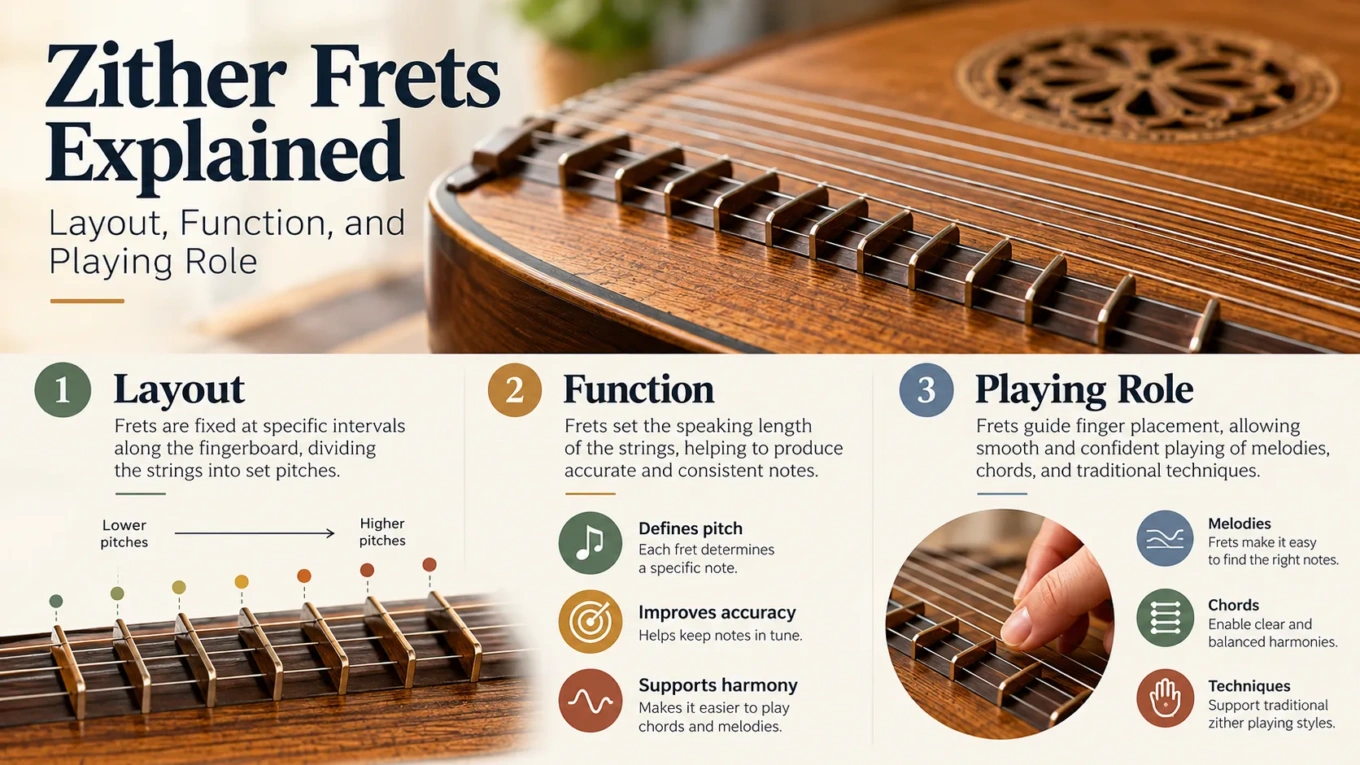
Zither Frets Explained: Layout, Function, and Playing Role
On a European concert zither[1], the frets occupy only one specialized part of the instrument. They sit on the fingerboard[2] beneath the melody strings, while the much larger field of accompaniment and bass strings normally remains open. This split explains the playing role of zither frets: the left hand can select chromatic melody notes at fixed positions while the open-string field remains available for harmony and bass.
The term “zither frets” therefore needs a narrow scope. Many instruments classified within the wider zither family have no fixed frets at all. The layout described here is centered on the European concert or Alpine zither and closely related fretted forms, not on guzheng, koto, qanun, santur, autoharp, or other zithers that organize pitch in different ways.
The Fretboard Covers Only the Melody-String Area
A concert zither combines two pitch systems on one body. A small group of melody strings[3] passes over the fingerboard. Beside them is a larger field of open strings[4] assigned to accompaniment, bass, and, on some instruments, lower extended registers.
| String Area | Fretted? | Primary Role |
|---|---|---|
| Melody strings | Yes | Stopped melodic notes and chromatic movement |
| Accompaniment strings | No | Open harmony and accompaniment |
| Bass strings | No | Open low notes |
| Additional low strings | Usually no | Extended bass range on instruments equipped with them |
This layout is easy to misread when looking at the instrument from above. The many open strings occupy more visual space, yet the narrow fretted section carries a large share of the melodic work.
The fretboard also distinguishes the concert zither from instruments whose pitch is set mainly by one string per note. A single fretted melody string can produce a succession of pitches because the player changes its effective vibrating length.
What a Fret Does to a Zither String
A fret[5] is a raised metal contact point crossing the fingerboard. When a melody string is played open, it vibrates between its two effective endpoints. Pressing that string onto a fret creates a new endpoint closer to the bridge. The remaining vibrating section is shorter, so the pitch rises.
The useful concept is the string’s vibrating length[6]. A player does not raise the note because the fret itself “contains” a particular pitch. The fret works because its position determines how much of the string remains free to vibrate.
- An open melody string uses its full speaking length.
- The left-hand finger presses the string down behind a selected fret.
- The string contacts the metal fret.
- That fret becomes the new endpoint of the vibrating section.
- The shorter string segment produces a higher pitch.
A higher fret therefore means a shorter active string. Moving back toward the open-string end restores more vibrating length and lowers the pitch.
Physical distinction: the finger supplies pressure, but the metal fret establishes the precise stopping line. This is why finger placement, fret height, string clearance, and fret condition all affect the result.
Why the Frets Become Closer Together
Zither frets do not form an evenly spaced ruler. The gaps become progressively smaller toward the bridge because musical pitch does not rise in a simple one-millimeter-per-note sequence.
On a chromatically fretted instrument designed around twelve-tone equal temperament[7], each successive fret raises the theoretical pitch by one semitone[8]. The frequency ratio from one semitone to the next is the twelfth root of two. Because frequency rises as the vibrating length becomes shorter, each new fret must divide the remaining string length proportionally rather than by a fixed number of millimeters.
The theoretical position of fret number n, measured from the open-string endpoint, can be expressed as:
Fret position = scale length × (1 − 2−n/12)
The equation explains two immediately visible features of the fingerboard. The first few fret spaces are broad. Near the bridge, the spaces become narrow.
The Twelfth Fret Is a Useful Geometric Check
The scale length[9] is the effective open vibrating length of the melody string. In an ideal twelve-tone layout, the twelfth fret leaves half of that length vibrating. The resulting pitch is one octave above the open string.
The twenty-fourth fret, where present and usable on a given string, lies at three quarters of the original scale length when measured from the open endpoint. Only one quarter of the original string length remains active beyond that point.
| Fret | 390 mm Scale | 435 mm Scale |
|---|---|---|
| 1 | 21.9 mm | 24.4 mm |
| 5 | 97.8 mm | 109.1 mm |
| 12 | 195.0 mm | 217.5 mm |
| 24 | 292.5 mm | 326.2 mm |
These figures are theoretical equal-tempered positions, not a repair template for every historical zither. Real instruments can differ in scale length, fret construction, bridge geometry, string properties, and historical design. Pressing a real string down also changes its tension slightly, so practical intonation[10] is not determined by geometry alone.
The Same Fret Number Does Not Mean the Same Note on Every String
A fret defines an interval above the string’s open pitch, not one universal note name across the whole fingerboard.
If two melody strings begin at different open pitches, pressing both at the fifth fret raises each by the same number of semitones, but their resulting notes remain different. The player therefore reads the fretboard as a combination of string identity and fret position.
This creates overlapping pitch territory. A note available high on one melody string may also be available in another position on a neighboring string, depending on the tuning and usable fret range. Fingering choice can therefore affect hand movement, phrasing, the connection between successive notes, and access to simultaneous stopped notes.
The exact open tuning belongs to the setup of the particular concert zither and should not be inferred from fret number alone. Historical instruments also need to be identified before assuming that their stringing and tuning follow a current concert-zither arrangement.
Historical Zither Fretboards Do Not Follow One Physical Pattern
Surviving late nineteenth- and early twentieth-century concert zithers show why fret count should never be treated as a universal specification. Museum-documented examples include instruments with 27 frets and others with 30, with the cataloged total sometimes including a zero fret. Melody-string vibrating lengths in documented examples also vary from roughly 389 mm to more than 430 mm.
| Approximate Date | Fret Description | Melody-String Length |
|---|---|---|
| 1880–1900 | 27 nickel-silver frets including zero fret; upper partial frets | About 390 mm |
| 1890–1910 | 27 brass frets including zero fret | About 389 mm |
| Around 1900 | 30 nickel-silver frets including zero fret | About 418 mm |
| 1900–1920 | 30 nickel-silver frets including zero fret | About 435 mm |
| Around 1920 | 30 nickel-silver frets including zero fret; several shortened upper frets | About 412 mm |
The numbers show two separate forms of variation. One zither can have a shorter scale but a similar nominal fret count to another instrument. A second difference appears in the upper register, where some frets extend across the full melody-string width while others stop partway across it.
Zero Frets
A zero fret[11] appears on many documented concert zithers. It sits at the open-string end of the playable fret system and can provide the contact point from which the open melody string begins its vibrating length. A nut or guide behind it can still control spacing and string path, depending on the construction.
This arrangement should not be assumed from appearance alone. An old zither may have a different endpoint arrangement, missing hardware, replacement parts, or wear that makes the original geometry harder to read.
Full and Partial Frets
Some historical concert zithers have upper-register partial frets[12] that cross only part of the fingerboard.
Documented examples include an eighteenth fret extending roughly three quarters across the fretboard, a twenty-third fret extending about half its width, and a twenty-fifth fret reaching only a quarter of the way across. Other instruments use different combinations.
The practical result is easy to overlook: a catalog entry stating that an instrument has 30 frets does not necessarily mean that every one of those frets is available under every melody string. The high register can be string-specific.
Partial frets also make visual fret counting unreliable unless the complete fingerboard is inspected. A short piece of fret wire near one edge may be part of the original design rather than a broken full-width fret.
Fret Materials Also Vary
Nickel-silver fret wire appears often on surviving concert zithers, but brass examples are also documented. The fret material should therefore be recorded as an observed construction detail rather than used alone to assign a maker, date, or quality level.
Age, fret profile, installation, wear, string type, and setup can matter more to playability than a simple brass-versus-nickel-silver label.
Position Dots Are Not Frets
Small dots or inlays on a zither fingerboard are position markers[13]. They help the player locate parts of the fretboard visually. They do not shorten the string and have no direct role in producing pitch.
Historical concert zithers show several marker arrangements. Museum examples place mother-of-pearl, bone, celluloid, or related inlays behind selected frets such as the fifth, ninth, twelfth, fifteenth, or seventeenth. The pattern is not identical on every instrument.
Fret: a raised contact point that changes the vibrating length of a stopped string.
Position marker: a visual locator that helps the player navigate the fingerboard.
This distinction matters when identifying an unfamiliar zither. A dot, painted mark, or inlay does not prove that a particular pitch system is present. The actual metal fret positions must be examined.
How Frets Divide the Work Between the Hands
In standard concert-zither playing, the left hand stops the melody strings against the frets. The right hand has a divided task: a thumb plectrum can sound the fretted melody strings while the remaining fingers reach into the open accompaniment and bass-string field.
That hand division is one of the defining practical effects of the instrument’s mixed layout. The left hand does not need to stop the accompaniment strings to form every harmony in the manner of a guitar. Those strings are already tuned as open pitches available to the right hand.
The frets therefore perform more than a tuning function. They turn a small number of melody strings into a chromatic melodic surface while allowing many neighboring strings to retain separate open-string roles.
Finger Placement Behind the Fret
For a clean stopped note, the finger normally presses the string in the space immediately behind the intended fret rather than directly on top of the metal crown. The string then seats firmly against the fret with less unnecessary pressure.
Placing the finger too far back can make a clean contact harder to achieve. Insufficient pressure may allow the string to rattle against the fret. Excess pressure can add hand tension and may pull the string farther from its ideal pitch than necessary.
The exact feel depends on the instrument’s action[14], fret height, string gauge, tension, and fingerboard condition. A zither with unusually high string clearance can demand more downward movement before the string reaches the fret.
Fret Condition Can Change Both Pitch and Playability
A correctly positioned fret can still cause trouble if its physical condition has changed. Old concert zithers may show flattened fret tops, corrosion, loosened fret ends, local height differences, damaged fingerboards, or replacement fret wire that does not match the surrounding work.
| Symptom | Possible Fret-Related Cause |
|---|---|
| Buzz at one position | A neighboring fret may sit too high, or the played fret may be worn or loose. |
| Note dies quickly | The string may contact a higher fret before it can vibrate freely. |
| Unusually heavy left-hand pressure | String clearance may be high, or fret geometry may be uneven. |
| Pitch differs from the expected chromatic step | Open tuning, scale geometry, fret placement, string condition, or setup may need inspection. |
| One upper string loses access to a fret | The fret may be intentionally partial rather than damaged. |
Fret wear should be interpreted together with the rest of the instrument. A buzzing note is not proof that the fret itself is the only problem. Bridge position, string condition, excessive clearance, a distorted fingerboard, loose structural parts, or an unsuitable replacement string can also affect the note.
Older-instrument caution: a historical zither should not be refretted, leveled, or altered simply because its measurements differ from a modern instrument. Original scale geometry, zero-fret construction, partial frets, bridge placement, and surviving fret material should be documented before irreversible work is considered.
Scale Length Determines the Physical Fret Locations
Two zithers can follow the same chromatic interval pattern while placing their frets at different millimeter measurements. The reason is scale length.
A 390 mm melody string reaches its theoretical twelfth-fret midpoint at 195 mm. A 435 mm melody string reaches the same musical relationship at 217.5 mm. Both positions represent an octave above the open string, yet they cannot share the same physical fret template.
This is particularly useful when examining incomplete or damaged historical instruments. Copying measurements from another zither of similar appearance can place every replacement fret slightly wrong if the two instruments were built around different vibrating lengths.
The bridge must also be treated as part of the system. Fret positions make sense only in relation to the effective string endpoints. A bridge that has shifted, been replaced, or been altered can make an otherwise orderly fretboard appear incorrectly laid out.
How to Read an Unfamiliar Zither Fretboard
An old zither can reveal much of its playing design before it is tuned. The safest approach is to read the string path and fretboard as one connected system rather than starting with the decorative style or the number of tuning pins.
- Count the strings that actually pass over the fingerboard. These are the strings the frets can affect. Do not include the neighboring open accompaniment field.
- Locate the open-string endpoint. Determine whether a zero fret, a nut, a wire saddle, or another arrangement establishes the start of the melody-string vibrating length.
- Inspect the full fret width. Check whether every upper fret crosses all melody strings or whether some are intentionally shortened.
- Look for position markers separately. Dots and inlays help with navigation but should not be counted as pitch-producing parts.
- Measure the effective melody-string length. Fret spacing can only be interpreted properly when the scale length is known.
- Check the midpoint relationship. On a conventional twelve-tone chromatic layout, the octave position should fall near half the effective open vibrating length.
- Examine fret height and wear. A visually correct fret position does not guarantee that the string will clear the neighboring frets.
- Inspect the bridge and string path. Altered endpoints can create an intonation problem even when the fret slots themselves have not moved.
- Identify the instrument before assigning a tuning. Fret geometry reveals interval structure, but absolute note names depend on the melody strings’ open pitches.
This method also helps separate a concert zither fretboard from superficially similar mechanisms. Autoharp chord bars selectively damp strings rather than shortening them at fixed pitch positions. Movable bridges on instruments such as koto or guzheng establish string divisions but do not operate as a row of finger-stopped frets. A visual marker on a fretless instrument can guide the hand without creating a physical stopping surface.
Glossary of Technical Terms
[1] Concert Zither: A European fretted zither, often associated with Alpine and Central European traditions, that combines a small group of fretted melody strings with a larger field of open accompaniment and bass strings.
[2] Fingerboard: The narrow surface beneath the concert zither’s melody strings on which the frets are installed and the left hand stops notes.
[3] Melody Strings: The strings that pass over the concert zither’s fretted fingerboard and can produce multiple stopped pitches. Their number and tuning depend on the instrument.
[4] Open Strings: Strings sounded without being stopped against a fret. On a concert zither, many accompaniment and bass pitches come from strings used in this manner.
[5] Fret: A raised metal strip or wire that establishes a fixed stopping point for a string. Pressing the string against it shortens the active vibrating length and raises the pitch.
[6] Vibrating Length: The section of a string free to vibrate between its effective endpoints. Fretting a melody string reduces this length.
[7] Equal Temperament: A tuning division in which an octave is divided into twelve equal logarithmic semitone steps. It provides the theoretical spacing model for many modern chromatically fretted instruments.
[8] Semitone: The smallest step in the ordinary twelve-note chromatic scale. Consecutive frets on a standard chromatic fretboard normally represent successive semitones.
[9] Scale Length: The effective vibrating length of an open melody string. It determines the physical distances required for theoretical fret placement.
[10] Intonation: The accuracy of pitches produced across the instrument. On a fretted zither it depends on more than fret position, including open tuning, string properties, scale geometry, pressure, and setup.
[11] Zero Fret: A fret positioned at the open-string end of the fret system. On zithers built with one, it can establish the open melody string’s effective speaking endpoint while another component behind it guides the string.
[12] Partial Fret: A fret that extends across only part of the fingerboard rather than beneath every melody string. Several historical concert zithers use partial frets in the upper register.
[13] Position Marker: A dot or inlay used as a visual navigation aid on the fingerboard. It does not contact the string or determine pitch.
[14] Action: The clearance between the strings and the fretted surface. It affects how far a string must move before reaching a fret and how much pressure the player needs.