African Zithers: Types, Regions, and Playing Traditions
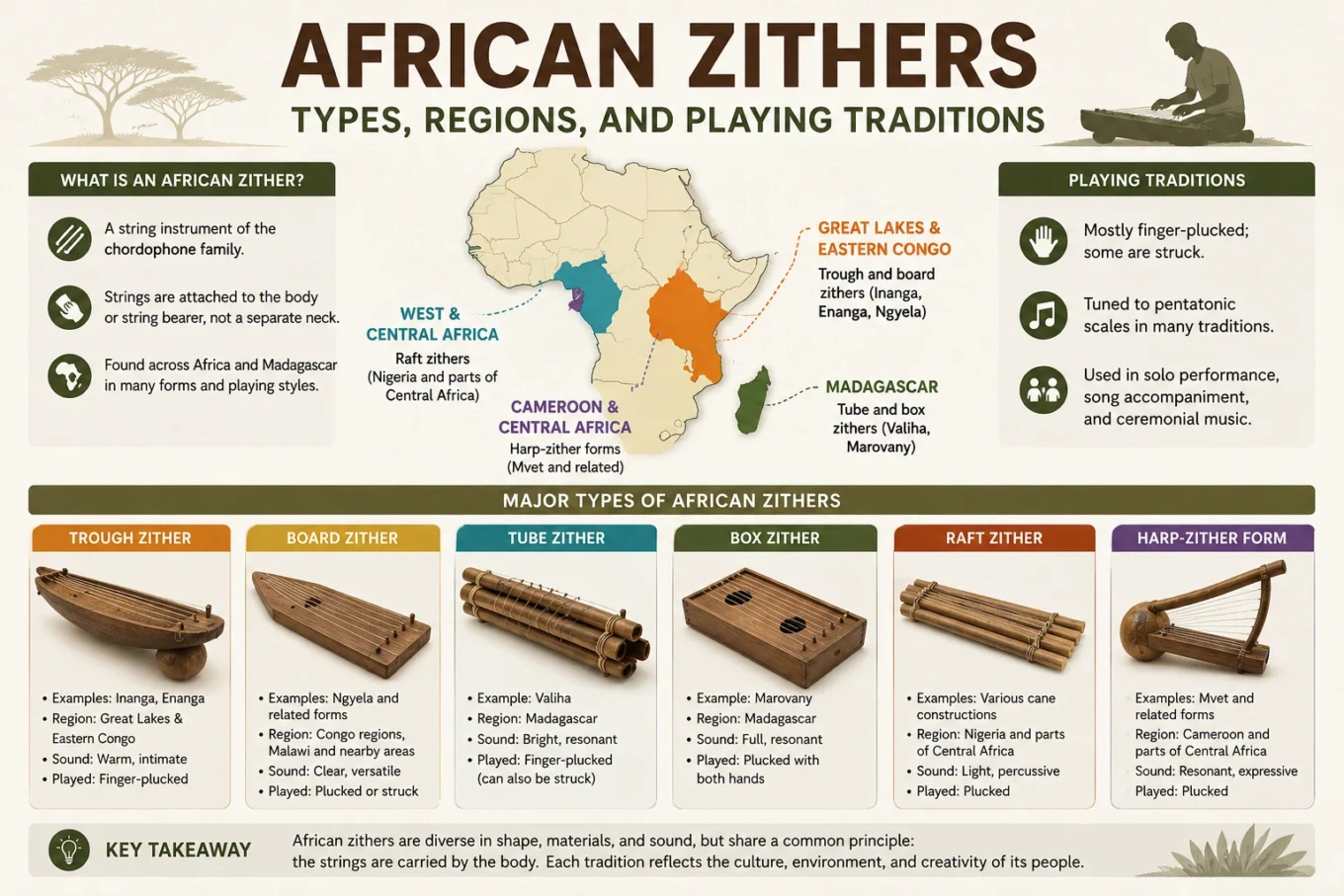
African zithers do not belong to one construction tradition or one musical style. Across the continent and Madagascar, documented instruments include shallow wooden trough zithers, flat board zithers, bamboo tube zithers, cane raft zithers, box forms, and instruments that sit near the boundary between zithers and harps. What connects them is not a shared sound, tuning, or repertoire, but their place within the wider zither branch of the chordophone family[1].
That distinction matters because the word zither is often understood narrowly as a European instrument. In organology[2], it can describe a much wider group of string instruments in which the strings are carried by the body or string bearer rather than extending from a separate projecting neck. African examples show just how varied that principle can become.
African Zithers Are Several Instrument Traditions
The clearest way to understand African zithers is to look first at construction and then at geography. Similar structural ideas may appear under different local names, while the same or closely related names can sometimes refer to instruments whose physical form is not identical.
| Structural Form | Examples | Associated Areas | Sounding Method |
|---|---|---|---|
| Trough zither | Inanga, enanga and related regional names | African Great Lakes and eastern Congo | Mainly finger-plucked |
| Board zither | Ngyela and related local forms; bangwe traditions | Congo regions, Malawi and nearby areas | Plucked or struck |
| Tube zither | Valiha | Madagascar | Finger-plucked; some documented forms can also be struck |
| Box zither | Marovany | Madagascar | Plucked with both hands |
| Raft zither | Various cane constructions | Documented in Nigeria and parts of Central Africa | Plucked |
| Harp-zither form | Mvet and related constructions | Cameroon and parts of Central Africa | Plucked |
This classification is more useful than treating every instrument as a regional variation of one supposed “African zither.” An inanga and a valiha differ in body shape, string arrangement, playing position, resonance, and musical setting even though both can be placed within the broader zither category.
The Great Lakes Trough-Zither Tradition
The inanga and related enanga forms are among the clearest examples of the African trough zither[3]. Documented examples occur around Burundi, Rwanda, Tanzania, and the eastern part of the Democratic Republic of the Congo.
The instrument’s wooden soundboard[4] is shallow and slightly concave, closer in appearance to a carved platter or elongated trough than to the rectangular box of many European and Asian zithers. Museum records describe examples roughly 75 to 115 centimeters long and about 25 to 30 centimeters wide, although regional and individual instruments vary.
One Long String Can Create Many Playing Lengths
A particularly useful detail for understanding the inanga is that the visible string courses may not be separate strings. In documented traditional examples, a single long fibrous string is wound repeatedly along the body through grooves cut into the short ends. The result looks like a row of independent strings, but the playing lengths remain mechanically connected.
This affects tuning. Increasing the tension of one section can influence adjacent sections because they belong to the same continuous cord. Tuning therefore involves balancing several connected lengths rather than adjusting a row of entirely independent strings.
Some trough zithers also use an attached calabash as a resonator[5]. The gourd does not replace the wooden instrument body; it supplements the relatively quiet sound produced by the strings and shallow wooden form.
Fixed Pitches and Pentatonic Organization
Many documented inanga and enanga examples use an anhemitonic pentatonic scale[6], meaning a five-note pitch organization without semitone steps between adjacent scale tones. Not every groove on the instrument necessarily carries an active playing section, and string count should not be treated as a fixed specification for the entire tradition.
The strings are commonly played open with the fingertips. Museum documentation also records techniques in which a player lightly touches a string before plucking to bring out upper partials, and in some cases the wooden body itself can be tapped with the fingernails as an additional rhythmic element.
The Instrument and the Singing Voice
Inanga performance cannot be understood only by examining string layout. Historical documentation from the Great Lakes region links the instrument closely with singing, narrative, personal experience, and local history.
The player may support a vocal line with recurring instrumental figures rather than treating the instrument as a separate virtuoso solo voice. The zither supplies pitch, pulse, and patterned accompaniment while the sung text carries another layer of the performance.
This relationship between instrument and voice appears repeatedly in several African zither traditions, though the repertoire and social setting differ by region.
Board Zithers of the Congo Region
The board zither[7] follows a different construction principle. Instead of carving a shallow trough, the maker uses a comparatively flat wooden plank as the string bearer. Museum documentation records board zithers in northeastern and southern parts of the Congo under several local names, including forms identified as ngyela, nzenze, enzenze, and others.
Once again, several apparent strings can be produced from one long cord. The string passes back and forth across the board through grooves near the ends. Small supporting pieces raise the string from the wood and establish playable lengths.
Why the Bridges Matter
A bridge[8] does more than keep a string away from the board. Its position and height affect the vibrating length, tension, clearance, and practical playability of the string.
Some documented Congo board zithers use additional bridge pieces. A higher central support can alter the way tension is distributed and may make individual sections easier to tune without disturbing neighboring sections as strongly.
Resonance can also be increased without building a conventional wooden soundbox. A hollow calabash may be attached beneath the plank, while other recorded forms use flexible bark around part of the board. These solutions show that the string bearer and the main resonating chamber do not always have to be the same object.
Plucked, Struck, and Stopped Strings
Board zithers are especially useful for showing why “African zither playing” cannot be reduced to a single technique.
- Some strings are plucked directly with the fingers.
- Some traditions use a small stick to strike the strings.
- On certain instruments, a player can press a string against the board to shorten its vibrating length.
- Several strings may be sounded in a broken-chord pattern rather than as isolated single notes.
That last approach can create an arpeggio[9]-like texture. The important point is structural: a flat board zither can support both fixed open-string pitches and techniques that temporarily modify the effective string length.
Bangwe and the Southern-Central Board-Zither Tradition
Bangwe is associated especially with Malawi and neighboring musical areas. It belongs to the board-zither side of the African picture, but its musical identity should not be collapsed into Congo examples simply because the bodies share a plank-based construction.
An archival recording from Malawi made in 1957 documents a bangwe m’kulu accompanying a narrative song. The archival description distinguishes this more resonant form from a locally made board zither. That single record should not be treated as a specification for every bangwe, but it illustrates an important point: makers could modify a familiar structural idea to gain more useful resonance.
Bangwe performance also demonstrates the recurring connection between zithers and the human voice. In recorded contexts, the instrument may accompany songs rather than function only as an independent melodic instrument.
Regional caution: a construction label such as “board zither” describes how an instrument is physically organized. It does not mean that all board zithers share one tuning, repertoire, social function, or performance technique.
Madagascar and the Tube-Zither Principle
Madagascar introduces a very different physical solution. The valiha is a tube zither[10] in which a cylindrical bamboo section acts as the string bearer and resonating body.
The strings extend around the outside of the cylinder rather than across a flat board. The player can therefore access string positions distributed around the tube, creating a playing geometry unlike the Great Lakes trough zither or the Congo plank forms.
Traditional Bamboo Strings Are Part of the Body
One of the most distinctive traditional valiha constructions is idiochord[11]. Narrow strips are cut from the outer surface of the bamboo while remaining attached at both ends. Small movable supports lift these strips away from the tube so that they can vibrate as strings.
The body and string material are therefore literally parts of the same piece of bamboo.
This construction also means that bridge placement contributes to pitch. Moving a support changes the effective vibrating length of a raised strip, while the physical properties of the bamboo set practical limits on tension and response.
Metal Strings Create a Heterochord Valiha
Not every valiha uses strings cut from its own bamboo body. Instruments fitted with strings made from another material belong to the heterochord[12] form. Museum collections include examples with metal strings, and modern construction may use several kinds of available wire.
This change is more than a cosmetic replacement. A separate metal string behaves differently from a strip of bamboo and allows makers to approach string attachment, replacement, tension, and durability in another way. Exact pitch systems and string counts should still be described instrument by instrument rather than presented as one universal valiha standard.
Marovany: A Malagasy Zither Without the Bamboo Tube
Madagascar also has box-shaped zither forms commonly called marovany. These instruments show why regional identity cannot be inferred from body shape alone.
A marovany may use a rectangular wooden box with strings arranged so that the player can reach different sets from opposite sides. Documented instruments also vary in material, and metal strings are common in many examples.
Both hands can take active melodic and rhythmic roles. This two-sided layout produces a different physical relationship between performer and strings from the cylindrical valiha, even though both belong to Malagasy zither traditions.
Recent ethnomusicological work on the valiha also treats changes in construction, tuning, and musical function as part of an active musical culture. That perspective is useful for African zithers more broadly. A museum specimen preserves evidence of one maker, place, and period; it does not freeze the tradition at that point.
Raft Zithers: Several String Bearers Joined Together
The raft zither[13] uses another approach. Instead of stretching several strings across one broad board, multiple narrow cane or tube-like elements can be bound side by side to create a raft-shaped instrument.
Museum collections preserve cane raft zithers attributed to Nigeria, while related raft constructions have been documented elsewhere in Africa. The physical appearance is immediately different from an inanga or valiha: the instrument resembles a bundle or flat assembly of narrow string-bearing elements rather than a carved wooden body.
A surviving mid-20th-century example in a major museum collection is classified as a plucked chordophone and is made from cane. The museum itself marks its Nigerian cultural attribution with uncertainty, which is a useful reminder that older collection records do not always provide exact regional identification.
Collection labels need context: museum terms such as “Nigerian?” or broad historical regional labels should be preserved with their uncertainty rather than converted into a more precise claim than the record supports.
Mvet and the Edge of the Zither Category
Mvet illustrates a classification boundary rather than a standard flat-zither design. Museum terminology may describe related forms as a harp-zither[14], reflecting the unusual relationship between the string bearer and an upright bridge structure.
In a conventional board zither, strings tend to remain close to the main body. In a harp-zither arrangement, the bridge changes their geometry more dramatically. The result can visually suggest a harp even though the instrument retains structural features that lead organologists to place it on the zither side of the chordophone classification.
Historical recordings from Cameroon document mvet in combined vocal and instrumental performance. One archived Bulu-associated recording identifies the musical function as a fable and describes a sung tale supported by choir and rattles.
The value of this example is not that every mvet performance follows that pattern. It shows that instrument classification and musical function answer different questions. Knowing that an object is a zither does not tell the listener whether it accompanies narrative, dance, ceremonial performance, recreation, or another form of music-making.
Local Names Do Not Map Neatly to Structural Types
African zither terminology can be difficult because local naming and organological naming operate on different levels.
Museum catalogues from the Congo region record terms such as inanga, enanga, nzenze, ngyela, and related spellings across collections. Similar names may appear in records for instruments that researchers classify differently according to body shape or string arrangement.
This makes three pieces of information more reliable than a name by itself:
- Where the instrument was documented.
- How its string bearer and body are constructed.
- How its strings are attached, supported, and played.
An instrument called inanga in one documented setting should therefore not automatically be assumed to have exactly the same construction as every object carrying a similar name elsewhere.
Spelling adds another layer. Historical catalogues were created in different languages and transcription systems, so enanga, inanga, nanga, and other forms must be read in their regional and collection context rather than treated as simple spelling errors.
Playing Traditions Depend on the Instrument’s Geometry
The physical form of a zither strongly shapes what the hands can do.
Open-String Playing on the Inanga
A Great Lakes trough zither may be held vertically or at an angle against the seated player’s body. Documented technique assigns groups of strings to each hand, with the fingertips plucking fixed open pitches.
Because several sounding sections can come from one continuous string, tuning the instrument is mechanically different from tuning a zither fitted with an individual tuning pin for every course.
Pressing and Striking Board Zithers
A Congo board zither can allow techniques unavailable on a deeply curved tube. Strings may be pressed against the plank to shorten their vibrating length, while other strings remain open. A stick can also replace the fingers as the sounding tool in some traditions.
This puts some African board zithers between categories that casual listeners might otherwise imagine as completely separate: plucked zither technique and struck-string technique can exist within closely related constructions.
Playing Around the Valiha
The cylindrical valiha distributes its strings around the bamboo tube. The hands approach the instrument from opposite sides, and each hand can work with its own group of pitches.
The physical design encourages interlocking motion between the hands rather than the single flat playing plane found on many board zithers. Changing the body from a tube to a rectangular marovany changes that geometry again without removing the basic principle of strings stretched directly across a string-bearing body.
Voice, Narrative, and Repeating Patterns
Several archival African zither traditions place the voice beside the instrument rather than treating singing as an optional addition.
Great Lakes trough-zither documentation includes songs dealing with historical events, everyday experiences, and personal narratives. An archived Malawi bangwe performance accompanies narrative song. A historical Cameroon mvet recording combines solo vocal performance with responding voices and other instruments.
A repeating instrumental figure can function as an ostinato[15], providing a stable musical pattern while the sung text develops over it. The exact relationship differs between traditions, but this helps explain why judging African zithers only by solo instrumental technique leaves out part of their musical role.
The instrument may support memory, phrasing, pulse, and formal organization for the singer. In such settings, separating “instrumental repertoire” from “vocal repertoire” too strictly can hide how the performance actually works.
Resonance Without a Standard Zither Soundbox
European box zithers can create an expectation that a zither needs a large enclosed wooden resonating chamber. African constructions show several other solutions.
| Construction | Resonating Approach | Example |
|---|---|---|
| Concave wooden body | The carved body supports the strings and contributes to resonance | Inanga / enanga |
| Flat board plus gourd | A separate calabash adds resonating volume | Some board zithers |
| Bamboo tube | The hollow tube is both body and resonating chamber | Valiha |
| Wooden box | An enclosed body carries strings and provides an internal air cavity | Marovany |
A separate gourd is especially revealing. It allows a maker to keep the string bearer thin or shallow while gaining more acoustic output from another component. In other cases, the bamboo or carved wooden body performs both jobs.
Material alone does not determine tone. Body dimensions, string tension, string material, bridge arrangement, playing force, resonator coupling, and construction quality all affect the result. Claims that one specific wood, cane, or gourd automatically produces a fixed sound should therefore be treated cautiously.
Materials Can Change While the Structural Idea Remains
African zither construction often shows continuity of design alongside changes in available materials.
Traditional strings may be made from plant fiber, animal-derived material, or strips raised directly from bamboo. Other instruments use metal wire or modern replacement materials. A change of string material can alter durability, workable tension, attack, maintenance, and response without turning the instrument into a different structural family.
The valiha makes this particularly easy to see. An idiochord bamboo valiha and a heterochord instrument fitted with metal strings use different string technologies, yet both preserve the tube-zither principle.
Congo board-zither documentation likewise records natural or animal string materials alongside later metal-string use. The important distinction is between construction principle and material specification. One can remain recognizable while the other changes.
A Regional Map Is More Useful Than a Country Checklist
Modern national borders are useful for locating museum records, but they do not define the historical limits of musical practice. Several zither traditions extend across neighboring regions.
African Great Lakes
Burundi, Rwanda, western Tanzania, Uganda-related traditions, and eastern Congo contain documented trough-zither practices associated with inanga, enanga, and related names. Construction, terminology, repertory, and playing position can vary.
Congo Basin and Adjacent Central African Areas
Board zithers appear under numerous names, while harp-zither forms add another structural branch. The region contains both plucked and struck techniques as well as traditions linked with vocal accompaniment.
Malawi and Nearby Southern-Central Areas
Bangwe traditions represent an important board-zither lineage. Archival material documents both local construction and modified instruments designed for stronger resonance.
Madagascar
The valiha demonstrates the whole-tube principle, while marovany forms move Malagasy zither construction toward a rectangular box. Madagascar therefore contains related musical traditions expressed through markedly different bodies.
West Africa
Raft zithers are documented in Nigeria, though surviving historical collection records can be cautious about exact attribution. Mvet-related traditions associated with Cameroon and neighboring Central African cultural areas also complicate any simple west-versus-central boundary.
North Africa Belongs to the Geography but Follows Another Zither Line
Any continental discussion also has to account for North Africa. Here the qanun represents a very different zither tradition from the inanga, bangwe, or valiha.
The qanun uses a trapezoidal resonating body, numerous strings arranged in courses, and a highly developed pitch-control and plucking system associated with Arab art-music traditions. Its construction and musical lineage connect North Africa closely with the eastern Mediterranean and Middle East.
It is therefore geographically an African zither in countries such as Egypt, but it should not be presented as a developmental branch of Sub-Saharan trough or board zithers. Geography and instrument genealogy do not always produce the same map.
Not Every African String Instrument Is a Zither
The wide meaning of zither does not make it a synonym for every neckless-looking or traditionally made string instrument.
Lutes, lyres, harps, musical bows, and zithers organize their strings differently. A projecting neck, a yoke-supported string plane, a harp-like relationship between strings and soundbox, or a flexible bow-shaped string bearer can move an instrument into another chordophone category.
The distinction becomes especially useful with unusual instruments such as the mvet, where researchers may use a compound term such as harp-zither to describe a form that does not fit the visual stereotype of a flat zither.
Classification works best when it begins with the physical instrument: identify the string bearer, trace where the strings run, examine the bridge arrangement, note whether a separate neck exists, and then consider the regional name.
African Zithers as Living Instrument Traditions
Museum objects and historical sound archives provide unusually detailed evidence for African zither construction. They preserve old string materials, groove patterns, bridges, resonators, local names, measurements, recording contexts, and descriptions of performance technique.
They also represent particular moments.
A bangwe recorded in the 1950s does not define every bangwe played later. A museum valiha made with bamboo strings does not make metal-string valiha less valid. An old catalogue name may not match terminology preferred by musicians today.
Recent research on Malagasy valiha practice is especially useful here because it examines construction and tuning changes together with musical and social use. The instrument survives not by remaining materially identical, but through continued making, adaptation, teaching, and performance.
The same principle helps make sense of African zithers as a group. Their connection lies in structural ideas—the trough, plank, tube, box, raft, or harp-zither string bearer—while each regional tradition gives those structures its own names, techniques, repertories, materials, and musical purposes.
Glossary of Technical Terms
[1] Chordophone: A musical instrument whose primary sound begins with vibrating strings. Zithers, lutes, harps, and lyres are all chordophones, but their strings are supported and organized differently.
[2] Organology: The study and classification of musical instruments, including their construction, materials, acoustical behavior, playing methods, and cultural use.
[3] Trough zither: A zither whose string-bearing body has a shallow concave or trough-like form. Inanga and enanga instruments from the African Great Lakes region are well-known examples.
[4] Soundboard: A vibrating surface that receives energy from the strings and helps radiate sound. On some African zithers it is also the main string-bearing body.
[5] Resonator: A body or cavity that reinforces vibrations from the strings. African zithers may use a carved wooden body, hollow bamboo tube, wooden box, bark structure, or attached calabash for this purpose.
[6] Anhemitonic Pentatonic Scale: A five-note pitch organization without semitone intervals between adjacent scale tones. It appears in documentation of several Great Lakes trough-zither traditions.
[7] Board Zither: A zither in which strings run across a relatively flat plank or board rather than a deep box or cylindrical tube.
[8] Bridge: A support that raises a string from the instrument body and helps define its vibrating length. Some African zithers use movable or supplementary bridges for tuning and string clearance.
[9] Arpeggio: A chord whose notes are sounded in sequence instead of simultaneously. Related broken-chord effects can be produced on some African board zithers.
[10] Tube Zither: A zither whose strings are carried by a tubular body. The Malagasy valiha is a whole-tube zither in which bamboo provides the principal structure.
[11] Idiochord: A construction in which the string is made from the same piece of material as the string bearer. Traditional valiha strings can be raised directly from the outer surface of the bamboo tube.
[12] Heterochord: A construction in which the strings are made from material separate from the body, such as metal strings attached to a bamboo valiha.
[13] Raft Zither: A zither formed by binding several narrow cane, stalk, or tube-like string bearers together in a flat raft-like assembly.
[14] Harp-Zither: A zither form in which an upright bridge or related structure gives the strings a more harp-like geometry while the instrument retains characteristics associated with the zither family.
[15] Ostinato: A recurring melodic or rhythmic figure. In vocal zither traditions, a repeated instrumental pattern can support a longer sung narrative or changing vocal line.