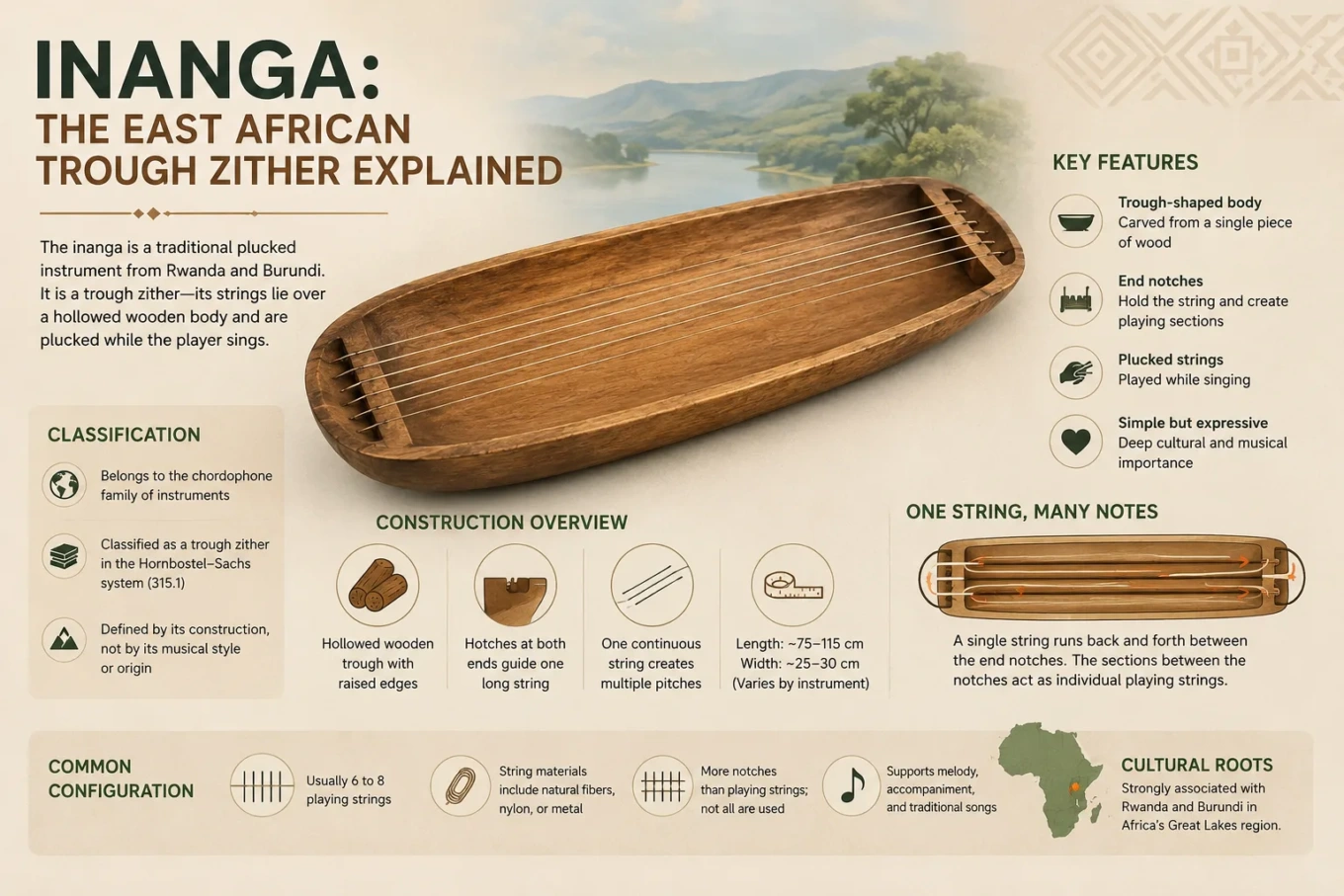
Inanga: The East African Trough Zither Explained
The inanga is a plucked trough zither[1] associated especially with Rwanda and Burundi in Africa’s Great Lakes region. Its strings do not run along a neck, and they are not arranged like those of a European concert zither. Instead, a hollowed wooden body forms a broad, shallow trough, while a long string passes back and forth between notches at the two narrow ends. The resulting parallel string sections are plucked as fixed pitches, often while the performer sings.
This construction places the inanga within the wider chordophone[2] family while giving it a form quite unlike many other instruments commonly called zithers. The instrument is especially useful for understanding how organological classification can connect instruments that look very different but share the same basic relationship between strings and their supporting body.
Why the Inanga Is Classified as a Trough Zither
The defining feature is the shape of the string-bearing body. A piece of wood is carved into an elongated, shallow vessel with raised edges. Strings stretch across the open face rather than between a separate neck and soundbox. That construction is the reason the inanga is described as a trough zither rather than a harp.
In the Hornbostel–Sachs system[3], documented inanga examples are placed among trough zithers. A museum specimen at Grinnell College is classified as 315.1, the category for trough zithers without a separate resonator. The classification describes physical construction, not musical style or geographic identity.
Classification note: Calling the inanga a zither does not mean it resembles a modern Alpine or concert zither. Here, “zither” is being used in the broader organological sense: the strings are supported primarily by the instrument body rather than by a separate neck.
A harp works differently. Its strings extend between a resonating body and a neck that meets it at an angle. The inanga has no comparable neck. The strings lie over the trough-shaped string carrier[4], making the zither classification structurally more precise.
A Hollowed Body With Notched Ends
Traditional inanga construction begins with a solid piece of wood shaped into an elongated oval or boat-like form. The center is hollowed so that the remaining body has a shallow concave profile. A raised rim follows the perimeter, becoming wider at the narrow ends where deep notches hold the string in position.
Museum documentation shows that dimensions vary rather than following one fixed specification. Recorded examples commonly fall within a range of about 75 to 115 centimeters in length and roughly 25 to 30 centimeters in width. These figures are useful for understanding the scale of the instrument, but they should not be treated as mandatory building measurements.
The notches are equally important. A documented inanga may contain more notches than it has active string sections. Royal Museum for Central Africa records describe instruments with eight to twelve notches at the ends while noting that not every notch has to carry a string.
| Feature | Documented Pattern | Variation |
|---|---|---|
| Body | Elongated, hollowed wooden trough | Exact outline and depth vary |
| Length | Often about 75–115 cm | No single standard size |
| Width | Often about 25–30 cm | Individual instruments differ |
| Playing strings | Six to eight are especially common | Other documented arrangements occur |
| End notches | Often more numerous than the active strings | Not every notch must be used |
| String material | Natural materials in older examples | Nylon and metal are also documented on newer instruments |
Royal Museum for Central Africa documentation reports a strong preference for six- to eight-string arrangements in its surveyed inanga material, accounting for nearly 90 percent of the group described there. That does not make eight strings a universal rule. Museum specimens and regional instruments show enough variation that “the inanga has exactly eight strings” is too rigid a definition.
One Long String Can Produce Many Playing Strings
The most revealing construction detail is easy to miss when looking at the instrument from above. What appears to be a row of independent strings may actually be sections of one continuous string[5].
The material is led from one end of the body to the other, seated in a notch, turned back across the trough and passed through another notch. Repeating this path creates several parallel lengths over the same body. Each playable length acts as a sounding segment[6].
- The long string is secured at one end of the instrument.
- It crosses the hollowed body lengthwise.
- A notch redirects it at the opposite end.
- The string returns across the body through another notch.
- The process repeats until the required number of playable segments has been formed.
- The remaining end is secured, often with a wooden fastening element.
An early twentieth-century Rwandan inanga preserved in the Grinnell College Musical Instrument Collection uses a single long cow-tendon string routed through eight notches to create eight playable string segments. Other documentation describes natural fibre and animal-derived strings, while nylon and metal have also been used on more recent instruments.
This continuous arrangement has consequences for tuning. The segments share one length of material rather than functioning as completely independent strings. Altering tension in one section can therefore influence neighboring sections. Tuning is a matter of balancing relationships across the instrument, not simply adjusting a row of isolated strings one by one.
Why the Number of Notches Does Not Equal the Number of Notes
The carved grooves at the ends of an inanga should not be counted as though each automatically represents a playable pitch. Some grooves remain unused. This explains why a body with a relatively large number of notches may still be configured with only six, seven or eight sounding sections.
The distinction matters when identifying museum objects. Counting visible grooves can produce an incorrect “string count,” especially when the original string has disappeared or has been replaced. The physical body preserves the possible routing positions; the stringing arrangement shows which positions were actually used at a given time.
This also helps explain why historical photographs, museum objects and contemporary instruments do not always match perfectly. The inanga is better understood as a construction tradition with documented variations than as an industrially standardized instrument.
The “Eyes” and “Teeth” of the Instrument
Inanga terminology can describe physical details in vivid anatomical language. Museum documentation from Rwanda refers to star-shaped or oval openings in the body as the “eyes of the inanga.” The openings form part of the recognizable appearance of many instruments and are associated in the museum documentation with the distribution of sound.
The notched projections at the ends can also be described as amenyo, meaning “teeth.” A Grinnell museum specimen records the terms amenyo (“teeth”) and amano (“toes”) for parts created by the carved notches.
Decoration is not limited to openings. Burned geometric patterns appear on documented instruments, especially near the ends or on the rear surface. These details can help distinguish individual objects, but decorative patterns should not automatically be assigned symbolic meanings unless that meaning is documented for the specific cultural and historical context.
Open Strings Shape the Inanga’s Musical Design
The inanga is normally played with open strings[7]. The performer plucks a string segment without pressing it against a fingerboard or shortening its vibrating length in the manner used on many necked string instruments. Each active segment therefore supplies a fixed basic pitch after the instrument has been tuned.
This is another reason that comparisons with fretted zithers can be misleading. The inanga does not need a row of frets to produce its melodic material. Pitch organization comes from the tuning relationships among the parallel string sections.
Documented instruments are commonly associated with an anhemitonic pentatonic[8] pitch organization. “Pentatonic” indicates a five-pitch basis, while “anhemitonic” means the collection avoids semitone steps. Not every physical string segment must therefore represent a different member of the scale, and not every available segment has to be used in every musical setting.
There is no useful reason to assign one universal Western-note tuning to every inanga. Exact pitch levels and interval relationships can vary with the instrument and performance tradition. A fixed formula such as C–D–E–G–A would imply a standardization that the surviving evidence does not support.
Tuning a Continuous String Is an Interdependent Process
Pitch rises when string tension is increased and falls when tension is reduced. On an inanga, however, adjustment has to account for the fact that neighboring playable lengths may belong to the same continuous string.
Royal Museum for Central Africa documentation notes that changing the tension used for one pitch can influence a nearby pitch. Some museum descriptions also record small pieces of wood used in connection with local tension adjustment. Such devices allow finer control, but their presence and form should not be assumed for every instrument.
The practical result is a tuning system that reflects the physical design of the instrument. A maker or player is not simply tuning several unrelated wires. The entire routed string acts as a connected mechanical system.
Plucking Position Changes More Than Pitch
Open-string construction does not mean every pluck produces exactly the same sound quality. The point where the finger contacts a string can change its timbre[9]. A pluck nearer an endpoint emphasizes a different balance of overtones from one made farther toward the middle of the vibrating section.
Grinnell’s description of its historical instrument specifically notes the use of both the flesh and nail sides of the thumb and forefinger. These contact differences give a performer another way to shape articulation without changing the basic tuning of the string.
The hollowed wooden body supports resonance[10], but it should not be treated as though every inanga has identical acoustic behavior. Wall thickness, dimensions, string material, tension and the individual piece of wood can all affect the result. Reliable descriptions are therefore more useful than unsupported claims about exact loudness or frequency response.
Playing Position Is Not Completely Fixed
A familiar playing position places the musician seated with the inanga held vertically or nearly vertically against the lap. In one documented description, the left little finger helps stabilize the instrument while other fingers of the left hand pluck upper strings and the right hand handles lower strings.
Historical museum evidence also preserves another approach. The Grinnell instrument is documented with one edge on the ground, the strings facing outward and the player positioned behind it, using the thumb and forefinger of both hands. The difference is useful because it warns against presenting one photograph or one modern performer as proof of a universal posture.
What remains consistent is the close physical relationship between both hands and the parallel strings. The player can alternate pitches, repeat short figures and control attack with fingertip or nail contact while the instrument remains stable against the body or another support.
Inanga Music Often Joins String Patterns With the Voice
The instrument has a strong documented association with solo song. Museum descriptions record performers singing about historical subjects, personal experiences and events from daily life while accompanying themselves on the inanga.
Earlier accounts also describe professional musicians performing for chiefs and maintaining epic or historical repertories. The instrument therefore served in settings where melody and text worked together rather than functioning only as an independent instrumental display.
One especially studied Burundian practice is often called inanga chuchotée, or “whispered inanga.” Ethnomusicologist Cornelia Fales examined the close perceptual relationship between the plucked instrument and a whispered vocal line. The interest of the practice lies partly in how vocal timbre and instrumental sound can be heard as closely integrated layers.
The whispered style should not be used as a definition for every inanga performance. It represents an important documented performance practice, while other performers use different vocal delivery and repertory.
The Instrument Belongs to a Great Lakes Cultural Setting
The name inanga is especially associated with Rwanda and Burundi. Closely related trough zithers, variant names and related construction traditions are also documented around the African Great Lakes, including areas of eastern Democratic Republic of the Congo and Tanzania.
This wider geography does not make every regional trough zither the same instrument. Similar string routing and hollowed bodies can occur alongside differences in terminology, playing technique, added resonators, repertory and local cultural use.
For that reason, “East African trough zither” is useful as a broad description, while the name inanga should remain connected to the communities and documented traditions in which that name is used. Organology[11] can group instruments by structure without erasing their regional identities.
What Historical Museum Instruments Reveal
Museum collections are especially valuable for the inanga because they preserve construction details that written descriptions can oversimplify. A Rwandan specimen in the Grinnell College collection was gathered during the first decade of the twentieth century. Its body was carved from a solid board, hollowed into a trough and fitted with eight playable sections formed from one long cow-tendon string.
The object also preserves carved notches, decorative treatment and the relationship between the string and the wooden body. Such details demonstrate that the continuous-string system is not simply a recent reconstruction technique.
Historical specimens also show why exact dimensions or string materials should not be turned into rigid definitions. A museum object documents one maker, one place and one period. Several well-described objects together reveal recurring construction principles while still leaving room for local and individual variation.
Separate Resonators Occur in the Wider Trough-Zither Family
Not every trough zither has exactly the same acoustic arrangement. Some related Great Lakes instruments use a supplementary resonator[12], including gourd-based forms documented in parts of the wider region.
This distinction appears in organological classification as well. A trough zither whose string carrier operates without a separate resonator belongs to a different structural subdivision from one coupled to an additional resonating vessel.
The distinction is useful when examining photographs or museum labels. A shallow wooden trough with parallel strings may belong to the same broad structural family as another instrument fitted to a gourd, but that does not make their construction identical.
Why Inanga Should Not Be Reduced to “Eight Strings”
String count is one of the easiest features to notice, yet it explains relatively little by itself. The more distinctive feature is the relationship between the carved body, the notched ends and a continuous string that becomes several parallel sounding lengths.
That construction shapes tuning, playing technique and pitch organization. It also distinguishes the inanga from instruments whose individual strings each have separate anchoring and tuning systems.
The instrument becomes clearer when its features are considered together:
- a broad, hollowed trough-shaped wooden body;
- deep notches cut into the narrow ends;
- several playable segments commonly formed from one continuous string;
- open-string plucking rather than fretting;
- pentatonic pitch organization in many documented examples;
- two-handed plucking with several documented holding positions;
- solo vocal performance closely associated with the instrument;
- strong documentation in Rwanda and Burundi within the Great Lakes region.
None of these features needs to be forced into one universal specification. Their combination is what makes a well-documented inanga recognizable.
A Living Instrument Beyond Museum Collections
The inanga remains part of contemporary performance and cultural education rather than existing only as a historical museum object. Recent museum programming has brought instrument collections together with living performers who can demonstrate playing, tuning and cultural context.
In 2024, the Haffenreffer Museum of Anthropology at Brown University hosted Burundian musician Steven Sogo for a learning-centered inanga performance connected with instruments in the museum collection. The event placed a preserved object back into a setting where performance knowledge could accompany physical examination.
Related public programming continued in 2025 through a “Finding the Spirit of Inanga” instrument exhibition organized by PVD World Music. These projects are useful examples of how museum instruments, oral knowledge and contemporary musicianship can be documented together without treating the instrument as a fixed artifact from the past.
The same approach is valuable when studying older inanga specimens. Measurements and material analysis can explain the object, but a performer can reveal information that is difficult to infer from a silent instrument: how tension is balanced, which fingers approach particular strings, how repeated figures support the voice and how the instrument is physically stabilized during performance.
Glossary of Technical Terms
[1] Trough Zither: A zither whose string-bearing body is shaped like a shallow trough, bowl or elongated concave vessel. The strings extend across the open or hollowed face of the body.
[2] Chordophone: An instrument whose primary sound source is a vibrating string. Zithers, harps, lutes and many other string instruments belong to this broad category even though their structures differ.
[3] Hornbostel–Sachs System: A widely used system for classifying musical instruments according to how they produce sound and how they are constructed. Trough zithers occupy a structural category within its chordophone section.
[4] String Carrier: The structural part of a zither that supports the strings and receives their tension. On the inanga, the carved wooden trough performs this role.
[5] Continuous String: One long piece of string material routed repeatedly across an instrument to create several playable lengths. Traditional inanga construction can use this arrangement instead of installing a separate piece of material for every sounding string.
[6] Sounding Segment: One vibrating section of a longer continuous string. On an inanga, several such segments can appear visually like separate strings even though they belong to the same piece of material.
[7] Open String: A string sounded without shortening its vibrating length by pressing it against a fingerboard or fret. Inanga pitches are normally produced from open string segments.
[8] Anhemitonic Pentatonic: A five-pitch scale type that does not contain semitone intervals between adjacent scale degrees. It is commonly documented in descriptions of inanga tuning and repertory.
[9] Timbre: The sound quality that helps distinguish two tones even when their basic pitch may be similar. On the inanga, plucking position and the use of fingertip or nail can influence timbre.
[10] Resonance: The response of an instrument body to string vibration. The hollowed wooden inanga body supports and shapes the sound produced by its strings.
[11] Organology: The study and classification of musical instruments, including their construction, materials, playing methods and cultural contexts. The term helps explain why the inanga is grouped structurally with trough zithers rather than harps.
[12] Resonator: A body or vessel that receives vibration from the strings or string carrier and reinforces the resulting sound. Some trough zithers use an additional gourd resonator, while documented inanga forms can rely on the carved wooden body itself.