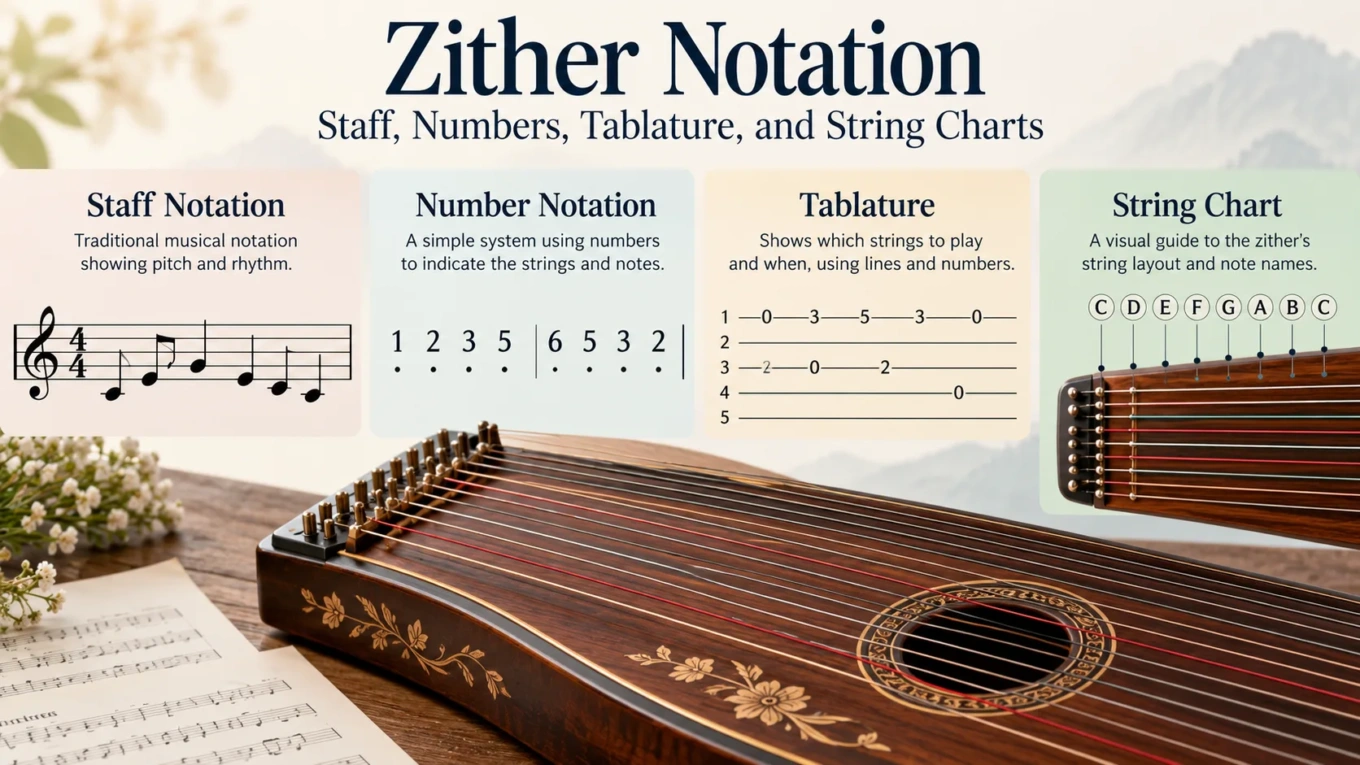
Zither Notation: Staff, Numbers, Tablature, and String Charts
A zither score does not always tell the player the same kind of information. Western staff notation[1] can identify sounding pitch and rhythm, numbered notation can describe scale degrees, tablature can specify strings and hand actions, while a string chart may simply map the physical instrument. Reading zither notation accurately therefore begins by asking what the symbols represent: pitch, scale degree, physical string, playing action, or a combination of them.
This distinction matters because the zither family includes instruments with very different layouts. A concert zither combines fretted melody strings with open accompaniment and bass strings. A guzheng commonly uses numbered notation alongside movable bridges. Koto notation can be closely tied to numbered strings and a chosen tuning. Guqin jianzipu can record detailed physical actions without functioning like a Western pitch-and-rhythm score. No single reading method fits all of them.
Four Notation Systems Answer Different Questions
The fastest way to separate the main systems is to identify the information each one gives directly. A symbol that looks simple on paper may require several additional pieces of information before it becomes a playable note.
| Notation Type | What It Mainly Shows | What May Still Be Needed |
|---|---|---|
| Staff notation | Pitch[2], duration, meter, rests, accidentals and articulation | String choice, fingering and instrument-specific technique |
| Numbered notation | Scale degree[3], octave and rhythmic value | Key, tuning and physical string location |
| Tablature | String, finger, position or physical playing action | Depending on the system, exact pitch or rhythm |
| String chart | String number, pitch and physical layout | Note order, rhythm, phrasing and most technique information |
The number 5 is not automatically the fifth string. In numbered notation it may mean the fifth degree of a scale. In a tablature system it may identify a physical string. On a tuning chart, “String 5” simply labels the fifth string in the chart’s numbering system.
Staff Notation on the Concert Zither
Staff notation describes music primarily through written pitches and rhythmic values. That makes it well suited to the European concert zither, but the score and the physical instrument are not identical maps.
A typical concert zither separates a small group of fretted melody strings[4] from a larger field of open strings[5] used for accompaniment, bass and, on some instruments, lower extensions. Historical and modern instruments vary in their total number of strings and in the extent of the bass range, so a score should not be interpreted from string count alone.
Written Pitch Does Not Automatically Name a String
When a note appears on a five-line staff, its vertical position identifies a musical pitch within the active clef. Its note shape and accompanying marks describe duration and other musical information. The notation does not necessarily say, “pluck the fifth string.”
On the fretted section of a concert zither, several pitches can be reached by stopping a string at different fret positions. In the open-string field, another pitch may be available directly from a dedicated string. The performer therefore translates a written pitch into a playable location according to the instrument’s layout, tuning and accepted fingering practice.
This is one of the main differences between staff notation and string-based tablature. Staff notation begins with the sound to be produced. Tablature often begins with the place or action used to produce it.
Accidentals Change Pitch, Not the Meaning of the String Layout
An accidental[6] such as a sharp, flat or natural changes the written pitch according to normal staff-notation rules. It should not be treated as an instruction to move automatically to the neighboring physical string.
This becomes especially important in a concert zither’s open-string area. The strings are organized for the instrument’s musical function rather than presented as a piano-like row in which every adjacent string simply rises by one semitone. Visual reference strings, bass organization and the chosen tuning system help the hand locate notes.
Tuning Sits Between the Score and the Instrument
Concert zithers are documented with more than one tuning arrangement, including Munich and Viennese forms. The differences matter when a player converts notation into fingerboard or open-string locations, but they do not turn staff notation into another notation system.
The score still describes pitches. The tuning determines where those pitches are available on that particular instrument.
Numbered Notation on Guzheng: Degrees, Not String Labels
Modern guzheng music is often encountered in jianpu[7], a numbered notation system in which the numerals 1 through 7 represent degrees of a scale rather than seven permanently assigned strings.
The system normally uses movable do[8]. If a score states that 1 equals C, then 1 represents C in that musical context, 2 represents D, 3 represents E and so forth according to the scale. If 1 is assigned to another pitch, the absolute notes change while the numerical relationships remain recognizable.
How Octave and Duration Are Added to the Numbers
The numeral alone identifies the scale degree. Other marks supply register and timing information.
- A dot above a numeral places the note in a higher octave.
- A dot below it places the note in a lower octave.
- Lines beneath a numeral shorten its rhythmic value according to the notation’s rhythmic structure.
- A dash after a numeral can extend its duration.
- Zero commonly represents a rest.
- Sharps or flats can alter individual scale degrees when required.
Those details make numbered notation more than a list of string numbers. It can carry melody and rhythm in a compact form while remaining independent of one fixed physical string layout.
Why Guzheng Makes the Difference Easy to Misread
Many modern guzheng tunings arrange open strings around a pentatonic pattern. A commonly encountered pattern uses degrees 1, 2, 3, 5 and 6 through successive registers. This creates a strong visual relationship between the written numbers and the instrument, but the number in the score is still a musical degree, not a permanent hardware label.
Pitches outside the open pentatonic set can be produced in several ways depending on tuning and repertoire. Left-hand pressure on the portion of a string beyond its movable bridge[9] can raise the sounding pitch, allowing the player to create inflected or additional scale tones without treating every chromatic pitch as a separate permanently tuned open string.
Notation trap: a printed “5” in jianpu normally means scale degree 5. A label reading “String 5” on a guzheng tuning chart identifies a physical string. The two numbers can coincide in a particular example, but their meanings are different.
Tablature Can Describe the Action Rather Than Only the Sound
Tablature[10] maps music to an instrument’s physical layout or playing technique. The amount of information varies widely. Some systems mainly identify strings; others can tell the performer where to place a finger and how to move it.
This makes the word “tablature” broader than guitar-style fret numbers. Within the zither family, one of the clearest examples is the notation used for guqin.
Guqin Jianzipu Encodes Performance Instructions
Guqin jianzipu[11] uses compact composite characters formed from components that indicate how a sound should be produced. A single notation unit can convey several pieces of information, including the string, the left-hand finger, a position associated with the instrument’s hui[12] markers, and a right-hand plucking action.
The resulting symbol is therefore closer to a condensed performance instruction than to a notehead placed at an absolute pitch on a staff.
For example, a guqin instruction can distinguish between different right-hand plucks on the same string or specify a left-hand stopping position. Those distinctions affect articulation, timbre and movement even when two actions produce closely related pitches.
Why Jianzipu Cannot Be Read Like a Western Score
Traditional jianzipu does not normally encode exact rhythmic duration and meter with the same explicit system used by modern staff notation. The notation preserves the physical method of producing sounds in great detail, while rhythmic realization can depend on transmission, interpretation and knowledge of the piece.
The process of reconstructing or working out a performable rhythmic realization from older guqin tablature is associated with dapu[13]. Modern editions may also place numbered notation or staff notation beside jianzipu so that pitch and rhythmic information can be read together with traditional fingering instructions.
This is an important boundary between notation systems. A guqin symbol is not merely an unusually shaped replacement for a Western note. It preserves another category of information.
Koto Notation Depends on the Relationship Between String and Tuning
Koto notation provides another example of why numbers cannot be interpreted without knowing what they label. The widely used thirteen-string koto numbers its strings in a defined physical sequence, and traditional or instructional notation can identify the string to be played rather than starting from an absolute written pitch.
That means the musical result depends on the tuning assigned to those strings.
String symbol + current tuning = sounding pitch.
If a particular notation sign directs the player to one string, changing the movable-bridge positions can change the pitch associated with that string while the physical string identity remains the same. Koto traditions also use different tunings for different repertories and contexts, so a string designation should not be converted to a fixed Western note without first establishing the tuning.
Notation practice can differ by school, edition and teaching method. Some scores add rhythmic marks, technique symbols or Western notation. The useful distinction is not whether a page contains numbers, but whether those numbers represent scale degrees or physical strings.
String Charts Are Maps, Not Complete Scores
A string chart[14] identifies the physical relationship between strings and their tuning. It can be printed beside a score, supplied with an instrument or created as a practice aid.
A useful chart may contain:
- string number or another string identifier;
- open-string pitch;
- octave or register;
- melody, accompaniment or bass grouping;
- bridge or playing-area information;
- visual reference strings or other location cues.
What it usually does not provide is the sequence of an entire musical performance. A string chart may show that String 8 is tuned to a particular pitch, but that fact alone says nothing about when String 8 should sound, how long it should ring, whether it should be accented, or what follows it.
Orientation Must Be Established Before the Numbers Are Trusted
String numbering is not universal across all zithers. String 1 may begin near the player on one instrument or farther away on another. Nor can the lowest string always be assumed to carry the lowest number.
Before using any chart, identify:
- which side of the diagram represents the player’s position;
- where String 1 begins;
- whether numbering follows physical position or pitch direction;
- whether the chart describes the exact instrument type and tuning in use;
- whether grouped, doubled or specialized strings require separate labels.
A chart can be technically correct and still be read backwards if its orientation is misunderstood.
One Printed “5” Can Carry Several Meanings
The same numeral is a useful test for distinguishing notation systems.
| Context | Meaning of “5” | What Determines the Sound |
|---|---|---|
| Jianpu | Fifth scale degree | Key, mode and octave marking |
| String tablature | Potentially the fifth physical string | The instrument’s tuning |
| String chart | String number 5 | The pitch assigned to that string |
| Fingering notation | Potentially a position or technique-related number | The rules of that particular notation system |
Staff notation avoids this particular ambiguity because a conventional notehead is positioned on a staff rather than represented by a scale-degree numeral. It introduces a different translation problem: the player must decide how that written pitch maps onto the available strings and positions.
Rhythm Is Encoded Differently Across Zither Notations
Pitch and string location are only part of reading a score. The notation must also be checked for the way it handles time.
| System | Rhythmic Information |
|---|---|
| Staff notation | Note values, rests, meter, ties and related marks provide explicit duration information. |
| Jianpu | Numerals combine with underlines, dashes, dots, rests and meter markings to express rhythm. |
| Koto notation | Rhythmic treatment depends on the notation tradition and edition; string information may be combined with timing marks. |
| Guqin jianzipu | Performance actions are recorded in detail, while exact rhythmic duration is not normally encoded as directly as in staff notation. |
| String chart | Normally provides no musical rhythm because it functions as an instrument map. |
This explains why converting one notation system into another is not always a matter of replacing symbols. Some information may have to be supplied from tuning, performance practice or a parallel notation layer.
Technique Marks Carry Information That Pitch Cannot
Zither playing often changes a sound after the initial pluck. A notation system therefore may need to describe more than the starting pitch.
Depending on the instrument and tradition, notation can indicate:
- left-hand pressure that raises or bends a pitch;
- glissando[15] across several strings;
- repeated plucking or tremolo;
- damping[16] to stop resonance;
- harmonic production;
- direction of a pluck;
- specific right- or left-hand fingers;
- slides, presses, releases and ornaments.
These marks should be interpreted within the notation tradition that uses them. A curved sign or finger number does not have one universal meaning across concert zither, guzheng, koto and guqin notation.
The distinction can be expressed simply: the written note may describe what should sound, while a technique mark explains how the player should make it sound.
Tuning Is the Translation Layer Behind the Page
Notation and tuning are separate subjects, but they meet whenever symbols must be converted into physical strings.
The translation works differently according to the system:
- Concert zither: written pitch → available fretted or open-string location.
- Guzheng jianpu: scale degree + key or tuning → sounding pitch → playable string and technique.
- Koto string notation: string designation + current tuning → sounding pitch.
- Guqin jianzipu: string + position + hand action + tuning → produced sound.
- String chart: string identifier → assigned open pitch.
This is why two pages can look similar while requiring different reading methods. The score may identify a sound directly, describe its place within a scale, point to a physical string, or encode the motion needed to create it.
The Same Simple Phrase in Different Systems
Consider a four-note ascending pattern that produces C, D, E and G in a C-based setting. The musical result can be represented through different types of information.
| System | What Might Be Written | What the Player Learns Immediately |
|---|---|---|
| Staff notation | C – D – E – G with written rhythmic values | Exact written pitches and durations |
| Jianpu | 1 – 2 – 3 – 5, with rhythmic marks | Scale degrees and timing; the key establishes the absolute pitches |
| String tablature | A sequence of string identifiers | Which physical strings or positions to use |
| String chart | String-to-pitch assignments such as String A = C | Where pitches are located, but not necessarily their musical order |
The fourth row is deliberately different. A string chart does not become a melody simply because it contains all four required pitches. It supplies the map that another notation system, memory or performance instruction can use.
Hybrid Scores Preserve More Than One Kind of Information
Modern teaching and publishing often place two notation systems together. This can solve a problem that neither system handles as efficiently on its own.
A traditional tablature may preserve fingering and gesture while staff notation supplies explicit pitch and rhythmic values. Jianpu can be placed beside instrument-specific technique marks. Guqin publications may pair jianzipu with numbered or Western notation so that the reader can see both the physical instruction and a more explicit melodic or rhythmic representation.
Hybrid notation is especially useful when music moves between performers trained in different reading systems. It also helps preserve instrument-specific technique rather than reducing every performance detail to pitch alone.
Digital engraving introduces another issue: not every traditional symbol fits ordinary music fonts. Staff notation and standard numerals are widely supported, while compound tablature characters or school-specific signs may require specialized fonts or manual notation tools. The musical meaning should remain primary; a visually similar substitute is not automatically an accurate substitute.
How to Identify an Unfamiliar Zither Score
An unfamiliar page can usually be classified by examining what its symbols appear to control.
- Look for a five-line staff. If noteheads move vertically across lines and spaces with conventional rhythmic values, the page contains staff notation.
- Look for 1 through 7 with octave dots and rhythmic underlines. This strongly suggests numbered notation rather than simple string numbering.
- Check whether a key relationship such as “1 = C” is given. That indicates scale-degree notation.
- Look for repeated string identifiers. If the marks consistently point to physical strings, the system is functioning as tablature or string notation.
- Check for finger, plucking or position instructions. Dense action information is a strong sign that the notation is instrument-specific tablature.
- Look for rows that pair every string with a fixed pitch. That is more likely a tuning or string chart than a musical score.
- Establish the tuning. String-based notation cannot be converted reliably into sounding pitches until the assigned tuning is known.
- Confirm the instrument tradition. A guzheng number, koto string mark and guqin tablature component should not be interpreted through the rules of another instrument.
Misreadings That Change the Music
Assuming That 1 Always Means C
In movable-do numbered notation, 1 represents the tonal reference defined by the score. It is C only when the musical context assigns C to 1.
Treating Every Number as a String Number
Jianpu numerals are scale degrees. Physical string labels identify parts of an instrument. Their visual similarity does not make their function interchangeable.
Assuming String 1 Is Always the Lowest String
Numbering direction depends on the instrument and tradition. Koto, guzheng, concert zither and other zither-family instruments should be read from their own established layouts rather than from a general low-to-high assumption.
Giving a String One Permanent Pitch Regardless of Tuning
Movable-bridge zithers can assign different pitches to the same numbered string by changing bridge placement and tension. A notation sign that identifies a string can therefore remain unchanged while its sounding pitch changes under another tuning.
Expecting Tablature to Contain Full Rhythmic Information
Some tablatures combine string and timing information, but this is not universal. Guqin jianzipu is especially action-oriented and does not normally specify exact rhythmic values in the manner of Western staff notation.
Reading a String Chart as Sheet Music
A chart maps the instrument. It does not automatically provide musical order, phrasing, articulation or duration.
Assuming Staff Notation Selects the Physical String
Staff notation identifies written pitch. When more than one playable location exists, fingering practice and musical context determine how that pitch is realized on the instrument.
Glossary of Technical Terms
[1] Staff Notation
A notation system that places notes on a set of horizontal lines and spaces to represent pitch, combined with note values and other symbols for rhythm and expression. On zither-family instruments, it usually describes the musical sound more directly than the physical string used to produce it.
[2] Pitch
The perceived highness or lowness of a musical sound. In zither notation, pitch may be written directly, derived from a scale degree, or determined from the tuning assigned to a particular string.
[3] Scale Degree
A note’s position within a scale, commonly represented by numbers such as 1 through 7. Numbered zither notation can use these relationships without permanently tying each numeral to one absolute pitch.
[4] Fretted Melody Strings
Strings that run over a fingerboard with frets and can produce different pitches when stopped at different positions. They form the melodic playing area of the European concert zither.
[5] Open String
A string sounded without being stopped against a fret or fingerboard. Many zithers use large groups of open strings for individual pitches, accompaniment or bass functions.
[6] Accidental
A notation mark such as a sharp, flat or natural that alters a written pitch. Its interpretation follows the notation system and does not by itself identify a neighboring physical string.
[7] Jianpu
A numbered musical notation system widely used in Chinese music and other contexts. Numerals normally represent scale degrees, with additional marks providing octave and rhythmic information.
[8] Movable Do
A solfège approach in which do, represented by 1 in numbered notation, follows the tonal reference rather than remaining permanently fixed to C. The printed key information establishes the absolute pitch represented by each degree.
[9] Movable Bridge
A bridge that can be repositioned beneath a string to change its vibrating length and help establish tuning. Individual movable bridges are central to the layout of instruments such as guzheng and koto.
[10] Tablature
Notation that describes where or how to play on an instrument rather than relying only on abstract pitch symbols. Depending on the tradition, zither tablature may specify strings, positions, fingers or playing actions.
[11] Jianzipu
The reduced-character tablature associated with guqin. Its compound symbols condense performance information such as string choice, finger use, stopping position and plucking action.
[12] Hui
Reference markers positioned along the surface of a guqin. They help identify important proportional positions used for stopped tones, harmonics and the positional instructions recorded in guqin tablature.
[13] Dapu
The process of working out a performable realization of an older guqin tablature, including rhythmic interpretation that the traditional notation does not specify in the same way as modern staff notation.
[14] String Chart
A diagram or table that maps physical strings to numbers, pitches, registers or functional groups. It describes the instrument’s layout rather than serving by itself as a complete musical score.
[15] Glissando
A continuous or rapidly connected movement through a sequence of pitches. On plucked zithers, it can involve sweeping across several adjacent strings rather than sounding only one isolated string.
[16] Damping
The deliberate stopping or shortening of a vibrating string’s sound. It is especially useful on resonant zithers, where open strings may continue ringing after the initial pluck.