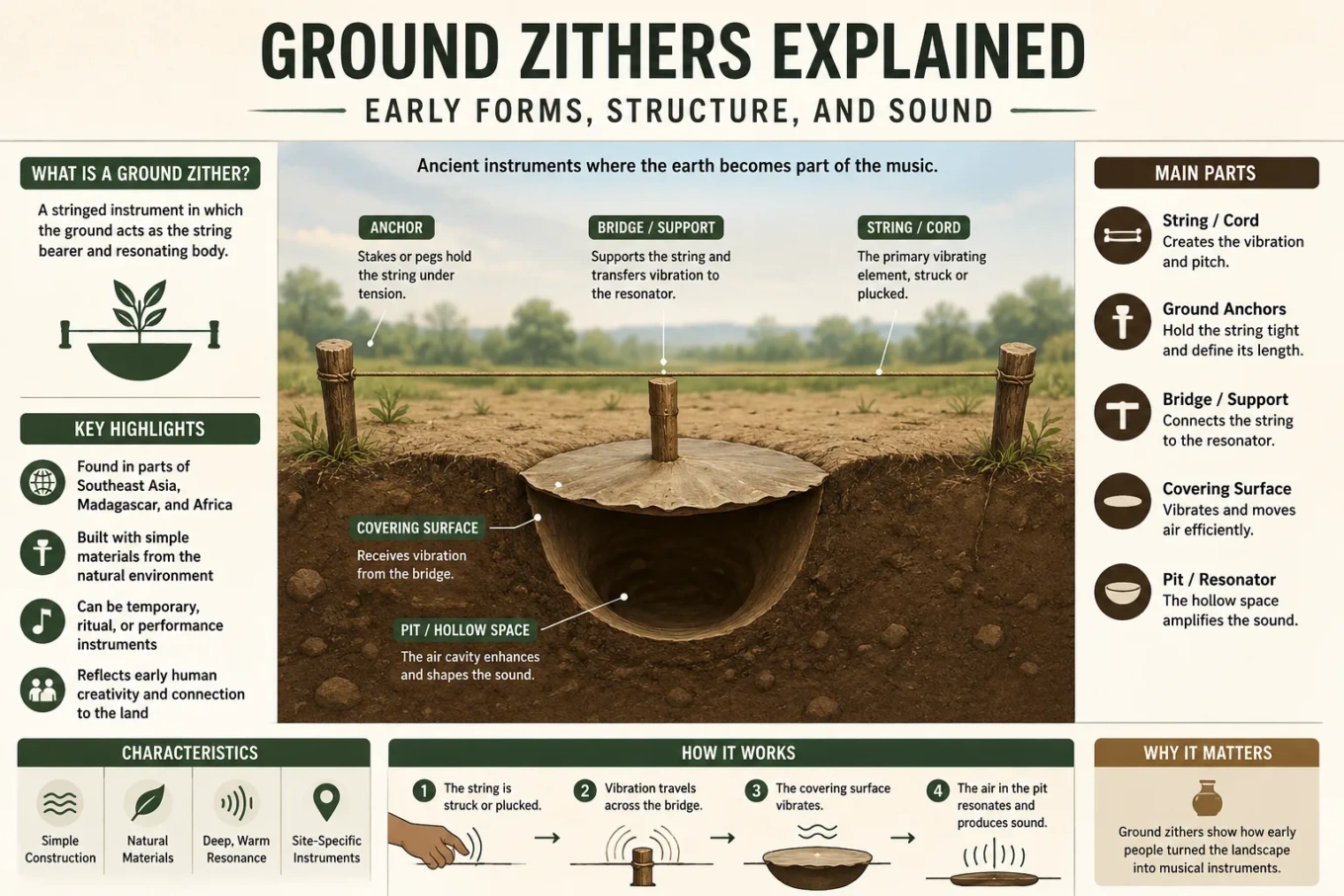
Ground Zithers Explained: Early Forms, Structure, and Sound
A ground zither reduces the zither principle to an unusually spare arrangement: a stretched string, fixed points, and the ground itself acting as the string bearer[1]. In documented forms, a pit, covered surface, bridge, or connecting cord may turn that simple stretched line into an audible musical system. The instrument can look more like a temporary installation than a conventional stringed instrument because part of its structure is literally built into the earth.
In the Hornbostel–Sachs system, ground zithers are classified as 314.21, within board-zither variations. The formal definition is narrower than some casual uses of the name: it describes a single string stretched between fixed points while the ground functions as its bearer. Historical documentation associates this structural idea with parts of Southeast Asia and Madagascar, while ground-zither terminology also appears in African instrument collections.
That simple classification does not mean every documented tradition uses an identical layout. Resonators, covers, strings, supports, striking methods, and performance roles can differ considerably. Ground zither is best understood as an organological construction principle rather than the name of one standardized instrument.
When the Earth Becomes Part of the Instrument
A zither placed on the floor is not automatically a ground zither. The distinction is structural.
On a concert zither, koto, guzheng, or many other zithers, a manufactured body carries the strings. With a ground zither, the earth takes over part of that job. Stakes or other fixed points hold the string under tension, while a cavity in the soil may provide the resonator[2]. The result is an instrument whose physical boundary is less obvious than that of a portable wooden zither.
Structural distinction: “Ground” describes more than playing position. The ground participates in supporting, anchoring, or acoustically coupling the string system.
A common documented arrangement can be understood as a chain of connected parts:
- A string or cord is stretched close to the ground.
- Its ends are held by stakes, pegs, or other fixed anchors.
- A central support or connecting element couples the string to a covered cavity.
- The string is struck or otherwise excited.
- Vibration passes from the string into the resonating surface and enclosed air.
No wooden soundbox has to surround the entire string. That is one reason the ground zither is useful for understanding how little physical structure a zither needs before a stretched string can become an effective musical sound source.
The Working Parts of a Ground Zither
The apparent simplicity hides several separate acoustic jobs. Each component controls a different part of the system.
| Part | Main Role | Effect on the System |
|---|---|---|
| String or cord | Primary vibrating element | Produces the pitched or partly pitched vibration when struck or plucked |
| Ground anchors | Hold the string under tension | Establish the usable length and resist the pull of the stretched string |
| Bridge or support | Supports and couples the string | May divide the string into sections and transfer vibration toward the resonator |
| Covering surface | Receives transmitted vibration | Moves more air than the narrow string can move alone |
| Pit or hollow space | Provides an air cavity | Modifies and reinforces parts of the radiated sound |
The String
The vibrating string may not resemble a modern metal instrument string. Documented traditions can use plant-based cords such as rattan or other locally available fibrous material. What matters acoustically is that the element can be put under enough tension to vibrate in a controlled way.
Three variables strongly shape its pitch: vibrating length, tension, and mass per unit length. Changing any of them can alter the result. This is why a ground zither should not be described as having one universal pitch or tuning.
The Anchors
The anchors replace part of the rigid structure that a portable zither body would normally provide. A stake driven into firm soil can oppose the pull of the string, allowing tension to exist between two distant points.
This arrangement also explains why some ground zithers are better understood as constructed performance systems than as objects that can simply be picked up and carried away intact.
The Bridge and Connecting Elements
A bridge[3] can do more than hold the string above another surface. Depending on the construction, it can help define separate vibrating sections and transmit energy away from the string.
Other forms use a short cord or loop between the stretched string and a resonating cover. The details matter. A rigid support pressing against a surface and a flexible connector pulling on it do not transfer vibration in exactly the same manner, even when both arrangements are grouped under the same broad instrument type.
The Covered Cavity
The pit is not merely an empty hole placed beneath the string. When a flexible or responsive surface covers it, that surface and the enclosed air interact with vibration transmitted from the string.
The covering may function somewhat like a membrane[4], although the material does not have to resemble drum skin. Historical descriptions mention materials such as bark, boards, leaves, or other available surfaces in different constructions.
The dimensions and stiffness of these parts influence the sound, but there is no useful universal rule such as “a deeper pit always produces a deeper ground-zither note.” String vibration, coupling, cover properties, cavity dimensions, and playing technique all interact.
How the Sound Travels from String to Pit
A bare string moving through air produces relatively little acoustic output because its surface area is small. Ground-zither construction addresses that limitation by coupling the string to something capable of moving more air.
The sound path can be described in five stages:
- Excitation: a stick, beater, finger, or other playing action starts the string vibrating.
- String motion: the stretched section oscillates according to its length, tension, and mass.
- Mechanical transfer: a bridge, support, or connector passes part of that vibration to another surface.
- Surface motion: the covering above the cavity vibrates and displaces more air.
- Cavity response: the enclosed air modifies the resulting sound before it radiates outward.
The first instant after a strike often contains a noticeable transient[5]. This gives struck ground zithers a percussive edge even though the primary vibrating element is a string. The following sustain[6] depends on how quickly energy leaves the string and how the rest of the structure responds.
This combination helps explain why a locally named “drum” can still be classified organologically as a zither. Local terminology may emphasize musical use or perceived sound, while instrument classification focuses on how sound is generated and how the vibrating element is supported.
One String Can Create Two Different Speaking Lengths
A central bridge can divide one continuous string into two speaking lengths[7]. If the bridge is not exactly midway between the anchors, the two sides can have different vibrating lengths.
For an ideal stretched string, with tension and linear density otherwise unchanged, frequency varies inversely with vibrating length:
f ∝ 1/L
A shorter section therefore tends to produce a higher fundamental frequency[8] than a longer section of the same string. Real ground-zither constructions are less tidy than an ideal physics model because supports, coupling points, striking position, string flexibility, and the resonator also affect what is heard.
This geometry makes a useful point: a single physical string does not necessarily mean a single usable pitch area. Where and how the string is divided can change its musical behavior.
Early Forms and the Limits of an Evolutionary Story
Ground zithers have often attracted attention in discussions of early string-instrument construction because they can be made with relatively few separate parts. A fixed string, ground anchors, a support, and a cavity provide a structurally direct way to combine string vibration with acoustic amplification.
Erich Moritz von Hornbostel described a ground-zither arrangement in 1933 as a horizontally stretched string running between pegs, with a central stick associated with a pit covered by bark. Ground zithers from Madagascar and Southeast Asia also entered early comparative organological literature.
That historical literature needs to be read carefully. Structural simplicity is not proof of chronological priority. An instrument that requires fewer manufactured components is not automatically older than every more elaborate zither, and similar solutions found in distant regions do not by themselves prove a single line of descent.
Evidence distinction: Ground zithers are well established as a recognized organological type and are documented in several regional traditions. Their simple construction makes them relevant to discussions of early string-instrument technology. It does not establish one ground-zither tradition as the proven ancestor of all later zithers.
Older theories of musical-instrument development often arranged simple forms into long evolutionary sequences. Modern readers should separate those historical interpretations from the directly observable evidence: construction details, collection objects, written descriptions, local practice, and classification.
Vietnamese Trống Quân Shows the Principle in Living Practice
Vietnam provides one of the clearest documented examples of a ground-zither principle continuing within a living performance tradition. In Hưng Yên, hát trống quân is a form of responsive singing in which a device called the trống quân can supply rhythm and an accompanying background sound.
Descriptions recorded by Vietnam’s cultural heritage authorities show how variable the construction can be. One documented arrangement uses a fresh rattan cord roughly 4.5 to 5 metres long. Its ends are tied to stakes driven into firm ground, while a wooden or metal container is placed centrally as a resonating body. A forked wooden support raises the rattan above it. The performer strikes the cord near the support with a small beater.
The reported sound is not treated as a precisely tuned melodic note. Its role includes keeping rhythm, marking divisions in the sung text, and filling spaces between vocal exchanges.
A Pit Can Still Be Part of the Modern Setup
Practice at Dạ Trạch also preserves a version that incorporates a shallow pit. Heritage documentation describes a hole roughly 20–30 cm deep, with material placed inside and bamboo pieces spanning the opening before the resonating container is positioned above it. For staged performances, musicians may instead place the apparatus on a long wooden support and avoid digging into the ground.
That variation is especially informative. It shows that a tradition can retain the acoustic and performance concept while changing how literally the ground participates in each performance.
Other local practice has moved farther away from the ground-zither construction, with conventional double-headed drums sometimes replacing the older device. The name of a musical tradition can therefore survive even while the physical accompaniment changes.
Phúc Lâm Uses Another Ground-Based Arrangement
A documented Phúc Lâm form uses a round pit as part of the resonance system, covered by a thin wooden board. A rattan string passes over a central support and is secured to bamboo stakes driven into the ground. The string is struck with a wooden beater to provide rhythmic accompaniment.
These examples should not be collapsed into a single blueprint for “the Vietnamese ground zither.” They show related acoustic ideas realized through local construction choices.
Madagascar and African Documentation
Madagascar appears in the historical classification literature attached to ground zithers, including the Hornbostel–Sachs definition of 314.21. Early comparative writing on string instruments also placed Malagasy examples beside Southeast Asian constructions when discussing the distribution of related structural ideas.
That comparison is useful at the level of morphology: strings positioned close to the earth, fixed anchors, and ground-related resonance provide features that can be compared across regions. Morphological resemblance alone should not be turned into a precise migration history unless additional evidence supports it.
African museum catalogues also preserve ground-zither terminology. The Royal Museum for Central Africa, for example, includes the Nedongu from the Democratic Republic of the Congo within its ground-zither classification. The museum’s broader chordophone collections make another point clear: African zithers include many distinct constructions, and a ground zither should not be confused with trough, raft, stick, or tube zithers simply because they occur within the same broad instrument family.
Ground Zither and Ground Bow Are Not the Same Construction
Ground zithers and ground bows[9] are easy to confuse because both can place a string beside a pit resonator and both may use the earth as part of the installation. The difference lies in the string-bearing system.
| Feature | Ground Zither | Ground Bow |
|---|---|---|
| String support | String stretched between fixed points associated with the ground | String tensioned by a flexible bow-like member |
| Flexible bow | Not the defining element | Central to the construction |
| Ground cavity | Found in documented forms | Can also be used as a resonator |
| Main classification clue | Ground functions as the string bearer | Flexible bar or bow carries and tensions the string |
The shared use of a pit does not erase that difference. Organological classification follows the relation between string and bearer, not just the shape of the resonator.
Why the Instrument Can Sound Both String-Like and Percussive
A ground zither does not have one universal timbre. Still, several parts of its construction explain why descriptions often emphasize a mixture of string vibration and a harder rhythmic attack.
Striking a stretched cord creates an immediate impact sound followed by vibration of the string. If a bridge or connector efficiently transfers that energy to a board, bark cover, container, or another resonating surface, the listener hears more than the narrow string by itself.
The resulting sound may contain:
- a sharp attack produced by the strike;
- a pitched or partly pitched string component;
- additional vibration from the support and covering surface;
- resonance shaped by the enclosed air space;
- mechanical noise from the beater, bridge, or string contact points.
The balance between these components changes with construction. A taut rattan cord coupled to a wooden container will not behave exactly like another plant-fibre string connected to a bark-covered earth cavity.
It is therefore safer to describe the acoustic mechanism than to assign every ground zither a fixed tonal character such as “deep,” “booming,” or “bright.” Those labels can be useful for a specific recorded instrument, but not for the whole category.
Why Some Ground Zithers Are Called Drums
Instrument names do not always follow the categories used by museum catalogues. The Vietnamese word trống is associated with drums, yet the stretched-string device used in some trống quân traditions fits a zither-type classification when examined through its sound-producing structure.
There is no real contradiction. A local name can reflect musical function, performance practice, or the way an instrument is perceived within its own tradition. Organology[10] asks a different set of questions: what vibrates, what supports it, how vibration is transmitted, and how the instrument is physically organized.
In trống quân, the struck cord can perform a job listeners readily associate with percussion: maintaining pulse and marking the flow of singing. Structurally, however, the vibrating string remains central to the sound-producing system.
An Instrument That May Exist Only for the Performance
A museum instrument is usually imagined as a self-contained object. Ground zithers complicate that assumption.
If stakes are driven into the soil, a cavity is dug, a covering is positioned, and the string is tensioned only for use, the complete instrument exists in that location for as long as the assembled system remains in place. Remove the stakes and cover the pit, and only separate components remain.
This temporary quality helps explain why historical evidence for such instruments can be uneven. Portable zithers can enter collections as complete objects. A ground-based instrument may be represented instead by photographs, field descriptions, recordings, individual components, or reconstructed performance practice.
For curators and instrument researchers, that changes the question from “Where is the instrument?” to “Which combination of objects, ground features, and actions creates the instrument?”
What the Ground Zither Reveals About Zither Structure
Large zithers can make the family seem dependent on elaborate woodworking: carved boards, hollow boxes, movable bridges, tuning pins, multiple strings, or decorative surfaces. The ground zither shows that none of those features defines the entire family.
The more useful structural idea is the relationship between the strings and the structure that bears them. A ground zither can dispense with the familiar portable body because the earth itself supplies that structural role.
It also separates two jobs that are easy to treat as one. Supporting a string and amplifying its vibration do not have to be performed by the same object. The ground can hold the tension while a covered pit, board, container, or coupled surface helps radiate sound.
That distinction makes the ground zither more than an unusual historical curiosity. It exposes the mechanics of a zither in an unusually visible form: tension must be maintained, a usable vibrating length must be established, energy must leave the string, and some part of the system must move enough air for the vibration to become musically useful.
Glossary of Technical Terms
[1] String bearer: The structure that supports the stretched string or strings of a chordophone. In a ground zither, the classification treats the ground itself as the bearer rather than a separate portable board or body.
[2] Resonator: A component or enclosed space that responds to vibration and helps shape or increase audible sound. Ground-zither resonators can involve a pit, a covered cavity, or another hollow body coupled to the string.
[3] Bridge: A support that holds a string at a defined position and can transfer vibration to another part of an instrument. On some ground zithers, it may also divide one string into separate vibrating sections.
[4] Membrane: A relatively thin surface that vibrates when driven mechanically or acoustically. In ground-zither descriptions, bark, leaf material, or another covering over a cavity may perform a membrane-like acoustic role without being a conventional drumhead.
[5] Transient: The brief, rapidly changing part of a sound immediately after it begins. A struck ground-zither string can have a strong transient caused by contact between the beater and string.
[6] Sustain: The portion of a sound that continues after the initial attack. Its duration depends on energy loss in the string and on how the string is coupled to the rest of the instrument.
[7] Speaking length: The part of a string that is free to vibrate between two effective stopping or supporting points. A bridge can create two different speaking lengths from one continuous ground-zither string.
[8] Fundamental frequency: The lowest principal frequency associated with a periodic string vibration and usually the main basis of its perceived pitch. Vibrating length, tension, and string mass all affect it.
[9] Ground bow: A ground-based chordophone in which a flexible bow-like member plays a defining role in tensioning the string. Its use of an earth cavity can resemble a ground zither, but the string-bearing structure differs.
[10] Organology: The study and classification of musical instruments, including their construction, sound production, history, terminology, and cultural use. For zithers, it helps distinguish instruments that may share visual features but use different string-bearing systems.