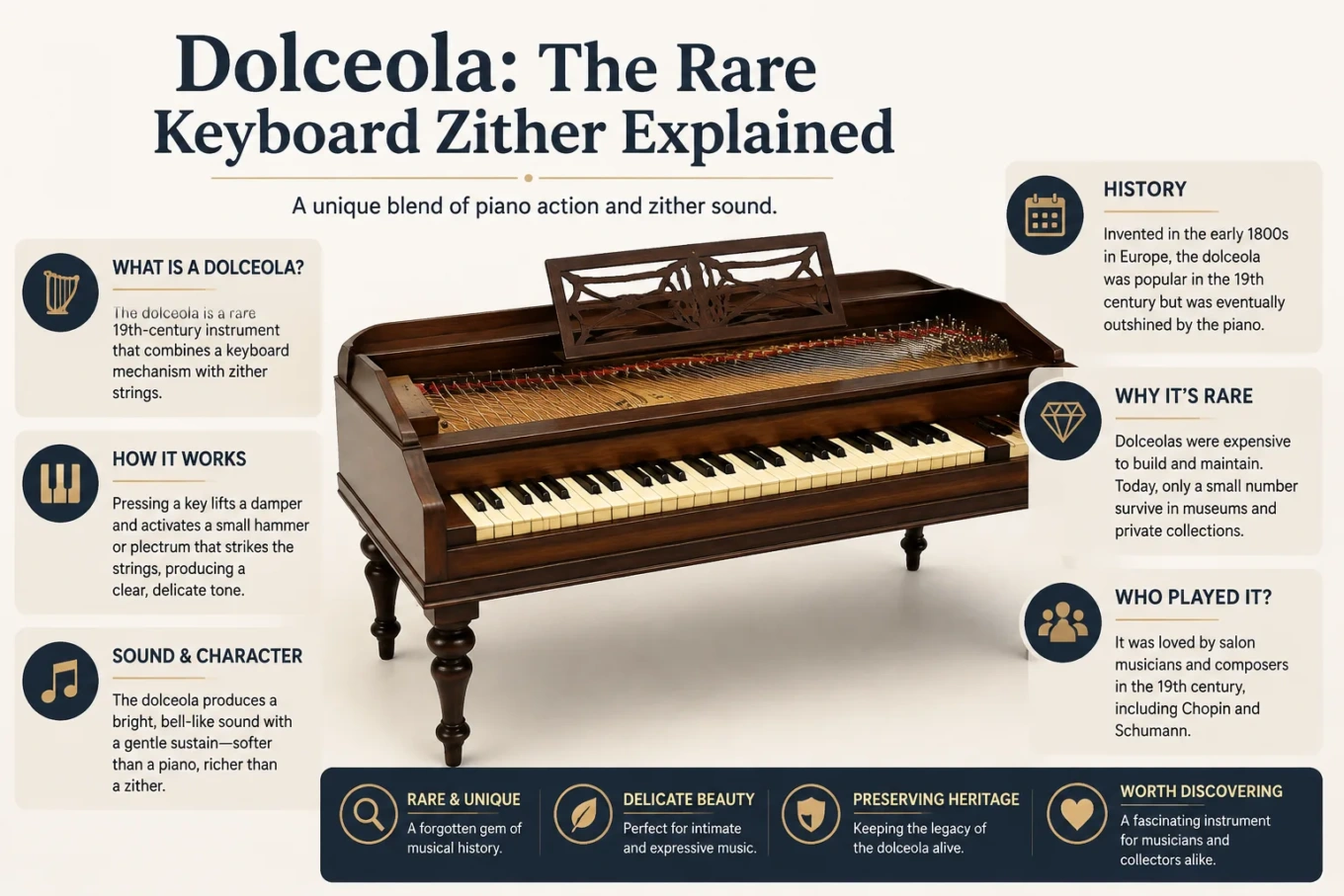
Dolceola: The Rare Keyboard Zither Explained
The Dolceola is a rare American keyboard zither[1] that can look like a miniature piano until its strings, key layout, and playing mechanism are examined closely. Made by the Toledo Symphony Company in Toledo, Ohio, during the first decade of the twentieth century, it combines a piano-like keyboard with the string arrangement of a zither. Its right-hand keys handle chromatic melody notes, while the left-hand section provides bass notes and prepared chord groups.
That combination explains both the instrument’s appearance and its unusual musical logic. The Dolceola belongs with zithers because its stretched strings form the sounding system of the instrument; the keyboard is the mechanism used to control those strings rather than evidence that the instrument is a small piano.
Classification Note: The presence of piano-style keys does not by itself make an instrument a piano. The Dolceola is a chordophone[2] whose keyboard operates strings arranged on a zither-like resonating body.
Why the Dolceola Looks Like a Piano but Is a Zither
The visual comparison with a piano is understandable. A Dolceola has black and white wooden keys, a raised case surrounding the string field, and a playing position that invites both hands to work at the keyboard. Period promotion also leaned heavily on the familiarity of the piano.
Its internal organization tells a different story. A documented museum example has 60 strings stretched across the body and 46 keys connected to a mechanical string-playing system. The strings remain central to the structure rather than being hidden inside the heavy plate-and-action arrangement associated with a conventional piano.
The word zither is used broadly here for a chordophone in which the strings run along or across the instrument’s own supporting body rather than along a projecting neck. The Dolceola is an unusual member of that broad family because the player reaches the strings indirectly through keys.
Main Details Worth Knowing
Surviving instruments and museum documentation make the Dolceola’s basic architecture unusually clear, although individual examples should not be assumed to match every detail exactly.
| Feature | Description |
|---|---|
| Instrument family | Keyboard-operated zither and chordophone |
| Maker | Toledo Symphony Company, Toledo, Ohio |
| Main production period | 1903–1907 |
| Documented string count | 60 strings on a museum-held example |
| Documented keyboard | 46 keys: 29 white and 17 black on the same example |
| Right-hand function | Chromatically arranged melody section |
| Left-hand function | Bass notes and grouped chord controls |
| String control | Mechanical tangents linked to the keys, with damping when keys are released |
The Powerhouse collection records these measurements and operating details for its Toledo Symphony Company Dolceola. They are especially useful because they describe a physical museum object rather than relying only on later summaries.
The Keyboard Does Not Follow Normal Piano Logic
The keyboard is one of the easiest parts of a Dolceola to misunderstand. Black and white keys suggest a standard piano pattern, yet the complete keyboard does not function as one continuous chromatic piano keyboard.
The right-hand area provides the melody side. Here, notes are arranged chromatically[3], allowing the player to move through semitone steps within the instrument’s melodic range.
The left-hand side uses a different system. Its keys are arranged in chordal groups. Museum documentation describes each group as containing two individually sounded strings followed by a three-note chord sounded together. That three-note combination is a trichord[4] in the literal sense of a three-note grouping.
This split allows one hand to provide accompaniment patterns while the other plays melody. It resembles the practical idea behind later keyboards with dedicated accompaniment controls more than it resembles unrestricted two-handed piano harmony.
Another detail makes visual assumptions unreliable: on the documented museum instrument, black keys are not always accidentals, and white keys are not always diatonic notes. The color pattern therefore cannot be read exactly as a pianist would read an ordinary keyboard.
The Note Chart Above the Keys
Original Dolceolas can also carry a fixed chart immediately above the keyboard. On the museum example, this metal chart identifies string or note names and shows their musical notation. It served as a practical orientation aid for a keyboard whose full layout was not self-explanatory.
This small feature says much about the instrument’s intended use. The Dolceola was designed not only as an unusual mechanical instrument but also as something a home musician could approach through visible note guidance and prepared accompaniment.
How a Dolceola Key Produces Sound
Pressing a Dolceola key sets a mechanical action[5] in motion. The key is connected to a tangent-like playing component that acts on the corresponding string. When the key is released, a damper[6] returns to the string and stops or shortens its vibration.
- The player depresses a key.
- The key moves its linked mechanical component.
- The selected string, or chord group where applicable, is set into vibration.
- The string transfers vibration through the instrument’s structure.
- Releasing the key allows the damping mechanism to control the remaining vibration.
The mechanism was important enough to receive dedicated patent development. An original action patent, U.S. Patent No. 719,641, was issued to Leander and David Boyd in 1903. A later patent, No. 857,380, issued to Leander Boyd in 1907, described an improved action intended to reduce mechanical noise.
Mechanical noise was therefore not merely an incidental modern restoration issue. It was something the makers themselves addressed while the Dolceola was still being developed.
What Shapes the Dolceola’s Sound
The Dolceola is often described as having a delicate, bell-like or music-box-like tone. Those descriptions are useful only when connected to the way the instrument works.
Its strings vibrate over a compact resonating structure rather than within the architecture of a full piano. The initial note has a clear mechanical attack, followed by string resonance[7]. Chord controls can set several strings sounding together, which produces a different envelope and texture from a single melody note.
The mechanical action can also remain audible. On a well-preserved or restored example, the listener may hear not only pitched strings but faint contact, release, and damping noises from the keyboard mechanism. These sounds belong to the physical behavior of the instrument rather than being electronic artifacts.
Listening Note: Listen separately for the start of the note and its decay. The Dolceola’s identity is especially clear in the contrast between a short mechanical attack and the softer vibration that follows.
The Strings, Resonating Body, and Damping System
A Dolceola depends on the interaction of metal strings, their supporting structure, and a resonating wooden body. The upper surface that receives and helps radiate string vibration functions as a soundboard[8], though the exact construction and condition can differ among surviving instruments.
Unlike a fretted concert zither, the Dolceola does not ask the performer to shorten a melody string against fingerboard frets. Pitch selection is built into the arrangement of separately tuned strings and their keyboard controls. That makes the instrument a fretless zither[9] in structural terms, even though its playing interface is far removed from finger-plucked fretless zithers.
The strings are also divided by musical function. Some support the chromatic melody section, while others belong to the bass-and-chord accompaniment system. This division is one reason the Dolceola cannot be understood well from the visible keyboard alone.
A Short Production Life in Toledo
The Dolceola emerged from Toledo, Ohio, in the early 1900s. Leander and David Boyd were associated with the instrument’s original patented action, and the Toledo Symphony Company became the name most closely linked with its commercial production. Archival holdings also preserve promotional and instruction material issued by the company around 1905.
The usual production range given for the instrument is 1903 to 1907. Estimates commonly suggest that roughly 5,000 may have been manufactured, but that figure should be treated as an approximate historical estimate rather than a verified surviving factory total.
The short manufacturing period helps explain why the instrument is uncommon, but production length alone does not tell the whole story. Dolceolas were mechanically more complicated than a basic chord zither, contained numerous strings and moving parts, and then had to survive more than a century of storage, changing ownership, repairs, and environmental exposure.
Why the Portable-Piano Idea Appealed to Buyers
The instrument was marketed during a period when manufacturers offered many forms of home music equipment designed to simplify accompaniment and make familiar songs more accessible. The Dolceola’s piano-like appearance gave buyers an immediately recognizable interface, while its preset accompaniment section reduced some of the note-selection work required by a full piano keyboard.
That helps explain why the instrument’s hybrid design was commercially useful rather than merely experimental. The keys offered familiarity; the chord layout offered convenience; the zither body kept the instrument relatively compact.
How Rare Is a Dolceola Today?
No reliable worldwide census of surviving Dolceolas is available. Published descriptions give different totals, and the meaning of “surviving” is often unclear. An instrument can exist in a collection yet be incomplete, unrestored, structurally fragile, or unable to hold playing tension.
A museum description states that fewer than one hundred were known according to the account it cites, while other modern discussions give different estimates. None provides a complete registry of every museum, private collection, attic discovery, restoration project, or unrecorded example.
Collector’s Note: “Known,” “surviving,” “complete,” “restored,” and “playable” are not interchangeable descriptions. A precise global survivor count should be treated cautiously unless it comes from a documented instrument census.
Rarity is therefore better described through evidence than through a dramatic fixed number. The instrument had a short production run, intact examples are uncommon, and fully playable examples represent a smaller group than instruments that merely survive.
Where the Washington Phillips Confusion Starts
Washington Phillips is still sometimes described as a Dolceola player. Later research into his instruments indicates that this identification is not accurate.
Phillips was associated in later accounts with the name “dulceola,” a spelling close enough to Dolceola to create decades of confusion. Research based on photographs, period descriptions, recorded sound, and surviving documentation points instead to unusual fretless zither-type instruments associated specifically with Phillips rather than a factory-built Toledo Symphony Company Dolceola.
This distinction matters because the playing methods differ. A manufactured Dolceola uses a keyboard action. Phillips’ recorded instrument is associated with direct hand playing of zither-like strings, not the standard keyed mechanism found on surviving Dolceolas.
Name Confusion: The Toledo-made Dolceola and the “dulceola” name associated with Washington Phillips should not be treated as two spellings for the same instrument.
The Dolceola in Recorded Music
A clearer documented recording connection comes from pianist Paul Mason Howard. Howard played Dolceola during 1944 recording sessions with Lead Belly, accompanying the singer’s 12-string guitar with the keyed zither. Contemporary photographic documentation also identifies Howard at a Dolceola during a Hollywood recording session with Lead Belly.
These recordings are useful for understanding the instrument because they place the Dolceola in an ensemble rather than treating it only as a museum object. Its bright attack, sustaining strings, and compact chordal support can occupy space between keyboard accompaniment and zither texture.
The instrument has also appeared in later recording contexts. Its continued use by a small number of musicians shows that a historical Dolceola can function as a working musical instrument when its action, strings, and structure remain serviceable.
How to Recognize a Surviving Dolceola
A genuine Dolceola is easier to identify by combining several construction details than by relying on its miniature-piano silhouette alone.
- Maker identification: Toledo Symphony Company markings are an important starting point.
- Split keyboard logic: the accompaniment side and chromatic melody side do not form a normal full piano keyboard.
- Visible string system: numerous strings extend across the zither-like body.
- Chord groups: the left-hand section controls prepared bass and chord functions.
- Note guide: surviving examples may retain a labeled musical chart above the keys.
- Mechanical damping: key operation is linked to string control and dampers rather than a conventional modern keyboard switch system.
The Powerhouse example also preserves 46 wooden keys and 60 strings, but these numbers should be used as documented identification data rather than an assumption that every surviving instrument is complete or unchanged.
Before Tuning or Restoring an Old Dolceola
A century-old Dolceola should not be approached as though it were a recently manufactured keyboard. String tension, bridge condition, wood movement, old repairs, felt and textile parts, dampers, and small action components may all affect whether the instrument can safely return to playing condition.
Bringing an instrument directly to full pitch without first checking its structure can place unnecessary stress on old components. Missing strings also complicate the process because replacing them requires more than choosing a modern string that simply fits the available space.
Luthier’s Note: Before tuning an unrestored Dolceola, inspect the soundboard, string anchoring points, bridges, tuning hardware, action, and damping components. Preservation of original parts can matter as much as immediate playability on a scarce historical instrument.
Mechanical stiffness is another concern. Forcing a reluctant key can damage a small linkage or aged component that may be difficult to replace accurately. Conservation-oriented inspection should come before aggressive adjustment.
How the Dolceola Differs from Related Instruments
The Dolceola shares traits with several other string instruments, but its combination of keyboard control and zither construction is unusually specific.
| Instrument | Main Playing Logic | Main Difference |
|---|---|---|
| Dolceola | Keys operate melody, bass, and chord strings | Keyboard-controlled zither with split accompaniment and melody functions |
| Autoharp | Strings are strummed while chord bars mute selected strings | Chord selection works through damping rather than a piano-like keyboard |
| Chord zither | Melody or accompaniment strings are commonly plucked directly | Usually lacks the Dolceola’s full keyed mechanical action |
| Marxophone | Strings are activated through flexible metal hammer mechanisms and direct playing | Uses a different mechanical approach and lacks the same keyboard layout |
| Piano | A chromatic keyboard controls a dedicated piano hammer action | Uses piano construction, scale design, and keyboard organization rather than zither-style string grouping |
The autoharp comparison is especially useful. Both instruments can simplify accompaniment, but they do so in opposite ways. An autoharp chord bar damps strings that should not sound; the Dolceola’s chord-side keys activate prepared note combinations.
A conventional chord zither comes closer in string organization, yet direct plucking remains the usual interface. The Dolceola places a mechanical keyboard between the player’s fingers and the strings.
Why the Dolceola Holds a Distinct Place in Zither History
The Dolceola documents a period when American instrument makers were experimenting with ways to make domestic music-making easier without abandoning acoustic strings. It combines several ideas that were already familiar separately: zither stringing, prepared chord accompaniment, visible note guidance, and keyboard control.
Its design also shows why instrument classification needs to look beyond appearance. The Dolceola can resemble a tiny piano, behave partly like an accompaniment instrument, and still remain structurally connected to the zither family.
The surviving examples preserve more than an unusual sound. They preserve an attempt to solve a practical musical problem: giving one player access to melody, bass, and ready-made harmony through a compact acoustic mechanism.
Frequently Asked Questions
Is a Dolceola a Piano or a Zither?
A Dolceola is best described as a keyboard zither. It has piano-like keys, but its strings and resonating body follow zither construction, while the keyboard serves as the mechanism that activates those strings.
How Many Keys Does a Dolceola Have?
A museum-documented Toledo Symphony Company example has 46 wooden keys, consisting of 29 white and 17 black keys. The complete keyboard does not function like an ordinary 46-key section of a piano because the left and right sides have different musical roles.
How Many Strings Does a Dolceola Have?
The same museum example has 60 strings. Surviving instruments may be missing strings or may have undergone repairs, so the observed count on an antique instrument should be checked against its condition and construction.
Did Washington Phillips Play a Dolceola?
The older claim is now considered unreliable. Research into Phillips’ photographs, period descriptions, and instruments indicates that he used a different fretless zither-type instrument or combined instruments associated with names such as “dulceola” and “manzarene,” not a standard Toledo-made Dolceola.
How Many Dolceolas Still Exist?
There is no dependable worldwide total. Different sources give different estimates, and some counts do not distinguish between complete, damaged, restored, and playable instruments. It is safer to describe the Dolceola as uncommon than to give an exact surviving number.
Can an Antique Dolceola Still Be Played?
Yes, some surviving instruments can be played after appropriate restoration or conservation work. Condition varies widely, and an old instrument should be inspected before tuning because its strings, wood, bridges, tuning hardware, dampers, and action may have deteriorated.
Glossary of Technical Terms
Keyboard Zither
A zither whose strings are controlled through keys rather than being reached only by direct plucking or striking. On the Dolceola, the keyboard operates separate melody and accompaniment strings.
Chordophone
An instrument whose primary sound source is a vibrating string. Zithers, including the Dolceola, belong to this broad string-instrument category.
Chromatic
An arrangement that includes successive semitone pitches rather than only the notes of one diatonic scale. The Dolceola uses a chromatic layout in its melody section.
Trichord
A group of three notes. In the documented Dolceola accompaniment layout, one control within a chord group can sound three strings together.
Action
The collection of moving parts that transfers a player’s key movement to the sound-producing parts of an instrument. The Dolceola uses a mechanical action between its keyboard and strings.
Damper
A component that contacts a vibrating string to reduce or stop its sound. Dolceola dampers return to the strings when their associated keys are released.
Resonance
The response of the strings and instrument body after energy is introduced. In a zither, this interaction helps determine how strongly a note projects and how it decays.
Soundboard
The resonating wooden surface that receives vibration from the strings and helps radiate it into the surrounding air. Its condition is important when evaluating an old zither.
Fretless Zither
A zither without a fretted fingerboard used to stop melody strings at different pitches. The Dolceola obtains different pitches from separately tuned strings controlled by its keyboard rather than by pressing strings against frets.