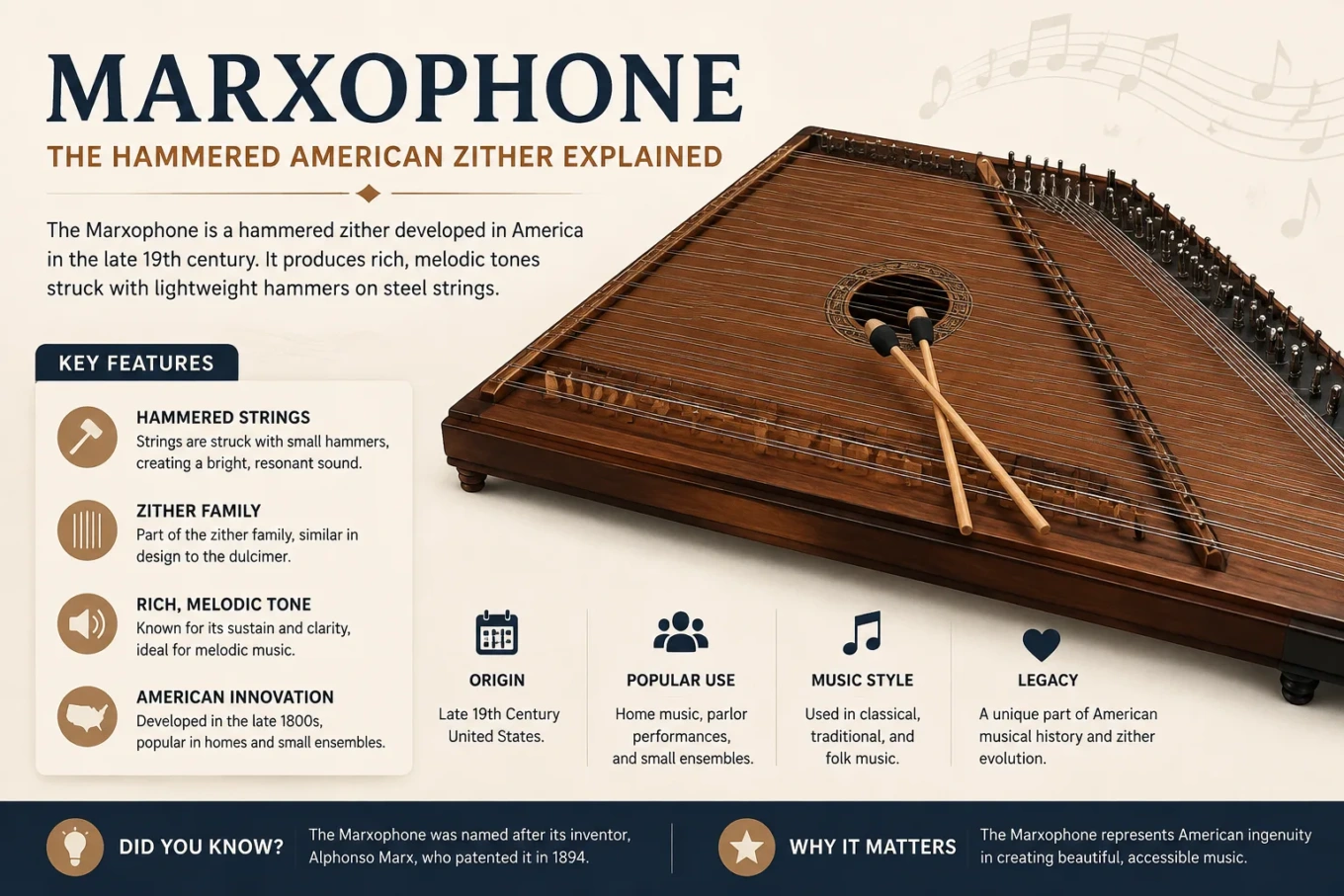
Marxophone: The Hammered American Zither Explained
The Marxophone is an American fretless zither[1] distinguished by a row of finger-operated metal springs that make small hammers strike paired melody strings. It belongs to the broad chordophone[2] family, yet its playing action can look deceptively keyboard-like. The player does not hold mallets as on a hammered dulcimer. Instead, pressing a spring-steel strip sets its attached hammer in motion.
That mechanical action gives the Marxophone its identity. A brief press can produce a single attack; a sustained press allows the flexible hammer assembly to rebound against the strings, producing a rapid repeated effect. Separate chord strings let the player supply harmony while the hammer mechanism carries the melody.
What Makes a Marxophone Different?
The Marxophone combines a zither-style resonating body with a mechanical melody attachment. Its strings stretch across a wooden soundboard[3], but the instrument divides their musical roles into two areas: grouped chord strings and paired melody strings.
A documented Phonoharp Company Marxophone in the National Music Museum has four bass or chord groups and fifteen paired melody positions covering a two-octave diatonic range. Instruments and surviving string layouts should still be examined individually rather than assuming that every Marxophone left the factory in exactly the same form.
| Feature | Arrangement |
|---|---|
| Instrument type | American fretless zither with a mechanical hammer attachment |
| Melody section | 15 paired melody positions in documented examples |
| Melody range | Two-octave diatonic layout in the patent example and museum specimens |
| Melody action | Finger-operated spring-steel strips with small hammer heads |
| Harmony section | Separate grouped chord or bass strings |
| Frets | None |
| Characteristic effect | Single struck notes or rapidly repeated hammer attacks |
Classification Note: Calling the Marxophone a “hammered zither” describes an important part of its sound production, but it can also create confusion. Its melody hammers are built into the instrument and operated by the fingers. They are not separate handheld beaters.
How the Spring-Hammer Mechanism Works
The Marxophone mechanism is easier to understand as a chain of movements:
- The player presses a rigid fingerpiece near the fixed end of a metal spring.
- The pressure bends the attached spring strip.
- The hammer head at the free end moves toward its assigned melody strings.
- The hammer strikes the strings and can continue vibrating if the fingerpiece remains depressed.
- Releasing the mechanism allows the hammer to return toward its resting position.
Each melody pitch can use a paired course[4] rather than one isolated string. In Henry C. Marx’s patent description, the two strings of a pair could be tuned in unison[5] and positioned closely enough for one striker to hit both.
Spring Steel Provides the Motion
The heart of the system is the spring hammer[6]. The patented design describes an elongated strip of spring steel, or another suitably resilient metal, fixed at one end and carrying a striker at the other.
The spring does more than move the hammer downward. Its elasticity lets the striker continue oscillating after the fingerpiece reaches its rest. That rebound is what allows a held note to become a sequence of closely spaced attacks.
The Fingerpiece Controls the Spring
The part touched by the player is not a piano key in the usual sense. It is a comparatively rigid fingerpiece attached near the anchored end of the spring strip.
When pressed, the fingerpiece moves until it meets a padded rest positioned above the strings. The fingerpiece then stops, while the flexible portion beyond it can continue vibrating. This separation between the rigid control point and the flexible striking section is central to the Marxophone’s action.
The Stop Bar Controls the Resting Position
The patented mechanism also includes a transverse stop above the free ends of the spring hammers. Its job is to arrest their movement when they are released.
The patent describes the stop as adjustable toward or away from the strings. Changing that distance changes how far a hammer can travel before striking, which can affect the strength of the attack. The same arrangement also allowed the hammer assembly to sit closer to the instrument for storage.
One Press Can Produce a Note or a Rapid Repeated Attack
The Marxophone does not require two separate controls for isolated notes and repeated notes. The difference comes from how the same spring is operated.
A Short Press Produces a Clear Attack
If the player depresses the fingerpiece and releases it quickly, the hammer can strike its string pair once before the spring has time to make another full oscillation.
This gives the melody a more separated, articulated character.
A Held Press Lets the Hammer Rebound
If the fingerpiece stays against its rest, the flexible spring can continue oscillating beyond that fixed point. The hammer repeatedly reaches the strings, producing a trill-like or tremolo[7] effect.
The resulting repetition is partly mechanical. It depends on the physical behavior of the spring, striker mass, contact point, string response, and the way the player depresses the control. It therefore does not respond exactly like repeated finger strikes on a piano key.
Listening Note: Listen for two layers in a Marxophone performance. The chord side gives broad zither-like harmony, while the melody side adds bright attacks that can turn into a lightly pulsing, mandolin-like shimmer when the spring hammers continue bouncing.
Why the Melody Strings Are Paired
The doubled melody layout is closely connected to the sound the mechanism was designed to produce. Marx’s patent describes paired strings placed close together so one hammer can strike both at the same time.
When the strings in a pair are tuned to the same pitch, the hammer excites two vibrating strings rather than one. This can produce a fuller attack and stronger combined resonance[8]. It also helps explain the patent’s stated aim of producing an effect associated with the mandolin, an instrument that commonly uses doubled courses.
The Marxophone should not be described as a mechanical mandolin, however. The resemblance concerns aspects of attack, doubled strings, and repeated-note texture. The body, string layout, and method of operation remain those of a zither-based instrument.
The Fifteen-Position Melody Layout
Surviving museum documentation records Marxophones with fifteen melody pairs. The patent also illustrates a two-octave C diatonic scale[9].
| Lower Octave | Upper Extension |
|---|---|
| C – D – E – F – G – A – B | C – D – E – F – G – A – B – C |
This gives fifteen scale positions from the first C through the C two octaves above it. Because each position can consist of two strings, fifteen playable melody notes can correspond to thirty physical melody strings.
The distinction matters when identifying or restringing an instrument: a count of the metal finger controls tells how many melody positions are available, while a count of the actual wires may be twice as high.
Why the Layout Is Not a Piano Keyboard
The standard documented melody arrangement is diatonic. It does not provide a complete sequence of semitones comparable to the white and black keys of a piano.
Marx’s patent states that additional strings and hammers could theoretically provide a chromatic scale[10], but that possibility should not be confused with the usual surviving Marxophone layout. The familiar instrument is built around the simpler two-octave diatonic melody system.
Chord Strings and Melody Hammers Have Different Jobs
The instrument’s physical layout separates accompaniment from melody. The patent describes strings grouped into chords on one part of the soundboard and open melody strings on the other.
A common playing approach uses the left hand on the chord groups while the right hand operates the melody springs. This gives one player access to harmony and melody without fretting strings or manipulating movable bridges.
A National Music Museum example records four bass groups identified as C, G, F, and D. Other surviving instruments, replacement string sets, and later descriptions may label or configure the fourth group differently, including D7 arrangements. The exact chord content should therefore be checked on the individual instrument rather than inferred from its name alone.
The Chord Side Is Played Directly
The hammer mechanism serves the melody side. The accompaniment strings can be swept or plucked directly by hand.
This mixed action is one reason the Marxophone is difficult to summarize with a single word such as “struck” or “plucked.” Its melody is mechanically struck while its chord groups can be directly plucked or strummed.
The Wooden Body Still Does the Acoustic Work
The spring assembly attracts attention, but the Marxophone remains an acoustic string instrument. The hammers start the vibration; the strings, bridges[11], soundboard, and hollow body turn that vibration into an audible musical tone.
The bridges transfer string energy into the soundboard. The broad wooden surface can then move more air than the thin strings could on their own. Body condition therefore matters on surviving instruments even when all of the mechanical parts appear present.
Cracks, loose joints, distorted bridges, or a badly deformed soundboard can change how efficiently string vibration reaches the body. Original construction varies between surviving instruments, so claims about one particular wood species or one universal body dimension should be treated cautiously unless the individual example is documented.
Henry C. Marx’s 1912 Playing Attachment
The mechanical idea associated with the Marxophone is documented in United States Patent No. 1,044,553, filed on January 18, 1912 and issued on November 19 of that year. The inventor was Henry C. Marx of Boston, Massachusetts, and the patent was assigned to the Phonoharp Company of East Boston.
The wording of the patent is revealing. Marx did not simply claim an entire new zither body. He described a playing attachment for stringed instruments based on manually operated spring strikers or hammers.
The design was intended to be attachable to suitable cithern- or mandolin-harp-type instruments without requiring the basic stringed body to be completely redesigned. The patented elements focus on the hammer support, spring strips, fingerpieces, rest, striker heads, and adjustable stop.
The Mandolin-Like Effect Was an Explicit Design Goal
The patent states that the spring strikers were intended to create an effect resembling a mandolin. That statement helps explain several construction choices that otherwise seem unusual when viewed independently:
- paired melody strings,
- unison tuning of those pairs,
- a hammer positioned over each pair,
- rapid repeated striking when a spring continues to vibrate.
The sound was therefore not an accidental by-product of the mechanism. The mechanical action and doubled melody strings were designed as parts of the same musical idea.
Numbered Notes Were Built into the Playing Concept
The patent also describes note markings placed in relation to the melody strings. Notes could be identified both by letters and by numbers.
This allowed the physical layout of the instrument to correspond to specially prepared music in a straightforward way. A player could identify a required melody position through a printed number rather than depending entirely on conventional staff-reading skill.
That feature belongs to a broader class of early twentieth-century home instruments designed to reduce the amount of notation knowledge needed to begin playing simple music. On the Marxophone, the simplified reading system worked together with fixed chord groups and predetermined melody pitches.
The convenience came with a tradeoff: the player gained direct access to ready-defined notes and harmonies but had less pitch flexibility than on an instrument with a full chromatic keyboard or a freely stopped fingerboard.
Phonoharp Company Marxophones
National Music Museum records identify surviving Marxophones made by the Phonoharp Company and date documented examples to the early twentieth century, including instruments placed broadly within the 1912–1926 period.
The same museum uses terms such as “Marxophone,” “fretless zither,” and chord/double-melody zither in its object documentation. These descriptions are useful because they show that the instrument can be understood simultaneously through its commercial name, its fretless construction, and its unusual division between chord strings and doubled melody strings.
The manufacturer’s label, patent marking, string layout, hammer mechanism, decoration, and hardware can all help distinguish a Marxophone from visually similar American chord zithers.
How the Marxophone Differs from Related Instruments
The Marxophone shares individual features with several better-known instruments, but none uses exactly the same playing logic.
| Instrument | Main Playing Action | Mechanical Feature |
|---|---|---|
| Marxophone | Chord strings plucked or strummed; melody strings struck by built-in spring hammers | Finger-operated spring-hammer bank |
| Hammered dulcimer | Strings struck directly with handheld hammers | Usually no attached hammer mechanism |
| Autoharp | Strings strummed or plucked while chord bars damp unwanted strings | Chord-bar damping system |
| Chord zither | Chord and melody strings commonly plucked or strummed directly | Usually lacks the Marxophone spring-hammer bank |
It Is Not a Hammered Dulcimer
The confusion is understandable because both instruments use hammers to excite strings. The physical gesture is different.
A hammered dulcimer player holds separate beaters and strikes exposed strings directly. A Marxophone player presses fixed metal controls attached to the instrument. The hammer action happens at the far end of those flexible strips.
A useful distinction is simple: the Marxophone builds its melody hammers into the instrument.
It Is Not an Autoharp
The autoharp also places a mechanism above a field of zither strings, but its familiar chord bars work mainly by damping strings that do not belong to the selected chord.
The Marxophone’s metal controls perform a different task. They actively strike designated melody string pairs. Its chord groups do not depend on the same chord-bar damping principle.
What the Marxophone Sounds Like
A well-functioning Marxophone has a bright, clearly defined attack from its melody hammers followed by the longer decay of vibrating metal strings. When both strings in a melody pair respond evenly, the note can sound broader than a comparable single-string strike.
Held spring hammers add another texture. Their repeating impacts create a lightly mechanical pulse that can suggest mandolin tremolo while retaining the ringing decay and open resonance associated with a zither body.
The chord section behaves differently. Sweeping several chord strings creates a wider harmonic wash beneath the more pointed melody attacks.
The final sound depends heavily on setup. Uneven unison tuning, hardened or damaged striker surfaces, misaligned hammers, corroded strings, loose bridges, and structural problems can all alter what an antique example produces.
The Mechanism Places Natural Limits on Expression
The spring-hammer system simplifies pitch selection, but it also introduces physical behavior that the player cannot control as freely as a hand-held mallet.
Each spring has its own stiffness, length, mass distribution, and striker weight. Those properties influence how quickly it rebounds. A spring that has been bent, repaired, shortened, or fitted with a replacement head may behave differently from neighboring hammers.
The mechanism can also make very even repeated attacks difficult when several original parts have aged differently. On an antique Marxophone, irregularity is not always a matter of playing technique; it can be evidence of mechanical condition.
Luthier’s Note: A hammer that misses one string of a paired course should not automatically be bent into position. The fault may come from the spring, support, bridge position, string spacing, or earlier repair work. Original geometry should be examined before altering old metal parts.
What to Check on an Antique Marxophone
Surviving Marxophones combine ordinary zither components with delicate mechanical parts. Condition should therefore be judged in both areas.
Spring-Hammer Bank
Count the metal springs and look for replacements, missing striker heads, bends, cracks, and corrosion. Adjacent springs should not rub against one another, and their hammers should correspond sensibly with the melody string pairs.
Paired Melody Strings
Check whether both strings remain in each melody course. A Marxophone with fifteen melody positions may use thirty physical melody strings when every position is fully doubled.
Unequal string gauges or improvised replacements can also make paired notes respond unevenly.
Chord Groups
Missing bass or chord strings can make the instrument appear more complete than it actually is because the open tuning area may still contain many wires. Identify the groups rather than relying only on the total string count.
Bridge and Soundboard Condition
Look for lifting bridge sections, cracks, sunken or raised areas of the soundboard, loose seams, and evidence that string tension has distorted the body.
Tuning Hardware
Old tuning pins[12] need enough friction in the wood to hold pitch. Heavy corrosion, oversized replacement pins, damaged pin holes, or pins that turn without resistance may indicate repair needs.
Labels and Patent Markings
Original printed labels, company markings, patent numbers, instruction cards, cases, and surviving music can help establish an instrument’s provenance[13] and identify how it was originally sold or configured.
Collector’s Note: Completeness matters more than surface polish alone. An instrument with worn decoration but an intact hammer bank, original hardware, identifiable labels, and a stable body can preserve more useful historical information than a heavily refinished example with missing mechanical parts.
Original Hammer Heads and Material Safety
Henry C. Marx’s patent states that the striker head could be made from materials chosen according to the desired sound, but it specifically describes lead as his preferred material. The patent also allows lead as one possible material for the rigid fingerpiece.
This does not prove that every surviving Marxophone contains the same material in every hammer or control. Parts may have varied in production or been replaced during more than a century of use.
Unknown vintage striker material should nevertheless be treated cautiously. Do not sand, grind, drill, scrape, or aggressively polish old hammer heads simply to improve their appearance. Deteriorating or unidentified components are better assessed before invasive cleaning or repair, particularly when an instrument will be handled around children.
Common Marxophone Misidentifications
“The Metal Strips Are Piano Keys”
They can resemble a primitive keyboard, but their function is different. Each control is part of a flexible striking mechanism rather than a conventional lever system operating a separate piano action.
“Fifteen Melody Notes Means Fifteen Melody Strings”
Not on the standard doubled layout. Fifteen melody positions can represent fifteen paired courses, giving thirty individual melody strings.
“The Hammer Mechanism Makes It a Percussion Instrument”
The audible tone comes primarily from stretched strings vibrating through the bridges and soundboard. The hammer is the device that starts that vibration.
“Every Marxophone Has Exactly the Same Chord Tuning”
Surviving documentation supports common layouts, but labels and chord content should be checked on the actual instrument. Museum records and modern replacement-string descriptions do not always describe the fourth chord group in exactly the same way.
“It Is Simply a Small Hammered Dulcimer”
The two instruments share the idea of striking strings, yet their physical technique is different enough that treating them as the same instrument obscures how the Marxophone mechanism works.
Glossary of Technical Terms
Fretless zither: A zither without a fretted fingerboard for shortening melody strings. On the Marxophone, pitches are determined by separate open strings rather than by pressing strings against frets.
Chordophone: An instrument whose primary sound source is vibrating stretched strings. Zithers form one broad group within the chordophone family.
Soundboard: The relatively broad resonating surface beneath the strings. String vibration reaches it through the bridge and causes a larger surface area to move air.
Course: One playable string position that may contain more than one physical string. A Marxophone melody course can contain a pair of strings sounded together by one hammer.
Unison: Two or more strings tuned to the same nominal pitch. Paired Marxophone melody strings can be tuned this way so a single hammer produces one reinforced note.
Spring hammer: A flexible metal strip carrying a striker at its free end. On the Marxophone, finger pressure bends the strip and its elasticity drives the hammer against the melody strings.
Tremolo: Rapid repetition of a note or sound. The Marxophone creates a tremolo-like effect when a spring hammer continues rebounding against its string pair.
Resonance: The response of strings and the instrument body to vibration. In a zither, bridges and the soundboard help transfer and radiate the energy produced by vibrating strings.
Diatonic scale: A seven-note scale pattern arranged around a tonal key without providing every chromatic semitone. The patent’s illustrated Marxophone melody section uses two octaves of a C diatonic layout.
Chromatic scale: A pitch system containing all twelve semitones within an octave. Marx’s patent notes that a chromatic arrangement could be produced with enough strings and hammers, though the familiar Marxophone layout is diatonic.
Bridge: A structural part over which strings pass and through which much of their vibration reaches the soundboard. Bridge position and stability affect string geometry as well as acoustic response.
Tuning pin: A metal pin around which a string is wound. Turning the pin changes string tension and therefore pitch, while the fit between pin and wood must be firm enough to hold the setting.
Provenance: The documented ownership, origin, repair, and collection history of an individual instrument. Labels, cases, music, receipts, and other associated material can help establish it.
Frequently Asked Questions
Is a Marxophone a zither?
Yes. Museum documentation describes it as a fretless zither. Its strings run across a resonating zither body, with separate chord strings and doubled melody strings. The unusual feature is the mechanical spring-hammer system used to play the melody.
Who Invented the Marxophone Hammer Mechanism?
Henry C. Marx patented the spring-hammer playing attachment. His application was filed on January 18, 1912, and U.S. Patent No. 1,044,553 was issued on November 19, 1912. The patent was assigned to the Phonoharp Company.
How Many Melody Strings Does a Marxophone Have?
Documented examples use fifteen paired melody positions. With two physical strings in each pair, that arrangement corresponds to thirty melody strings, covering a two-octave diatonic sequence.
Why Does a Marxophone Hammer Bounce?
The hammer sits at the free end of a flexible spring-steel strip. When the rigid fingerpiece is held against its rest, the remaining flexible section can continue vibrating, causing the striker to hit the strings repeatedly.
Is a Marxophone the Same as a Hammered Dulcimer?
No. A hammered dulcimer is normally struck with separate handheld hammers. The Marxophone has its hammers permanently mounted on spring strips, and the player activates them with the fingers.
Can Marxophone Strings Also Be Plucked?
The strings are physically accessible, so they can be sounded directly, although the defining melody system uses the spring hammers. The chord section is normally played directly by plucking or strumming rather than through the hammer bank.