Tremoloa: The Novelty Zither Explained
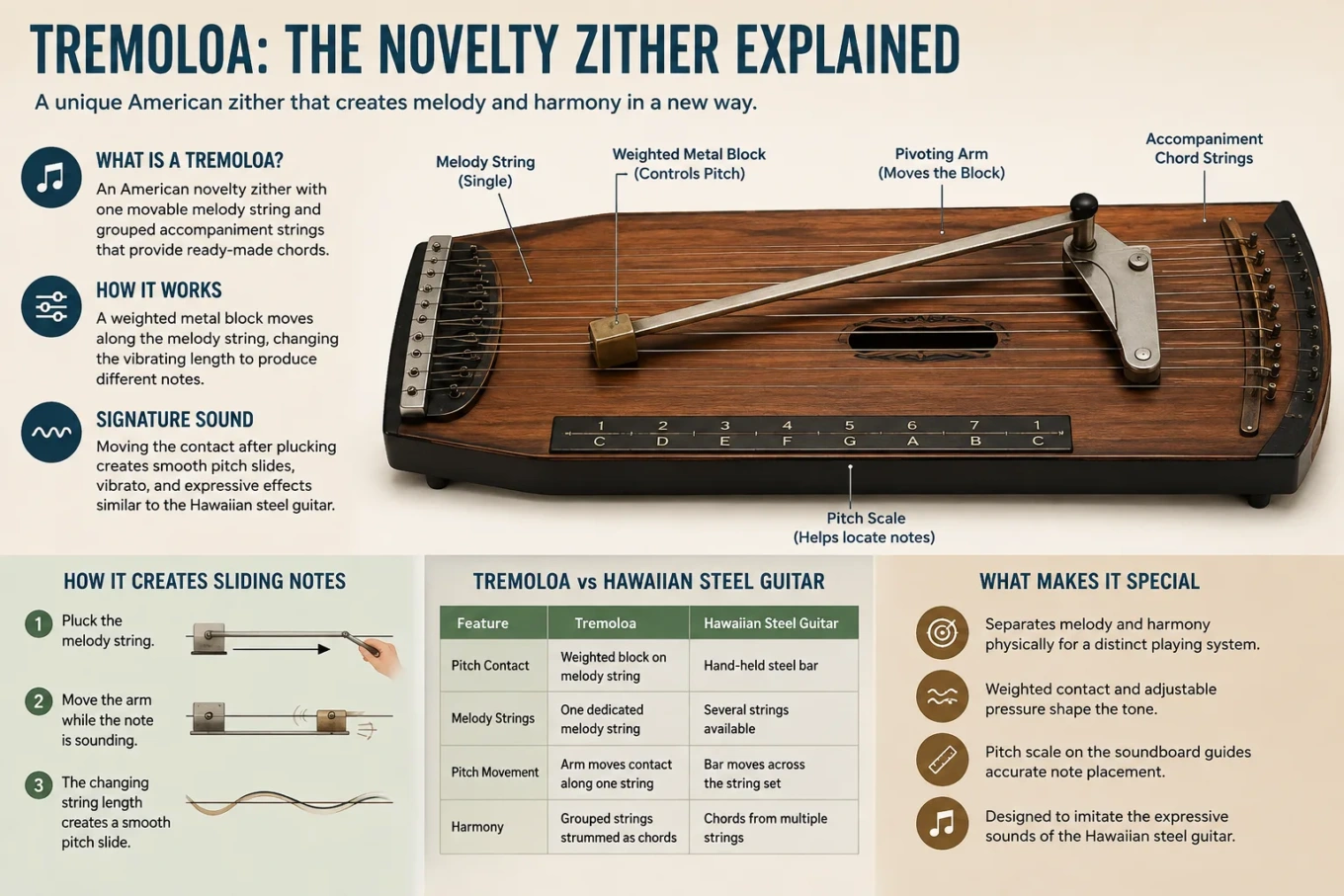
The Tremoloa is an American novelty zither built around one unusually specific musical idea: a single melody string is controlled by a movable metal contact while grouped accompaniment strings supply ready-made chords. Instead of fretting notes with the fingers, the player moves a pivoting arm so that a weighted block travels along the melody string. The result is a compact fretless zither[1] capable of smooth pitch movement associated with the Hawaiian steel-guitar sound that fascinated American audiences in the early twentieth century.
Its appearance can be deceptive. Most of the instrument resembles the shallow wooden body of other American chord zithers, yet the long metal arm crossing the soundboard changes both how melody is produced and how the instrument should be understood. The Tremoloa is not simply a zither fitted with an ornamental lever. The lever, weighted contact, melody string, pitch markings and accompaniment banks form one connected playing system.
The defining feature: a Tremoloa separates melody and harmony physically. One string carries the movable melody, while grouped strings provide fixed accompaniment chords.
The Moving Block Replaces a Conventional Fingerboard
The Tremoloa patent describes a hollow resonating body with grouped accompaniment strings and one dedicated melody string. A hard metal block rests against that melody string. The block can slide along the string, and its position determines the vibrating length that produces the note.
In practical terms, the block performs a job similar to a movable fret. A conventional fretted instrument fixes possible stopping points into the fingerboard. The Tremoloa instead moves the contact point itself.
The block is attached to a long arm mounted on a pivot away from the melody string. Moving the outer end of the arm sweeps the block through an arc along the string. An index on the arm corresponds with a marked scale on the soundboard, helping the player locate intended pitches without placing a finger directly on the string.
Why the Metal Block Is Weighted
The contact is not meant merely to touch the string. Its weight helps it remain in contact while the string vibrates. In the patented design, the block can also move slightly with the vibrating string rather than acting as a completely rigid stop.
This interaction affects timbre[2]. The patent even provides a way to change how firmly the block bears on the string. Adjusting the mechanism alters how freely the block can vibrate and therefore changes the character of the resulting note.
That detail helps explain why the Tremoloa mechanism is more elaborate than a simple sliding bar. The designers were controlling pitch, contact pressure and mechanical response at the same time.
The Arm Also Serves as a Pitch Locator
A marked scale beside the path of the arm turns the mechanism into a visual playing interface. The original patent allows the scale to use numbers or note letters, including positions corresponding to a diatonic scale[3].
The player therefore does not need a conventional fingerboard. The position of the arm indicates where the movable contact should sit for a particular pitch.
How the Tremoloa Produces Its Sliding Sound
The most recognizable Tremoloa effect comes from moving the metal contact after the melody string has been plucked. Because the vibrating length changes while the note is sounding, the pitch moves continuously instead of jumping immediately from one fixed note to another.
This produces portamento[4] and related sliding effects. Small repeated movements around a pitch can create a wavering sound, while a broader sweep creates a more obvious glide between pitches.
The patent specifically states that the instrument was intended to imitate tonal effects associated with the Hawaiian steel guitar. The comparison makes mechanical sense: both instruments change pitch by altering the effective sounding length of a string with a smooth movable contact rather than ordinary finger fretting.
| Feature | Tremoloa | Hawaiian Steel Guitar |
|---|---|---|
| Pitch contact | Weighted block controlled by an attached arm | Hand-held steel or bar |
| Melody strings | Dedicated single melody string in the patented concept | Several strings available to the bar |
| Pitch movement | Arm moves the contact along one string | Player moves the bar across the string set |
| Harmony | Separate grouped accompaniment strings | Produced through the tuning and selection of the main string set |
The resemblance therefore concerns a particular sonic effect and pitch-control principle. A Tremoloa does not reproduce the full layout or playing vocabulary of a steel guitar.
Seventeen Strings in a Well-Documented Tremoloa Layout
A documented Tremoloa configuration uses four accompaniment groups of four strings each, plus the single melody string. That gives seventeen strings in total.
The four accompaniment groups are associated with C, F, G and D chords. Each bank can be struck or plucked as a unit to provide harmony while the melody is played independently on the long string controlled by the arm.
| String Group | Strings | Musical Role |
|---|---|---|
| C chord bank | 4 | Fixed accompaniment |
| F chord bank | 4 | Fixed accompaniment |
| G chord bank | 4 | Fixed accompaniment |
| D chord bank | 4 | Fixed accompaniment |
| Melody string | 1 | Movable pitch |
This arrangement should be treated as a documented Tremoloa layout rather than a rule for every surviving example. Instruments made across different production periods can show construction or labeling differences.
Why the Chord Strings Are Separate
The separation makes the instrument easier to organize musically. The melody system does not need to create full chords, and the accompaniment section does not need a complicated mechanism for changing harmony.
The player can pluck one of the preset string groups with one hand while controlling the melody system with the other. The arrangement therefore divides musical tasks across physically different parts of the soundboard.
Unlike an autoharp, there is no need for a chord-bar mechanism that selectively damps unwanted strings. The Tremoloa’s chord groups are already separated into fixed harmonic banks.
Plucking, Sliding and Coordinating Both Hands
The patented playing method assigns different jobs to the hands. One hand operates the melody mechanism and a plectrum[5], while the other supplies accompaniment from the grouped strings.
The melody action involves several movements:
- Position the arm so the indicator corresponds with the desired note.
- Pluck the melody string.
- Hold the block at a stable point for a fixed pitch, or move the arm while the string continues sounding.
- Use the accompaniment banks to supply the appropriate chord.
That sequence explains an apparent contradiction in the design. The Tremoloa was conceived for people without extensive conventional instrumental training, but producing clean music still requires coordination. The printed pitch positions simplify note finding; they do not remove the need for rhythm, accurate positioning or controlled movement.
Intonation Depends on the Moving Contact
Because the melody does not rely on permanent frets, intonation[6] depends on where the block rests. The printed guide helps, but the mechanism still has to stop in the correct position.
This also gives the Tremoloa expressive possibilities that a fixed set of frets would restrict. A player can approach a note gradually, move through intermediate pitches or introduce a gentle oscillation after the attack.
The Resonating Body Has a Supporting Role
The unusual arm attracts most of the attention, but the wooden body still performs the acoustic work expected of a zither-type instrument. The patent describes a hollow box with openings intended to support resonance[7].
The melody string stretches across a pair of bridges[8]. One end is anchored while the other reaches a tuning post. The patent also describes measures intended to control unwanted vibration around the bridge area, including a muting element such as felt.
This matters because the movable block creates an extra mechanical contact on the melody string. The instrument has to preserve a useful sounding section of string while preventing other short sections from contributing distracting vibration.
Contact Pressure Can Change the Response
The patented arm can be adjusted so that the metal block bears more lightly or more heavily on the string. Lighter contact allows the block greater freedom of movement; heavier contact restricts that movement.
This is a form of mechanical damping[9]. It changes how readily motion continues through the block and string system. The design therefore treats the movable contact as an acoustic component rather than only a pitch marker.
The Patent Explains What the Inventors Were Trying to Achieve
Harold G. Finney and John H. Large filed the relevant United States patent application on August 30, 1929. It was assigned to International Musical Corporation of Hoboken, New Jersey, and the patent was issued on March 1, 1932.
The patent language is unusually useful for understanding the Tremoloa because it identifies the intended player as well as the mechanism. The design was aimed especially at people who were not skilled with conventional instruments. It also explicitly identifies imitation of the Hawaiian steel-guitar effect as a design goal.
Patent chronology
August 30, 1929: patent application filed by Harold G. Finney and John H. Large.
March 1, 1932: U.S. patent 1,847,303 issued for the stringed-instrument design.
This context explains several otherwise odd features. The printed note scale reduces dependence on learned fingerboard positions. Preset chord groups simplify accompaniment choices. The movable block packages a steel-guitar-like slide technique into hardware that remains attached to the instrument.
Why It Belongs to the Zither Family
The word zither is sometimes used narrowly for the European concert zither, but it also has a broader organological use for chordophones whose strings are stretched along or across a body without the neck arrangement typical of guitars and related lutes.
The Tremoloa fits the broader zither concept. Its strings run across a shallow resonating body, and its melody system does not depend on a projecting neck. The patent itself describes the invention as an instrument “of the zither type.”
Within that broad family, the Tremoloa is better understood alongside American fretless and chord-zither developments than alongside the concert zither. Its grouped accompaniment strings and printed playing aids place it within a particular culture of home-oriented mechanical and semi-mechanical zithers.
How to Recognize a Tremoloa
Body shape alone is not enough. Several American zithers from the same broad period use shallow wooden soundboxes, tuning pins and printed instructions. The Tremoloa is identified most reliably by the way its melody system is constructed.
- A long movable arm: mounted above the soundboard and able to sweep through a controlled range.
- A hard contact block or roller: positioned against one dedicated melody string.
- A pitch guide: numbers or note markings placed beside the path of the arm.
- Grouped accompaniment strings: separate banks intended to sound fixed chords.
- Conventional tuning hardware: tuning posts or pins for bringing the individual strings to pitch.
- A shallow resonating body: usually visually closer to other fretless zithers than to a guitar.
The moving block and single-string melody system are the strongest clues. A zither with chord banks but no sliding melody mechanism may belong to a related American novelty-zither tradition, but it is not identified as a Tremoloa merely because its outline looks similar.
The Name Does Not Mean the Instrument Produces Only Tremolo
The word “Tremoloa” naturally suggests tremolo[10], but the mechanism can create several kinds of pitch behavior.
Moving the block steadily along the string produces a glide. Moving it back and forth around a pitch produces a wavering effect. Holding it still produces a more stable note. These actions involve pitch movement rather than only repeated changes in loudness.
This distinction matters because musical terminology separates tremolo from vibrato[11], even though historical instrument names and advertising language do not always follow modern technical usage precisely. The Tremoloa mechanism can create an audible oscillation of pitch as well as longer sliding gestures.
Why the Tremoloa Is Not an Autoharp or Marxophone
Several American novelty zithers were designed to make accompaniment or melody more approachable, but their mechanisms solve different problems.
An autoharp normally places a damping system over a larger field of tuned strings. Pressing a chord control silences strings that do not belong to the selected harmony. The Tremoloa instead provides physically grouped accompaniment banks while reserving a separate string for movable melody.
A Marxophone uses a different mechanical principle again. Its characteristic mechanism strikes melody strings rather than sliding a weighted contact along one string. Both instruments show how makers experimented with mechanically assisted zither playing, but their sound-producing actions are not interchangeable.
The Tremoloa is therefore best identified by function rather than by the broad label “novelty zither”: fixed chord banks below one playing task, a sliding melody contact for the other.
The Fixed Chords Also Define Its Musical Limits
Preset accompaniment makes basic harmony straightforward, but it also places boundaries around the music. A documented C–F–G–D layout offers only four readily available chord banks. Music that depends on other harmonies requires adaptation rather than a simple change of hand position.
The single melody string creates a different limitation. It can move through many pitches, yet it does not provide the simultaneous multi-string melodic possibilities of instruments in which several individually pitched strings are available beneath the hands.
These limits are part of the original design logic. The Tremoloa trades harmonic flexibility for a simpler separation between melody and accompaniment.
A Mechanical Design That Still Invites Experiment
The Tremoloa remains an interesting object for instrument builders because its musical logic is visible in its hardware. The positions of the arm represent melody pitches; the chord banks represent discrete harmony choices. Those actions can be translated into mechanical control without redesigning the underlying acoustic instrument.
A documented 2026 experimental project demonstrated this directly by automating a surviving Tremoloa. Stepper-driven mechanisms controlled melody positioning and plucking, while separate actuators played the four chord banks. The original instrument itself was left physically unmodified.
The project does not indicate a broad Tremoloa revival. It does show that a design patented nearly a century earlier can be interpreted as a set of mechanical musical instructions: choose a chord, move to a melody position, pluck, then slide if the phrase calls for continuous pitch movement.
What the Tremoloa Reveals About American Novelty Zithers
The Tremoloa occupies an unusual point between acoustic instrument, playing aid and mechanical interface. Its inventors did not merely add another string arrangement to an existing zither. They transferred a slide-based pitch technique into a device that guides the player’s hand along a marked path.
That makes the instrument useful for understanding a wider design idea found in American home zithers: difficult musical actions could be simplified by changing the instrument itself. Printed scales could replace memorized finger positions. Fixed string banks could reduce chord choices to physical zones. Mechanical parts could reproduce gestures that otherwise demanded a separate instrumental technique.
The Tremoloa takes that idea unusually far. Its identity is concentrated in one moving contact point, one melody string and one arm whose motion turns a simple pluck into a continuously changing note.
Glossary of Technical Terms
[1] Fretless Zither: A zither without a conventional sequence of fixed frets for stopping melody strings. Pitch may come from separately tuned open strings or, as on the Tremoloa, from another method of changing the effective string length.
[2] Timbre: The tonal character that helps distinguish sounds even when their pitch and loudness are similar. On the Tremoloa, the vibrating string, resonating body and movable metal contact all contribute to the perceived tone.
[3] Diatonic Scale: A seven-note scale pattern associated with major and minor tonal systems. The Tremoloa patent describes an arm-position scale that could identify notes using letters corresponding to diatonic pitches.
[4] Portamento: A continuous glide from one pitch toward another. The Tremoloa can create this effect when its weighted contact moves along the melody string while the note is still sounding.
[5] Plectrum: A small implement used to pluck a string. Period playing methods for the Tremoloa combine plucking with movement of the melody-control mechanism.
[6] Intonation: The accuracy of produced pitch. Because the Tremoloa uses a movable contact rather than fixed melody frets, correct pitch depends partly on positioning that contact accurately.
[7] Resonance: The response of the instrument body and enclosed air to vibrating strings. The Tremoloa’s hollow body helps transfer and reinforce string vibration acoustically.
[8] Bridge: A structural contact that supports a string and transfers vibration toward the resonating body. The patented Tremoloa melody string is stretched across bridge elements while the movable block contacts the sounding section.
[9] Damping: The reduction or control of vibration. Tremoloa patent details include ways to limit unwanted string or block movement so that the melody mechanism responds more predictably.
[10] Tremolo: A repeated fluctuation commonly associated with rapid repetition or changes in amplitude. The Tremoloa name evokes a wavering effect, although its sliding mechanism also produces continuous pitch movement.
[11] Vibrato: A controlled periodic variation in pitch around a central note. Small back-and-forth movements of the Tremoloa’s pitch contact can produce a related audible effect.