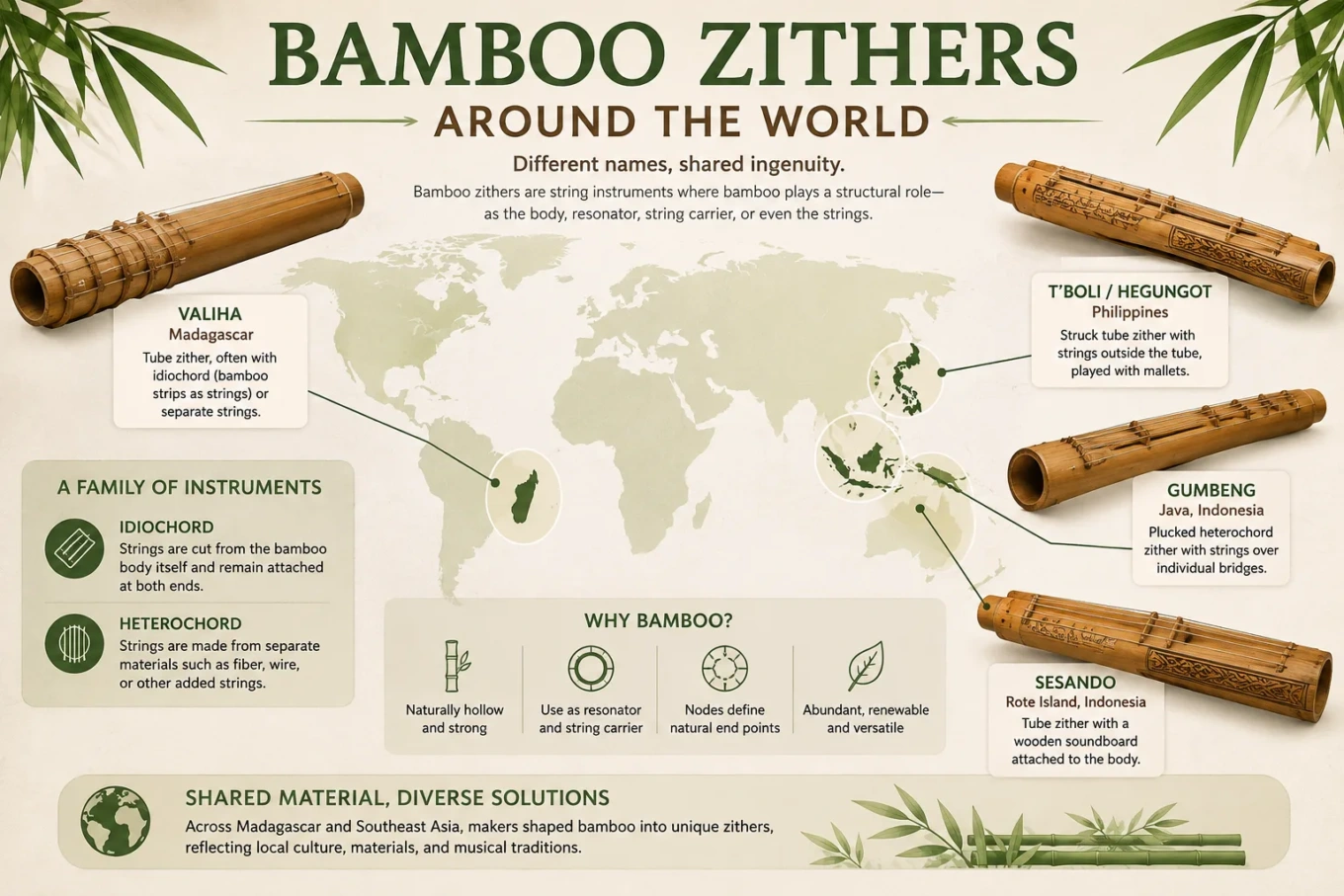
Bamboo Zithers Around the World
Bamboo zithers are not a single instrument type with different regional names. They are a group of zithers in which bamboo takes a structural role: it may form the body, act as the resonating chamber, carry the strings, or even supply the string material itself. A Malagasy valiha, a Philippine struck tube zither, a Javanese gumbeng, and a Rotinese sesando can all belong to the broad bamboo-zither landscape while differing sharply in string material, playing action, bridge layout, and acoustic design.
The form most closely associated with the term is the tube zither[1], where the strings run along or around a hollow tubular body. Bamboo suits this construction unusually well because a single culm can provide a rigid string carrier and an enclosed or partly opened air cavity. In some traditions, the same outer surface can also be cut into narrow raised strips that become playable strings.
When Bamboo Is More Than the Body
The most revealing difference among bamboo zithers is not geographical. It is the relationship between the tube and the strings.
In an idiochord[2] instrument, narrow strips are cut from the outer layer of the bamboo but left attached at both ends. Small wedges lift the strips away from the tube and place them under tension. The body and the strings therefore begin as one piece of material.
A heterochord[3] bamboo zither uses strings made from material separate from the body. Documented examples use fibre, wire, or other added string materials. This change can require different attachment points, tuning devices, and bridges[4]. It also makes it possible to replace a string without cutting another strip from the instrument’s tube.
Structural distinction: “Bamboo zither” describes the material and construction of the instrument, while “idiochord” and “heterochord” describe where its strings come from. A bamboo zither can belong to either category.
The hollow tube functions as a resonator[5], but makers do not all treat it in the same way. Nodes may close the ends. Openings can be cut into the wall or ends. Some instruments remain visually close to a bare bamboo tube, while others add an external sound-radiating structure that changes the instrument’s entire silhouette.
A Geographic Cluster Rather Than One Worldwide Tradition
Bamboo tube zithers are especially well documented across Madagascar, island and mainland Southeast Asia, and the Philippines. Closely related construction ideas also appear in parts of the wider Austronesian cultural sphere. Their distribution should not be read as proof that every instrument descends from one named ancestor or followed one simple migration route.
The shared material encourages similar solutions. Bamboo grows as a naturally hollow tube, its outer wall can carry tension, and its nodes can define the ends of a resonating chamber. Those physical properties help explain why comparable instrument shapes can appear across distant communities. Historical connections may also matter, but resemblance alone does not establish a direct line of descent.
Madagascar: Valiha and the Flexibility of One Instrument Name
The valiha is one of the clearest examples of a bamboo tube zither in Madagascar. Museum collections preserve instruments made from a long bamboo tube with strings distributed around the cylindrical body. Some examples are idiochord, with strings raised from the bamboo surface; others use separate strings.
This variation matters because the name valiha does not describe only one frozen construction. The Metropolitan Museum of Art holds a bamboo valiha dated March 30, 1905, measuring 91 cm in length. The Horniman Museum also documents an idiochord valiha whose sixteen strings are formed from the body itself and raised over individual bridges. Other documented valiha use separate metal strings.
The contrast shows how a musical tradition can preserve a recognizable tube-zither identity while construction changes. Replacing bamboo-derived strings with added metal strings alters more than the raw material. It changes how strings can be attached, replaced, tensioned, and adjusted.
Valiha Is Not the Only Malagasy Zither Form
Madagascar also has related zither forms that do not duplicate the cylindrical valiha. The marovany, for example, demonstrates that Malagasy zither traditions cannot be reduced to one bamboo-tube profile. A late nineteenth-century Sakalava marovany in the Metropolitan Museum collection is made from bamboo and bark and is classified as a plucked tube zither.
For a worldwide comparison, the useful lesson is terminological: local instrument names can cover histories and construction practices that are more complex than a single English category suggests.
The Philippines: A Vocabulary of Tube-Zither Designs
Philippine bamboo zithers are particularly useful for understanding how much variation can exist within the tube-zither idea. Names differ among communities and languages, and construction should be described from the individual tradition rather than treating one name as the national form.
Strings Around the Tube
Some Philippine instruments use a polychordal[6] layout, with several playable strings positioned around the circumference of the bamboo. In idiochord versions, these strings are lifted directly from the tube wall. Movable supports under the strips can change their vibrating length and tension.
Kolitong or closely related names are often used in discussions of northern Philippine tube zithers, but naming varies by language and community. It is therefore safer to treat “kolitong” as a local or regional name rather than a universal label for every Philippine bamboo zither.
Struck Zithers Change the Role of the Strings
Other Philippine bamboo zithers are struck instead of being treated mainly as finger-plucked melody instruments. A late nineteenth-century tube zither in the Metropolitan Museum collection has a bamboo tube, two oblong openings, and four separate fibre strings. The museum classifies it as a struck tube zither. The same collection records a late nineteenth-century takumbo made from bamboo and fibre in the struck-tube category, as well as a Luzon dungadung made from bamboo.
These objects are useful because they prevent an easy but inaccurate equation: bamboo tube zither does not automatically mean “idiochord strings plucked with the fingers.” Separate strings and percussive playing actions are also documented.
Gong Patterns Can Reappear on Zithers
In parts of the Philippines, tube zithers also sit close to gong-based musical thinking. Ethnomusicological descriptions of Cordillera zithers note that some instruments may be plucked or struck and can be used to rehearse or imitate gong-playing patterns. Here, the zither is not simply a small substitute for a larger instrument. Its string layout and playing technique allow familiar rhythmic or pitch relationships to be carried into another sound-producing body.
Indonesia: From Gumbeng to the Sesando’s Expanded Resonator
Indonesia provides two very different ways to build around a bamboo tube.
Gumbeng Keeps the Tube Visually Central
A late nineteenth-century Javanese gumbeng in the Metropolitan Museum collection combines bamboo, wood, and wire and is classified as a plucked tube zither. The tube remains the obvious structural center. Separate wire strings show that a traditional bamboo body does not require strings made from bamboo itself.
Other Indonesian tube-zither traditions use different layouts and playing methods, so gumbeng should not be treated as a template for the entire archipelago. It is most useful here as a documented example of a heterochord approach built around a bamboo tube.
Sesando Turns the Tube Into the Core of a Larger Acoustic Structure
The sesando, also widely spelled sasando or sasandu, takes a different path. A late nineteenth- to early twentieth-century instrument collected on Timor and associated with the Rotinese community uses a central bamboo tube, metal strings, movable bridges, tuning pegs, and a broad sound-radiating structure made from lontar palm frond.
The bamboo is still essential, but it no longer defines the visible outline by itself. The palm structure surrounds the stringed tube and acts as a much larger acoustic reflector. This makes the sesando a useful reminder that a tube zither can remain organologically tied to a bamboo cylinder even when the instrument no longer looks like a simple tube.
The same museum example has ten or eleven metal strings. That number should not be treated as a fixed specification for all sesando, since later forms and makers use different string systems.
Borneo: When a Bamboo Zither Carries Gong-Like Functions
The Bidayuh pratuokng of Sarawak offers another solution. Research on instruments from Annah Rais describes the pratuokng as an idiochord bamboo tube zither whose musical organization can correspond to functions found in the local gong set.
A 2024 study of the Bidayuh Biatah pratuokng describes a form with seven strings and a drum component. That detail belongs to the documented Annah Rais form and should not be projected onto every instrument carrying a related name. Earlier work on the same tradition discusses the relationship between pratuokng voices and the canang, satuk, and tawak functions of Bidayuh gongs.
This is an important design clue. A bamboo zither can organize several musical functions on one tube rather than merely supplying a single melody line. The physical compactness of the instrument does not tell the whole story of its musical role.
Mainland Southeast Asia Adds More Playing Possibilities
Bamboo zithers also occur in mainland Southeast Asian traditions. Smithsonian Folkways field recordings of Kmhmu music from Laos, Vietnam, Thailand, and communities in the United States include a briing tube zither and a plaw. Such documentation matters because museum objects show construction well, while field recordings preserve the instrument as part of performed music.
Across the broader region, tube zithers may be plucked, struck, or used in mixed percussive and melodic roles. A construction label therefore cannot stand in for a playing-technique label.
Six Designs Show Why “Bamboo Zither” Is a Broad Category
| Instrument or Tradition | Region | Construction | Defining Feature |
|---|---|---|---|
| Valiha | Madagascar | Bamboo tube; idiochord or separate strings in documented forms | One named tradition can span different string materials |
| Philippine tube zither | Philippines | Bamboo tube; forms include body-derived or separate fibre strings | Plucked and struck designs both occur |
| Takumbo | Philippines | Bamboo and fibre | Documented as a struck tube zither |
| Gumbeng | Java, Indonesia | Bamboo, wood, and wire | Separate strings on a clearly tube-centered body |
| Sesando | Rote/Timor tradition, Indonesia | Bamboo core, metal strings, palm-frond sound structure | External reflector expands the acoustic architecture |
| Pratuokng | Sarawak, Malaysia | Idiochord bamboo tube in documented Bidayuh forms | Can carry functions comparable with a local gong set |
Why Bamboo Changes the Instrument’s Design
Bamboo does not merely replace wood. Its growth form encourages a different type of instrument engineering.
- The hollow internode can become a sound chamber. A maker begins with an enclosed or partly enclosed tube instead of carving a cavity from a solid block.
- The outer wall can supply string material. In idiochord construction, raised strips remain attached to the same body that supports them.
- Nodes can define structural boundaries. Depending on the design, they may help close the ends of the tube or become areas where openings are made.
- Wedges can do several jobs. Small supports can lift a body-derived string away from the surface, establish its vibrating section, and help adjust tension or pitch.
- The cylinder allows strings to occupy more than one face. A player may have strings distributed around the circumference rather than laid across a single flat soundboard.
These properties help explain why bamboo tube zithers often look structurally economical. Body, string carrier, air cavity, and in some cases string material are integrated into one culm.
Changing the String Material Changes the Mechanical System
Replacing a raised bamboo strip with wire or fibre is not a cosmetic substitution. The new string has its own elasticity, mass, attachment needs, and workable tension range. Makers may therefore need pegs, nails, holes, bindings, or different bridge arrangements to secure and tune it.
The audible result cannot be predicted from material alone. String length, thickness, tension, bridge contact, body dimensions, playing force, and the surrounding resonating structure all affect timbre[7] and sustain[8]. It is reasonable to expect a metal string and a raised bamboo strip on otherwise similar instruments to behave differently, but broad claims such as “metal is brighter” or “bamboo is warmer” are too crude without comparing the actual instruments.
Separate strings also make repair more modular. An idiochord string is physically part of the body; a heterochord string can usually be replaced independently. That practical difference can influence how makers adapt older designs to available materials.
The Same Body Shape Can Support Different Musical Jobs
Classification describes how an instrument is built and how it produces sound, but it does not fully describe what musicians do with it.
A bamboo zither may carry a melody, accompany singing, create a repeated rhythmic pattern, or reproduce relationships associated with a gong ensemble. Philippine struck zithers and the Bidayuh pratuokng make this especially clear. Their strings are part of a broader performance system, not merely a row of pitches waiting to be played in sequence.
That distinction is central to organology[9]. Two instruments can share a tube-zither construction yet occupy different musical roles. Conversely, a zither and a gong set can have very different physical structures while sharing parts of a musical pattern or ensemble logic.
Local Names Carry More Information Than the Global Label
“Bamboo zither” is useful when comparing construction across regions. It is much less precise when describing an individual musical tradition.
Names such as valiha, kolitong, takumbo, gumbeng, sesando, and pratuokng point toward particular communities, histories, and instrument designs. Even then, spelling and usage can vary. A name recorded by one museum, researcher, or language community may have another spelling elsewhere.
The safest approach is to keep two levels of description separate:
- Structural label: terms such as tube zither, idiochord, heterochord, plucked, or struck explain physical construction and sound production.
- Local instrument name: the culturally used name identifies a particular tradition more closely, but may still cover local variants.
This also prevents the word zither from becoming misleading. In its broad organological use, a zither is a chordophone[10] whose strings run along the body without a separate neck functioning as the main string carrier. That broad category includes instruments whose appearance and performance practice differ greatly from the European concert zither.
Similar Forms Do Not Prove a Single Migration Route
The resemblance between Madagascar’s valiha and bamboo tube zithers of Southeast Asia has long attracted attention. Madagascar also has well-established Austronesian linguistic and population connections with island Southeast Asia, so comparison is historically reasonable.
Even so, an instrument’s shape is not a migration map. Early comparative organology sometimes treated visual similarity as stronger evidence of diffusion than present-day scholarship would accept without support from language, chronology, archaeology, historical records, and detailed construction comparison.
For bamboo zithers, two explanations can operate at the same time. Related communities can transmit instrument ideas, and distant makers working with the same hollow, fibrous material can also arrive at similar engineering choices. A raised strip on a bamboo tube is a particularly plausible solution wherever suitable bamboo and the relevant craft knowledge are present.
Museum Objects and Field Recordings Preserve Different Evidence
A museum object can preserve details that are difficult to recover from prose: tube diameter, string attachment, bridge shape, sound openings, decoration, repairs, and the exact combination of materials. The dated valiha, Philippine struck zithers, gumbeng, and sesando in major collections make historical construction directly comparable.
But an object without its performance setting has limits. A field recording or ethnographic description can show whether the instrument accompanies a song, reproduces gong-related patterns, participates in an ensemble, or is played alone. Neither type of evidence replaces the other.
This is particularly useful with bamboo instruments because organic materials change, wear, and are often rebuilt. A surviving museum specimen documents one physical moment in a tradition, not every form the instrument has taken.
What Bamboo Zithers Reveal About the Zither Family
Bamboo zithers stretch the familiar image of a zither far beyond a flat soundboard with strings arranged across its face. The same broad string-family principle can appear as a closed bamboo cylinder with raised body strings, a struck instrument with separate fibre strings, a wire-strung Javanese tube, or a Rotinese instrument surrounded by a palm-frond reflector.
The material encourages this variety because bamboo can perform several structural jobs at once. Yet the instrument is ultimately defined by more than the plant from which it is made. String origin, bridge system, resonating structure, playing action, local terminology, and musical function determine what each bamboo zither actually is.
Glossary of Technical Terms
- [1] Tube zither
- A zither whose strings are carried by a tubular body. In bamboo examples, the tube often also forms the main resonating chamber.
- [2] Idiochord
- A string arrangement in which the string material is cut or raised from the instrument’s own body. On bamboo zithers, narrow strips of the outer wall can remain attached at both ends and be lifted with small supports.
- [3] Heterochord
- A construction in which the strings are made from material separate from the body. Bamboo zithers with added fibre or metal strings belong to this category.
- [4] Bridge
- A support that holds a string away from the body and transfers vibration into the instrument. On some bamboo zithers, small movable bridges also help establish effective string length or tension.
- [5] Resonator
- The part of an instrument that receives and radiates vibration more effectively than the string alone. A hollow bamboo tube can serve this role, while the sesando adds a much larger palm-frond sound-radiating structure around the tube.
- [6] Polychordal
- Having several strings as part of one string-bearing structure. In Philippine bamboo tube zithers, multiple strings may be distributed around the circumference of the tube.
- [7] Timbre
- The quality that makes two sounds distinguishable even when their pitch and loudness are similar. String material, bridge contact, body geometry, and playing action can all shape the timbre of a bamboo zither.
- [8] Sustain
- The length and manner in which a note continues after it is plucked or struck. It depends on the complete vibrating system rather than on string material alone.
- [9] Organology
- The study and classification of musical instruments, including their construction, sound production, history, and cultural use. For bamboo zithers, organology helps separate structural similarities from local instrument identities.
- [10] Chordophone
- A musical instrument in which stretched strings are the primary vibrating elements. Zithers form one broad group within the chordophones.