Oceanic Zithers: Bamboo, Tube, and Indigenous String Instruments
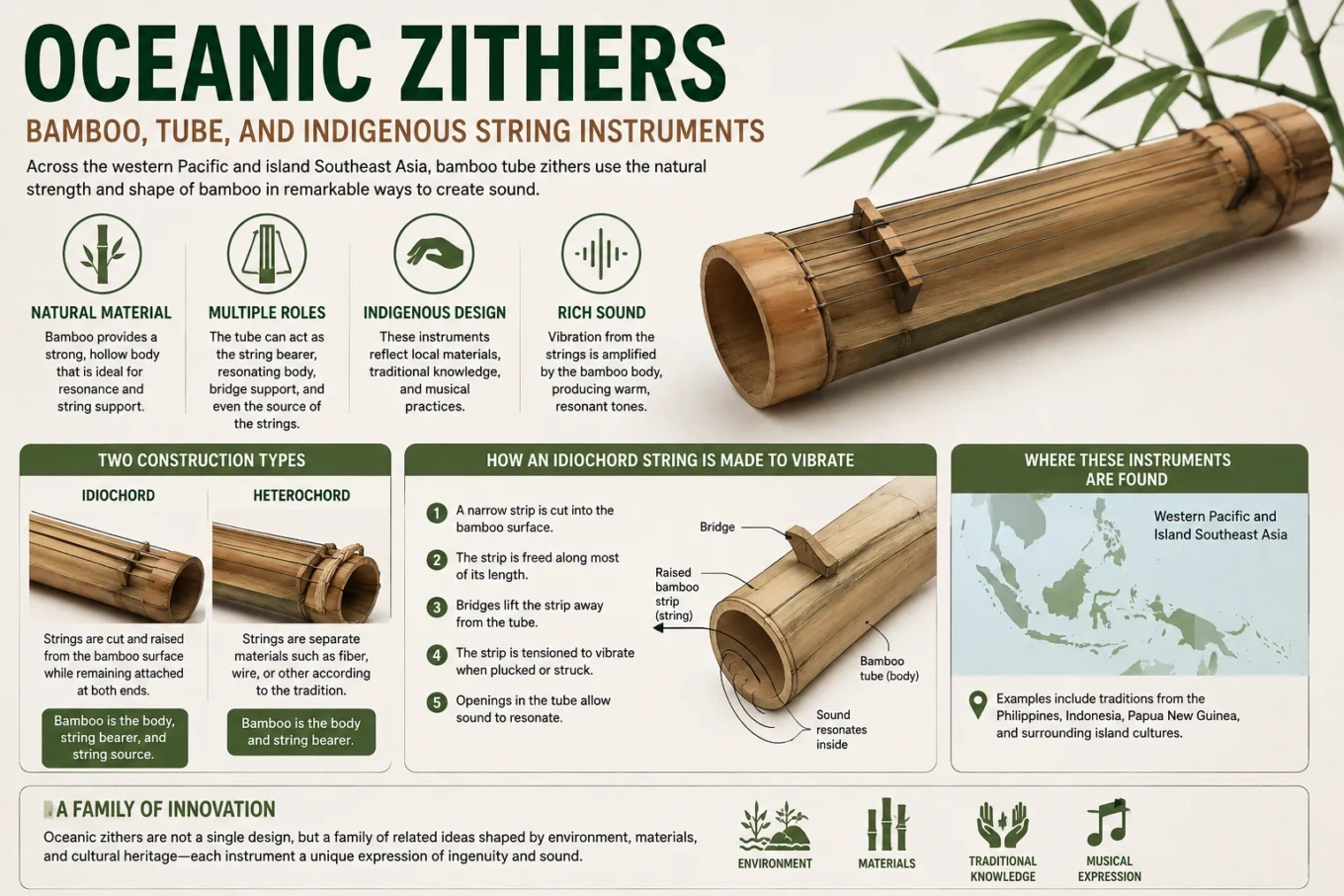
Across the western Pacific and island Southeast Asia, some zithers turn a bamboo tube into far more than a container for strings. The tube can act as the string bearer[1], part of the resonating body, a support for small bridges, and, in idiochord[2] forms, even the source of the strings themselves. Narrow strips are cut from the bamboo’s outer surface, raised on small supports, tensioned, and made to vibrate. Other traditions attach separate fibre or metal strings to the tube. The result is not one “Oceanic zither” design, but a family of related construction ideas shaped by local materials and musical practice.
The term Oceanic zither is best treated as a regional description rather than a single formal instrument category. Museum and organological writing may discuss Pacific instruments together with nearby island Southeast Asian traditions because of shared materials, related tube-zither structures, and Austronesian cultural history. That does not make every bamboo zither from Indonesia or the Philippines geographically Oceanian. A careful description keeps the regional setting and the instrument’s physical classification separate.
Why the Bamboo Tube Matters
A tube zither[3] uses a complete or tube-like body as the main support for its strings. In many documented Pacific and island Southeast Asian forms, bamboo is especially well suited to this role because a mature culm already provides a hollow, rigid structure. A maker does not need to build a box around an empty cavity before stringing the instrument.
The natural geometry of bamboo also changes what can be done with the strings. A section cut between or around the plant’s nodes can provide a closed or partly opened resonating chamber. The hard outer cortex[4] can be worked into narrow lengthwise strips. Small pieces of wood or bamboo can then lift those strips away from the tube so they have clearance to vibrate.
One tube can perform several jobs: it can carry the strings, provide a resonating cavity, hold bridges or wedges, and, in idiochord construction, supply the string material itself.
This is why bamboo tube zithers should not be understood as ordinary zithers made from a different raw material. In many examples, the material determines the architecture of the instrument before the first string is tuned.
Idiochord and Heterochord Designs Change the Instrument at Its Source
The most useful structural divide is between idiochord and heterochord[5] construction.
In an idiochord tube zither, one or more strings are cut from the surface of the tube while remaining attached at both ends. The string and its bearer therefore begin as one piece of material. In a heterochord design, the strings are separate components attached to the tube. They may be made from plant fibre, wire, or another material depending on the regional form and period.
| Construction | Where the String Comes From | What Bamboo Does |
|---|---|---|
| Idiochord | A strip cut and raised from the tube surface | Body, string bearer, and string source |
| Heterochord | A separate fibre, wire, or other string | Body and string bearer |
The distinction affects more than terminology. An integral bamboo strip has limits set by the thickness, width, elasticity, and condition of the tube from which it was cut. A separate string gives a maker more freedom to choose another material and to use pegs, ties, or other fittings that are not possible in the same way with an integral strip.
Neither construction should be treated as a simple “early” or “advanced” stage. Both are meaningful solutions. They reflect different relationships among available materials, pitch control, repair, playing technique, and the musical role expected from the instrument.
How an Integral Bamboo String Is Made to Vibrate
The defining feature of an idiochord bamboo zither is easy to miss in photographs because the string can resemble a separate strand laid over the tube. In fact, the string is part of the bamboo wall.
- A narrow longitudinal strip is cut into the outer surface without separating it at the ends.
- The strip is carefully freed along most of its length.
- Small wedges or a bridge[6] lift it away from the tube.
- The raised strip is placed under enough tension to vibrate when plucked or struck.
- Openings in the tube, where present, allow the interior cavity to interact with the vibrating structure.
The exact method varies. String width, support position, openings, tube diameter, and the number of strings are not fixed across the region. Some makers use several raised strings spaced around the circumference; others use paired or parallel strings concentrated on one part of the tube.
Pitch control can also depend on the supports beneath a string. Moving a wedge changes the effective vibrating length and may also alter tension. The effect is mechanically different from turning a geared tuner on a modern guitar, even though both operations are used to bring a string toward an intended pitch.
Plucked and Struck Tube Zithers Belong to the Same Structural Family
The word “zither” does not mean that the strings must be plucked. A chordophone[7] is classified by vibrating strings as the primary sound source, while the way those strings are set in motion can vary.
Pacific and Philippine museum records show both plucked and struck tube zithers. A player may use fingers to set individual strings into vibration, or a small stick may provide a sharper attack. Some local forms combine string sound with percussive effects from the bamboo body.
This distinction matters when identifying an unfamiliar instrument. A cylindrical bamboo body with raised strings does not tell the full story. Wear marks, string layout, bridges, openings, and the presence of a beater can reveal whether the instrument was designed mainly for melodic plucking, rhythmic striking, or a mixed technique.
A late nineteenth-century Philippine tube zither preserved in a major museum collection, for example, is classified as a struck tube zither. Its construction uses a bamboo tube with openings and four fibre strings. That object alone is enough to show why “tube zither” describes body and string arrangement more reliably than playing method.
Philippine Bamboo Zithers: One Construction Idea, Many Local Forms
The Philippines preserves several bamboo tube-zither traditions under different local names. It is safer to speak of related regional forms than to force them into one standardized instrument profile. Names, string counts, dimensions, openings, and playing methods can differ among communities.
Polychordal Forms and Strings Around the Tube
Some Philippine bamboo zithers use several strings arranged lengthwise around the circumference. This polychordal[8] layout allows the player to reach multiple fixed pitches on one compact body. Raised bamboo strings may be supported by small movable pieces that help define their sounding length.
Kolitong is one name associated with multi-string bamboo tube zithers in the northern Philippines, particularly in Kalinga contexts. It should not be treated as the universal name for Philippine tube zithers. Related instruments elsewhere in the archipelago may have different construction details and different local terminology.
Parallel-String Forms and Rhythmic Playing
Other Philippine forms use one or two groups of parallel strings rather than distributing many strings around the tube. These can support a more rhythmic playing logic, especially when the strings are struck.
Takumbo is commonly associated with this parallel-string tube-zither pattern. In idiochord examples, narrow strips are raised from the bamboo itself. Small supports keep them clear of the body, and a central feature beneath or between the strings may contribute to the instrument’s response when struck.
Togo in Recorded Maguindanao Music
The togo also appears in documented Philippine performance rather than only in museum catalogues. A mid-twentieth-century Smithsonian Folkways recording from Maguindanao identifies a performance by two togo tube-zither players. That record is useful because it places the instrument in an audible musical setting alongside a wider sound culture that includes gongs, lutes, flutes, jaw harps, drums, and other instruments.
It also warns against reducing bamboo zithers to isolated “folk objects.” Their design makes sense only when connected to how players organize rhythm, pitch, ensemble texture, and social performance.
Sesando and Sasandu: A Tube Zither with an External Resonating Shell
The sesando, also widely known by the Rotinese name sasandu, shows how far tube-zither construction can move away from the visual appearance of a bare bamboo cylinder. Its central bamboo tube carries separate metal strings, while a broad palm-leaf structure surrounds the string system and acts as an added resonator[9].
A documented late nineteenth-century example collected on Timor uses bamboo, teak, palm, and wire. Museum classification places it among plucked tube zithers. The strings are not cut from the bamboo surface, so the instrument belongs on the heterochord side of the tube-zither divide.
The Lontar-Palm Resonator Is Functional, Not Merely Decorative
The fan-like shell gives the sesando its most recognizable silhouette. It surrounds the string-bearing tube and provides a larger surface and enclosed space for the instrument’s sound to develop. The exact acoustic result depends on construction, condition, stringing, bridge setup, and the shape of the palm structure, so it is better described as part of the instrument’s projection system than assigned one fixed tonal effect.
Movable Bridges Divide the String Layout
Small bridges positioned around the central tube help organize the strings and their vibrating lengths. Historical examples may use several bridge and tuning components around the tube rather than one straight bridge line. This creates a playing surface that wraps around the instrument instead of lying flat like the strings of a board zither.
One documented historical sesando has ten or eleven metal strings, with bass and treble handled by different hands. That count belongs to the recorded museum object, not to every sesando or sasandu. Later and regional instruments can use different string systems.
Musical Use Goes Beyond Solo Display
Historical documentation connects the sesando with song accompaniment as well as solo playing. It has been used in community settings on Timor and among Rotinese people, with the instrument supporting sung material rather than functioning only as a freestanding instrumental voice.
This social role helps explain why construction cannot be separated from technique. The player must reach around a circular string field, control bass and treble areas, and balance the instrument against the human voice. The palm resonator, string layout, and hand positions are parts of one performance system.
“Oceanic” and “Austronesian” Are Not Interchangeable Labels
Tube zithers are often discussed alongside the history of Austronesian-speaking populations because related bamboo instruments occur across a broad area that includes island Southeast Asia and parts of the Pacific. Instrument distribution can help researchers compare technologies and cultural connections, but it does not provide a migration map by itself.
Austronesian[10] is primarily a language-family term used in wider historical and cultural research. Oceania is a geographic and cultural-region term whose boundaries depend on the context in which it is used. The Philippines and Indonesia, for example, belong geographically to Southeast Asia even when their instruments are discussed beside Pacific traditions in comparative music studies.
Classification boundary: similar bamboo construction can support a historical comparison without making two instruments members of the same geographic tradition.
That distinction is useful when considering Madagascar’s valiha. Valiha is one of the best-known bamboo tube zithers and can be idiochord in traditional forms, yet Madagascar is not part of Oceania. Its value here is comparative: it shows how a related tube-and-string solution appears far outside the Pacific while remaining relevant to studies of Austronesian cultural history.
Why Tube Zithers Stand Out in Pre-Contact Pacific String Traditions
String instruments were not distributed through the pre-contact Pacific in the same way as drums, slit gongs, flutes, trumpets, and other sound-producing devices. Museum scholarship notes that, outside island Southeast Asia, string instruments in the Pacific were relatively uncommon before Western contact. The mouth bow and tube zither were the principal string-instrument forms documented across much of the region.
That history gives the tube zither a particular place in Pacific organology[11]. It represents a local string technology that does not depend on the neck-and-body architecture familiar from lutes, guitars, or violins. The vibrating string sits on or grows from the same structure that carries it.
Later imported and locally adapted instruments changed Pacific string music in many places. Hawaiian ʻukulele traditions are one well-known example of a different historical process involving a necked string instrument derived from Portuguese models. Tube zithers belong to another structural line and should not be presented as early versions of those later instruments.
Bamboo Shapes the Mechanics Before It Shapes the Tone
Claims about the “sound of bamboo” can become too vague. The more useful starting point is mechanical.
- Hollow form: the plant naturally provides a tube that can function as a resonating cavity.
- Hard outer surface: the outer layer can support narrow raised strips in idiochord designs.
- Nodes and internodes: an internode[12] provides a natural tube section, while nodes can close or define its ends.
- Low part count: some designs need no separate soundboard, neck, or attached string set.
- Flexible modification: holes, cracks, wedges, bridges, and separate strings can alter the same basic tube form.
These features affect how vibration travels through the instrument. String length, tension, mass, bridge contact, body openings, tube stiffness, and attached resonators all contribute to the resulting timbre[13]. Bamboo alone does not guarantee one fixed tone.
Age, moisture history, wall thickness, species, workmanship, and surface condition can also change the response of a particular object. That is one reason museum instruments should not be used to make overly exact claims about how every regional example originally sounded.
From Integral Bamboo Strips to Fibre and Wire
String material can reveal an important construction shift. In the most materially integrated idiochord form, the maker cannot replace the vibrating strip without altering the tube itself. If a strip breaks completely, repair may require local reconstruction or replacement of the body section.
Heterochord instruments separate those roles. A worn fibre or wire string can, in principle, be replaced while the tube survives. Separate strings also allow different fastening and tuning systems. This can support changes in pitch range, tension, durability, and maintenance, though the result depends on the whole design rather than the string material alone.
Historical sesando examples demonstrate that metal wire and bamboo can coexist in a traditional regional instrument. Modern materials therefore should not automatically be read as evidence that an instrument has lost its identity. The better question is which structural relationships remain: tube as string bearer, bridge placement, resonating shell, string layout, and playing technique.
How to Read an Unidentified Bamboo Zither
An object can often be narrowed to a structural family before its cultural identity is known. Identification should begin with the physical evidence rather than a guessed ethnic or national label.
| Clue | What It Can Suggest |
|---|---|
| Complete bamboo tube | Whole-tube rather than flat-board construction |
| Strings cut from the surface | Idiochord construction |
| Separate fibre or wire strings | Heterochord construction |
| Small wedges under strings | Raised string clearance and possible pitch adjustment |
| Strings around the circumference | Multi-sided playing surface, often associated with polychordal forms |
| Large palm-leaf shell | Strong clue toward sesando/sasandu-type construction |
| Beater wear or striking stick | Possible struck playing method |
Construction can narrow the field, but it cannot establish cultural identity on its own. Two communities can solve similar acoustic problems with the same plant material, and related communities can build visibly different instruments. Provenance, local name, collection history, language, playing practice, and maker knowledge remain necessary for a reliable identification.
What Makes These Instruments Distinct Within the Zither Family
Oceanic and nearby Austronesian tube-zither traditions show how broad the zither category becomes when classification follows string placement rather than familiar European shapes. A zither does not need a flat soundboard, a rectangular case, metal strings, or finger-plucked technique. It can be cylindrical, struck, wrapped in a palm resonator, or built with strings cut directly from its own body.
The most informative distinctions are therefore structural: whole tube or partial tube; integral or separate strings; strings arranged around the circumference or in parallel groups; bare tube or added resonator; plucked or struck excitation. Local names and cultural uses remain equally important, because the same structural label can cover instruments that serve different musical purposes.
Seen this way, bamboo tube zithers are not a peripheral curiosity beside better-known board and box zithers. They demonstrate one of the clearest cases in which the material, the resonating body, and the string system are designed as a single physical problem. Their diversity comes from the different ways communities solved that problem.
Glossary of Technical Terms
[1] String Bearer
The structural part that supports the strings and holds their fixed points. In a whole-tube zither, the bamboo tube itself serves as the string bearer.
[2] Idiochord
A string construction in which the vibrating string is cut from the same material as the body or string bearer. In bamboo tube zithers, a strip of the tube’s outer layer remains attached at both ends and is raised for vibration.
[3] Tube Zither
A zither whose main string-bearing structure is a complete or tube-like body. Bamboo is common in many Pacific and island Southeast Asian examples.
[4] Cortex
The hard outer layer of a bamboo culm. In some idiochord zithers, narrow sections of this surface are cut and lifted to form integral strings.
[5] Heterochord
A construction in which the strings are made from material separate from the string bearer. Fibre, wire, or other attached strings can make a bamboo tube zither heterochord.
[6] Bridge
A support that holds a string away from the body and transfers vibration into the instrument. Small movable bridge or wedge pieces on bamboo zithers can also affect vibrating string length.
[7] Chordophone
An instrument whose primary sound source is one or more vibrating strings. Zithers are chordophones whether their strings are plucked, struck, or activated by another method.
[8] Polychordal
Having several strings that can provide multiple pitches or musical functions. On some bamboo tube zithers, these strings are distributed around the circumference of the tube.
[9] Resonator
A body or cavity that receives vibration from the string system and helps radiate sound. The palm-leaf shell surrounding a sesando is an added resonating structure around the central bamboo tube.
[10] Austronesian
A large language family extending from Taiwan and island Southeast Asia across much of the Pacific and to Madagascar. The term is useful in comparative musical-instrument research but is not a synonym for Oceania.
[11] Organology
The study and classification of musical instruments, including their construction, sound production, history, and cultural use. Tube-zither terminology often comes from organological classification systems.
[12] Internode
The length of a bamboo culm between two nodes. This naturally hollow section can provide the main body of a tube zither.
[13] Timbre
The character or tone quality that helps distinguish two sounds even when pitch is similar. On a tube zither, string material, bridge contact, tube structure, openings, and resonators can all shape timbre.