Zither Strings: Materials, Number, and Setup Explained
Zither strings are not defined by one material, one count, or one setup method. A concert zither, a koto, a guzheng, a qanun, a santur, a kantele, and a tube zither can all belong to the wider zither family, yet their strings may be metal, silk, nylon, gut, plant fiber, or even lifted from the body material itself. The shared idea is organological rather than cosmetic: a zither is a chordophone[1] in which the strings are stretched across a body, board, tube, box, frame, or resonator instead of being carried by a projecting neck.
That makes zither string setup a matter of structure. The player does not only ask “how many strings?” but also “what kind of body carries them, how are they divided, what material suits the pitch range, and how do bridges, pins, frets, or dampers control the sound?” A zither’s string plan is the map of the instrument.
Zither Strings and the Shape of the Instrument
Most zithers place their strings above a soundboard[2] or another vibrating surface that helps turn string vibration into audible tone. On box zithers, the body often works as a closed resonating body[3]. On board zithers, the top surface may be long, flat, slightly arched, or hollowed. On tube zithers, a section of bamboo or another tube can serve as both string carrier and resonator.
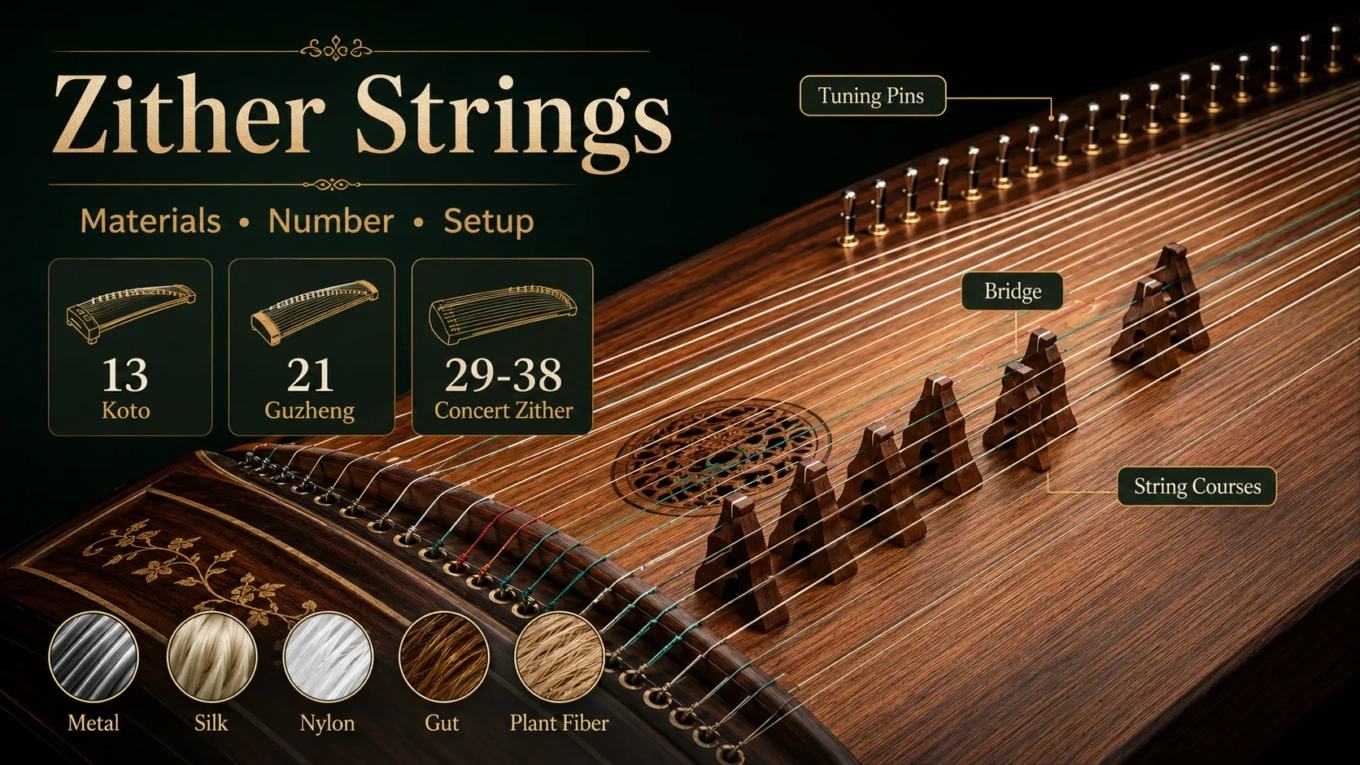
This is why zither strings vary so widely. A European concert zither uses a mixed string field: several fretted melody strings and many open accompaniment or bass strings. A Japanese koto normally uses thirteen strings set over individual movable bridges. A modern guzheng usually has twenty-one strings, also supported by individual bridges. A qanun may use many grouped strings, while a monochord-like zither may use only one.
The number is never just decoration. More strings can offer more ready pitches, wider range, drones, chordal support, or paired strings for a fuller tone. Fewer strings can make pitch bending, modal playing, or rhythmic clarity easier. In a zither, the string count tells the player what the instrument is built to do.
Why Zither String Counts Vary So Much
The zither family includes small folk instruments, court instruments, art-music instruments, teaching instruments, experimental instruments, and modern concert forms. Their string counts reflect different musical needs.
| Instrument type | Common string pattern | What the pattern supports |
|---|---|---|
| Concert zither | Often around 29 to 38 strings, with 34 or 35 common in many modern examples | Melody, accompaniment, bass, and sometimes contrabass ranges on one tabletop instrument |
| Koto | Most commonly 13 strings | Scale-based tuning, pitch bending, and melodic playing through individual bridge placement |
| Guzheng | Modern instruments are commonly 21 strings, though older and regional forms vary | Wide melodic range, pentatonic layouts, left-hand pitch shading, and strong projection |
| Qanun or kanun | Often arranged in courses of two or three strings; total count varies by regional design | Bright attack, quick modulation, and pitch control through levers or regional setup systems |
| Santur or hammered dulcimer type | Strings are commonly grouped in multiple-string courses | Hammered attack, paired resonance, and a broad register across a trapezoid body |
| Autoharp or chorded zither | Many metal strings, with chord bars and dampers | Chordal accompaniment with selected strings allowed to ring |
| Simple bamboo or raft zither | Can have very few strings; some are cut from the body itself | Local tuning, direct construction, and a close link between material and tone |
A course[4] matters as much as the raw string count. Three strings tuned together do not behave like three separate notes. They behave as one reinforced pitch. This is common in instruments such as the qanun, where grouped strings create a clear, ringing sound while preserving the pitch layout.
By contrast, an open string[5] on a concert zither, koto, guzheng, or psaltery usually gives one pitch unless it is altered by bridge movement, pressing, damping, or retuning. A fretted string[6] can produce several stopped pitches along a fingerboard, as on many concert zithers.
Melody Strings, Accompaniment Strings, and Drones
Some zithers divide their strings into musical jobs. A concert zither is the clearest example. Its melody strings[7] run over a fretted fingerboard, while its other strings are played open for harmony, bass, and accompaniment. This setup lets one player combine a plucked melody line with harmonic support.
Other zithers do not separate the string field in the same way. On a koto or guzheng, each string normally has its own bridge, and the whole field can serve melodic, ornamental, or accompanimental purposes depending on tuning and technique. On some folk zithers, one or more drone strings[8] may repeat a tonal center while other strings move around it.
This difference affects setup. A melody string needs reliable pitch response, comfortable spacing, and a material that answers well to the player’s touch. A drone string may be chosen for steadiness and sustain. A bass string needs enough mass to speak at a low pitch without feeling loose or dull.
String Materials Used on Zithers
Zither strings have been made from many materials. The best choice depends on the instrument’s age, region, body strength, pitch range, and playing method.
Metal Strings
Metal strings are common on concert zithers, autoharps, many psalteries, hammered dulcimers, santurs, and some modern Asian zithers. Steel gives brightness, volume, and tuning stability when the body is built for the tension. Brass, bronze, copper-wound steel, and other wound forms can add mass for lower notes.
Metal strings suit instruments that need projection and a clean attack. They also suit string fields with many open notes, because the sound can remain clear even when several strings ring together. The tradeoff is tension. A body not built for metal strings can warp, crack, or lose its intended response if restrung carelessly.
Silk Strings
Silk was historically important on several East Asian zithers, including older forms of koto, guzheng, guqin, and related instruments. Silk has a softer attack than many modern metal or synthetic strings. It can give a dry, intimate, textured tone, especially on instruments made for that response.
Modern players may use silk for historical performance, personal tone preference, or instrument-specific reasons. It is not interchangeable with every modern string set. A zither built and voiced for nylon-wrapped steel may feel weak or unstable if fitted with silk without proper adjustment.
Gut Strings
Gut strings appear in older European and Middle Eastern string traditions and may be found in some historical zither-family contexts. They offer warmth and flexibility, but they are sensitive to humidity and can require more care than many modern materials.
On instruments such as qanun-type zithers, older gut usage has often been replaced by nylon, PVF, fluorocarbon, or related synthetic materials in modern practice. Historical accuracy and practical performance needs may point in different directions.
Nylon, PVF, and Other Synthetic Strings
Nylon and related synthetic materials are common on modern qanun, kanun, koto, and other zithers. They can offer a smooth tone, stable manufacture, and lower sensitivity to climate than gut. Some guzheng strings combine a steel core with nylon wrapping, creating a strong, bright sound with a surface feel different from plain wire.
Synthetic strings are not all the same. A plain nylon string, a wound synthetic string, and a nylon-wrapped steel string behave differently under the hand. The label “nylon” can hide very different construction.
Plant Fiber and Idiochord Strings
Some simple zithers use plant fiber, reed, raffia, bamboo, or other organic materials. In an idiochord[9] zither, the string may be cut and lifted from the same piece of material that forms the body. This construction is found in several tube, raft, or stick zither traditions.
These instruments show why “string material” cannot be separated from body design. The string, bridge, and resonator may be parts of one material system rather than separate components bought and installed later.
How Material Changes Tone and Feel
String material shapes four practical qualities: attack, sustain, tension, and touch.
- Steel often gives a bright attack and long sustain, especially on box or board zithers with a lively top.
- Brass or bronze-wound strings can support lower pitches without needing an impractically thick plain string.
- Nylon and related synthetics often feel smoother and can soften the attack.
- Silk can produce a more textured, less glassy sound on instruments built for it.
- Gut can feel elastic and warm, but it reacts strongly to moisture and temperature.
- Plant-based or idiochord strings often produce a close, local sound tied to the body material.
The same material does not sound identical on every zither. A steel string on a hammered dulcimer is not experienced like a steel string on a concert zither. The body, bridge angle, speaking length, and playing technique all change the result.
Bridge Systems and String Setup
The movable bridge[10] is one of the most visible setup features in many zithers. On koto and guzheng, each string rests on its own bridge, and the bridge location helps set pitch and response. Moving a bridge changes the speaking length of the string and therefore its pitch.
Other zithers use fixed bridges[11], long bridge rails, small individual supports, or paired bridge systems. A qanun uses bridge and lever arrangements that support quick pitch changes. A concert zither uses a different setup: melody strings pass over a fretboard area, while the open strings are arranged in groups across the body.
Good bridge setup is not only about tuning. The bridge must stand upright, support the string cleanly, transfer vibration into the body, and avoid choking the tone. A bridge placed too close to a stressed area may make the string feel tight or uneven. A bridge placed carelessly may buzz or lean under tension.
Tuning Pins, Hitch Pins, and Anchoring Points
Most modern zithers use a tuning pin[12], peg, wrest pin, or similar device to control string tension. At the other end, the string may attach to a hitch pin, loop, tailpiece, knot, or tied point. The exact system depends on the instrument.
On a concert zither or autoharp, many strings run across a flat or shallow box body and are tightened by metal pins. On a koto, strings pass over bridges and are anchored in a way that supports both tuning and bridge placement. On a qanun, grouped strings must remain evenly matched within each course. If one string in a course is sharper, flatter, or weaker than the others, the course can shimmer in an uncontrolled way.
String anchoring also affects maintenance. A loop-end metal string, a tied nylon string, and a silk string secured by traditional methods each require different handling. For older instruments, the safest replacement is often not the newest string material but the material and tension range closest to what the body was built to carry.
String Gauge, Scale Length, and Tension
Three setup details work together: gauge[13], scale length[14], and tension[15]. A longer string needs a different gauge than a shorter string if both are expected to reach useful pitches. A low string may need winding or extra mass. A high string may need a thinner gauge to avoid excess strain.
This is especially clear on instruments with many strings across a wide range. The lowest strings cannot simply be thicker versions of the highest strings without limit. Builders choose materials, diameters, and winding methods so the set feels balanced and the body is not overloaded.
Changing string sets without understanding tension can damage an instrument. Replacing gut or nylon with metal is risky unless the zither was built for it. Replacing a historical set with a much heavier modern set can pull bridges out of position, bend pins, distort the top, or make the tone harsh.
Action, Spacing, and Playability
Action[16] is the playing height of the strings above the surface, frets, or reference plane. On a fretted concert zither, action affects how cleanly the melody strings can be stopped. Too high, and the left hand works too hard. Too low, and buzzing becomes likely.
On koto, guzheng, qanun, santur, and similar open-string zithers, string height affects plucking comfort, hammer response, pitch bending, and damping. The player needs enough space for the finger, pick, or hammer to activate the string cleanly. At the same time, the instrument should not feel stiff or uneven.
String spacing also matters. Narrow spacing can help fast passages on some instruments, but it can make isolated plucking harder. Wider spacing can help clarity, but it may slow some patterns. Traditional layouts often reflect long practical experience with a specific playing technique.
Sympathetic Resonance and Dampers
Many zithers allow several strings to ring at once. This can create a halo of resonance, especially when open strings share related pitches. A sympathetic string[17] may sound in response to another string even when it is not plucked directly, though not all zithers have strings designed only for that role.
Some instruments control ringing through the hand. Others use mechanical help. An autoharp uses a damper[18] system under chord bars: pressing a bar lets selected strings ring while muting others. This turns a many-string zither into a practical chord instrument.
Setup must respect the desired amount of resonance. A zither with too little damping can sound blurred. A zither with too much damping can lose the floating quality that makes open-string instruments appealing.
Setup Steps for a Newly Strung Zither
Exact setup differs by instrument, but the working order is similar for many zither-family instruments.
- Identify the instrument type before choosing strings. A concert zither, koto, guzheng, qanun, santur, autoharp, and bamboo tube zither need different sets.
- Check the body for cracks, loose pins, leaning bridges, distorted tops, weak glue joints, or old repairs.
- Match string material and tension to the instrument’s design, age, and regional form.
- Install strings gradually instead of bringing the whole instrument to pitch at once.
- Set bridges in their starting positions before fine tuning, especially on movable-bridge zithers.
- Bring the strings up in stages, allowing the body and strings to settle.
- Check for buzzing, slipping knots, uneven courses, dead notes, or bridge lean.
- Fine-tune after the strings have stretched and stabilized.
A new string set rarely settles in one pass. Metal strings may stabilize faster than gut or some synthetics, but all strings need time under tension. On multi-course zithers, the player must also match the strings within each course so the pitch speaks as one tone.
Tuning and Intonation
Tuning[19] sets the intended pitch of each string. Intonation[20] concerns how accurately pitches behave across the playable range or string field. A zither can be “in tune” string by string but still feel poorly set up if bridge positions, frets, or courses do not align well.
Movable-bridge zithers make this visible. The bridge does not only support the string; it defines the speaking length. A small shift can change pitch and feel. On koto and guzheng, the tuning system is therefore physical and visual. The layout of bridges across the top tells the player how the scale is arranged.
Different instruments also use different temperament[21] habits. A qanun setup for makam performance may treat pitch adjustment differently from a concert zither tuned for Western chromatic use. A folk zither may follow a local mode rather than equal temperament. Setup should follow the music the instrument is meant to play.
Playing Method and String Choice
A string that works well under a fingertip may not be ideal under a hammer. A string that sounds clear with a plectrum[22] may feel too sharp or stiff for bare fingers. A guzheng player using fingerpicks[23] may need a surface and tension that respond to strong attack, while a guqin player may prefer a very different tactile response.
Hammered zithers such as santur and hammered dulcimer types need strings that speak quickly when struck. Plucked zithers need a balance between resistance and release. Bowed zithers need a surface and tension that respond to bow hair. Autoharps need a string field that works with mechanical damping.
The setup is successful when the material, body, and playing method agree with each other. A string is never only a pitch source; it is also a point of contact between hand and instrument.
Common Setup Problems
Buzzing
Buzzing can come from a loose string end, worn bridge slot, low action, loose damper, uneven fret, weak pin, or a vibrating decorative part. On zithers with many strings, the source can be hard to locate. Muting nearby strings by hand can help isolate the problem.
Dead or Weak Tone
A dead note may point to poor bridge contact, old string material, a damaged winding, weak break angle, or a soundboard area that is not responding well. On movable-bridge instruments, a small bridge adjustment can sometimes restore clarity.
Unstable Tuning
New strings stretch. Old pins slip. Gut and some synthetics react to humidity. Courses may drift apart. Tuning instability is normal after restringing, but if it persists, the instrument may need pin work, bridge correction, or a better-matched string set.
Uneven Feel Across the Range
If treble strings feel tight while bass strings feel loose, the gauges may not match the scale length. If one course sounds rough, the strings in that course may not be matched. If the body sounds strained, the set may be too heavy.
Choosing Strings for Older Zithers
Older zithers need caution. A museum object, family instrument, or early commercial zither may not tolerate modern high-tension strings. The safest starting questions are simple: what material did this model likely use, what string count did it carry, what tuning was intended, and has the body changed shape over time?
Do not assume that brighter is better. A historical box zither designed for lighter wire or gut may lose its character if fitted with a modern heavy set. A koto built for a specific bridge height may respond poorly to strings that pull too hard. A qanun with older construction may need a careful match between course count, lever setup, and string material.
When the instrument has cultural, family, or collection value, a specialist repairer or maker is the right person to assess tension and setup. The cost of a careful inspection is small compared with a cracked top or pulled pin block.
How to Read a Zither String Layout
A practical way to understand any zither is to read its string layout from the player’s point of view.
- Count the separate sounding pitches, not only the physical strings.
- Notice whether strings are single, paired, tripled, or grouped in larger courses.
- Look for frets, movable bridges, fixed bridges, levers, dampers, or chord bars.
- Check whether the lowest strings are wound, thicker, longer, or placed on a different part of the body.
- Observe whether the instrument is meant for plucking, striking, bowing, or mixed technique.
- Ask whether the tuning is chromatic, modal, pentatonic, diatonic, or tied to a regional system.
This reading often explains the instrument faster than a label. A thirteen-string long board with individual bridges suggests a different musical logic from a thirty-five-string concert zither with frets and open accompaniment strings. A trapezoid instrument with repeated courses and hammer marks tells another story. The string plan is the instrument’s working design.
Glossary of Technical Terms
[1] Chordophone: A stringed instrument whose sound begins with vibrating strings. In the zither family, the strings are carried by a body, board, tube, box, or frame rather than by a projecting neck.
[2] Soundboard: The vibrating top or surface that receives energy from the strings. On many zithers, it is the main surface that helps turn string vibration into audible tone.
[3] Resonating body: The part of the instrument that amplifies and colors the string sound. It may be a wooden box, hollow board, bamboo tube, gourd, or another resonant structure.
[4] Course: A group of two or more strings treated as one pitch. Qanun and santur-type instruments often use courses to create a stronger, brighter tone.
[5] Open string: A string sounded without being stopped by a finger on a fret. Many zithers rely heavily on open strings, which makes tuning and damping especially important.
[6] Fretted string: A string that can be pressed against frets to produce different pitches. Concert zithers often use fretted melody strings alongside open accompaniment strings.
[7] Melody string: A string or string group mainly used for the main tune. On concert zithers, these strings usually run over a fingerboard.
[8] Drone string: A string tuned to a repeated pitch or tonal center. Drone strings support modal playing and can give a zither a steady harmonic base.
[9] Idiochord: A string made from the same material as the instrument body, often lifted from bamboo, reed, or bark. Some tube and raft zithers use this construction.
[10] Movable bridge: A bridge that can be repositioned to adjust pitch, scale layout, or response. Koto and guzheng setup depends heavily on movable bridge placement.
[11] Bridge: The support that holds a string above the body and transfers vibration into the resonating surface. Bridge shape, height, and contact strongly affect tone.
[12] Tuning pin: A pin or peg used to tighten or loosen a string. Many zithers use rows of pins because they carry many separate strings.
[13] Gauge: The thickness or diameter of a string. Gauge must match pitch, scale length, material, and the strength of the instrument body.
[14] Scale length: The vibrating length of a string between its speaking endpoints. On movable-bridge zithers, changing bridge position changes the scale length.
[15] Tension: The pulling force created when a string is tuned to pitch. Excess tension can damage a zither that was built for lighter strings.
[16] Action: The height and playing clearance of the strings. Good action allows clean sound without making the instrument hard to play.
[17] Sympathetic string: A string that vibrates in response to another sounding pitch. Some zithers use sympathetic resonance intentionally, while others simply allow nearby open strings to ring.
[18] Damper: A felt, pad, hand technique, or mechanical part that stops a string from ringing. Autoharps use dampers under chord bars to select which strings sound.
[19] Tuning: The chosen pitch arrangement of the strings. Zither tunings may be chromatic, modal, pentatonic, diatonic, or tied to a regional performance system.
[20] Intonation: The accuracy and behavior of pitches across the instrument. Bridge placement, fret position, courses, and string tension can all affect it.
[21] Temperament: A system for spacing pitches within an octave. Zithers used in different traditions may not follow the same pitch-spacing habits.
[22] Plectrum: A small pick used to pluck strings. Its material, shape, and hardness change attack and tone.
[23] Fingerpick: A pick worn on the finger. Guzheng, qanun, and related instruments may use fingerpicks or ring-mounted plectra depending on tradition.
FAQ
How many strings does a zither have?
There is no single number. Some zithers have one or only a few strings, while concert zithers, autoharps, qanuns, and hammered dulcimer types can have many strings. The count depends on the instrument type, region, tuning system, and musical role.
Are zither strings always metal?
No. Many modern zithers use metal, but others use silk, nylon, gut, fluorocarbon, plant fiber, or mixed constructions such as nylon-wrapped steel. Some simple zithers use idiochord strings cut from the body material itself.
Can guitar strings be used on a zither?
Usually not as a direct substitute. Guitar strings are designed for different scale lengths, tensions, anchoring systems, and playing methods. A zither should be restrung with a set matched to its body, tuning, and string layout.
Why do some zithers have grouped strings?
Grouped strings, or courses, let several strings sound as one pitch. This can make the tone brighter, louder, or more sustained. It also affects tuning work, because every string in the course must match closely.
Why do koto and guzheng bridges move?
The movable bridges help set the speaking length and pitch of each string. Their placement shapes the scale, touch, and resonance of the instrument. Moving a bridge even slightly can change both tuning and response.
What is the safest way to restring an old zither?
First identify the instrument type and its likely original string tension. Avoid replacing lighter historical strings with heavy modern metal strings unless the instrument was built for them. Older or valuable instruments should be checked by a repairer or maker familiar with zithers.